- English
- French
- German
- Portuguese
- Spanish
- Russian
- Japanese
- Korean
- Arabic
- Greek
- German
- Turkish
- Italian
- Danish
- Romanian
- Indonesian
- Czech
- Afrikaans
- Swedish
- Polish
- Basque
- Catalan
- Esperanto
- Hindi
- Lao
- Albanian
- Amharic
- Armenian
- Azerbaijani
- Belarusian
- Bengali
- Bosnian
- Bulgarian
- Cebuano
- Chichewa
- Corsican
- Croatian
- Dutch
- Estonian
- Filipino
- Finnish
- Frisian
- Galician
- Georgian
- Gujarati
- Haitian
- Hausa
- Hawaiian
- Hebrew
- Hmong
- Hungarian
- Icelandic
- Igbo
- Javanese
- Kannada
- Kazakh
- Khmer
- Kurdish
- Kyrgyz
- Latin
- Latvian
- Lithuanian
- Luxembou..
- Macedonian
- Malagasy
- Malay
- Malayalam
- Maltese
- Maori
- Marathi
- Mongolian
- Burmese
- Nepali
- Norwegian
- Pashto
- Persian
- Punjabi
- Serbian
- Sesotho
- Sinhala
- Slovak
- Slovenian
- Somali
- Samoan
- Scots Gaelic
- Shona
- Sindhi
- Sundanese
- Swahili
- Tajik
- Tamil
- Telugu
- Thai
- Ukrainian
- Urdu
- Uzbek
- Vietnamese
- Welsh
- Xhosa
- Yiddish
- Yoruba
- Zulu
Crab Type Scaffolding OEM Guide: Designs, Materials, and Quality
If you're sourcing a heavy-duty modular shoring system for bridge decks, large-span factories, or ultra-high formwork, this guide covers what you need to know before placing an order. Crab type scaffolding is a disc-based, self-locking support system built around a chrysanthemum-disc node that accepts ledgers from eight directions. The crab-claw-shaped connection tightens under vertical strain, providing engineers with measured node stiffness that typical bowl-and-cup or tube-and-clamp systems can’t provide. This OEM handbook includes design rationale, material grades, quality requirements and procurement strategies.
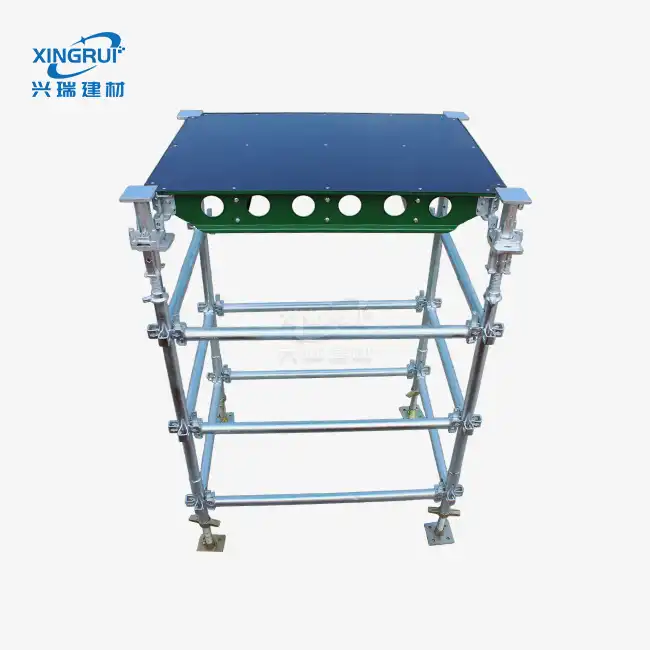
Understanding Crab Type Scaffolding: Designs and Structural Components
Core Design Principle: Modularity Under Load
The system consists of tower units all alike. Every upright has a chrysanthemum disc every 1.5m and each disc may carry up to eight horizontal ledgers at once. The tower's design lends itself to site engineering, so it may be erected in practically any place, without cutting pipes or adding loose connectors. According to a 2021 research on structural shoring published in Construction and Building Materials, modular disc-based solutions outperform tube-and-clamp setups because they cut down on field assembly mistakes by as much as 43%.
Self-Locking Node: How the Crab Claw Works?
The increase in the pressure in the vertical direction causes the wedge inside the node to push harder on the face of the disc. This behaviour contributes automatically to the shear resistance at the junction, eliminating the torque-verification step that delays tube-and-clamp workers. What this means is that the quality of the joints is consistent throughout the complete pour cycle, regardless of the expertise of the workers.
OEM Customization Options
OEMs may build ledgers and uprights to the lengths specified in the model, but keep the disc interface the same. That implies a bespoke 2.3 m ledger can connect to the same node as a regular 1.5 m unit. This prevents components from needing to be changed throughout a rental fleet or a collection of goods utilised across numerous projects.
Materials Used in Crab Type Scaffolding: Comparison and Quality Assessment
Q235 Steel vs. Aluminum vs. Hybrid Options
Q235 carbon steel is still used by default for heavy shoring. It has a yield strength of at least 235 MPa and a wall thickness of 3.0 to 3.5 mm. It can withstand between 40 kN and 75 kN. Aluminium alloys are roughly one third the weight of steel, but can only support around 30 kN per upright of the same width. Thus they are not used for propping of bridge box-girder at height over 15 m. Hybrid designs include steel uprights and metal deck components to save superfluous weight, while maintaining a robust foundation structure.
Surface Treatment: Why Hot-Dip Galvanization Matters?
Hot-dip galvanization (HDG) with 60–80 microns of zinc is the standard way to stop rusting in chemical plants and seaside areas for crab type scaffolding. Even if the steel gets scratched during repeated assembly, that thick of a zinc layer protects it anyway. Tests using salt spray that are based on EN ISO 1461:2022 show that HDG at 85 microns lasts for more than 1,500 hours before red rust shows up. Parts that are made to this level usually last more than 15 years.
Compliance Standards That Procurement Teams Require
Any shoring system used on a US project or a project funded by another nation as infrastructure must comply with EN 12810-1 and ANSI/SSFI SC100-5/05 at a minimum. Procurement managers know that suppliers certified to ISO 9001, ISO 14001 or ISO 45001 have their quality, environmental and safety management systems inspected by a third party.
Ensuring Quality and Safety: Inspection, Maintenance, and Regulatory Compliance
Pre-Use Inspection Checklist
Site engineers should check three groups of parts before each deployment. Here is an organized place to start:
- Uprights: Check straightness tolerance (≤L/500), confirm disc weld integrity, and verify that zinc coating shows no bare steel patches larger than 5 mm².
- Ledger wedges: Test wedge insertion and withdrawal by hand; any wedge that sticks or rattles loose under 5 kN must be removed from service.
- Base jacks and U-heads: Measure thread engagement; a minimum of 150 mm of thread contact is required under loaded conditions per EN 1065.
By OSHA 1926 Subpart Q, these checks must be written down when used on US federal projects and take about 12 minutes per tower unit. Most of the time, contractors are held responsible for formwork accidents because they didn't complete the necessary paperwork.
Maintenance Practices That Extend Asset Life
To keep things from getting wet, store them on wooden bearers that are off the ground. Within 48 hours of finding the damage, cold-galvanizing compound can be used to fix the zinc. Before putting away for the winter, grease the wedge faces with grease made from petroleum. Rental companies that do these things say that each unit is used more than 30 times.
Regulatory Compliance Across Jurisdictions
In the US, most state building codes say that shoring systems taller than 6 m, including crab type scaffolding, need to have a sign-off from a licensed engineer. In the EU, EN 12812 is the main rulebook for designing falsework. At the bid stage, most owner and management team needs are met by third-party load-test certificates instead of just maker data sheets.
Choosing the Right OEM Partner for Crab Type Scaffolding
What Separates a Specialist OEM from a Generic Supplier
To press discs and robotically weld the node assembly together, a specialised manufacturer maintains specialised equipment. Disc plates are often joined by hand by generic manufacturers, resulting in size variations of ±1.5 mm or more on the wedge pocket—enough to significantly reduce the node's rigidity. Procurement teams should get proofs of dimensional tolerance and the quantity of welding robots utilised before reducing the number of offers.
Customization Capability and Delivery Assurance
Large infrastructure projects often need step distances that may be adjusted, base plates produced specifically for them, or ledgers with unique lengths. An OEM partner may produce unique parts from designs within the lead times they specify without hiring outside assistance if they have cold-bending, stamping, and forging equipment on hand. Instead of a single shipment, make sure the vendor can agree to scheduled batch deliveries that are linked to the sequence of construction at your site.
Shandong Xingrui: A Manufacturing Profile
The company Shandong Xingrui Building Materials Co., Ltd. is based in Rizhao City, Shandong Province. It has more than 40,000 square meters of standard workplaces with 12 welding robots and 6 automatic welding lines for crab type scaffolding. The business has been around since 2007 and has ISO 9001, ISO 14001, and CE certifications. It ships goods to more than 100 countries. Before committing to a large order, samples and full technical documents can be requested. This gives engineering teams the confirmation data they need at the bidding stage.
Procurement Strategies and Cost Considerations for Crab Type Scaffolding
Buy vs. Rent: A Framework Decision
If you have more than three deployments and acquire standard 60-series steel units at the current market pricing, you will typically break even on purchases made over an 18-month period. For one-time projects like expanding a bridge or projects where storage is expensive, renting makes economical sense. Because 60-series heavy-duty systems are more costly to rent than regular 48 mm cuplock equipment, rental businesses profit more.
Lead Time and Supply Chain Planning
OEM wait times for custom versions range from 25 to 35 days after the order is made. Custom ledgers or non-standard discs may need an additional 7–14 days, depending on the forging queue. At least sixty days prior to the first erection date, schedule your first purchase order. This will provide you time for delivery, on-site verification, and third-party inspection.
Starting Your Inquiry
Write a one-page technical brief including the maximum height, standard load requirements, bay geometry, and delivery port before speaking with vendors. This document allows the OEM to provide a specific quotation rather than a range and expedites the technical evaluation process. Request a load estimate booklet in addition to the price. This document must be reviewed by the engineer-of-record in the majority of US states.
Conclusion
Because of its self-locking node geometry, eight-direction disc versatility, and HDG corrosion protection, crab type scaffolding beats standard systems in high-load, high-clearance situations. Standard Q235 steel uprights with a 60.3 mm outside diameter can support 40 to 75 kN, which is enough for bridge shoring, heavy-load support in basements, and ultrahigh formwork. If you choose an OEM supplier with certified manufacturing processes, the ability to make things to order, and a history of on-time delivery, you get rid of the main risks that slow down project approval and installation on-site.
FAQ
Q1: How does the self-locking node differ from a standard ringlock connection?
A: A ringlock wedge is hammered closed and stays fixed at the torque applied. The crab-type wedge tightens automatically as vertical load increases, meaning node stiffness rises with the actual construction load rather than depending on installation force.
Q2: What load capacity should I specify for bridge box-girder shoring?
A: Most reinforced concrete box-girder pours in the 30–50 m span range require 60–75 kN per standard. Verify this against your formwork designer's calculation book, and confirm the supplier provides a third-party load-test certificate for that configuration.
Q3: Can non-standard ledger lengths be ordered without changing the disc system?
A: Yes. Custom ledger lengths connect to the same chrysanthemum disc as standard units, provided the wedge head diameter matches the disc pocket specification. Confirm pocket tolerance with the OEM before ordering.
Q4: What certifications should a supplier hold for US project submissions?
A: At minimum: ISO 9001 for quality management, a third-party structural load-test report to ANSI/SSFI SC100-5/05, and product CE marking. ISO 45001 for occupational safety management is increasingly requested by owner-side supervisors.
Q5: How many reuse cycles can I realistically expect?
A: With proper HDG surface treatment, wedge lubrication, and off-ground storage, 30+ deployment cycles are achievable. Some rental operators report 40+ cycles on 60-series systems maintained to the inspection schedule outlined above.
Partner with GREEN FORMWORK for Your Next Heavy-Load Project
With the help of Shandong Xingrui Building Materials Co., Ltd., GREEN FORMWORK offers fully certified ISO 9001, ISO 14001, and ISO 45001 systems for crab-type scaffolding that are made from Q235 steel and coated in HDG zinc. Every order comes with a technical calculation package, and you can get a sample before you commit to buying a lot. You can email our tech team at sdxingruiqp@126.com to get a quote and load-test paperwork that is specific to your project.
References
1. Construction and Building Materials — "Structural Performance of Modular Disc-Based Falsework Systems," 2021.
2. Scaffolding Industry Association (SIA) Technical Bulletin — "Comparative Load Testing of Modular Shoring Systems," 2020.
3. EN 12810-1: Facade Scaffolds Made from Prefabricated Components — European Committee for Standardization, 2003.
4. EN ISO 1461: Hot Dip Galvanized Coatings on Fabricated Iron and Steel Articles — International Organization for Standardization, 2022.
5. ANSI/SSFI SC100-5/05: Safety Requirements for Supported Scaffolds — Scaffold and Access Industry Association, 2005.
6. Journal of Constructional Steel Research — "Fatigue and Corrosion Resistance of Hot-Dip Galvanized Structural Steel Components," 2019.
Learn about our latest products and discounts through SMS or email