- English
- French
- German
- Portuguese
- Spanish
- Russian
- Japanese
- Korean
- Arabic
- Greek
- German
- Turkish
- Italian
- Danish
- Romanian
- Indonesian
- Czech
- Afrikaans
- Swedish
- Polish
- Basque
- Catalan
- Esperanto
- Hindi
- Lao
- Albanian
- Amharic
- Armenian
- Azerbaijani
- Belarusian
- Bengali
- Bosnian
- Bulgarian
- Cebuano
- Chichewa
- Corsican
- Croatian
- Dutch
- Estonian
- Filipino
- Finnish
- Frisian
- Galician
- Georgian
- Gujarati
- Haitian
- Hausa
- Hawaiian
- Hebrew
- Hmong
- Hungarian
- Icelandic
- Igbo
- Javanese
- Kannada
- Kazakh
- Khmer
- Kurdish
- Kyrgyz
- Latin
- Latvian
- Lithuanian
- Luxembou..
- Macedonian
- Malagasy
- Malay
- Malayalam
- Maltese
- Maori
- Marathi
- Mongolian
- Burmese
- Nepali
- Norwegian
- Pashto
- Persian
- Punjabi
- Serbian
- Sesotho
- Sinhala
- Slovak
- Slovenian
- Somali
- Samoan
- Scots Gaelic
- Shona
- Sindhi
- Sundanese
- Swahili
- Tajik
- Tamil
- Telugu
- Thai
- Ukrainian
- Urdu
- Uzbek
- Vietnamese
- Welsh
- Xhosa
- Yiddish
- Yoruba
- Zulu
Ringlock Scaffolding System Uses in Oil, Gas, and Power Plants
When a refinery shutdown runs over schedule, every idle hour costs tens of thousands of dollars. Scaffold choice is rarely the headline reason—but it is often the hidden one. The ringlock scaffolding system has become the go-to access solution across North American oil, gas, and power plant projects precisely because it cuts erection time, holds up under heavy industrial loads, and meets the strict compliance requirements that EPC contractors and plant owners demand. This guide walks through why that matters and how to source the right system for your next project.
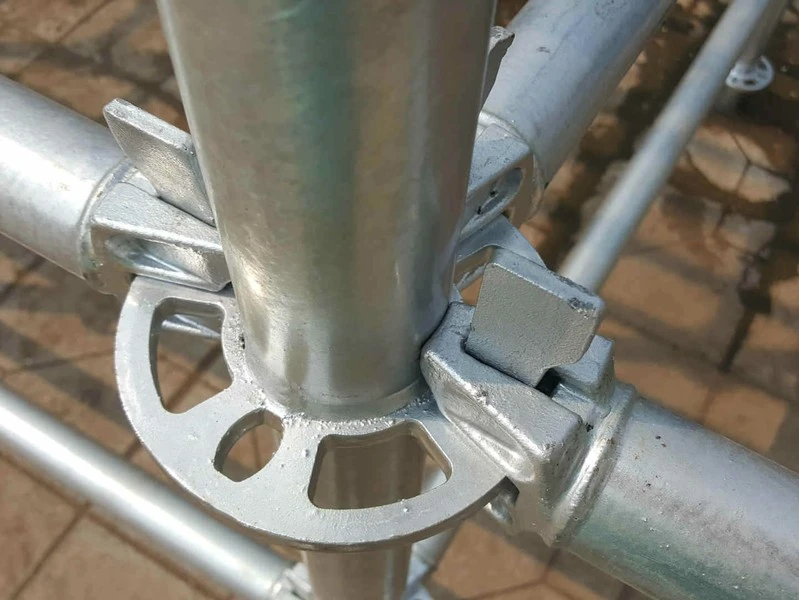
What Is a Ringlock Scaffolding System and Why Is It Essential in Industrial Plants?
The Core Mechanism
To make a ringlock system, you need to weld an eight-hole rosette disk into each vertical standard at set intervals. The forged steel heads of horizontal ledgers and diagonal braces fit into the rosette holes and a wedge pin is driven home to join them. Gravity and vibration make the pin tighter, which means that load makes the link stronger instead of weaker.
Key Components
There are four main parts that make up every installation: vertical standards made of 48 × 3.2 mm Q235 steel tube, horizontal ledgers with spans of 0.9 m, 1.2 m, and 1.5 m, rosette disks spaced every 1.5 m, and base plates that can be adjusted. In saline, chemical, and high-humidity plant environments, hot-dip galvanization keeps all surfaces from rusting.
Why Industrial Plants Prefer It?
Refineries and power plants have a lot of complicated pipes, small walkways, and uneven machine footprints. Because one rosette node can hold up to eight parts at once, crews can change the structure to fit around obstacles without having to cut tubes or make custom fittings. This means less work has to be done and fewer changes have to be made in the field at safety-critical sites.
Comparing Ringlock Scaffolding with Other Scaffolding Systems for Industrial Applications
Ringlock vs. Tube-and-Clamp
Tube-and-clamp systems let you be as creative with the shape as you want, but each part needs its own clamp that is torqued to the right level. Inconsistent clamp torque is a real safety risk on a shift with more than 500 people. A modular ringlock system's wedge-pin link gets rid of that variable completely, making a more stable structure in less time.
Ringlock vs. Cuplock
Cuplock scaffolding has a locking system with a top cup and a bottom cup that can hold four ledger connections per node. That number is doubled by ringlock scaffolding system's eight-way rosette, which gives engineers more shape choices when they're working near heat exchangers or reactor vessels. Studies on the efficiency of modular scaffold assembly show that it can be put up up to 30% faster than similar cuplock setups on complicated industrial layouts.
Ringlock vs. Frame Scaffolding
While prefabricated frame scaffolding works well for repetitive, straight-run facades, it doesn't work so well in crowded process areas where bay lengths range. The ringlock system's adjustable ledger lengths can handle bay sizes that aren't all the same without the need for extra parts. This keeps the inventory of parts low and site logistics easy to handle.
When safety gaps are important and project deadlines are tight, these differences in performance mean the most. Choosing the right system at the beginning of the project saves a lot of money later on.
Installation, Maintenance, and Safety Best Practices for Ringlock Scaffolding in Industrial Plants
Site Preparation and Layout Planning
The site crew should walk around the area and mark where the base plates will go on a sized drawing before the first standard is put up. It's important to check the ground-bearing capacity. Base plates spread point loads across the surface, but mudsills are still needed for unstable substrates. Check the heights above vertical standards and look for any live pipes that create no-go areas.
Compliant Assembly Sequence
Set the base plates, raise the starter standards, enter the ledgers at the first rosette level, lock the wedge pins, and add the diagonal braces for support on the sides. Do this for each lift. Both EN 12811-1 and ANSI/SSFI SC100-5/05 say that bracing must be done at certain times. If you follow the manufacturer's instructions for putting the structure together, it will stay within its approved load limit.
Inspection and Maintenance Protocols
After each turn of the project, the parts of a ringlock scaffolding system should be looked at to see if the standards are bent, the rosette welds are cracked, and the wedge pins are worn. There shouldn't be any base metal showing through the hot-dip galvanized coating. Parts that are broken should be taken out of stock right away. If you keep your ringlock system in good shape, it can last for 10 to 15 years and be used on many projects. This means that it costs much less per use than single-use options.
Procurement Insights: How to Source the Best Ringlock Scaffolding Systems for Oil, Gas, and Power Plants
Certifications to Verify Before Ordering
Ask each possible supplier for ISO 9001 quality management certification, CE marking with a Declaration of Performance (DoP), and material test certificates for each batch. For jobs in the US, check with your safety team to see if they meet the standards of OSHA 29 CFR 1926 Subpart Q. When asked, suppliers who can't produce traceable paperwork pose a safety risk that can cause project permits to be delayed.
Evaluating Supplier Capability
When qualifying a source, these are the main things that should be looked at:
- Production capacity: Does the facility run automated welding lines that guarantee dimensional consistency? Xingrui's 40,000 ㎡ workshops operate 12 welding robots and 6 automatic welding lines, supporting large-volume orders without quality drift.
- Custom order support: Can the supplier produce non-standard ledger lengths or OEM-branded components from your drawings within 7–14 days for samples?
- Export track record: Suppliers shipping to 100+ countries have proven logistics processes, commercial documentation experience, and port relationships that reduce clearance delays.
- Technical responsiveness: Direct access to an engineering team that can issue load calculation reports and respond to site queries in real time lowers project risk significantly.
These criteria help procurement teams tell the difference between good partners and generic catalog suppliers. A low-cost way to make sure of both quality and delivery time is to ask for a sample order before committing to a full project quantity.
Total Cost of Ownership
The price to buy a ringlock scaffolding system is shown on a single line. The cost of reusable Q235 steel parts that can be put together more than 50 times is spread out over many projects. Take into account the fact that faster assembly means fewer hours of work, lower loss rates mean fewer parts are broken, and rework costs are avoided when the system is put together correctly the first time. In the first two to three project cycles, quality modular scaffolding is more cost-effective than other options.
Future Trends and Innovations in Ringlock Scaffolding for Industrial Applications
Digital Monitoring Integration
Plant owners are starting to put IoT load sensors on scaffolding during important lifts. These sensors send data to site control rooms in real time. This method lets structure engineers know about overloading situations early on, before they become problems. Ringlock systems are good for adding sensors because their fixed-node geometry makes it easy to place sensors in the same place every time.
Material and Coating Advances
Research into high-strength low-alloy steels like Q355B points toward lighter standards with the same load ratings. This would make it easier on assembly teams and lower the weight of freight. New zinc-aluminum alloy coatings are also hitting the market. They protect against rust better than standard hot-dip galvanization in chloride-rich coastal plant environments.
Sustainability and Circular Procurement
Project owners are requiring ESG reports from EPC companies more and more. These needs are met by scaffolding systems that keep track of reuse rates, recovered steel content, and how the scaffolding is returned at the end of its useful life. When a manufacturer has ISO 14001 Environmental Management System certification, its environmental practices can be checked by a third party. This gives it an advantage when bidding on infrastructure or energy projects that are open to the public.
Conclusion
The ringlock scaffolding system is used on oil, gas, and power plant projects because it is mechanically reliable, can be changed to fit different shapes, and has compliance credentials that can be checked. Its self-locking rosette node is faster and more reliable than older connection methods, and its reusable Q235 steel construction gives it great long-term value. The modular ringlock system is a good buy for tough industrial settings for procurement teams that look for certified suppliers, ask for clear documentation, and think about the total cost over the product's entire life.
FAQ
Q1: How does a ringlock system improve safety over tube-and-clamp scaffolding?
A: The wedge-pin connection tightens as load and vibration increase, which eliminates the loosening risk associated with manually torqued clamps. This mechanical behavior produces a more consistent structure across large crews working at different experience levels.
Q2: What load capacity should I expect from a standard ringlock scaffold?
A: A single Q235 steel standard typically supports between 40 kN and 70 kN depending on ledger spacing and bracing configuration, as referenced in EN 12812 shoring standards. Always request the supplier's certified load calculation report for your specific configuration.
Q3: Can a ringlock system adapt to irregular plant layouts?
A: Yes. The eight-way rosette node accepts ledgers and braces at multiple angles, and ledger lengths of 0.9 m, 1.2 m, and 1.5 m cover most bay dimension variations. Custom lengths are available through made-to-order production runs.
Q4: Is the system compatible with components from different manufacturers?
A: Rosette geometry is broadly standardized, but manufacturing tolerances vary between brands. Structural compatibility testing is required before mixing components from different sources to confirm joint integrity under load.
Q5: What is the expected service life?
A: Under routine inspection and maintenance, a hot-dip galvanized ringlock scaffold system typically delivers 10 to 15 years of service life across multiple reuse cycles.
Partner with GREEN FORMWORK for Your Next Industrial Scaffold Project
With help from Shandong Xingrui Building Materials Co., Ltd., GREEN FORMWORK sells ringlock scaffolding systems that are CE- and ISO-certified to EPC builders and plant managers in over 100 countries. We are a reliable company that makes ringlock support systems. Our products are made from Q235 steel and come in custom designs. We also send out samples within 7–14 days and provide full technical documentation. You can email our team at sdxingruiqp@126.com to get a price or a technical advice.
References
1. European Committee for Standardization. EN 12811-1: Temporary Works Equipment — Scaffolds — Performance Requirements and General Design. CEN, 2003.
2. European Committee for Standardization. EN 12810-1: Facade Scaffolding Made from Prefabricated Components — Part 1: Product Specifications. CEN, 2003.
3. Scaffold & Access Industry Association. ANSI/SSFI SC100-5/05: Scaffolding — Safety Requirements. SAIA, 2005.
4. Health and Safety Executive. Scaffolding: Safety in Construction — HSG150. HSE Books, 2006.
5. Occupational Safety and Health Administration. 29 CFR 1926 Subpart Q — Scaffolds. U.S. Department of Labor, 2020.
6. International Organization for Standardization. ISO 9001:2015 — Quality Management Systems: Requirements. ISO, 2015.
Learn about our latest products and discounts through SMS or email