- English
- French
- German
- Portuguese
- Spanish
- Russian
- Japanese
- Korean
- Arabic
- Greek
- German
- Turkish
- Italian
- Danish
- Romanian
- Indonesian
- Czech
- Afrikaans
- Swedish
- Polish
- Basque
- Catalan
- Esperanto
- Hindi
- Lao
- Albanian
- Amharic
- Armenian
- Azerbaijani
- Belarusian
- Bengali
- Bosnian
- Bulgarian
- Cebuano
- Chichewa
- Corsican
- Croatian
- Dutch
- Estonian
- Filipino
- Finnish
- Frisian
- Galician
- Georgian
- Gujarati
- Haitian
- Hausa
- Hawaiian
- Hebrew
- Hmong
- Hungarian
- Icelandic
- Igbo
- Javanese
- Kannada
- Kazakh
- Khmer
- Kurdish
- Kyrgyz
- Latin
- Latvian
- Lithuanian
- Luxembou..
- Macedonian
- Malagasy
- Malay
- Malayalam
- Maltese
- Maori
- Marathi
- Mongolian
- Burmese
- Nepali
- Norwegian
- Pashto
- Persian
- Punjabi
- Serbian
- Sesotho
- Sinhala
- Slovak
- Slovenian
- Somali
- Samoan
- Scots Gaelic
- Shona
- Sindhi
- Sundanese
- Swahili
- Tajik
- Tamil
- Telugu
- Thai
- Ukrainian
- Urdu
- Uzbek
- Vietnamese
- Welsh
- Xhosa
- Yiddish
- Yoruba
- Zulu
Why Rosette Ringlock Scaffolding Is Ideal for Heavy-Duty Jobs
When a project demands structural reliability under extreme loads, rosette ringlock scaffolding consistently proves its worth. This modular system—built around an eight-hole daisy-type rosette joint—delivers 360° multi-angle connectivity, bolt-free assembly, and a service life exceeding 15 years. For supply chain managers sourcing rental fleet assets or project engineers specifying heavy industrial scaffolding, the system's EN 12810-compliant design and Q235 premium steel construction address both safety compliance requirements and long-term asset value. This guide explains exactly why this system outperforms traditional alternatives across demanding job sites.
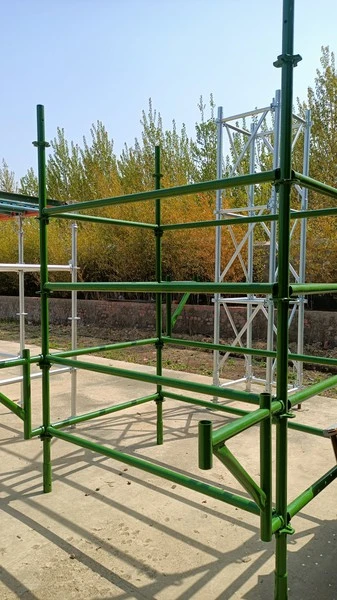
Understanding Rosette Ringlock Scaffolding: Fundamentals and Design Principles
The engineering roots of the system can be found in European modular scaffolding standards that were created in the 1970s and 1980s and later written down as EN 12810 and EN 1281. The circular rosette disk that is welded every 0.5 meters along each vertical standard is what makes it unique. It makes fixed connection points across the whole frame height.
The Rosette Connection Mechanism
The eight-hole daisy-type rosette disk can hold up to eight members at once. Four small holes are used for horizontal ledgers spaced at 90-degree intervals, and four big holes are used for diagonal braces spaced at different angles. It only takes one hammer blow to lock each member into the rosette because the wedge head is tapered. There are no bolts, nuts, or other secondary fasteners needed. This gravity-assisted locking design keeps the mechanism from releasing by accident, even when the spot is vibrating a lot.
Core Component Breakdown
Each vertical standard is made from a Q235B steel tube that has an outside width of either 48.3mm or 60mm and a wall thickness of 3.0mm to 3.25mm. The method is finished off with base plates, vertical braces, and ledgers. The set 0.5-meter node spacing makes sure that the whole structure is built to the same size, which is very important when mixing parts from a large rental fleet.
Built for Precision and Reuse
Tight dimensional tolerances are checked with go/no-go gage testing to make sure that every part is built to specification for rosette ringlock scaffolding. This level of accuracy makes it easy to mix parts from the same system generation. Dimensional consistency cuts down on sorting time and avoids compatibility problems on the job site for rental companies that manage inventory across multiple job sites.
Why Rosette Ringlock Scaffolding Excels in Heavy-Duty Applications?
This method works better than cuplock and frame framing when there are a lot of axial loads or when the site shape isn't straight. The shape of the nodes effectively spreads forces across multiple members at the same time, stopping stress from building up in one area.
Material Strength and Corrosion Resistance
When sprayed at a thickness of 65 to 80 microns, hot-dip galvanization protects the outside of pipes, the inside walls of holes, and weld gaps that aren't covered by pre-galvanized coatings. Independent tests show that HDG coatings this thick don't rust for more than 15 years in marine and petrochemical settings, while pre-galvanized alternatives only last about 2–3 years. This difference is important for rental companies that are figuring out the total cost of an asset over its whole life.
Compliance with International Safety Standards
There are three standards that the system has to meet: EN 12811, AS/NZS 1576, and ANSI/SSFI SC100. The ISO 9001, ISO 14001, and ISO 45001 standards cover quality management, environmental management, and health and safety at work, respectively. Shandong Xingrui Building Materials Co., Ltd. On request, third-party test reports that cover load capacity and dimensional compliance are available to help with the normal process of procurement verification.
Adaptability to Complex Site Configurations
For example, petrochemical tanks, bridge shoring frames, and entry structures for offshore platforms often need shapes that aren't straight lines. Because the rosette node can bend in different directions, the scaffold can go around round tanks and refinery boilers, which is something that regular orthogonal systems can't do. This geometric adaptability cuts down on the need for custom fabrication on-site, which saves time and money on safety risks.
Comparing Rosette Ringlock Scaffolding with Other Scaffolding Systems
Understanding where this system stands relative to cuplock, kwikstage, and traditional tube-and-clamp scaffolding helps procurement managers make defensible sourcing decisions. Each system has legitimate applications, but the differences in assembly speed, load capacity, and maintenance burden are material.
Rosette Ringlock vs. Cuplock Scaffolding
Rosette ringlock scaffolding uses a rosette connection that accepts a maximum of eight members per node. Cuplock uses a cup-and-blade connection that accepts a maximum of four members per node. The rosette system gives significantly greater geometric flexibility per node. Assembly speed for rosette systems is generally 20–30% faster than cuplock on complex geometries because fewer re-positions are required to achieve diagonal bracing angles.
Rosette Ringlock vs. Frame Scaffolding
Traditional welded frame scaffolding offers fast erection on simple rectangular facades but lacks the flexibility for any non-standard configuration. Frame systems also generate higher transport volume per working platform square meter because frames cannot be efficiently nested. Ringlock components stack and pack more densely, which directly reduces sea freight cost per unit—a factor that matters for international bulk procurement.
Rosette Ringlock vs. Tube-and-Clamp Systems
Tube-and-clamp scaffolding requires individual bolt-tightened clamps at every connection point. Labor time is substantially higher, torque consistency is difficult to verify, and loose clamps represent a genuine dropped-object hazard. The bolt-free wedge connection of the rosette system eliminates both the labor overhead and the dropped-component risk in a single design decision.
Procurement Insights: Finding the Right Ringlock Scaffolding Partner
Selecting a supplier for a large rental fleet expansion is a multi-stage process. The decision cycle typically runs six to twelve months from initial comparison to framework agreement, and the supplier relationship that results tends to be long-term. Getting the selection criteria right from the start protects both capital and operational performance.
Certification and Test Report Verification
Request third-party load capacity test reports, dimensional inspection records, and material chemical analysis certificates before committing to a sample order. EN 12810 compliance documentation should reference the specific product model, not a generic system type. Shandong Xingrui provides full quality traceability documentation and accepts factory audits as part of standard pre-order qualification.
Dimensional Precision and Fleet Compatibility
For operators already holding ringlock inventory, the critical compatibility check is wedge-head geometry and rosette plate thickness. Even minor deviations in these dimensions create joint play that compromises load distribution. Request go/no-go gauge test records as part of the sample evaluation package, and physically test sample components against your existing fleet before committing to volume orders.
Logistics, MOQ, and Long-Term Supply Continuity
Shandong Xingrui ships rosette ringlock scaffolding from Rizhao Port, a dedicated cargo seaport in Shandong Province with direct container routes to European and North American destinations. The company's 79,800 m² facility with 12 welding robots and 6 automatic welding lines supports large-scale orders with consistent lead times. Tiered pricing on annual framework agreements is available, and replacement component supply is maintained as a standard service commitment.
Best Practices for Assembly, Maintenance, and Safety Management
Even if the scaffolding system is well-designed, it still needs to be put together correctly and regularly maintained so that it works as expected for at least 15 years. These are the main things that must be done to protect both worker safety and asset value:
- Pre-assembly inspection: Check each standard for straightness within the 0.2% tolerance limit. Bent or kinked verticals must be withdrawn from service before erection begins, as they compromise axial load capacity.
- Wedge seating verification: After initial assembly, walk the frame and confirm each wedge is fully seated with a sharp hammer blow. A correctly seated wedge produces a distinctive solid sound; a hollow sound indicates incomplete engagement.
- Post-project galvanization inspection: Use a magnetic induction gauge to verify zinc coating thickness remains above 45 microns after field use. Components falling below this threshold should be flagged for re-galvanizing or retirement.
- Storage and stacking protocol: Store standards horizontally on racking with rosette disks clear of ground contact. Vertical stacking on concrete floors accelerates corrosion at base plate welds.
When these steps are taken consistently, they protect the value of the rental asset pool and lower the risk of insurance claims throughout the lifecycle of the fleet.
Conclusion
There are three strong reasons why rosette ringlock scaffolding is better for heavy-duty jobs: a bolt-free rosette connection that makes assembly faster and eliminates the risk of dropped fasteners; Q235 steel construction with a 65+ micron HDG coating that lasts for 15+ years; and compliance with EN 12810 and ISO management system certifications that meet the requirements of European rental market audits. These are not small benefits for procurement managers who are building or updating a renting fleet; they directly affect insurance costs, upkeep budgets, and the long-term returns on assets. Compare the system to the requirements for your current fleet and ask for sample paperwork to start the qualification process.
FAQ
What maximum height is achievable with this system?
Technically, heights above 50–100 meters are possible, but every installation above the normal height needs an engineering calculation that is unique to the spot. The amount of diagonal bracing and the distance between the tie-backs need to be just right to handle lateral loads at height. Use specific construction guides for big structures instead of general ones.
Can components be mixed with other brands of ringlock?
It is strongly advised not to mix unless the shape of the receiving wedge-head and the thickness of the rosette plate are physically tested and shown to be the same. A lot of devices use the same 48.3mm pipe standard, but they have different wedge taper angles or rosette hole diameters.
How does the wedge handle industrial vibration?
The tapered wedge stays in place with the help of gravity and a goalkeeper mechanism. As part of regular site safety checks, wedges should be re-inspected and re-seated every so often when there is sustained vibration.
Is hot-dip galvanization worth the cost premium over pre-galvanized?
Yes, HDG coating at 65 microns or more covers the inside of pipes and weld areas, and it lasts about ten times longer than pre-galvanized coating when it comes to protecting against rust. The difference in lifecycle costs is big for rental items that are used over ten or more renting cycles.
What maintenance does the rosette disk require?
After heavy-load uses, check rosette disks for cracks or warping at the weld root. Any change that can be seen at a link node means it needs to be taken out of service right away.
Request a Quote from GREEN FORMWORK — Certified Ringlock Scaffolding Supplier
With the help of Shandong Xingrui Building Materials Co., Ltd., GREEN FORMWORK sells rosette ringlock scaffolding that meets EN 1281 standards to rental companies and building companies in more than 100 countries. Our 65+ micron HDG-coated Q235 steel parts come with full ISO 9001, ISO 14001, and ISO 45001 paperwork, records of measurement inspections, and different prices for yearly framework agreements. You can get samples with technical support. To start the buying approval process, email our team at sdxingruiqp@126.com.
References
1. British Standards Institution. EN 12810-1: Facade Scaffolding Made of Prefabricated Components — Part 1: Product Specifications. BSI, 2003.
2. British Standards Institution. EN 12811-1: Temporary Works Equipment — Part 1: Scaffolds — Performance Requirements and General Design. BSI, 2003.
3. Standards Australia. AS/NZS 1576.1: Scaffolding — General Requirements. Standards Australia, 2010.
4. Scaffold & Access Industry Association. ANSI/SSFI SC100: Safety Requirements for Scaffolding. SAIA, 2019.
5. International Organization for Standardization. ISO 1461: Hot Dip Galvanized Coatings on Fabricated Iron and Steel Articles — Specifications and Test Methods. ISO, 2009.
6. Hüsken, G., and Brouwers, H.J.H. "Structural Performance of Modular Scaffolding Systems Under Combined Loading." Engineering Structures, vol. 58, 2014, pp. 391–403.
Learn about our latest products and discounts through SMS or email