- English
- French
- German
- Portuguese
- Spanish
- Russian
- Japanese
- Korean
- Arabic
- Greek
- German
- Turkish
- Italian
- Danish
- Romanian
- Indonesian
- Czech
- Afrikaans
- Swedish
- Polish
- Basque
- Catalan
- Esperanto
- Hindi
- Lao
- Albanian
- Amharic
- Armenian
- Azerbaijani
- Belarusian
- Bengali
- Bosnian
- Bulgarian
- Cebuano
- Chichewa
- Corsican
- Croatian
- Dutch
- Estonian
- Filipino
- Finnish
- Frisian
- Galician
- Georgian
- Gujarati
- Haitian
- Hausa
- Hawaiian
- Hebrew
- Hmong
- Hungarian
- Icelandic
- Igbo
- Javanese
- Kannada
- Kazakh
- Khmer
- Kurdish
- Kyrgyz
- Latin
- Latvian
- Lithuanian
- Luxembou..
- Macedonian
- Malagasy
- Malay
- Malayalam
- Maltese
- Maori
- Marathi
- Mongolian
- Burmese
- Nepali
- Norwegian
- Pashto
- Persian
- Punjabi
- Serbian
- Sesotho
- Sinhala
- Slovak
- Slovenian
- Somali
- Samoan
- Scots Gaelic
- Shona
- Sindhi
- Sundanese
- Swahili
- Tajik
- Tamil
- Telugu
- Thai
- Ukrainian
- Urdu
- Uzbek
- Vietnamese
- Welsh
- Xhosa
- Yiddish
- Yoruba
- Zulu
Are 8-Hole Disc Scaffolding Components Compatible With Standards Today?
Yes — 8-hole disc scaffolding components are broadly compatible with today's major international scaffolding standards, including EN 12811, EN 12810-1, AS/NZS 1576, and OSHA guidelines. Compatibility depends on dimensional precision, material certification, and weld integrity. When sourced from a certified manufacturer maintaining tolerances within ±0.1mm and supplying mill certificates alongside CE documentation, the rosette-based modular system integrates cleanly into multi-regional project environments. The critical variable is not the system design itself but the manufacturing consistency behind each component delivered to your warehouse.
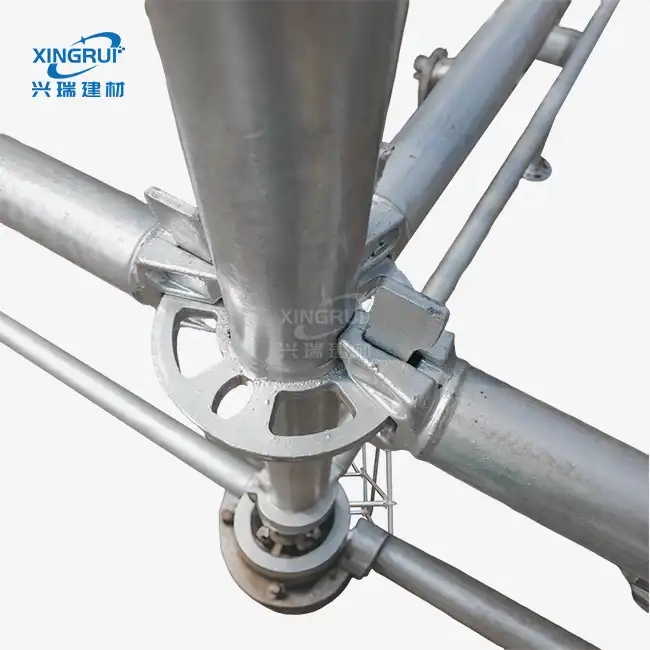
Understanding 8-Hole Disc Scaffolding Components and Their Standards
The rosette connection is what makes this setup unique. Along the vertical standard, there are eight equally spaced holes. Four of them are narrow slots for perpendicular ledgers, and the other four are bigger slots for diagonal braces. The holes are welded every 500 mm. This shape allows real connectivity in more than one direction, which is something that regular frame or cuplock systems just can't do.
What the Key Standards Actually Require
In Europe, EN 12811-1 sets rules for temporary works equipment, including how much weight it can hold, how accurate its measurements must be, and how its materials must be tracked. AS/NZS 1576 covers related issues in both the Australian and New Zealand markets. In the US, OSHA 29 CFR 1926 Subpart Q sets the minimum standards for load-bearing and safety factors. All three frameworks have one thing in common: they all put a high value on accurate measurements, checked material grades, and written load-test results. If a seller can't show a mill certificate or a load test record from a third party, they aren't meeting these standards.
Why Compatibility Criteria Matter for Procurement
Dimensional drift is a real operational risk when you mix parts on different jobsites or get them from more than one supplier. Even a difference of 0.8 mm in rosette width can change how wedges sit, which lowers the shear resistance of the connection. Purchasing managers who are looking for parts for delivery networks in Southeast Asia and the Middle East can save time and money by sticking with a single certified seller whose parts have the same shape in every production batch of 8-hole disc scaffolding.
Technical Analysis: How the 8-Hole System Meets Current Safety Benchmarks
The engineering reasoning behind the eight-hole rosette fits perfectly with the principles of redundancy that are built into today's scaffolding rules. 8-hole disc scaffolding embodies this principle by distributing forces through multiple symmetric paths, and spreading the load across eight connection points lowers the stress at any one node. This is why this system works consistently in buildings taller than 20 meters, where lateral wind loads become the most important design factor.
Comparing Performance Against Ring-Lock and Frame Alternatives
Ring-lock scaffolding works in a similar way to modular scaffolding, but its connections have fewer angles, which makes it less flexible for building odd shapes. It's faster to put up conventional frame scaffolding on flat, repetitive facades, but it can't be adjusted to work on curved surfaces, maintain petrochemical tanks, or support bridges. The 8-hole disc scaffolding is the best when the project needs protection in more than one way and different bay shapes without lowering the load capacity.
Where Dimensional Tolerance Is the Real Compliance Variable
The most mechanically demanding part of the system is the weld at the point where the rosette meets the pipe. At Shandong Xingrui's production plant, ultrasonic testing is done at this junction to make sure that there isn't a subsurface weld discontinuity that weakens the joint's ability to split. Pipe outer diameters that are kept to 48mm or 60mm within ±0.1mm make sure that parts from the same maker can be used with any other part in your inventory. This meets the standards for dimensional tracking in EN 12810-1.
Practical Considerations for Procurement and Assembly
When you buy scaffolding to sell in a competitive market, your customers will start judging it as soon as it gets out of the container. Consistent component counts, clean packaging, and easy-to-read markings are not just nice-to-haves; they show that the manufacturing process is being done correctly. 8-hole disc scaffolding stands out as a prime example—its uniform hole spacing and reliable locking mechanism directly reflect the production precision that customers look for, making every visual cue on the container floor a trustworthy signal of overall quality.
Here are the main factors for verifying purchase that lower risk further down the line:
- Spectrochemical material analysis: Verifies compliance with steel grade (Q235 carbon steel for standards and ledgers), giving a record that can be tracked and meets the needs of end-client audits.
- Weld strength verification: Ultrasonic or magnetic particle inspection on rosette connections finds cracks below the surface before the parts leave the factory, not after they get to your warehouse.
- Hot-dip galvanization measurement: A zinc coating of at least 80 microns, confirmed by a magnetic thickness gage, meets ISO 1461 standards and protects against corrosion for 15 to 25 years in coastal or industrial settings.
- Load-bearing documentation: Destructive test records from a third party that show the axial load capacity is higher than 40kN give your downstream contractors the engineering proof they need.
- Dimensional tolerance records: Batch inspection reports that show the outer diameter and wall thickness are kept within ±0.1mm prove that all of your inventory's seamless parts can be swapped out.
These requirements protect your profit margin by getting rid of the two most expensive situations in scaffolding distribution: guarantee claims from failures in the field and returns due to wrong measurements. If a supplier gives you paperwork for all five categories, they may be at a higher level of manufacturing development than your rivals' suppliers.
Market Insights: Comparing 8-Hole Disc Scaffolding Solutions
The global market for scaffolding keeps moving toward systems that are made up of separate parts. More and more projects in the Gulf Cooperation Council region and Southeast Asia specify the ringlock format because subcontractors know it saves time when putting up and taking down structures—up to 50% less work hours compared to tube-and-coupler options directly affect a contractor's ability to compete in bids.
Material Selection and Cost Efficiency Over Product Lifecycle
The tensile strength of Q235 premium carbon steel is good enough for the load ranges found in mid-rise and industrial construction, and it's still cheap enough to buy in bulk. The hot-dip galvanization process used at Shandong Xingrui creates a zinc layer that is more than 80 microns thick. This makes the part last much longer than painted or electro-galvanized alternatives.
8-hole disc scaffolding benefits significantly from this durability, as its multiple connection points see repeated assembly and disassembly. The lifecycle cost per use drops a lot with HDG products when your customers put up parts 15–20 times a year. This is something your sales team can safely talk to builders who are looking at prices regarding their 8-hole disc scaffolding.
Customization and Lead Time as Competitive Differentiators
When a manufacturer offers mixed-container packing, which includes standards, ledgers, diagonal braces, base jacks, and U-head jacks in the same package, you can save money on shipping costs and make managing your inventory easier. Shandong Xingrui can make custom items based on drawings or samples provided by the customer. The company's 79,800-square-meter production base and twelve welding robots ensure that even large orders are filled on time.
Future Outlook: Evolving Standards and What They Mean for Your Inventory
Regulatory bodies in Europe and the Asia-Pacific region are looking over scaffolding safety standards. They are paying special attention to rules for material tracking, corrosion paperwork, and IoT-enabled load monitoring integration. Manufacturers who already follow the certification frameworks for ISO 9001, ISO 14001, and ISO 45001 can easily adapt to these changes without stopping their production. If you buy from a supplier who already has these three certifications, your inventory will still meet new standards, saving your distribution business the cost of re-qualification.
Conclusion
When the production method behind them satisfies the dimensional, material, and paperwork requirements of today's international standards, 8-hole disc scaffolding components are compatible with them. As a whole, the rosette pattern is strong and popular in markets from Europe to the Middle East and Southeast Asia.
What makes a product compliant or non-compliant is the way it was made—checking the steel grade, the quality of the welds, the thickness of the galvanization, and the consistency of the dimensions. When you work with a certified, high-capacity manufacturer, you get rid of that risk and give your distribution network a product that they can sell over and over again without getting complaints.
FAQ
Can components from different disc scaffolding manufacturers be mixed on the same structure?
It is possible to mix if both makers use the same rosette shape standard, but there is a chance of problems. Wedge angles and rosette widths can be 0.5mm to 1mm different from one maker to the next. Before putting together different brands of 8-hole disc scaffolding on a load-bearing building, you should always make sure they will work together and get approval from a structural engineer.
What certifications should a supplier provide before I place a trial order?
Ask for ISO 9001 for managing quality, CE certification that covers the necessary EN standards, and a current mill certificate for the steel that will be used. A load-test report from a third-party lab gives you more confidence than what the maker says.
How does hot-dip galvanization affect product lifespan in humid or coastal environments?
Paint or electro-galvanization can't protect against rust as well as a zinc layer that is more than 80 microns thick and is applied using the hot-dip method described in ISO 1461. When used in humid tropical or marine-adjacent environments, HDG products reliably last 15 to 25 years with simple maintenance. This is a big plus when your customers work near the coast.
Is specialized assembly training required for this system?
For expert scaffolders, the wedge-lock mechanism works naturally, but for beginners, learning the right way to place the ledger and braces needs organized training. No matter what kind of system is being used, most regulatory frameworks require a "scaffolding competent person" to oversee the erection.
Partner With GREEN FORMWORK for Certified 8-Hole Disc Scaffolding Supply
GREEN FORMWORK, which is backed by Shandong Xingrui Building Materials Co., Ltd., sells ringlock scaffolding systems made from high-quality Q235 steel that are approved by ISO 9001, ISO 14001, and ISO 45001 bodies. We are a reliable 8-hole disc scaffolding manufacturer for volume importers thanks to our mixed-container capacity, 0.1mm dimensional consistency, and samples-with-technical-backup policy. Visit sdxingrui.com or email our team at sdxingruiqp@126.com to get a quote on your trial order right away.
References
1. European Committee for Standardization. EN 12811-1: Temporary Works Equipment — Scaffolds: Performance Requirements and General Design. CEN, 2003.
2. European Committee for Standardization. EN 12810-1: Facade Scaffolds Made of Prefabricated Components — Part 1: Products Specifications. CEN, 2003.
3. Standards Australia / Standards New Zealand. AS/NZS 1576: Scaffolding — General Requirements. SAI Global, 2010.
4. International Organization for Standardization. ISO 1461: Hot Dip Galvanized Coatings on Fabricated Iron and Steel Articles — Specifications and Test Methods. ISO, 2009.
5. Occupational Safety and Health Administration. OSHA 29 CFR 1926 Subpart Q — Scaffolds. U.S. Department of Labor, 2023.
6. International Organization for Standardization. ISO 9001: Quality Management Systems — Requirements. ISO, 2015.
Learn about our latest products and discounts through SMS or email