- English
- French
- German
- Portuguese
- Spanish
- Russian
- Japanese
- Korean
- Arabic
- Greek
- German
- Turkish
- Italian
- Danish
- Romanian
- Indonesian
- Czech
- Afrikaans
- Swedish
- Polish
- Basque
- Catalan
- Esperanto
- Hindi
- Lao
- Albanian
- Amharic
- Armenian
- Azerbaijani
- Belarusian
- Bengali
- Bosnian
- Bulgarian
- Cebuano
- Chichewa
- Corsican
- Croatian
- Dutch
- Estonian
- Filipino
- Finnish
- Frisian
- Galician
- Georgian
- Gujarati
- Haitian
- Hausa
- Hawaiian
- Hebrew
- Hmong
- Hungarian
- Icelandic
- Igbo
- Javanese
- Kannada
- Kazakh
- Khmer
- Kurdish
- Kyrgyz
- Latin
- Latvian
- Lithuanian
- Luxembou..
- Macedonian
- Malagasy
- Malay
- Malayalam
- Maltese
- Maori
- Marathi
- Mongolian
- Burmese
- Nepali
- Norwegian
- Pashto
- Persian
- Punjabi
- Serbian
- Sesotho
- Sinhala
- Slovak
- Slovenian
- Somali
- Samoan
- Scots Gaelic
- Shona
- Sindhi
- Sundanese
- Swahili
- Tajik
- Tamil
- Telugu
- Thai
- Ukrainian
- Urdu
- Uzbek
- Vietnamese
- Welsh
- Xhosa
- Yiddish
- Yoruba
- Zulu
Best Cuplock Scaffolding System for Heavy-Duty Construction Projects
When procurement teams search for the best cuplock scaffolding system, they prioritize node consistency, load certification, and long-term rental value. The cuplock scaffolding system uses a fixed bottom cup and a rotating top cup to lock up to four horizontal members at a single node point — no loose bolts, no wedges. Shandong Xingrui Building Materials Co., Ltd. (GREEN FORMWORK) manufactures this system from Q235 premium steel with Φ48×3.0mm uprights and bowl buckle joints welded at 600mm spacing, meeting BS EN 12811-1 load standards for bridge decks, power plants, and civil infrastructure worldwide.
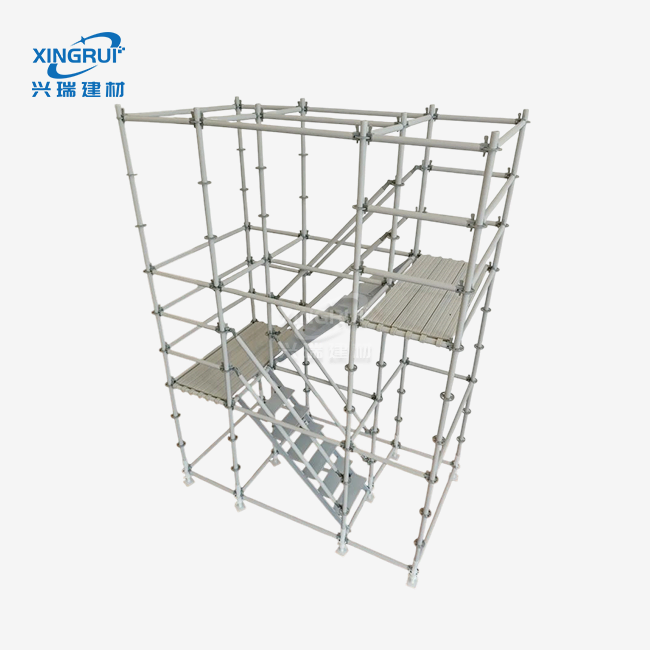
Understanding the Cuplock Scaffolding System
Contractors in the Middle East, Africa, and Southeast Asia choose the bowl-type lock coupler scaffold over others, and for good reason. Its shape is simple, the strength of its nodes can be measured, and its parts can be switched out at any size.
Core Components and Their Roles
The parts of the system are uprights, transoms, base jacks, horizontal ledgers, and the famous bowl buckle joints. There are welded node points every 600 mm on each Φ48×3.0mm pole. The lower cup stays in place, but the upper cup can turn to catch the ledger blades and lock with a single hammer blow. Base jacks make it easy to change the height even when the ground isn't level, which is useful for work on bridge abutments and foundation strengthening.
Global Safety Standard Compliance
The cuplock scaffolding system from GREEN FORMWORK is tested against BS EN 12811-1 to see how well it handles both vertical and horizontal loads. The plant has certificates for ISO 9001 quality management, ISO 14001 environmental management, and ISO 45001 health and safety at work. All batches of production are covered by CE approval. When it comes to international projects where owner consultants or supervisory engineers want proof of compliance, these third-party credentials really matter when it comes to qualifying bids.
Why Bowl Buckle Geometry Matters
The bowl bend node spreads the load out over four connection places at the same time, unlike pin- or wedge-based systems. This shape doesn't let eccentric loading happen, like when concrete is poured or when wind blows on tall falsework towers. Robotic welding gives precise measurements, so each node in a 500-tonne order acts the same. This is important when your site engineer is figuring out the safe working loads for a highway bridge deck, and it is exactly why the cuplock scaffolding system performs so consistently on demanding projects.
Comparing Cuplock with Other Scaffolding Systems
Picking the correct modular system can change the cost of labor, the ability to pay rent, and the approval of the structure. This is how the bowl buckle system stacks up against the two most popular options in the target market.
Cuplock vs. Ringlock Scaffolding
Ringlock systems offer more angular connection flexibility — typically eight connection positions per node — making them well-suited for curved facades and complex access geometry. The bowl buckle system, by contrast, centers load at a single node, which gives it an advantage in pure vertical shoring applications like slab falsework and bridge deck support. For contractors whose primary work is heavy civil infrastructure rather than architectural access, the bowl buckle method gives more rigidity at node points for every dollar spent.
Cuplock vs. Kwikstage and Frame Scaffolding
Kwikstage systems have a swivel blade-and-rosette connection that makes setting up faster for low-rise residential work. Frame scaffolding works well for repetitive access to facades where the shape doesn't change. The bowl belt device is the only one that can consistently hold a load at a height. Comparing the rates of putting up modular scaffolding consistently shows that bowl buckle systems cut assembly work by up to 40% compared to traditional tube-and-clamp methods. This is because the self-aligning cup gets rid of the need to manually tighten each fitting.
Lifecycle Cost and Rental Residual Value
A 60–80 micron hot-dip galvanized coating keeps parts safe in humid tropical climates and high-salinity coastal areas. The resale and rental yield are directly affected by this surface treatment. Rental companies in the Gulf and Southeast Asia say that steel bowl buckle parts are still very cheap used because they can be used with different brands at the ledger-blade level. When you buy a hot-dip galvanized system in bulk from a certified manufacturer, you usually get your money back within two to three project cycles.
Design Principles and Load Capacity for Heavy-Duty Projects
Knowing how a modular shoring system works from an engineering point of view helps buying teams make the right choices and avoid setups that aren't well thought out.
Load Distribution at the Node Point
Each bowl buckle node can hold four horizontal pieces at the same time. The fixed bottom cup takes on vertical loads from the ledger blades, and the upper cup stops movement to the side. Structural engineers can check this arrangement against BS EN 12811-1 or other national codes to make sure the load path is stable. GREEN FORMWORK includes third-party test reports with every batch of products, which meets the needs of owner consultants on projects that are supervised from abroad. This level of verification is what makes the cuplock scaffolding system reliable for international projects.
Safe Working Load Calculation
Any falsework configuration's safe working load is based on the distance between uprights, the length of the bays, and the number of the ties. For a normal 1.5m x 1.5m grid with Q235 Φ48×3.0mm uprights, official capacity tables say that the vertical load on each upright should be between 30 and 60 kN, depending on its useful length and the bracing it has. Before putting up falsework on a bridge deck or an elevated slab, project engineers should always get a professional design drawing.
Custom Configurations for Specialized Projects
GREEN FORMWORK can make products to order based on customer drawings or samples. This is important for building power plants because of non-standard bay sizes or chemical conditions that eat away at metals, which means that the tube wall thickness needs to be changed or the surface treatment needs to be changed. The factory has five semi-automatic forging lines and four cold roll forming sets that can handle different sizes without changing normal production schedules.
Installation Process and Best Practices
How well the system works at the spot is directly related to how well the installation was done.
Step-by-Step Assembly Sequence
Place the base plate on a level surface and the screw jack on hard ground. Place the first set of uprights, align the ledger blades with the lower cups, turn the top cups downward, and hammer the home. Use a spirit level to check the line after each move. Each fourth bay or as shown on the technical model should have a diagonal brace. Because the cups are self-aligning, skilled workers can set up a standard 10m × 10m falsework bay in less than two hours, which is about twice as fast as using tube-and-clamps.
Common On-Site Errors and How to Avoid Them
The most common installation mistake is not fully seating the upper cup before hammering, which leaves a gap at the node and lowers the lateral resistance. On the inspection checklist, the upper cup should be fully turned, the blade should be fully inserted to the stop, and there should be no obvious gap between the cup faces. Any cup with sagging closing lugs or that won't close all the way should be taken out of service. The technical support team at GREEN FORMWORK can help with on-site training documentation.
Maintenance and Inspection Protocols
Before stacking, clean the cup sides of any mud or concrete that is left over from each project cycle. Check the straight ends for distortion from being overloaded. In normal use, the hot-dip galvanized surface doesn't need any paint upkeep. However, parts that are exposed to chemical splashes should be checked for covering peel. Storing things the right way—stacked horizontally on wooden bearers and out of water—keeps the tolerances for size and lengthens the service life over many rental cycles. These simple maintenance habits are what keep a cuplock scaffolding system dependable season after season.
Procuring Cuplock Scaffolding: Buying Guide and Trusted Suppliers
There is a set order to large-scale buying for foreign projects: qualification, sample, framework contract, and batch delivery.
Evaluating Supplier Credentials
Before placing trial orders, procurement managers should make sure that the product has ISO 9001 quality certification, CE marking paperwork, and third-party test reports are available. GREEN FORMWORK's 79,800 m² factory in Rizhao, Shandong, has 12 welding robots and 180 quality technicians, so buyer-appointed agencies can do inspections before the goods are shipped. As usual, letter-of-credit transactions come with a certificate of origin and inspection papers.
Pricing, MOQ, and Delivery Logistics
Because Rizhao is near a harbor, it has lower interior freight costs for loading containers and can offer cheap FOB prices for large orders. Our company ships to more than 100 different countries. Framework contract pricing with rolling batch delivery is available for annual purchases between $500,000 and $5,000,000, which is about the same amount of money that infrastructure general contractors usually spend on purchases. You can get samples before you confirm your order.
Customization and After-Sales Support
With the made-to-order service, you can get custom tube lengths, special surface treatments, and bay sizes that aren't the usual. During the whole job cycle, technical support is provided. For product information and price quotes, email GREEN FORMWORK at sdxingruiqp@126.com or visit sdxingrui.com.
Conclusion
Shandong Xingrui Building Materials Co., Ltd., which does business as GREEN FORMWORK, sells industrial-grade cuplock scaffolding systems to contractors and rental companies in more than 100 countries. Our Q235 steel parts, ISO-certified production, and transportation at Rizhao seaport can handle big orders with proof of identity.
FAQ
Why is this system preferred for heavy civil infrastructure?
It makes a strong, bolt-free link that can handle both vertical shoring loads and side wind forces at the same time. Because of this, it can be used for bridge falsework, building power plants, and supporting high slabs where load stability is very important.
Can components from different manufacturers be mixed?
According to BS 5975, the industry should test for compatibility before putting together parts from different sources. Changes in the cup casting tolerances can affect how well the locking works. For important structural uses, GREEN FORMWORK says to keep orders from a single batch.
What certifications should I require from a supplier?
Ask for at least ISO 9001 certification, CE marking, and a load test report from a third party that references BS EN 12811-1 or a national standard that is similar. Letters of credit usually need country-of-origin certificates and material mill certificates for Q235 steel.
How many reuse cycles can I expect?
Hot-dip galvanized bowl buckle parts can be used 8–12 times before they need to be replaced, as long as they are cleaned, stored, and inspected after each project. This helps the rental business's finances in the Middle East and Southeast Asia.
Is technical support available for installation?
Yes, GREEN FORMWORK gives project teams technical documentation, assembly guides, and on-call support. Samples are sent out before large sales so that they can be checked at the site level.
Connect with GREEN FORMWORK for Your Next Project
In high-growth areas, the bowl buckle modular scaffold is still the best heavy-duty shoring option for bridge, power plant, and public infrastructure projects. It has a node-point rigidity, an assembly speed, and a galvanized durability that make it useful for the whole project lifecycle. When buying teams buy in bulk, the supplier's ability to make the goods, provide certifications, and handle transportation are just as important as the price per unit. All three are taken care of by GREEN FORMWORK from its production base in Rizhao. Send an email to sdxingruiqp@126.com or visit sdxingrui.com to start the process of qualifying.
References
1. British Standards Institution. BS EN 12811-1: Temporary Works Equipment — Scaffolds — Performance Requirements and General Design. BSI, 2003.
2. Standards Australia / Standards New Zealand. AS/NZS 1576.1: Scaffolding — General Requirements. SAI Global, 2010.
3. Health and Safety Executive (HSE). Guidance on the Use of Falsework. HSE Books, 2008.
4. Peng, J. L., Pan, A. D., & Chan, S. L. "Simplified Models for Analysis and Design of Modular Falsework Systems." Journal of Structural Engineering, ASCE, 1997.
5. International Organization for Standardization. ISO 9001:2015 Quality Management Systems — Requirements. ISO, 2015.
6. Construction Industry Research and Information Association (CIRIA). Falsework: Report on the Design and Use of Falsework, Report 106. CIRIA, 1995.
Learn about our latest products and discounts through SMS or email