- English
- French
- German
- Portuguese
- Spanish
- Russian
- Japanese
- Korean
- Arabic
- Greek
- German
- Turkish
- Italian
- Danish
- Romanian
- Indonesian
- Czech
- Afrikaans
- Swedish
- Polish
- Basque
- Catalan
- Esperanto
- Hindi
- Lao
- Albanian
- Amharic
- Armenian
- Azerbaijani
- Belarusian
- Bengali
- Bosnian
- Bulgarian
- Cebuano
- Chichewa
- Corsican
- Croatian
- Dutch
- Estonian
- Filipino
- Finnish
- Frisian
- Galician
- Georgian
- Gujarati
- Haitian
- Hausa
- Hawaiian
- Hebrew
- Hmong
- Hungarian
- Icelandic
- Igbo
- Javanese
- Kannada
- Kazakh
- Khmer
- Kurdish
- Kyrgyz
- Latin
- Latvian
- Lithuanian
- Luxembou..
- Macedonian
- Malagasy
- Malay
- Malayalam
- Maltese
- Maori
- Marathi
- Mongolian
- Burmese
- Nepali
- Norwegian
- Pashto
- Persian
- Punjabi
- Serbian
- Sesotho
- Sinhala
- Slovak
- Slovenian
- Somali
- Samoan
- Scots Gaelic
- Shona
- Sindhi
- Sundanese
- Swahili
- Tajik
- Tamil
- Telugu
- Thai
- Ukrainian
- Urdu
- Uzbek
- Vietnamese
- Welsh
- Xhosa
- Yiddish
- Yoruba
- Zulu
Can Tubular Scaffolding Be Used for Residential Renovation Projects?
Yes — tubular scaffolding works exceptionally well for residential renovation projects. Its modular steel tube-and-coupler design adapts to narrow driveways, uneven facades, and multi-story exteriors where rigid prefabricated frames simply cannot fit. Whether you are managing exterior repointing on a two-story townhouse or coordinating a full facade overhaul across a residential block, this system gives crews a safe, adjustable working platform at a cost that holds up against budget scrutiny. The rest of this guide breaks down the technical details, procurement strategy, and safety requirements you need before placing an order.
Understanding Tubular Scaffolding and Its Suitability for Residential Renovations
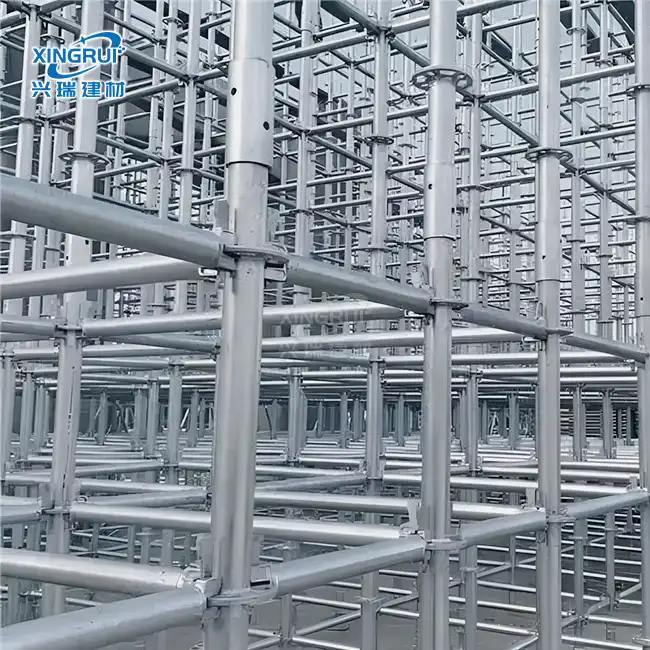
Tube-and-coupler scaffolding is made of standard steel pipes that are joined together with special clips. Frame or system scaffolding comes in fixed-bay sizes, but this method lets you change the shape of the structure on-site, which is very helpful when residential plots aren't straight or are very close together.
Steel vs. Aluminum Tubes for Home Renovation
Steel tubes, especially Q235 grade tubes with a 48.3 mm outside diameter, can hold more weight and are usually used for domestic work on multiple floors. Aluminum tubes are lighter and won't rust if they aren't coated, but they can't hold as much weight in one direction. Steel is still the better buy per ton for most remodeling projects with three or more floors.
Modular Design and Configuration Freedom
Putting together or taking apart the modular tube combination frame doesn't require any special tools. Crews that already know how to build in the area pick it up quickly, which cuts down on the time needed for training. Right-angle, swivel, and sleeve couplers let standard 48-series pipes join, so the structure can follow bay windows, hidden openings, or stepped rooflines without having to be expensively custom-built.
Load Capacity Relevant to Residential Use
Light to medium duty loads are common in residential remodeling. For example, bricklayers, plasterers, and their tools rarely need to carry more than 2.0 kN/m² per working platform. With 3.2 mm wall thickness, a properly set up tubular scaffolding tube-and-clamp system can handle this, and upgrading to 4.0 mm wall tubes gives you more room for heavier exterior stone or covering panels.
How to Effectively Use Tubular Scaffolding in Residential Renovation Projects
Two main ways that residential sites are different from business sites are that room is limited and neighbors are close. Making sure the erection process is correct from the start saves money and keeps the community safe.
Choosing the Right Configuration for the Job
Before you place your order, make a map of the building's boundaries and mark any obstacles, such as gates, utility meters, or low tree branches. For fixes on one story, single-lift setups work. For two- to four-story facades, the standard method is to use separate, tied scaffolds that are braced back to the building. At the point where walls meet bay projections, swivel couplers handle changes in angle.
Safe Assembly Practices on Confined Sites
As per OSHA 29 CFR 1926 Subpart Q, all scaffolding must be watched by a qualified person. When putting base plates down on private sites, always do it on hard, level ground and never right on soft landscaping. At every working lift, put up toe boards and guardrails. Each tie-in point should be set up no more than every 4 m up and down and every 6 m across the wall.
Real-World Application: Multi-Story Exterior Repair
A common situation is when a contractor replaces weathered render on a four-story apartment building from the 1930s. The tube-and-coupler system connects the uneven window projections and lets each lift work on its own every 2 meters. The tubes and couplers can be taken apart, moved, and used on another project. With proper care, they can be used 50 or more times, which means that the cost of each deployment goes down.
Comparing Tubular Scaffolding with Other Scaffolding Types for Residential Renovations
A ringlock or frame system would work better for a home contract? This is something that procurement teams often ask. The answer relies on how hard the job is, how much money you have, and how much work you can do.
Here are the most important ways to compare different types of common scaffolding:
- Tube-and-coupler (tubular scaffolding): Most geometric flexibility; works well with uneven facades; takes longer to put together than modular systems but doesn't need any special parts—universal couplers are available from many suppliers, which keeps maintenance costs low.
- Frame scaffolding: Easiest to set up on flat, regular facades because the bay sizes are fixed. It works best for repeated bays in new buildings than for repair work where the windows are moved around.
- Ringlock scaffolding: Great for big commercial or infrastructure projects; it's easier to put together than tube-and-coupler scaffolding; the proprietary rosette nodes make the cost per unit higher; it's not as good for small residential orders.
When you set the price of a bid, these differences matter. For a home remodeling builder working on multiple sites at the same time, the tubular scaffolding tube-and-coupler system's uniform consumables make them less reliant on a single source and lower their long-term costs for spare parts. It's faster with frame systems for easy jobs, but it's more flexible and cheaper over its entire life with tube-and-coupler systems for more difficult or varied jobs.
Procurement Guide for Tubular Scaffolding in Residential Renovation Projects
It takes more than just taking the lowest quote per ton to find the right system at the right price. Your real landed cost depends on things like quality certifications, how quickly containers are loaded, and how fast your provider is.
Identifying Project-Specific Needs Before Ordering
Estimate the area of the wall to find the total length of the tubes. Then, add in the couplers at a rate of about 6–8 pieces per vertical meter of individual scaffold. When you order in full 20- or 40-foot container loads for a large home program, the cost of freight per ton goes down. Shandong Xingrui Building Materials Co., Ltd. lets buyers make custom orders and send samples before committing to full production. This lets buyers make sure that the sizes meet the needs of their specific projects.
Evaluating Supplier Certifications
Give more weight to providers who have ISO 9001 (quality management), ISO 14001 (environmental management), or ISO 45001 (health and safety at work) certifications. These standards show that production processes can be checked and tracked, which is useful when the final customer asks for proof of warranty. Shandong Xingrui's GREEN FORMWORK products have all three certifications and come with paperwork to prove they are of high quality.
Purchase vs. Rental: Financial Considerations
Since quality galvanized tubes can be used over and over again, buying and having a tube-and-coupler collection usually becomes cheaper than renting after 18 to 24 months of active use. This is because quality galvanized tubes can be used over and over again. It makes sense to rent for one-time projects or places where storage costs a lot. When figuring out how much an object will lose value over time, buyers should take into account the 40–60 micron hot-dip galvanized covering life.
Safety Guidelines and Maintenance Tips for Tubular Scaffolding in Residential Contexts
Without a doubt, safety is the most important thing. A well-kept system keeps workers safe, lowers your risk of lawsuits, and makes your inventory last longer.
Pre-Use Inspection Checklist
Check that the tubular scaffolding tube is straight and doesn't have any cracks that can be seen, that the coupler jaws and locking pins are in good shape, and that the base plate and sole board are in good shape before each deployment. Any tube that has pitting deeper than 0.5 mm or weld seam rust that can be seen should be taken out of service. As per industry guidelines (BS EN 12811-1), inspections should be done after installation, every seven days while in use, and after any high-wind event.
Corrosion Management in the Field
Hot-dip galvanization is the most lasting protection because the zinc layer sticks to both the inside and outside of the tube after it is formed, covering any weld seams. A magnetic induction gage should be used once a year to check the zinc coating thickness in coastal or high-humidity residential areas. If the layer on a tube drops below 20 microns, it should be re-galvanized or replaced.
Personnel Training Requirements
Both OSHA and EN rules say that erectors need to get official training before they can work on scaffolds. For workers working on home renovations, the bare minimum is a one-day site-specific induction that goes over how to set up, tie-in, and handle emergencies. Keep track of all of your training records. This will protect you during project reports and insurance reviews.
Conclusion
For home renovations, tubular scaffolding tube-and-coupler scaffolding has been used for a long time and can be easily modified. Because it can be used in any shape, requires no special materials, and can be used over and over, it is the best choice for builders who have to deal with different designs and tight budgets.
What makes the difference between a cost-effective rollout and a liability is a proper site assessment, certified supplies, and disciplined checking processes. When you buy from a qualified maker whose production processes have been checked and whose quality control procedures have been written down, you lower the risk of the purchase and protect your project margin on every contract.
FAQ
Can tube-and-coupler scaffolding support work on buildings taller than four stories?
Yes. The system can handle buildings much taller than 25 m, but any plan taller than that needs to be approved by a structural engineer to make sure it takes wind load and cumulative dead load into account. For taller configurations, walls should be at least 4 mm thick.
Is it safe to reuse scaffolding tubes across multiple residential projects?
Yes, as long as each tube passes a visual and size check before being sent back out into service. It is possible for Q235 steel tubes with their hot-dip galvanized coating to last for 50 or more deployment rounds. Keep a record of each inspection so that you can find it later.
How do I select a reliable tubular scaffolding supplier for bulk residential orders?
Check that the company has ISO 9001 certification, that they can show proof of their production capacity (workshop size, automatic lines), and that they are ready to send you samples before you commit to a full order. When suppliers give you detailed datasheets and guarantee letters, you take on a lot less risk. The 40,000+ m² factory that makes GREEN FORMWORK products has 12 welding robots and six automated production lines.
What payment terms do most international scaffold manufacturers accept?
Manufacturers who have been around for a while usually accept T/T, L/C, and, for long-term customers, agreed account terms. Before you place a free order, make sure you understand how to pay.
Do aluminum tubes work with standard steel couplers?
Even though they fit literally, you need to make sure that the couplers are rated for aluminum tubes to stop galvanic rust and that they have enough friction grip when they're loaded.
Get Competitive Pricing on Certified Tubular Scaffolding — Contact GREEN FORMWORK Today
With help from Shandong Xingrui Building Materials Co., Ltd., GREEN FORMWORK sells Q235 tube scaffolding to builders and traders in over 100 countries. We are a certified manufacturer of tubular scaffolding with ISO 9001, ISO 14001, and ISO 45001 certifications. We offer free samples, full technical support, and discounts for large orders. To get a price right away, email your project details to sdxingruiqp@126.com or go to sdxingrui.com.
References
1. Construction Industry Scaffolding Safety Handbook — Occupational Safety and Health Administration (OSHA), 2021.
2. BS EN 12811-1: Temporary Works Equipment — Scaffolds — British Standards Institution, 2003.
3. EN 74-1: Couplers, Spigot Pins and Baseplates for Use in Falsework and Scaffolding — European Committee for Standardization, 2005.
4. Scaffolding: A Practical Guide for Contractors — Health and Safety Executive (HSE), 2019.
5. Steel Structures: Design and Behavior — Salmon, C.G., Johnson, J.E., and Malhas, F.A., Pearson Education, 2009.
6. ISO 9001:2015 Quality Management Systems — Requirements — International Organization for Standardization, 2015.
Learn about our latest products and discounts through SMS or email