- English
- French
- German
- Portuguese
- Spanish
- Russian
- Japanese
- Korean
- Arabic
- Greek
- German
- Turkish
- Italian
- Danish
- Romanian
- Indonesian
- Czech
- Afrikaans
- Swedish
- Polish
- Basque
- Catalan
- Esperanto
- Hindi
- Lao
- Albanian
- Amharic
- Armenian
- Azerbaijani
- Belarusian
- Bengali
- Bosnian
- Bulgarian
- Cebuano
- Chichewa
- Corsican
- Croatian
- Dutch
- Estonian
- Filipino
- Finnish
- Frisian
- Galician
- Georgian
- Gujarati
- Haitian
- Hausa
- Hawaiian
- Hebrew
- Hmong
- Hungarian
- Icelandic
- Igbo
- Javanese
- Kannada
- Kazakh
- Khmer
- Kurdish
- Kyrgyz
- Latin
- Latvian
- Lithuanian
- Luxembou..
- Macedonian
- Malagasy
- Malay
- Malayalam
- Maltese
- Maori
- Marathi
- Mongolian
- Burmese
- Nepali
- Norwegian
- Pashto
- Persian
- Punjabi
- Serbian
- Sesotho
- Sinhala
- Slovak
- Slovenian
- Somali
- Samoan
- Scots Gaelic
- Shona
- Sindhi
- Sundanese
- Swahili
- Tajik
- Tamil
- Telugu
- Thai
- Ukrainian
- Urdu
- Uzbek
- Vietnamese
- Welsh
- Xhosa
- Yiddish
- Yoruba
- Zulu
Best Loose Steel Tube Scaffolding for Heavy-Duty Industrial Work
When industrial projects demand structural support that adapts rather than constrains, loose steel tube scaffolding delivers where rigid frame systems fall short. Manufactured from Q235 premium steel with a standard 48.3mm outer diameter and wall thickness between 3.2mm and 4.0mm, this disassembled split-type system lets crews combine independent bars freely on-site — no fixed modulus required. Whether you're reinforcing an irregular concrete pour, supporting petrochemical pipework, or staging a scattered renovation, this guide breaks down everything B2B procurement teams need to source the right product with confidence.
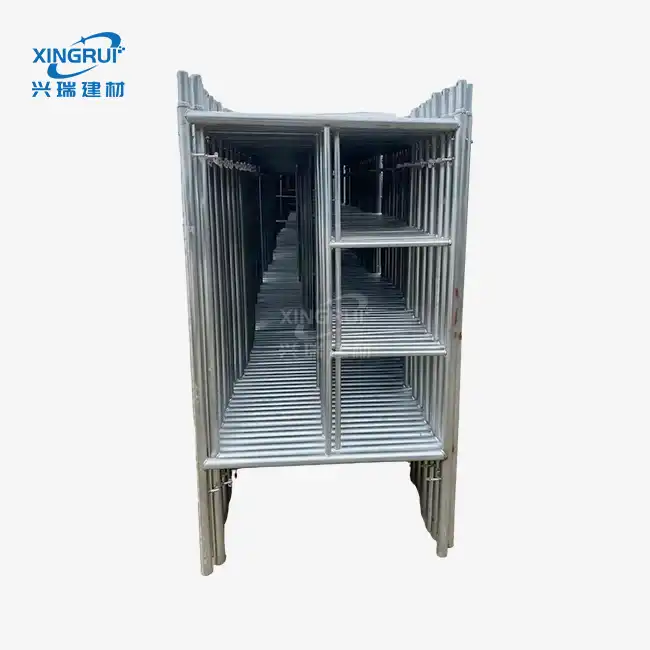
Understanding Steel Tube Scaffolding: Components, Specifications, and Safety
One of the oldest and most trusted temporary work systems in the world of construction is tube and coupler scaffolding. Unlike pre-fabricated frame parts, it gives engineers full control over the shape of the building, which is very useful when building contours or access issues make standard modular setups impossible.
Core Components and Dimensional Standards
Vertical standards, horizontal ledgers, diagonal braces, base plates, swivel couplers, and right-angle couplers are all parts of a full Loose Steel Tube Scaffolding system. The standard outer width of 48.3mm in the industry makes sure that it works with drop-forged couplers that are approved to EN 74 and BS 1139 around the world. The load capacity is directly related to the thickness of the wall. Tubes have a tensile strength of about 340 MPa at 3.2mm and 520 MPa at 4.0mm, which is strong enough for heavy falsework and industrial maintenance platforms.
Hot-dip galvanization (HDG) with a zinc covering layer of 40–60 microns protects against corrosion in salt spray and damp conditions, meeting EN ISO 1461 standards. At Shandong Xingrui Building Materials Co., Ltd., each tube has a heat number stamp that can be linked to its Mill Test Certificate (MTC). This makes sure that the whole structure is accountable.
Safety and Compliance Protocols
For projects that will be sold in North America and Europe, EN 39, BS 1139, ISO 9001, ISO 14001, and CE certification must be met without fail. A lot of companies don't meet this standard, but Xingrui does because it has ISO 45001 certification for workplace health and safety management. Five inspection methods are used to make sure that each tube meets the EN 39 mechanical test standards for accuracy in size, zinc coating weight, chemical makeup, resistance to flattening, and integrity when bent.
How Tube and Coupler Scaffolding Compares to Other Systems
Teams that buy things often compare tube and connection choices to ringlock (system scaffolding), cuplock, and frame scaffolding. Each system has a place in the market, but they are very different in how well they can adapt.
Ringlock scaffolding can be set up more quickly on rectangular floor plates that are used over and over again. This makes it useful for high-rise walls. Cuplock is good for shoring that is moderately complicated and has a moderate range of heights. Frame scaffolding is the least expensive way to do simple work around the house. These, however, don't compare to the geometric freedom of separate steel tubes when the building isn't straight, entry is limited, or support points need to be placed without a fixed-node grid.
Here is a practical comparison across key procurement criteria:
- Geometric flexibility: Tube and coupler systems can be set up with any angle and distance between them. Ringlock nodes can only lock at 0°, 45°, 90°, and 135°, which isn't good for structures that are curved or tapered.
- Bulk cost per ton: Because loose tubes and couplers are single-component goods, they have a lower per-unit cost. This makes buying them in bulk and putting them in containers easier.
- Adaptability to different types of projects: Separate bars can be used in very different project shapes. Fixed-geometry modular kits often come with parts that don't do anything when the project's size changes.
- On-site customization and cutting: Tubes can be cut to the widths needed on demand, which gets rid of the wasteful waste of material that comes with fixed-module systems.
Procurement Guide: Sourcing Quality Steel Tube Scaffolding at Scale
Effective buying strikes a balance between price per ton, quality of materials that can be checked, how quickly containers can be loaded, and help after the shipping. Loose Steel Tube Scaffolding procurement depends on this balance, as competitive ton pricing must align with verifiable material quality, container loading efficiency, and responsive post-shipment support to ensure total cost optimization. Here are the main things that set trustworthy providers apart from low-cost risks:
- Certified material proof: Ask for MTCs with spectrographic composition data that confirms the grade (Q235 or equivalent S235GT/S355), the amount of carbon in the material, and the manganese to carbon ratios. Suppliers who can't provide batch-level traceability put the responsibility on those who buy from them.
- Verification of wall thickness: Magnetic induction gages and accurate micrometers should be used to check the wall thickness at both ends and in the middle of the tubes that were tested. A difference of 0.2 mm in wall thickness lowers load capacity by about 6 to 8 percent, which is a big deal for heavy-duty uses.
- Container packing density: When standard 6-meter tubes are packed together, they usually pack at 20–22 tons per 40HQ container. Before setting a freight budget, make sure you know exactly how to pack the items.
- Management systems and certifications: ISO 9001 (quality), ISO 14001 (environmental), and ISO 45001 (safety) certifications show that the process is controlled in a planned way, not just that requirements are met on the spot.
- Custom sizes and samples: Xingrui can accommodate requests for custom sizes and offers physical samples along with technical advice before placing large orders. This is a useful safety measure before committing to a large quantity.
Xingrui has a 79,800-square-meter factory in Rizhao, Shandong Province, where 180 professional workers work with 12 welding robots and six automatic welding lines. The dedicated seaport, airport, and high-speed rail connections in Rizhao make it easy to send goods to more than 100 countries.
Installation and Maintenance Best Practices
Good installation practices protect the worth of the object and the safety of workers for as long as the scaffolding is in use.
Pre-Assembly Checklist
Before you start the construction, check each tube for obvious deformation, coupler-seat damage, or coating breaches. When the load-bearing ability is unknown, base plates must rest on packed, level ground with sole boards. Check the coupler's torque requirements. EN 74 says that right-angle couplers must have a closing torque of at least 50 Nm in order to work at their maximum load. Loose Steel Tube Scaffolding requires these pre-use inspections and torque verifications, as tube integrity and coupler tightness are critical for load capacity and EN 74 compliance.
Routine Inspection and Maintenance
If you take care of hot-dip galvanized tubes properly, they can last for 10 to 15 years in moderately exposed areas [⁋]. Inspection times should be set on a schedule that is based on the length of the project and the severity of the environment. Some important maintenance tasks are re-torquing couplers that have come loose after an earthquake or heavy load cycle, adding cold galvanizing solution to any coating breach with a width of more than 5 mm, and replacing any tube that has a visible oval shape or permanent deformation.
Maximising Efficiency and Safety on Industrial Job Sites
The most important thing that can be changed to make a scaffold safer is how the weight is distributed. By placing standards no more than 1.8 meters apart in the lift direction and no more than 1.5 meters apart on falsework that is highly loaded, the loads on each tube stay well within the Q235 tensile range. When loads aren't distributed evenly, diagonal bracing every four lifts stops increasing racking failure.
Digital load tracking devices are now built into Loose Steel Tube Scaffolding systems used on big building and petrochemical projects. These sensors collect real-time strain data that lets workers know when loads are too high before they cause structural problems. This technology costs more up front, but it lowers incident rates by a significant amount on sites where simultaneous multi-level loading is not possible.
Conclusion
Loose Steel Tube Scaffolding is still the most flexible temporary work option for heavy-duty construction, repair, and industrial tasks. It is the best choice for procurement teams that are in charge of a wide range of projects because it is cost-effective per ton, allows for geometric freedom, and works with global coupler standards. When you buy from a company like Shandong Xingrui Building Materials Co., Ltd., whose management systems are certified and whose quality inspection protocols are clear, you lower the risk further down the line and help the site perform consistently. Before committing to a large order, ask for examples and detailed data sheets to make sure that the product meets the requirements.
FAQ
How long does hot-dip galvanized tube scaffolding last under heavy industrial use?
If you inspect and maintain hot-dip galvanized tubes regularly, they should last between 10 and 15 years in moderate exposure conditions. In chemical or marine settings, reapplying the protective layer every 5–7 years makes it last a lot longer.
Can tubes be custom-cut or ordered in non-standard lengths?
Yes, Xingrui does take requests for custom sizes. Also, tubes can be cut to exact lengths on-site while the system is being put together. This gets rid of extra material and waste, which is a major cost advantage over fixed-module systems.
What certifications should I require from a scaffold tube supplier?
Ask for compliance documents for ISO 9001, ISO 14001, EN 39, or BS 1139 at the very least, as well as batch-level MTCs. Getting ISO 45001 certification adds a layer of assurance to your HSE paperwork that makes it stronger.
Is purchasing bulk tube scaffolding more cost-effective than renting?
When buying in bulk, direct purchase at mill-exit price always works out better than rental cost accumulation after 18–24 months of use for wholesalers and rental fleet owners. Shopping in bulk also protects you against changes in the price of steel by locking in known material costs.
Are Q235 tubes compatible with EN 74-certified couplers?
Yes, Q235 tubes made to the 48.3mm OD standard can be used with EN 74 and BS 1139 certified drop-forged or pressed steel couplers. This is the standard for global interoperability.
Request a Quote from GREEN FORMWORK — Your Trusted Steel Tube Scaffolding Supplier
GREEN FORMWORK puts you in touch with Shandong Xingrui's certified manufacturing services. Our Loose Steel Tube Scaffolding is made to meet EN 39, BS 1139, ISO 9001, ISO 14001, and CE standards, with custom sizing, full MTC documentation, and samples available on request. Contact our procurement team today at sdxingruiqp@126.com to receive competitive bulk pricing and technical guidance tailored to your project volume.
References
1. British Standards Institution. BS 1139-2.1: Metal Scaffolding — Couplers (2009). London: BSI. Used in the components and coupler compatibility section.
2. European Committee for Standardization. EN 39: Loose Steel Tubes for Tube and Coupler Scaffolds (2001). Brussels: CEN. Used in the safety and compliance protocols section.
3. CIRIA. Scaffolding and Temporary Works: A Guide for Designers and Contractors (2019). London: CIRIA. Used in the system comparison section.
4. ASTM International. ASTM A53/A53M: Standard Specification for Pipe, Steel, Black and Hot-Dipped, Zinc-Coated (2022). West Conshohocken: ASTM. Used in the procurement guide section on material documentation.
5. Shandong Xingrui Building Materials Co., Ltd. Company Profile and Product Catalogue (2024). Rizhao: Xingrui Group. Used in the procurement guide section on manufacturer capability.
6. International Zinc Association. Zinc Coatings: A Comparative Analysis of Corrosion Protection Afforded by Various Zinc Coating Types (2021). Brussels: IZA. Used in the maintenance section on galvanized tube service life.
Learn about our latest products and discounts through SMS or email