- English
- French
- German
- Portuguese
- Spanish
- Russian
- Japanese
- Korean
- Arabic
- Greek
- German
- Turkish
- Italian
- Danish
- Romanian
- Indonesian
- Czech
- Afrikaans
- Swedish
- Polish
- Basque
- Catalan
- Esperanto
- Hindi
- Lao
- Albanian
- Amharic
- Armenian
- Azerbaijani
- Belarusian
- Bengali
- Bosnian
- Bulgarian
- Cebuano
- Chichewa
- Corsican
- Croatian
- Dutch
- Estonian
- Filipino
- Finnish
- Frisian
- Galician
- Georgian
- Gujarati
- Haitian
- Hausa
- Hawaiian
- Hebrew
- Hmong
- Hungarian
- Icelandic
- Igbo
- Javanese
- Kannada
- Kazakh
- Khmer
- Kurdish
- Kyrgyz
- Latin
- Latvian
- Lithuanian
- Luxembou..
- Macedonian
- Malagasy
- Malay
- Malayalam
- Maltese
- Maori
- Marathi
- Mongolian
- Burmese
- Nepali
- Norwegian
- Pashto
- Persian
- Punjabi
- Serbian
- Sesotho
- Sinhala
- Slovak
- Slovenian
- Somali
- Samoan
- Scots Gaelic
- Shona
- Sindhi
- Sundanese
- Swahili
- Tajik
- Tamil
- Telugu
- Thai
- Ukrainian
- Urdu
- Uzbek
- Vietnamese
- Welsh
- Xhosa
- Yiddish
- Yoruba
- Zulu
How to Choose the Best Frame Scaffolding System for Your Project?
Choosing the right frame scaffolding system directly affects your project's safety, timeline, and bottom line. A well-matched modular scaffold setup reduces labor overhead, prevents costly assembly errors, and keeps your crews compliant with OSHA regulations. Whether you manage a regional distribution network or oversee masonry contractors across multiple job sites, understanding what separates a reliable scaffold system from a liability starts here. This guide walks through the key selection criteria, procurement best practices, and comparative insights that matter most to B2B buyers making volume decisions.
What Is a Frame Scaffolding System?
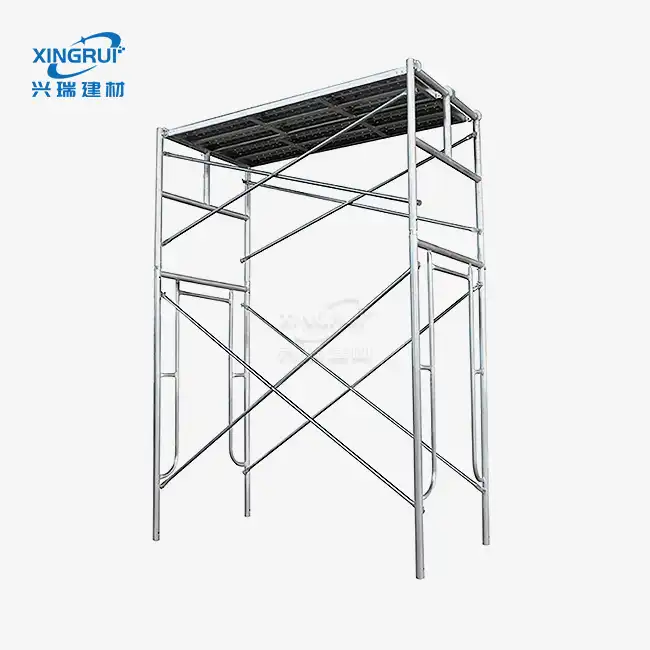
A frame scaffolding system is a temporary structure that is pre-made and flexible. It is made up of vertical doorway frames, horizontal cross-braces, and platforms that hold weight. Because it's easy for people and tools to move between floors, it's the standard choice for masonry facades, internal renovations, and MEP installs.
Core Components and How They Work Together
Vertical loads are sent down to movable base plates by paired steel frames, and diagonal cross-braces stop the system from leaning to the side. Standardized locking pins or gravity clips let you connect parts without tools, so you don't have to guess what to do on the job site. Because the mechanism is so simple, assembly times are 50–70% faster than with traditional tube-and-clamp setups. This number is always used as a benchmark in the scaffolding industry.
Key Criteria for Choosing the Best Frame Scaffolding System
The price of support is often the only thing that procurement managers look at. That method leaves out the factors that determine the real cost of a frame scaffolding system over the whole lifecycle. Here are the main evaluation factors that you should think about before you buy anything.
Structural Safety and Compliance Standards
Any scaffolding used on a job site in the United States must meet the rules set out in OSHA 29 CFR 1926 Subpart Q. Internationally, EN 12810 and EN 12811 set the rules for how well wall supports should work. Instead of just listing their own standards, look for providers who can show you proof of third-party load tests. Pin-to-pin dimensional tolerance, which should be kept to within ±1mm, affects the stability of vertical stacking and stops eccentric loading, which is a major reason why scaffolds fall down.
Material Grade and Surface Treatment
The grade of the tube material determines how long it will last. With a 42x2.0mm outer diameter and a wall thickness of 2.0 mm, Q235 carbon steel has a proven mix of tensile strength and weight economy. Surface treatment is also very important. Hot-Dip Galvanization (HDG) with a coating thickness of ≥60μm protects against corrosion for more than 15 years in coastal or humid areas, while regular powder coating breaks down much more quickly in the same conditions.
Component Completeness and Logistics Readiness
Receiving frames that don't have cross-braces, foot planks, or casters that work with them cause operational delays and sourcing problems. Make sure that the provider you're dealing with sends full, matched sets. Warehouse-ready packing with SKU barcoding is just as important as the steel itself for wholesalers who are in charge of warehouse-to-shelf processes. Private-label (OEM) packaging from suppliers adds more value because it lets you brand goods directly for your renting or retail network.
Practical Procurement and Installation Best Practices
Decisions about where to get materials made at the purchase order stage affect how well the field works months later. Before choosing a frame scaffolding system supplier, make sure they have the right ISO certifications, look over their factory audit reports, and ask for a sample shipment so that a third party can test its size and weight.
These procurement checkpoints consistently tell the difference between suppliers who are reliable and those who aren't:
- Certification paperwork: Check for compliance with ISO 9001, ISO 14001, and ISO 45001, as well as CE certification, as separate proof of a strict manufacturing system, rather than just depending on product brochures.
- Dimensional consistency: Ask for batch measurement reports that include pin-to-pin accuracy data from more than one production run, not just one reference sample.
- Planning the load of a container: Work with providers who know how to optimize full-container loads (FCLs) to lower the cost of settled goods and avoid freight delays during busy times that make it harder to restock.
- Installation training: Make sure that all of your contractors get the most up-to-date assembly instructions, re-inspection plans for after a storm, and verticality (plumb) verification methods that are in line with OSHA green-tag standards.
These checkpoints lower the risk of failures in the field, customer returns, and liability exposure — the three cost drivers that erode margin on scaffold product lines faster than any price negotiation can recover.
Frame Scaffolding vs. Alternative Scaffold Systems
Knowing when a portal frame scaffolding system setup works better than others helps you show end users the value and explain to store operations teams why stocking decisions were made the way they were.
Frame vs. Tube-and-Clamp
Tube-and-clamp scaffolding is the most flexible in terms of shape for irregular buildings, but it takes a lot more skilled work to set up safely. It takes two to three times longer to put together, and the consistency of the clamp torque depends on the operator. This causes variation that OSHA inspectors often point out. A standard frame method gives you more work done per hour of labor for repeated masonry and facade work, which is what most regional dealers do most of the time.
Frame vs. Ringlock or Cuplock System Scaffolding
Ringlock and cuplock system framing works great for complex engineering falsework and high-rise shoring. It takes longer to learn and costs more per unit for its parts. A frame scaffold system is designed to work best for low- to medium-rise entry work, managing rental fleets, and contractors who value speed over flexibility. When your customers care about short rental cycles and getting back to work quickly between projects, the ROI calculation favors frame systems.
Why GREEN FORMWORK Frame Scaffolding Stands Apart?
Shandong Xingrui Building Materials Co., Ltd. makes GREEN FORMWORK, which is industrial-grade modular frame scaffolding systems designed for B2B delivery needs around the world. Since 2007, the business has been based in a 79,800 m² building in Rizhao, Shandong. This is a city with a direct seaport, airport, and high-speed rail that helps with export logistics to more than 100 countries.
Each unit is made with 12 welding robots and 6 automatic welding lines spread out over a 40,000-square-meter standard workshop. Dimensional accuracy is kept to ±1mm between production runs by checking the raw materials with spectrochemical methods and testing the welds' stability with ultrasonic waves. As a full, matched set, every system comes with cross-braces, foot planks, casters, and door frames that are 914 mm wide and 1.7 m or 1.93 m high.
There are ISO 9001, ISO 14001, ISO 45001, and CE marks on GREEN FORMWORK frame systems. HDG surface treatment with a coating layer of at least 60μm has been shown to prevent corrosion for 15 years. The molded frame is made of a single piece, so the weld joints are not weak like they are in manufactured options. OEM private-label packing, barcoding that's ready for the warehouse, and shipping samples are all normal services, not extras that cost extra.
This mix of full products, deep certifications, and logistics skills leads to fewer customer complaints, lower return rates, and higher category margins for wholesalers with 20 to 200 branch locations.
Conclusion
Choosing the right scaffold system is a purchase choice that will affect safety, profit, and the image of the brand for a long time. The evaluation factors listed here—material grade, OSHA/EN compliance, dimensional tolerance, component completion, and seller certification—make it easy to screen materials for all kinds of projects and buying situations. Shandong Xingrui's GREEN FORMWORK meets all of these needs with its proven manufacturing credentials, full sets of parts, and OEM capabilities that work well with North American distribution networks. Frame scaffolding system from GREEN FORMWORK delivers on these criteria, with consistent dimensional tolerances and complete kit configurations that streamline procurement and ensure job-site safety compliance.
FAQ
What factors affect the price of a frame scaffolding system?
Unit cost is affected by the type of steel, how it is treated on the outside, the size of the frame, the amount ordered, and the CIF destination. HDG-treated systems cost more than powder-coated ones, but they need to be replaced much less often over the course of a 5–10 year fleet span.
How do I verify OSHA compliance before purchasing?
Ask for load test reports from a third party that include references to OSHA 29 CFR 1926.452 and EN 12810. Make sure that the pin-to-pin dimensional tolerances are written down for all production batches, not just reference samples. ISO 9001 approval from the factory that makes the product adds to the overall system security.
Can I order custom dimensions or private-label packaging?
Yes. GREEN FORMWORK can make things to your exact specs and put your brand's name on OEM private-label packaging. Warehouse-ready barcoding is a standard option that lets you put the items right on the shelves without having to re-label them at the distribution center.
What is the maximum safe height for a standard frame scaffold?
Based on OSHA rules, typical setups are safe up to 125 feet (38m). Structures taller than that need an engineering plan made just for the site and structural tie-ins checked by a licensed professional engineer.
Request a Quote from GREEN FORMWORK — Your Trusted Frame Scaffolding System Supplier
For wholesalers who require dependability on a large scale, GREEN FORMWORK's frame scaffolding systems are designed. We can help you with your inventory plan from the first sample to the yearly supply agreement. Our production is ISO-certified, and we offer full sets of parts, HDG corrosion protection, and private labeling. Get in touch with our team right away to ask about product details, prices, or a sample shipment. Reach us at sdxingruiqp@126.com to start your sourcing evaluation.
References
1. Occupational Safety and Health Administration (OSHA). Scaffolding — 29 CFR 1926 Subpart Q. U.S. Department of Labor, 2023.
2. Scaffold & Access Industry Association (SAIA). Scaffold User Handbook. SAIA, 2022.
3. British Standards Institution. EN 12810-1: Facade Scaffolding Made of Prefabricated Components. BSI, 2003.
4. Construction Industry Institute (CII). Scaffold System Selection and Productivity Benchmarking. University of Texas at Austin, 2021.
5. Shandong Xingrui Building Materials Co., Ltd. Company Profile and Export Capabilities. sdxingrui.com, 2024.
6. International Organization for Standardization. ISO 9001:2015 Quality Management Systems — Requirements. ISO, 2015.
Learn about our latest products and discounts through SMS or email