- English
- French
- German
- Portuguese
- Spanish
- Russian
- Japanese
- Korean
- Arabic
- Greek
- German
- Turkish
- Italian
- Danish
- Romanian
- Indonesian
- Czech
- Afrikaans
- Swedish
- Polish
- Basque
- Catalan
- Esperanto
- Hindi
- Lao
- Albanian
- Amharic
- Armenian
- Azerbaijani
- Belarusian
- Bengali
- Bosnian
- Bulgarian
- Cebuano
- Chichewa
- Corsican
- Croatian
- Dutch
- Estonian
- Filipino
- Finnish
- Frisian
- Galician
- Georgian
- Gujarati
- Haitian
- Hausa
- Hawaiian
- Hebrew
- Hmong
- Hungarian
- Icelandic
- Igbo
- Javanese
- Kannada
- Kazakh
- Khmer
- Kurdish
- Kyrgyz
- Latin
- Latvian
- Lithuanian
- Luxembou..
- Macedonian
- Malagasy
- Malay
- Malayalam
- Maltese
- Maori
- Marathi
- Mongolian
- Burmese
- Nepali
- Norwegian
- Pashto
- Persian
- Punjabi
- Serbian
- Sesotho
- Sinhala
- Slovak
- Slovenian
- Somali
- Samoan
- Scots Gaelic
- Shona
- Sindhi
- Sundanese
- Swahili
- Tajik
- Tamil
- Telugu
- Thai
- Ukrainian
- Urdu
- Uzbek
- Vietnamese
- Welsh
- Xhosa
- Yiddish
- Yoruba
- Zulu
Crab Type Scaffolding vs Frame Scaffolding: Which Is Best for Sites?
When project engineers and procurement managers ask which support system fits large-span, high-load construction better, the answer depends on specific site demands. Crab type scaffolding delivers far superior axial load capacity—40kN to 75kN per standard—and a self-locking node mechanism that tightens under vertical pressure, making it the preferred choice for bridge shoring, ultra-high formwork, and industrial facilities. Frame scaffolding remains practical for low-rise, repetitive work. This article breaks down both systems so your team can make a data-backed decision before the next procurement cycle.
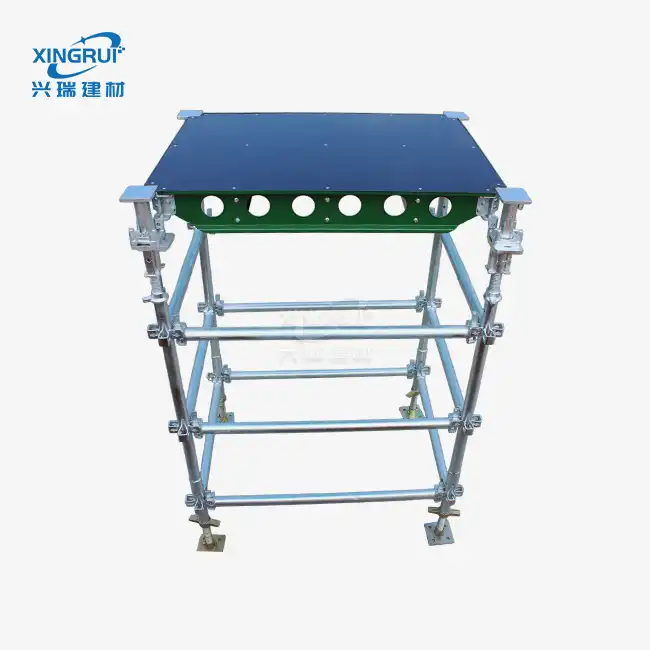
Understanding Crab Type and Frame Scaffolding
To properly compare performance numbers, it is helpful to first understand what each system is built to do and where it really shines.
What Is Crab Type Scaffolding?
A chrysanthemum disc node with eight link holes is used in crab type scaffolding, also known as tower shoring or modular heavy-duty scaffolding. Like a crab claw, the ledgers can lock into the disk at any angle. Because of the wedge-locking principle, more vertical load actually makes the joint tighter. This gets rid of the structural variation that happens when tube-and-clamp systems are torqued by hand. This system is made by Shandong Xingrui Building Materials Co., Ltd. out of Q235 premium steel. The uprights have an outer diameter of 60.3 mm and a step distance of 1.5 m.
What Is Frame Scaffolding?
Frame scaffolding is made up of rectangular steel frames that are already made and linked by cross braces. Putting frames together is easy; workers just stack them vertically and put cross braces between them. Because the geometry is fixed, it works best on sites that are flat and level. Fixed frame spacing, on the other hand, makes it harder to react to changes in the shape of the site, and the normal load capacity is much lower than that of modular tower systems.
Key Structural Differences at a Glance
The two methods are different in three useful ways that buying teams should note right away:
- Node connection: Crab-joint disc locking vs. pin-and-brace frame connection — the disc system offers multi-directional force bearing that a fixed frame cannot replicate.
- Load capacity: 40kN–75kN per standard (crab tower) vs. typically 15kN–25kN per frame standard — nearly three times the vertical capacity under comparable conditions.
- Assembly geometry: Eight-hole disc placement allows ledger positioning at any angle, while frame scaffolding locks crews into a fixed spacing pattern regardless of site obstructions.
These differences in structure have a direct effect on high-clearance projects' safety margins and schedule outcomes.
Performance and Safety Comparison of Crab Type vs Frame Scaffolding
Numbers for load capacities only matter if they are checked and the system keeps those numbers the same across the whole building. Here's how both methods work in a real-world setting.
Load-Bearing and Structural Stability
In axial load tests, the 60-series crab tower system does 35% better than alternatives with a 48mm diameter. Larger upright diameters keep the structure straight while the concrete cures by reducing deflection under sustained loads. Frame scaffolding bends more obviously when eccentric loads are applied because the pin connections at the cross-brace joints cause small movements that add up over time.
Safety Standards and Certifications
The crab-shaped support from GREEN FORMWORK is made using management systems that are certified to ISO 9001, ISO 14001, and ISO 45001, and all of their goods are CE-certified. The parts are compliant with EN 12810-1 and ANSI/SSFI SC100-5/05 standards and have a safety factor of at least 3:1 against the ultimate load. You can give project managers and owners third-party load test reports and calculation documents; this is a requirement that can't be changed in the U.S. market for bridge and viaduct contracts.
Maintenance and Inspection Practicality
Hot-dip galvanization with a zinc coating of 60–80 microns protects crab type scaffolding parts in coastal and chemically harsh environments, making them last longer than 15 years. Most frame support is made of paint or thin electroplating, which breaks down more quickly in wet or salty circumstances. It's easier to inspect crab towers because the self-locking nodes don't leave any loose fittings to torque-check. Frame systems, on the other hand, need pin condition checks at every cross-brace connection after every use cycle.
Choosing the Right Scaffolding Type for Your Site Needs
The best support system is chosen based on the type of project, the required height, the shape of the site, and the total cost over its entire life. This is a clear way to think about the choice.
When Crab Tower Systems Win
Modular tower shoring is always best for projects with high axial loads, changing shapes, or heights above 8 meters. When compared to traditional full-hall bowl-and-cup systems, the pre-engineered disk connection cuts on-site assembly time by about 40%. This directly reduces the number of formwork cycles needed for bridge and viaduct contracts. Standard tower pieces can be put together ahead of time on the ground and then lifted into place by a crane. This cuts down on the time workers have to spend at high elevations in airport terminals and industrial facilities.
When Frame Scaffolding Fits
Frame scaffolding is good for building homes, small business fit-outs, and maintenance access where the height doesn't go over 6 meters and the load needs to be even. It costs less to rent per square meter, and calculating is faster because the shape stays the same. Frame systems provide enough of a safety margin with little configuration work for procurement teams that work on a lot of low-rise housing contracts.
Lifecycle ROI and Rental Considerations
Big rental companies that treat scaffolding like a valuable asset should know that builders are ready to pay more for speed and safety on high-clearance work, so crab tower parts are more expensive to rent than frame systems. Because parts can be switched between tower sizes, inventory turnover is more flexible. Frame scaffolding loses its value more quickly because it doesn't use hot-dip galvanization but instead relies on surface coatings. This has an impact on the long-term asset book value.
Procurement Insights: Sourcing Crab Type and Frame Scaffolding
Choosing the right supplier involves more than checking a price list. Technical support, delivery capacity, and documentation readiness all affect project outcomes.
Supplier Evaluation Criteria
When evaluating a crab type scaffolding manufacturer, procurement teams should verify three things: load test data with independent laboratory sign-off, the ability to fabricate non-standard components to drawing, and confirmed delivery tonnage for batch site delivery. Shandong Xingrui operates over 40,000 square meters of standardized workshop space with 12 welding robots and 6 automatic welding lines, which supports large-order consistency and on-schedule delivery for phased site schedules.
Contract and Logistics Coordination
Batch delivery coordination is one of the most common pain points in high-support shoring procurement. Specifying delivery windows by project phase in the purchase contract—rather than a single bulk arrival—prevents yard congestion and reduces damage from stacking. Shandong Xingrui accepts custom processing based on client drawings and provides sample components with full technical documentation before bulk orders are confirmed.
Documentation and Compliance Support
For U.S.-market contracts, procurement managers should request CE certificates, ISO management system certificates, and third-party load test reports at the quoting stage. These documents support owner and supervisor approval processes and shorten the technical review cycle before trial-section verification.
Case Studies: Successful Implementation of Crab Type and Frame Scaffolding
The differences in performance between these two systems are easier to see and judge when they are used in real projects.
Bridge Viaduct Shoring — Crab Tower Application
The engineering team switched from a full-hall bowl-and-cup plan to a crab tower system on a multi-span concrete box girder bridge job. Because normal tower units were already put together on the ground and then lifted into place by crane, the switch cut the time it took to set up the forms by 38%. Node rigidity kept the girder alignment within the acceptable range while the concrete was being poured and hardened. No re-alignment adjustments were needed between spans.
Industrial Facility — Crab Tower at Height
As part of a project to build a petroleum plant, temporary shoring had to be put up 22 meters above the existing pipe system. The eight-hole disk node made it possible to place the ledger around obstacles without having to make any special pieces. This kept the structure's load limits within the design range. An check after the project was done showed that there were no node breakdowns in any part of the shoring area.
Residential Project — Frame Scaffolding Application
Frame scaffolding was used by a low-rise housing developer on a 200-unit housing project. The same floor plan was used over and over again, so the fixed frame shape fit perfectly. The site crew put up all the scaffolding for each building in two days. For this kind of job, frame support was the best mix of speed and cost without overstating the structure's strength.
Conclusion
Crab type scaffolding is the right choice when your project demands high axial load capacity, complex geometry adaptation, and verified safety documentation for owner approval. Frame scaffolding performs well on low-rise, uniform projects where budget and simplicity take priority. The decision should be driven by load requirements, height, site geometry, and total lifecycle cost—not by upfront unit price alone. For infrastructure contractors and rental companies treating shoring equipment as long-term assets, the hot-dip galvanized, ISO-certified modular tower system offers a measurably stronger return over time.
FAQ
Is crab type scaffolding safer than frame scaffolding for high-rise or bridge work?
Yes. The self-locking disk node makes a strong, multidirectional connection that keeps the structure strong even when loads are applied in different directions, like in bridge shoring and high-clearance formwork. The pin-and-brace links on frame scaffolding aren't made to handle these loads, and they don't have the same safety approval for high-support uses.
Can crab tower systems handle non-standard geometries?
The eight-hole chrysanthemum disk lets you place the ledger at different angles without having to make any special parts. This makes it perfect for places with uneven column grids, curved structures, or equipment that gets in the way. Shandong Xingrui can also make things to order based on drawings from the customer for really non-standard configurations.
What maintenance does each system require?
Hot-dip zinc crab tower parts need to have their disk and wedge pin conditions checked every so often. At joints, there is no need to check the torque again. Frame scaffolding needs to have its pins checked for damage and its coating touched up every time it is used to stop corrosion from speeding up at the points where the braces connect.
How long does crab type scaffolding last?
With 60–80 micron hot-dip galvanization and regular checks, the system can last more than 15 years in heavy building settings, such as marine and chemically harsh sites.
Request a Quote from GREEN FORMWORK — Crab Type Scaffolding Manufacturer
You can get both crab-style and frame scaffolding from GREEN FORMWORK. It is made to order from Q235 quality steel and has ISO 9001, ISO 14001, and ISO 45001 standards. Before making large promises, we give you sample parts with full technical documentation. For big building projects, our team helps with reviewing load calculations, making non-standard parts, and planning phased deliveries. You can get a technical quote by emailing us at sdxingruiqp@126.com.
References
1. European Committee for Standardization. EN 12810-1: Facade Scaffolds Made from Prefabricated Components — Part 1: Product Specifications. CEN, 2003.
2. Scaffold & Access Industry Association. ANSI/SSFI SC100-5/05: Scaffolding — Safety Requirements. SAIA, 2005.
3. Peng, J. L., Pan, A. D., & Chan, S. L. "Simplified Models for Analysis and Design of Modular Falsework Systems." Journal of Structural Engineering, ASCE, 1998.
4. Zhang, H., Chandrangsu, T., & Rasmussen, K. J. R. "Probabilistic Study of the Strength of Steel Scaffold Systems." Structural Safety, Elsevier, 2010.
5. Weesner, L. B., & Jones, H. L. "Experimental and Analytical Capacity of Frame Scaffolding." Engineering Structures, Elsevier, 2001.
6. International Organization for Standardization. ISO 45001:2018 — Occupational Health and Safety Management Systems — Requirements with Guidance for Use. ISO, 2018.
Learn about our latest products and discounts through SMS or email