- English
- French
- German
- Portuguese
- Spanish
- Russian
- Japanese
- Korean
- Arabic
- Greek
- German
- Turkish
- Italian
- Danish
- Romanian
- Indonesian
- Czech
- Afrikaans
- Swedish
- Polish
- Basque
- Catalan
- Esperanto
- Hindi
- Lao
- Albanian
- Amharic
- Armenian
- Azerbaijani
- Belarusian
- Bengali
- Bosnian
- Bulgarian
- Cebuano
- Chichewa
- Corsican
- Croatian
- Dutch
- Estonian
- Filipino
- Finnish
- Frisian
- Galician
- Georgian
- Gujarati
- Haitian
- Hausa
- Hawaiian
- Hebrew
- Hmong
- Hungarian
- Icelandic
- Igbo
- Javanese
- Kannada
- Kazakh
- Khmer
- Kurdish
- Kyrgyz
- Latin
- Latvian
- Lithuanian
- Luxembou..
- Macedonian
- Malagasy
- Malay
- Malayalam
- Maltese
- Maori
- Marathi
- Mongolian
- Burmese
- Nepali
- Norwegian
- Pashto
- Persian
- Punjabi
- Serbian
- Sesotho
- Sinhala
- Slovak
- Slovenian
- Somali
- Samoan
- Scots Gaelic
- Shona
- Sindhi
- Sundanese
- Swahili
- Tajik
- Tamil
- Telugu
- Thai
- Ukrainian
- Urdu
- Uzbek
- Vietnamese
- Welsh
- Xhosa
- Yiddish
- Yoruba
- Zulu
Round Tube Scaffolding Uses in Construction, Maintenance, and Events
Round tube scaffolding — also called tube and coupler scaffolding — is one of the most widely used temporary structure systems across Africa, South Asia, and beyond. Built from Q235 steel pipes in standard Φ48×3.0mm dimensions, this system connects steel tubes with swivel or fixed couplers, giving site teams the freedom to build at any angle or height. Whether supporting a rising residential block, wrapping around a refinery tower, or framing an outdoor event stage, round tube scaffolding delivers consistent load capacity and geometric freedom that rigid modular systems simply cannot match.
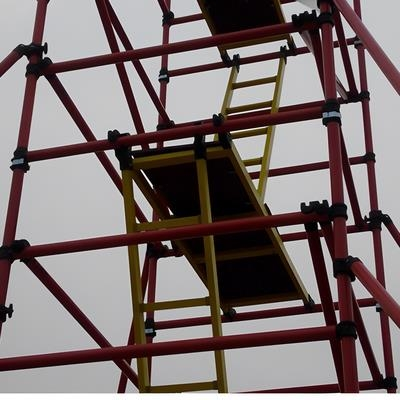
Understanding Round Tube Scaffolding: Types, Standards, and Design Principles
What Sets It Apart from Other Systems?
Because ringlock and cuplock structures depend on pre-designed node points, uprights and ledgers can only be put in certain places. On the other hand, tube and coupler scaffolding lets you connect at any point along the tube. In places where bay sizes change across the same station or where the building's facade isn't straight, this makes it the best choice. The system also works with existing stock, which is very helpful for distributors who have to keep track of a lot of different kinds of stock.
Applicable International Standards
Design and safety are governed by three main rules. Minimum standards for the U.S. market are set by OSHA 1926 Subpart Q. European temporary work buildings are covered by EN 12811-2, which lists load classes ranging from 0.75 kN/m² to 6.0 kN/m². The quality control system of a company is confirmed by ISO 9001. Before shipping, buyers of steel tube scaffolding should make sure the product meets all safety standards by asking for mill certificates, wall thickness test results, and CE paperwork.
Key Design Principles and Maintenance Basics
A single normal tube can usually hold 20 to 40 kN, but this depends on how far apart the braces are and how long the tube is. To stop localized buckling under eccentric loads, the wall thickness must be the same, which should be at least 3.0 mm. For care, check the tubes every six months in places that are wet or near the coast. Check the joint line for cracks, corrosion, and flattening. Repainting or galvanizing worn tubes before putting them back into service protects your per-unit investment and adds several years to their useful life.
Advantages and Practical Uses of Round Tube Scaffolding in Various Industries
Why the Numbers Work in Your Favor?
Most importers look at cost per ton first, which is a good thing to do. Round tube scaffolding made of aluminum is more expensive than Q235 steel tube scaffolding, but it still has a maximum strength of 235 MPa. Because they are reusable, each tube can be used for 15–20 project rounds before it needs to be thrown away. This means that the starting cost is spread out over a long period of time. This kind of durability-to-cost ratio directly saves margin for wholesalers who sell to price-conscious customers.
When comparing systems, these are the main performance benefits that you should keep in mind:
- Geometric freedom: Tubes connect at any point, not just at fixed nodes, making complex or irregular structures manageable on-site.
- Load consistency: The circular cross-section distributes stress evenly in all directions, reducing the risk of directional failure under shifting loads.
- System compatibility: Standard Φ48 outer diameter fits universal couplers available in local markets across Africa and South Asia, reducing spare-part dependency on a single supplier.
Because of these benefits, tube and coupler scaffolding is the most common choice for builders who need freedom but don't want to pay more for designed modular parts.
Construction: High-Rises, Bridges, and Foundations
When building homes or businesses with more than one floor, workers change the width of the bays to match the structural grid of each floor. For work on bridges and raised forms, the tube-and-coupler device can easily support heavy loads that frame scaffolding can't. This is exactly how scaffolding is set up around reinforced concrete piers 20 meters or more high in West African construction projects all the time.
Maintenance and Events
For industrial maintenance teams, putting up steel tube scaffolding around cylinder tanks and pipe racks would leave gaps in prefabricated frames. In event production, movable stages, lighting rigs, and crowd-barrier systems made from steel tubes can be put together and taken apart in just a few hours. For rental companies and distributors with limited warehouse space, the fact that the same inventory can be used for both purposes is important.
How to Assemble and Maintain Round Tube Scaffolding: A Step-by-Step Guide
Tools, Components, and Pre-Assembly Checks
A spirit level, a tape measure, and platform spanners (usually 7/16") are all tools that are needed. Steel standards (verticals), ledgers (horizontals), transoms, base plates, and right-angle or swivel couplers are the main parts. Before putting the tubes together, check each one for dents deeper than 1 mm, cracks near the weld seams, and walls thinner than 2.7 mm. Ignore tubes that don't meet the standards right away; failing to meet wall thickness standards is the most common reason for project failure in the middle.
Assembly Sequence and Load Compliance
First, put the base plates down on packed ground. Next, set up the standards at the right distances, which are usually 1.2m to 1.8m for medium-duty uses. At each lift height, attach ledgers. Then, add transoms and decking boards. Use a torque wrench to tighten the couplers to 40–65 Nm. Do not go over the design load that was calculated for that specific configuration. Site managers should put up the load chart at the access point for the scaffold and talk to workers about it before each shift starts.
Inspection and Preventive Maintenance
In high-wind conditions with round tube scaffolding, do a visual check after every shift. Plan to use ultrasonic measuring tools to do a formal thickness check every two years. To keep wetness from building up inside the tube bore, store tubes horizontally on racks that are off the ground. Hot-dip galvanized tubes last 10–15 years outside, while painting tubes only last 2–3 years. This means that the extra cost is worth it over the life of the asset.
Choosing the Right Round Tube Scaffolding for Your Business Needs
Comparing Systems Across Project Types
Frame scaffolding is easier to put together for simple home projects, but it doesn't work for structures that are curved or don't fit together straight. Ringlock systems are faster on big construction sites, but they cost more per unit and need system parts that fit together perfectly. Tube and coupler scaffolding is in the middle. It's a little slower to set up than modular systems, but it's much more flexible and doesn't require as much money for distributors who work on a wide range of projects.
Evaluating Suppliers Before You Commit
Before placing a bulk order, make sure you have the following: Q235 material certifications with heat number traceability, wall thickness test reports for the specific production batch, CE and ISO documentation, and packing details that show how many tubes are in each 20-foot container. If a supplier gives you samples and full technical support before you buy, that's a good sign that their quality process is reliable. Being clear about lead times and accepting L/C are also strong signs of a business that is good for business.
Custom Orders and OEM Options
Many importers look for standard lengths like 1.5m, 2.0m, 3.0m, 4.0m, and 6.0m. However, sometimes projects need non-standard cuts or finishes that are hot-dip galvanized. Making sure that a maker can handle custom orders without a bothersome minimum number requirement will help you serve contractors with specific needs and get them to buy from you again.
Building Trust and Ensuring Long-Term Partnership with Scaffold Suppliers
Certifications as a Baseline, Not a Guarantee
ISO 9001 makes sure that there is a method for managing quality. ISO 14001 is about managing the environment. Getting a CE certificate means that round tube scaffolding meets European safety standards. These documents are the bare minimum that can be used to find building materials that can be shipped around the world. If a provider has all three and is willing to share audit results when asked, that goes beyond marketing speak to show that they are accountable.
What Long-Term Partnerships Actually Look Like?
When it comes to scaffolding, the best supplier relationships are ones where batch quality stays the same, lead times are predictable, and problems are quickly fixed after shipping. If a plant has specific expert staff, they can give you installation guides, load tables, and inspection checklists in English. This makes it easier for you to communicate. Established in 2007 and doing business with people in over 100 countries, Shandong Xingrui Building Materials Co., Ltd. has 920 employees, 180 of whom are technicians. This is the kind of depth that can handle ongoing technical questions from your local site teams.
OEM and After-Sales Support
OEM deals let importers brand steel tube scaffolding for their own market, which builds customer loyalty at the level of distribution. After-sales support, which includes providing replacement parts and technical information, lowers the cost of problems that happen after the sale. Choose providers who give this before a problem arises instead of after it has been brought up.
Conclusion
For contractors working in the construction, maintenance, and event industries, round tube scaffolding is still the most flexible and cost-effective temporary structure system. Because it is made of reused Q235 steel, has a free-connection geometry, and works with universal couplers, it is a reliable stocking choice for importers who serve price-conscious markets. Putting things together correctly, checking them regularly, and getting them from a recognized maker are the three things that will protect your investment and your clients' safety on the job site.
FAQ
What factors most affect load capacity in a tube and coupler system?
The main things that can change are the standard spacing, the ledger spacing, and the effective tube length between the brace points. Depending on these things, a single standard can hold 20–40 kN. For any load-bearing shoring job, you should always have a structural expert check the layout.
How long does assembly and disassembly typically take on site?
A two-person, skilled crew can set up a normal 50m² working platform at a height of 4m in about 4–6 hours and take it down in 3–4 hours. It will take longer to make complex arrangements around curved buildings.
Is hot-dip galvanized tubing worth the added cost?
Yes, in places with a lot of humidity or near the coast. HDG tubes have a zinc coating that is at least 60μm thick. This makes them last 10–15 years outside, while painted tubes only last 2–3 years. When you think about how often you'll have to change the tones, the extra cost per ton quickly pays for itself.
Can this scaffolding system be mixed with modular ringlock components?
Yes. Steel tubes can be used with tube-to-rosette couplers to add to or extend ringlock grids where the fixed node spacing doesn't match the structure. This is what is usually done on large industrial sites.
What should I request from a supplier to verify wall thickness?
Ask for a report on the ultrasonic thickness test from the production batch and a mill certificate that shows the chemical makeup of Q235. Compare the test results to the 3.0 mm wall thickness that was given before you confirm your order.
Get Reliable Round Tube Scaffolding from GREEN FORMWORK
With help from Shandong Xingrui Building Materials Co., Ltd., GREEN FORMWORK sells professional-grade round tube scaffolding to importers and dealers in South Asia, Africa, and other places. Our Q235 steel tubes are made to meet the standards of ISO 9001, ISO 14001, and CE, and the consistency of the wall thickness is checked on each batch. We accept L/C as a form of payment, offer samples with full technical paperwork, and can handle big orders and load containers on time. Get a quote from our team right away by emailing sdxingruiqp@126.com.
References
1. British Standards Institution. BS EN 12811-1: Temporary Works Equipment — Scaffolds. BSI, 2003.
2. Occupational Safety and Health Administration. OSHA Standard 1926 Subpart Q: Scaffolding. U.S. Department of Labor, 2011.
3. International Organization for Standardization. ISO 9001: Quality Management Systems — Requirements. ISO, 2015.
4. Chandrangsu, T., and Rasmussen, K.J.R. "Investigation of Geometric Imperfections and Joint Stiffness of Support Scaffold Systems." Journal of Constructional Steel Research, 2011.
5. Peng, J.L., et al. "Experimental and Analytical Studies on Steel Tube Scaffolding Systems." Engineering Structures, 2007.
6. Construction Industry Scaffolders Record Scheme (CISRS). Scaffolding — Tube and Fitting Guide. CITB, 2019.
Learn about our latest products and discounts through SMS or email