- English
- French
- German
- Portuguese
- Spanish
- Russian
- Japanese
- Korean
- Arabic
- Greek
- German
- Turkish
- Italian
- Danish
- Romanian
- Indonesian
- Czech
- Afrikaans
- Swedish
- Polish
- Basque
- Catalan
- Esperanto
- Hindi
- Lao
- Albanian
- Amharic
- Armenian
- Azerbaijani
- Belarusian
- Bengali
- Bosnian
- Bulgarian
- Cebuano
- Chichewa
- Corsican
- Croatian
- Dutch
- Estonian
- Filipino
- Finnish
- Frisian
- Galician
- Georgian
- Gujarati
- Haitian
- Hausa
- Hawaiian
- Hebrew
- Hmong
- Hungarian
- Icelandic
- Igbo
- Javanese
- Kannada
- Kazakh
- Khmer
- Kurdish
- Kyrgyz
- Latin
- Latvian
- Lithuanian
- Luxembou..
- Macedonian
- Malagasy
- Malay
- Malayalam
- Maltese
- Maori
- Marathi
- Mongolian
- Burmese
- Nepali
- Norwegian
- Pashto
- Persian
- Punjabi
- Serbian
- Sesotho
- Sinhala
- Slovak
- Slovenian
- Somali
- Samoan
- Scots Gaelic
- Shona
- Sindhi
- Sundanese
- Swahili
- Tajik
- Tamil
- Telugu
- Thai
- Ukrainian
- Urdu
- Uzbek
- Vietnamese
- Welsh
- Xhosa
- Yiddish
- Yoruba
- Zulu
Crab Type Steel Tube Scaffolding Benefits for Safer Worksites
Crab type steel tube scaffolding delivers measurable safety gains on demanding construction sites. Its crab-claw socket connection locks each joint into a fixed geometric position, eliminating the slip risk common in loose-coupler systems. Engineered from Q235 premium carbon steel with uniform wall thickness of 3.0–3.25 mm and hot-dip galvanization of ≥80 μm, the system handles vertical loads up to 50 kN per post while resisting overturning and deformation. For B2B procurement teams sourcing heavy-duty modular shoring, this architecture directly reduces structural failure risk and keeps projects compliant with EN 12810-1 and related international standards.
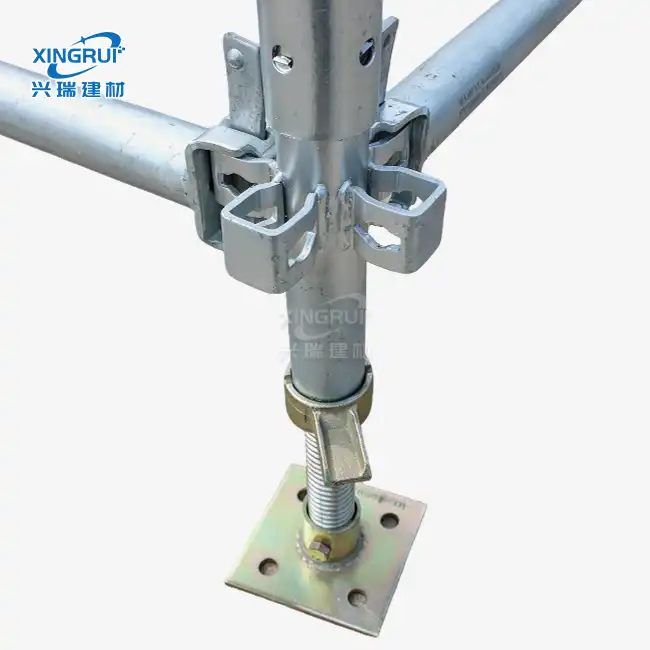
What Is Crab Type Steel Tube Scaffolding?
The Crab-Claw Joint: A Structural Breakthrough
Crab type steel tube scaffolding features the crab-claw joint, which is a big step forward in structure. Individual clamps must be tightened by hand on traditional tube-and-coupler scaffolding. In each joint, a human variable is added. In the crab-type system, that variable is swapped out for a vertical standard that is already made and has set holes. With just one hammer blow, a wedge-head horizontal ledger locks into place. You don't need any power tools or guesswork about the torque.
Every node in this geometry-driven link has a high rotational stiffness. The system works so well in basements and factories where supporting large spans of formwork requires load lines that are evenly spread out and easy to predict. This is because each junction point can hold up to four horizontal or diagonal members at the same time.
The 60-series standard from GREEN FORMWORK uses outer-diameter verticals that are 60.3 mm wide and diagonal tie bars that go both ways. That shape makes the frame less likely to sway side to side, which is very important for tall shoring towers that hold pours of cast-in-place concrete.
Key Benefits of Crab Type Steel Tube Scaffolding for Safer Worksites
Structural Safety Backed by Material Science
Safety on the job is a question of materials and engineering in the end, and crab type steel tube scaffolding provides structural safety backed by material science. The GREEN FORMWORK system uses Q235 carbon steel, which has a yield strength of about 235 MPa. This means that each post can hold up to 50 kN of weight. Hot-dip galvanization at ≥80 μm makes a zinc layer that is mechanically bound and lasts longer than spray-applied coatings by years.
This is important information for rental groups that go through dozens of projects every year, and crab type steel tube scaffolding fits seamlessly into that lifecycle because its consistent joint geometry and standardized tubes allow rapid assembly, disassembly, and reuse without compromising load capacity—directly supporting the durability and cost-efficiency that rental fleets depend on across multiple job sites.
Here are the main success benefits that buying leaders always point out:
- Anti-overturning geometry: The two-way diagonal tie bar design fights lateral forces from wind loads, concrete pour pressure, and machine movement all at the same time, so it doesn't need any extra bracing.
- Deformation resistance: When the wall thickness is the same across all tubes, the weak-point stress concentrations that happen in steel that is rolled unevenly are eliminated. This keeps the frame straight under long-term load.
- Assembly speed: The hammer-and-wedge connection cuts the time needed to put something together by three to five times compared to traditional coupler systems. This saves workers hours per project without affecting the integrity of the joints.
- Service life exceeding 15 years: The galvanized finish doesn't rust in coastal and high-humidity areas as long as it's inspected regularly and stored properly. This means that the structural rating stays the same after hundreds of rental cycles.
These benefits directly lead to a lower cost-per-use number, which is a calculation that asset managers with busy event or construction schedules care a lot about.
Compliance With International Standards
The system is certified by ISO 9001, ISO 14001, and ISO 45001, and it meets EN 12810-1 and AS/NZS 1576. It is also owned by Shandong Xingrui Building Materials Co., Ltd. Documented compliance lowers the risk of responsibility that comes with every installation for European buying teams working under the EU Machinery Directive and local temporary structure regulations.
Crab Type Steel Tube Scaffolding Compared to Other Scaffolding Types
Why Heavy-Duty Projects Favour the Crab-Type System
Crab type steel tube scaffolding is often preferred for heavy-duty projects. A lot of people trust Ringlock scaffolding, but its rosette link depends on pins that are driven by wedges across a round disk. In situations with a lot of twisting stress, the rosette shape spreads load differently than the crab socket, which sends load along the vertical standard. The crab-type design works better for large-span basement shoring where vertical load is the main factor.
Aluminum frame scaffolding is portable, but it can't hold as much weight. A standard for a steel crab-type post says it can hold 50 kN, which is a lot more than most aluminum equivalents, which usually can't hold more than 30 kN in similar configurations. That gap isn't just for fun when the job includes cast concrete or big industrial tools; it's a safety margin for the site.
In some markets, bamboo and basic tube-and-coupler systems are still used, but they don't offer the joint-locking certainty or galvanized corrosion protection that is needed for long-term rental cycles. The made-to-order feature of the crab-type system lets clients get unique lengths and spacings that match their current truss or stage stock, which bamboo can't do.
How to Choose and Procure Crab Type Steel Tube Scaffolding for Your Project
Procurement Criteria That Reduce Long-Term Risk
When choosing crab type steel tube scaffolding that will be used more than once, you need to look at more than just the price. The following standard summary includes the criteria that experienced asset managers look for:
- Steel grade and wall thickness certification: For verification of steel grade and wall thickness, you should ask for spectral analysis results that prove the carbon and manganese contents. Check to see if the wall thickness is within the acceptable range of 3.0 to 3.25 mm.
- Galvanization depth: Salt-spray test results show that a covering of ≥80 μm is the standard for durability in outdoor and marine settings.
- Dimensional tolerance: To ensure seamless socket contact across a mixed collection, tubes must stay within ±0.5 mm of each other in diameter.
- Load test documentation: Every batch shipment should include non-destructive compression tests on node points that prove the quoted capacity with a safety factor of at least 2:1.
- Customisation lead time and MOQ flexibility: For rental businesses, being able to order replacement tubes and extra lengths without having to commit to full-container minimums keeps inventory levels steady throughout the year.
Checking the ISO 9001, 14001, and 45001 certifications of suppliers for quality, environmental management, and worker safety gives a baseline that can be used for auditing before the factory inspection. GREEN FORMWORK ships to more than 100 countries from Rizhao, Shandong, a port city with direct sea freight access. This cuts down on delivery times for purchase rounds that need to be completed quickly.
Best Practices for Using Crab Type Steel Tube Scaffolding Safely
Installation, Inspection, and Maintenance Protocols
The right way to set up crab type steel tube scaffolding starts before the first tube gets to the slab. It is important to compare the ground bearing capacity to the post load rating. Before the standards are plumbed, the base plates must be level and sit on solid bearing surfaces.
Each wedge head needs to be hit with a hammer hard during assembly so that it fits fully into the socket cup. It only takes seconds per joint to visually check each connection and make sure the wedge is fully driven and tight. This gets rid of the confusion that comes with open couplers. Since no power tools are needed, the checking process stays the same even when different group members have different skills.
It's easy to do upkeep after use. Get the concrete off of the tubes before putting them away. Check the galvanized surface for wear and use zinc-rich paint to fix any bare steel that you find. To keep things from permanently bowing, store them horizontally on wooden supports. These habits keep the system in good shape for 15 years, which is long enough for rental fleets to make money off of it.
Conclusion
Crab type steel tube scaffolding is a safe and cost-effective choice for large B2B procurement teams. With its socket-and-wedge joint design, the structure provides predictable load paths, quick assembly, and a surface that doesn't rust even after years of heavy use. The recorded compliance with EN 12810-1 and the ISO 9001, ISO 14001, and ISO 45001 certifications make heavy-duty modular shoring safer for project owners, safety engineers, and asset managers who are looking at it. These certifications lower both site risk and purchase risk. This method is more of an asset than a one-time expense because it can be made to order and extra tubes are always available.
FAQ
What load can each post carry?
In GREEN FORMWORK's 60-series system, each vertical standard can hold up to 50 kN. Compression testing shows that there is a minimum 2:1 safety factor for vertical loads.
How does this system compare to cuplock scaffolding?
The wedge-lock mechanism is more rigid in torsional directions than the top-cup screw. It also lets you see more quickly that the joint is fully secured, which cuts down on inspection time during busy installation schedules.
Is customisation available for non-standard dimensions?
Yes. The system is custom-made, so you can choose your own tube lengths and spacings that work with the truss or stage you already have. For secret dimension details, you can get an NDA deal.
Does the system require specialist tools on site?
No, all you need for hammer-and-wedge assembly is a regular scaffolding hammer. This means that trained teams can do the work without needing any special tools.
How long does the galvanized finish last in outdoor environments?
Hot-dip galvanization at ≥80 μm protects against corrosion for more than 15 years under standard upkeep conditions, such as being exposed to salt spray and high humidity.
Partner With GREEN FORMWORK for Your Next Heavy-Duty Shoring Project
GREEN FORMWORK, backed by Shandong Xingrui Building Materials Co., Ltd., supplies certified crab type steel tube scaffolding to buyers in more than 100 countries. Our made-to-order manufacturing, ISO-certified quality system, and dedicated technical support team make us a reliable crab type steel tube scaffolding manufacturer for rental fleets and construction projects of any scale. Request a sample, discuss custom specifications, or get a full technical package today. Contact us at sdxingruiqp@126.com or visit sdxingrui.com.
References
1. British Standards Institution. BS EN 12810-1: Façade Scaffolding Made from Prefabricated Components. BSI, 2003.
2. Standards Australia / Standards New Zealand. AS/NZS 1576: Scaffolding General Requirements. SAI Global, 2010.
3. International Organization for Standardization. ISO 9001: Quality Management Systems — Requirements. ISO, 2015.
4. International Organization for Standardization. ISO 45001: Occupational Health and Safety Management Systems. ISO, 2018.
5. Occupational Safety and Health Administration. OSHA 1926 Subpart Q — Concrete and Masonry Construction. U.S. Department of Labor, 2020.
6. Huang, Z., & Li, Q. Structural Behavior of Modular Steel Tube Scaffolding Systems Under Combined Loading. Journal of Constructional Steel Research, 2021.
Learn about our latest products and discounts through SMS or email