- English
- French
- German
- Portuguese
- Spanish
- Russian
- Japanese
- Korean
- Arabic
- Greek
- German
- Turkish
- Italian
- Danish
- Romanian
- Indonesian
- Czech
- Afrikaans
- Swedish
- Polish
- Basque
- Catalan
- Esperanto
- Hindi
- Lao
- Albanian
- Amharic
- Armenian
- Azerbaijani
- Belarusian
- Bengali
- Bosnian
- Bulgarian
- Cebuano
- Chichewa
- Corsican
- Croatian
- Dutch
- Estonian
- Filipino
- Finnish
- Frisian
- Galician
- Georgian
- Gujarati
- Haitian
- Hausa
- Hawaiian
- Hebrew
- Hmong
- Hungarian
- Icelandic
- Igbo
- Javanese
- Kannada
- Kazakh
- Khmer
- Kurdish
- Kyrgyz
- Latin
- Latvian
- Lithuanian
- Luxembou..
- Macedonian
- Malagasy
- Malay
- Malayalam
- Maltese
- Maori
- Marathi
- Mongolian
- Burmese
- Nepali
- Norwegian
- Pashto
- Persian
- Punjabi
- Serbian
- Sesotho
- Sinhala
- Slovak
- Slovenian
- Somali
- Samoan
- Scots Gaelic
- Shona
- Sindhi
- Sundanese
- Swahili
- Tajik
- Tamil
- Telugu
- Thai
- Ukrainian
- Urdu
- Uzbek
- Vietnamese
- Welsh
- Xhosa
- Yiddish
- Yoruba
- Zulu
Round Tube Scaffolding OEM: How to Select a Reliable Manufacturer
Choosing the right round tube scaffolding OEM directly shapes your procurement outcome — from on-site safety and load performance to per-ton cost and delivery reliability. With hundreds of Chinese manufacturers competing on price alone, the real differentiator lies in verified material grades, wall thickness consistency, certification traceability, and supply chain transparency.
This guide walks B2B procurement professionals through a structured evaluation framework — covering technical benchmarks, OEM qualification criteria, cost analysis, and partnership verification — so you can source steel tube scaffolding with confidence and protect your margins project after project.
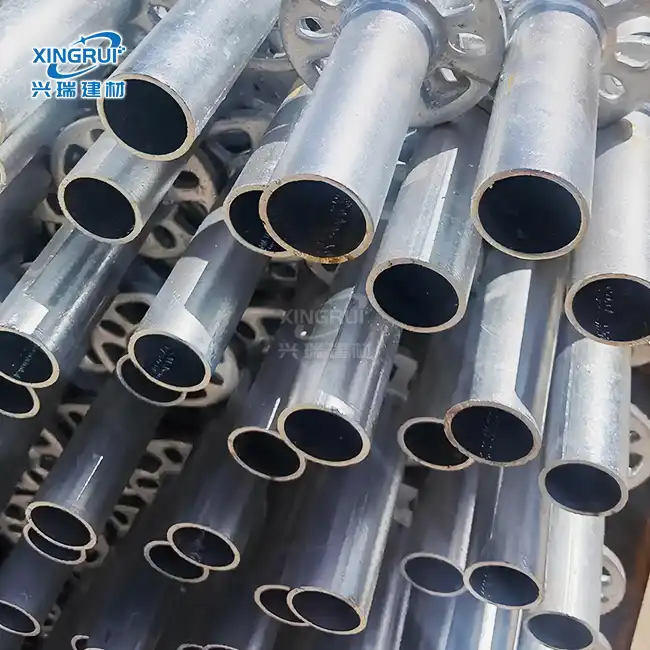
Understanding Round Tube Scaffolding and Its Industry Requirements
For many years, tube and coupler scaffolding has been an important part of the building industry in Africa, South Asia, and other places. Its staying power comes from being able to change. A round tube scaffolding can be set up around uneven facades, confined urban work sites, and non-standard structure shapes without having to pay a lot of money for costly rebuilding.
What the Technical Specifications Actually Mean for Buyers
It's not just a coincidence that the usual measurement is Φ48×3.0mm Q235 carbon steel. The minimum yield strength of Q235 grade steel is 235 MPa, which is a good balance between load-bearing reliability and cost-effectiveness. If the wall is at least 3.0 mm thick, it stops localized cracking from happening when loads are compressed. Smooth tube surfaces and even wall thickness are not just nice to look at; they are necessary for structural integrity. When the wall thickness of a tube changes, weak spots form that break without warning when the site loads change.
For buying teams that buy in bulk, knowing these numbers changes the way they talk to vendors—from negotiating prices to checking the quality of their work, and even assessing specifications like round tube scaffolding. What should you ask a supplier who quotes less than the market rate? Where did the wall thickness go?
Core Criteria to Evaluate When Selecting a Round Tube Scaffolding OEM
Not every company that sells round tube scaffolding follows the same rules. When judging an OEM, you need to look at more than just the catalog. You need to look at the production environment, quality system, and record of compliance.
Here are the main things that set trustworthy OEMs apart from low-compliance vendors:
- Material traceability: A trustworthy OEM gives mill certificates for every batch that prove the grade of steel (Q235 or a similar grade) and list its chemical makeup and mechanical properties. Lack of a certificate means not being responsible.
- Wall thickness verification: Ultrasonic thickness gauges should be standard on the production floor so that wall thickness can be checked. Dimensional correctness of Φ48×3.0mm must be maintained, not just taken for granted. Any difference more than ±0.2mm changes how well the structure works at full size.
- Certified quality management systems: ISO 9001 approval shows that quality control is planned, not reactive. The topics covered by ISO 14001 and ISO 45001 include environmental and workplace safety management, which are signs of a business that is built to last.
- Production automation: Factories with 12 welding robots and several automatic welding lines can make sure that all large orders are the same size, which is impossible to do by hand.
All of these factors lower the risk that hurts low-profit import trades, like getting tubes that are too small, failing customs checks, or site rejections that hurt your image further down the line.
Why Certification Matters Beyond Compliance
CE approval isn't just needed to get into a market. It means that the company that made the product has had a third party check its structure and safety. When importers sell their goods in places where the distributor is responsible for quality, getting them from CE-certified OEMs gives them a solid quality paper trail—and this applies equally to structural components like round tube scaffolding, where certification directly impacts load-bearing reliability and traceability.
Comparing Round Tube Scaffolding OEMs: What Sets Trusted Manufacturers Apart?
Manufacturers in the scaffolding tube market range from trading companies that rebrand third-party stock to fully integrated plants that process steel in-house. There is a big difference in how consistent the products are between these two groups, and it's hard to tell from the prices alone.
Customization Capacity and Length Range Flexibility
An OEM you can trust can provide tubes in a range of normal lengths, including 1.5m, 2.0m, 3.0m, 4.0m, and 6.0m, without lowering the quality of any of them. This adaptability is important for importers who work with mixed-use building markets, where road, municipal, and private projects need different scaffolding designs. An OEM that only offers one length makes it harder to service a wide range of project types effectively.
After-Sales Support and Technical Documentation
As standard shipping paperwork, top manufacturers include material test reports, dimensional inspection records, and technical datasheets in addition to the product itself. This paperwork helps the site managers of your customers and meets customs standards in places where imports are strictly controlled. Manufacturers who are ready to give full technical support for pre-shipment samples show that they are confident in their own quality system. This is a strong signal in a market where switching during shipment is still a known risk.
Practical Steps to Verify and Finalize Your OEM Partnership
Before a letter of credit is opened, buying choices for round tube scaffolding are protected by a system of checks. The steps below are for both first-time OEM engagements and regular re-qualification of current suppliers.
- Define specifications in writing: Make sure you agree on the Φ48×3.0mm size, the Q235 grade, the wall thickness limit, the surface treatment needs, and the length mix before you ask for quotes. Whenever there are quality disputes, they always start with unclear specifications.
- Request samples with inspection documentation: Physical samples let your verification worker check the surface finish, wall thickness, and straightness of the tube. Samples that come with batch test results are more likely to be real than samples that are sent without any paperwork.
- Conduct a factory audit: Either online or in-person audits of the production facility are needed to make sure that the automation equipment, quality inspection stations, and ways of storing raw materials are in line with what the manufacturer says they are. A 79,800-square-meter building with separate workshops for cold bending, welding, and casting can be inspected, but a business that runs out of a warehouse can't.
- Run a pilot order: Spending some of your buying budget on a trial shipment before you place a full-scale order confirms that the product will be consistent, the packing will be good, and the shipping schedule will be met.
These steps make it less likely that the most expensive import mistake will happen: paying for walls that are 3.0 mm thick but only getting 2.5 mm thick ones, and specifying the wrong round tube scaffolding dimensions or material grade for your project.
Cost Considerations and Market Comparison for Round Tube Scaffolding OEMs
The price per ton is the most common way to measure procurement, but the total landed cost tells a more complete story. Unit prices are changed by the type of material, how it is treated on the outside, and the number of orders. This changes how the costs of different OEM choices are compared.
Hot-dip galvanized tubes cost more than painted ones, but they last 10–15 years outside, compared to 2–3 years for painted tubes. This makes the lifecycle cost calculation very different. When reusable scaffolding systems are used for more than one job, the extra cost of durability is usually more than the initial price difference after three to five reuse rounds.
If you want to compare tube and coupler scaffolding to frame or cuplock options, you need to do an honest ROI analysis as well. Because modular systems are less flexible per unit, projects that don't follow standard designs end up with higher lost costs. Steel tube scaffold systems, on the other hand, can be rearranged without having to replace any parts. This saves money in construction markets with a lot of turnover.
Conclusion
There's more to choosing a trustworthy round tube scaffolding manufacturer than just checking prices. Before committing fully, it's necessary to check the traceability of materials, make sure that production is automated, make sure that certifications cover everything, and do organized test buying. When importers choose an OEM as a methodical process instead of a price negotiation, they always get better quality and have stronger relationships with their suppliers.
The important factors are written down: steel grade Q235, walls that are all 3.0 mm thick, quality control that is ISO-certified, and an open pre-shipment check. The reason for these standards is that sourcing below them leads to site failures, not just smaller profit margins.
FAQ
What certifications should a reliable scaffolding tube OEM hold?
Check for ISO 9001 (quality management), ISO 14001 (environmental management), and CE approval at the very least. Coverage of workplace safety by ISO 45001 adds another level of credibility to the business. These licenses show that the manufacturer's quality control procedures have been checked and written down, not just what they say they do.
How do I verify wall thickness compliance before shipment?
As part of the paperwork needed before shipping, you should need ultrasonic thickness gauge inspection reports. A statistically valid sample from the production batch should be spot-checked by your verification agent. In the buying deal, say what tolerance limits are accepted. For Φ48×3.0mm tubes, this is usually ±0.2mm.
Can I order multiple tube lengths in a single container?
Yes, well-known OEMs usually offer lengths of 1.5m, 2.0m, 3.0m, 4.0m, and 6.0m in a variety of combinations. Before confirming the order mix, check with your provider to see how efficiently containers can be loaded. The different length combinations affect the packing density and the cost of freight per ton.
Is hot-dip galvanizing worth the additional cost?
HDG finish adds a zinc layer of ≥60μm that makes things last 10–15 years outside or in places with a lot of damp. Painted tubes usually last two to three years before they start to rust badly. The HDG extra usually pays for itself in the second deployment cycle for round tube scaffolding systems that can be used again.
What payment terms do most OEMs accept for large orders?
For first-time orders, most well-known makers will take letters of credit (L/C), which covers both parties. For repeat sales, partial T/T plans may be possible. Before signing a large-scale contract, make sure you understand the payment terms for the sample and pilot orders.
Partner With GREEN FORMWORK for Proven Round Tube Scaffolding Supply
With help from Shandong Xingrui Building Materials Co., Ltd., GREEN FORMWORK makes approved round tube scaffolding that is sold to people in over 100 countries. We offer consistent products that meet your customers' needs thanks to our use of Q235 steel, Φ48×3.0mm precision tubes, ISO 9001, ISO 14001, and CE certifications, as well as our automatic production capacity for big orders. You can email our team at sdxingruiqp@126.com or go to sdxingrui.com to get samples, detailed information, or a cheap bulk quote right away.
References
1. British Standards Institution. BS EN 39: Loose Steel Tubes for Tube and Coupler Scaffolds — Technical Delivery Conditions. BSI, 2001.
2. Occupational Safety and Health Administration. OSHA Standard 1926.452: Scaffolding. U.S. Department of Labor, 2020.
3. International Organization for Standardization. ISO 9001: Quality Management Systems — Requirements. ISO, 2015.
4. Construction Industry Scaffolding Association. TG20:21 Guide to Good Practice for Scaffolding with Tubes and Fittings. CISRS/NASC, 2021.
5. International Organization for Standardization. ISO 14001: Environmental Management Systems — Requirements with Guidance for Use. ISO, 2015.
6. Chandrangsu, T., and Rasmussen, K.J.R. "Structural Modelling of Support Scaffold Systems." Journal of Constructional Steel Research, Elsevier, 2011.
Learn about our latest products and discounts through SMS or email