- English
- French
- German
- Portuguese
- Spanish
- Russian
- Japanese
- Korean
- Arabic
- Greek
- German
- Turkish
- Italian
- Danish
- Romanian
- Indonesian
- Czech
- Afrikaans
- Swedish
- Polish
- Basque
- Catalan
- Esperanto
- Hindi
- Lao
- Albanian
- Amharic
- Armenian
- Azerbaijani
- Belarusian
- Bengali
- Bosnian
- Bulgarian
- Cebuano
- Chichewa
- Corsican
- Croatian
- Dutch
- Estonian
- Filipino
- Finnish
- Frisian
- Galician
- Georgian
- Gujarati
- Haitian
- Hausa
- Hawaiian
- Hebrew
- Hmong
- Hungarian
- Icelandic
- Igbo
- Javanese
- Kannada
- Kazakh
- Khmer
- Kurdish
- Kyrgyz
- Latin
- Latvian
- Lithuanian
- Luxembou..
- Macedonian
- Malagasy
- Malay
- Malayalam
- Maltese
- Maori
- Marathi
- Mongolian
- Burmese
- Nepali
- Norwegian
- Pashto
- Persian
- Punjabi
- Serbian
- Sesotho
- Sinhala
- Slovak
- Slovenian
- Somali
- Samoan
- Scots Gaelic
- Shona
- Sindhi
- Sundanese
- Swahili
- Tajik
- Tamil
- Telugu
- Thai
- Ukrainian
- Urdu
- Uzbek
- Vietnamese
- Welsh
- Xhosa
- Yiddish
- Yoruba
- Zulu
Cuplock Steel Tube Scaffolding: Load Capacity, Safety, and Cost Guide
Modular Cuplock steel tube scaffolding uses Φ48.3 mm steel tubes with fixed and moving cups to lock ledgers to standards at predefined intervals. No single figure describes its load capacity. Steel grade, wall thickness, bay size, lift height, bracing, ties, & ground conditions determine it. Safe usage needs a solid foundation, tight bracing, pre-shift inspection, and a skilled supervisor. Compare itemised bids rather than unit costs since tonnage, finish, extras, freight, and replacement components affect cost. The guide outlines each point and what to want before ordering.
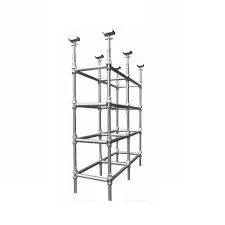
What Is Cuplock Steel Tube Scaffolding and How Does the System Work?
How the Cup Node Locks the Frame
Each cuplock node contains 2 cups. The vertical tube standard has a lower cup welded on it. The top cup glides along the tube. Put the forged blade ends of up to four ledgers or transoms in the bottom cup, drop the top cup, revolve it, and hammer it tight. The node retains horizontals at ninety degrees and feeds the typical vertical and horizontal forces. Since cups remain on the tube, workers don't chase loose bolts or wedges. Every lift maintains the same repeatable grid in our Q235 standards with 600 mm nodes.
Main Components and What Each One Does
A full cuplock scaffold goes beyond tube. Standards support vertical loads. Our ledgers set bay length at 0.9, 1.2, or 1.5 m. Transoms help platforms. Braces diagonally stop sway. Base jacks level the structure and disperse load into the ground, while U-head jacks shore formwork beams. The scaffold is tied to the building. Tube orders alone do not build safe scaffolds because they lose lateral stability without bracing or ties. Our Q235 steel tube foundation with cup-lock joints is standardised, but we can produce pieces to your designs.
Advantages and Limits Against Tube-and-Clamp
Cuplock rises quicker than tube-and-clamp as one node replaces numerous couplers and a wrench. Bay geometry repeats, parts exchange, and inspected galvanised steel may be reused. These qualities are ideal for high-rise and large-scale construction, as teams repeat the grid. However, constraints exist. Tube-and-clamp works better with curved or uneven constructions, while ringlock rosettes have more connection angles. Cuplock requires careful inventory management since various manufacturers' components may not fit. You may add couplers for bracing or unusual sections as the norms utilise 48.3 mm tube.
Cuplock Scaffolding Dimensions and Load Capacity: What Decides Safe Performance?
Standard Sizes, Tolerances, and Weight
Specifications vary by maker, so check each number before you compare quotes. Here are our core cuplock steel tube scaffolding dimensions.
| Parameter | Our specification |
|---|---|
| Steel grade | Q235 |
| Tube outer diameter | Φ48.3 mm |
| Wall thickness | 3.0–4.0 mm |
| Node spacing | 600 mm |
| Ledger lengths | 0.9 m / 1.2 m / 1.5 m |
| Connection | Self-locking cup node |
| Finish | Hot-dip galvanized, 60–80 microns of zinc |
| Cup spacing tolerance | ±1.5 mm |
Tube weight per metre is not final item weight for cuplock steel tube scaffolding. As calculated, 48.3 mm tube weighs 3.35 kg per metre at 3.0 mm wall and 4.4 kg at 4.0 mm. Cups, blades, and spigots increase the total weight. Container capacity depends on component length. Request dimension drawings, tolerances, item weights, and a list of items before ordering.
Why No Single Load Figure Exists
Using one capacity for every cuplock mechanism is oversimplified. Steel grade, wall thickness, bay spacing, lift elevation bracing, ties, foundation, load arrangement, and wind affect load safety. The Chinese standard GB/T 700 defines Q235 as a carbon structural grade. Wall thickness affects the picture: 4.0 mm tube stores 30% more steel per metre than 3.0 mm. As unbraced length increases, standard capacity decreases. Geometry and loads matter. Masonry concentrates weight, shoring transports wet concrete, while shipyard work impacts. A certified engineer should approve a load table prepared for your precise system with calculations and test results.
Load Terms and Duty Classes
Suppliers use different load phrases with different meanings. In usage, working load is expected. Design load uses code-required safety factors. Failure occurs at ultimate load. Never compare suppliers' final and working figures. A scaffold must sustain its own weight and four times the maximum planned load per OSHA 29 CFR 1926.451 in the US. The light, medium, and heavy duty grades are 25, 50, and 75 pounds per square foot. In EN 12811-1, six load classes range from 0.75 - 6 kN/m². China's JGJ 166-2016 covers cuplock scaffold safety. Match class to labour, not price.
Cuplock Scaffolding Safety Requirements and Erection Procedure
Foundation Checks Before the First Base Jack
Ground-level scaffold issues predominate. Before setting a jack, check soil, slab, drainage, and settling risk. OSHA 1926.451(c)(2) requires scaffold legs and posts to rest on base plates, mud sills, or other solid foundations. Spread the load using sole boards on soft terrain. Confirm that slabs can support jack point loads, particularly over basements or voids. A lengthy screw weakens the leg, thus shorten the jack extension. Drain away from the grid to avoid washing out soil near a base. Include these checks in the way statement and gain permission.
Step-by-Step Erection Sequence
Each bay should follow the same sequence. Start with the grid and sole boards. Step two: level the base jacks. Third, install standards and the initial ledgers and transoms, then confirm plumb and level before tightening further nodes. The scaffold should rise with diagonal braces, not after. Fifth, install platforms, guardrails, and toe boards. Platforms above 10 feet above ground must have guardrails under OSHA. Sixth, erect steps or ladders and secure the scaffold to the structure at the desired spacing. Before climbing, fully activate all cups.
Inspection, Weather, and Dismantling
OSHA 1926.451(f) requires a competent person to install and check cuplock steel tube scaffolding before each shift. Check again after storms, impacts, or other events that might undermine the structure. Workers may track scaffold status using tags. Look for concrete, bent rims, and weld fractures in cups. Stop operations in heavy wind and restrict loads. Stay away from electricity wires. Disassemble in reverse and lower pieces by hand or hoist rather than tossing. Traceable records assist. We inspect cup welds using CO₂ gas-shielded welding checks, magnetic particle tests and mill test certifications for steel strength.
Cuplock Scaffolding Cost, Comparison, and Rental or Purchase
What Drives the Total Cost
Unit price rarely tells the whole story. Here are the items that shape landed cost for cuplock steel tube scaffolding.
| Cost item | What to confirm |
|---|---|
| Steel and wall | Q235, 3.0 or 4.0 mm, price per tonne or per piece |
| Finish | Hot-dip galvanized (60–80 microns) or painted |
| Accessories | Braces, jacks, platforms, ties |
| Packing | Pieces and weight per container |
| Freight and duties | Incoterms, port, customs paperwork |
| Spare parts | Quantity shipped with the main order |
Many overseas buyers purchase by the tonne, so confirm whether the quote covers bare tube or finished pieces with cups and blades. A thinner wall lowers weight and price but also lowers capacity, so compare quotes at equal wall thickness and finish. Settle Incoterms, payment currency, and terms in writing before you sign. These details prevent surprises after the container leaves the port.
Galvanized or Painted, and How Ringlock Compares
Hot-dip galvanising inhibits rust on humid, coastal, and industrial areas by coating steel with 60–80 microns zinc. ISO 1461 specifies and tests this coating. Painted steel is cheaper but requires repainting and works for dry areas and short ownership periods. Check the finish against the service setting and stock retention. Ringlock's rosette provides additional connection angles for intricate layouts, but its pieces are different from cuplock's, so you can't combine them. Judge systems by installed cost, service life, and project fit, not headline price.
Rental or Purchase
Rental suits one-time initiatives, teams without storage, and brief tasks for cuplock steel tube scaffolding. Multiple projects benefit from ownership since galvanised components can be returned to the yard, sorted, and reused. Project duration, use, storage, maintenance, and demand should be considered. Contractors operating abroad may not have rental fleets nearby, so a lost item requires another international shipping. Order a spare margin with the main shipment. We may also divide an order into batches that meet building milestones.
How to Choose a Manufacturer and Buy a Complete Cuplock Set
What to Check in a Cuplock Scaffolding Manufacturer
Focus on capacity, quality, and export experience, not pricing. Founded in 2007, Shandong Xingrui Building Materials Co., Ltd. runs a 79,800 m² facility in Rizhao, a port city. The firm operates 4 cold roll forming sets, 12 welding robots, and 6 automated welding lines with 920 employees, including 180 technicians. We export to over 100 countries and regions and have ISO 9001, ISO 14001, and ISO 45001 management systems. Request material certifications, load tables, drawings, coating requirements, test reports, packaging information, and project references from suppliers. We construct to your designs and provide samples and technical support.
Matching the System to Your Project
Staged erection, wind checks, tie-ins at fixed spacing, and crane coordination are needed for high-rise operations. Standards, ledgers, transoms, U-head jacks, and project-specific calculations for fresh concrete, vibration, and construction loads are needed for concrete formwork and shoring. Bridge and tunnel falsework rely on standard axial capacity and node stiffness. Industrial and shipyard locations add corrosion, constrained access, pipes, and permit regulations, making galvanised finishes worth considering. Send us your plan and ask each supplier for similar project experience so we can offer a setup.
Procurement Checklist for a Complete Set
Use 3 reviews. Check standards, ledgers, transoms, braces, base components, platforms, steel grade, wall thickness, connection measurements, design loads, bay widths, lift heights and compatibility in the technical assessment. Confirm itemised costs, lead times, inspection milestones, packing, Incoterms, payment terms, warranty, replacement parts, and landing cost in the commercial review. Count pieces, inspect welds, dimensions, cups, spigots, coating, and deformation upon delivery. Check batch markings against certifications and save nonconforming parts for a written claim. An error at reception costs far less than one on the scaffold at height.
Conclusion
The cuplock steel tube scaffolding system includes Q235 tube standards, cup nodes, ledgers, bracing, jacks, platforms, and ties. Capacity varies on wall thickness, bay size, lift height, bracing, ground, and loading and must be certified with a configuration-specific load table and technical assessment. Safe usage requires solid foundations, ordered erection, pre-shift inspection, and regulated deconstruction. Without identical criteria for finish, accessories, packaging, goods, replacement parts and terms, pricing per tonne or piece is meaningless. Rental fits short work, galvanising matches tough locations, and ownership suits recurring projects. Quality control, dimensional uniformity, and manufacturer records determine a purchase's success.
FAQ
Can I mix cuplock parts from different suppliers?
Not without checking. Cup height, blade shape, and tube diameter must match. Request drawings from both suppliers and test one sample bay before you combine stock.
Does cuplock steel tube scaffolding have one standard load rating?
No. Capacity changes with wall thickness, bay size, lift height, bracing, and ground. Request a load table for your exact configuration and have an engineer review it.
Is galvanized or painted better?
Galvanized steel resists rust longer on humid, coastal, or industrial sites and needs less upkeep. Painted steel suits dry, short projects where upfront cost matters most.
What should a complete quotation list?
It should list quantities, weights, steel grade, wall thickness, finish, unit prices, Incoterms, lead time, warranty, documents, and the container loading plan.
Request a Cuplock Steel Tube Scaffolding Quote from GREEN FORMWORK
Send your drawings, bay sizes, expected loads, destination, and delivery schedule to GREEN FORMWORK at sdxingruiqp@126.com. As a cuplock steel tube scaffolding supplier producing Q235 systems in Rizhao, we provide itemized quotations, samples, technical assistance, custom sizes, and batch shipping plans. Visit sdxingrui.com for product details, and let our team match a reusable cuplock system to your project.
References
1. OSHA, 29 CFR 1926 Subpart L: Scaffolds, 1996
2. European Committee for Standardization, EN 12811-1: Temporary Works Equipment – Scaffolds – Performance Requirements and General Design, 2003
3. Ministry of Housing and Urban-Rural Development of China, JGJ 166: Technical Standard for Safety of Cuplock Steel Tubular Scaffolding in Construction, 2016
4. International Organization for Standardization, ISO 1461: Hot Dip Galvanized Coatings on Fabricated Iron and Steel Articles – Specifications and Test Methods, 2022
5. Standardization Administration of China, GB/T 700: Carbon Structural Steels, 2006
6. American Society of Safety Professionals, ANSI/ASSP A10.8: Scaffolding Safety Requirements in Construction and Demolition Operations, 2019
Learn about our latest products and discounts through SMS or email