- English
- French
- German
- Portuguese
- Spanish
- Russian
- Japanese
- Korean
- Arabic
- Greek
- German
- Turkish
- Italian
- Danish
- Romanian
- Indonesian
- Czech
- Afrikaans
- Swedish
- Polish
- Basque
- Catalan
- Esperanto
- Hindi
- Lao
- Albanian
- Amharic
- Armenian
- Azerbaijani
- Belarusian
- Bengali
- Bosnian
- Bulgarian
- Cebuano
- Chichewa
- Corsican
- Croatian
- Dutch
- Estonian
- Filipino
- Finnish
- Frisian
- Galician
- Georgian
- Gujarati
- Haitian
- Hausa
- Hawaiian
- Hebrew
- Hmong
- Hungarian
- Icelandic
- Igbo
- Javanese
- Kannada
- Kazakh
- Khmer
- Kurdish
- Kyrgyz
- Latin
- Latvian
- Lithuanian
- Luxembou..
- Macedonian
- Malagasy
- Malay
- Malayalam
- Maltese
- Maori
- Marathi
- Mongolian
- Burmese
- Nepali
- Norwegian
- Pashto
- Persian
- Punjabi
- Serbian
- Sesotho
- Sinhala
- Slovak
- Slovenian
- Somali
- Samoan
- Scots Gaelic
- Shona
- Sindhi
- Sundanese
- Swahili
- Tajik
- Tamil
- Telugu
- Thai
- Ukrainian
- Urdu
- Uzbek
- Vietnamese
- Welsh
- Xhosa
- Yiddish
- Yoruba
- Zulu
Door Frame Scaffolding vs Ringlock: Which System Fits Your Job?
Choosing between door frame scaffolding and ringlock scaffolding is one of the most practical decisions a procurement manager faces before a project begins. Door frame scaffolding — the H-shaped, walk-through portal system built from Q235 steel — works best on small to medium construction sites where speed and simplicity matter most. Ringlock scaffolding suits complex, irregular structures that demand multi-directional connections. Neither system is universally superior. The right choice depends on your site geometry, labor skill level, budget cycle, and compliance requirements. This article breaks down both systems so you can decide with confidence.
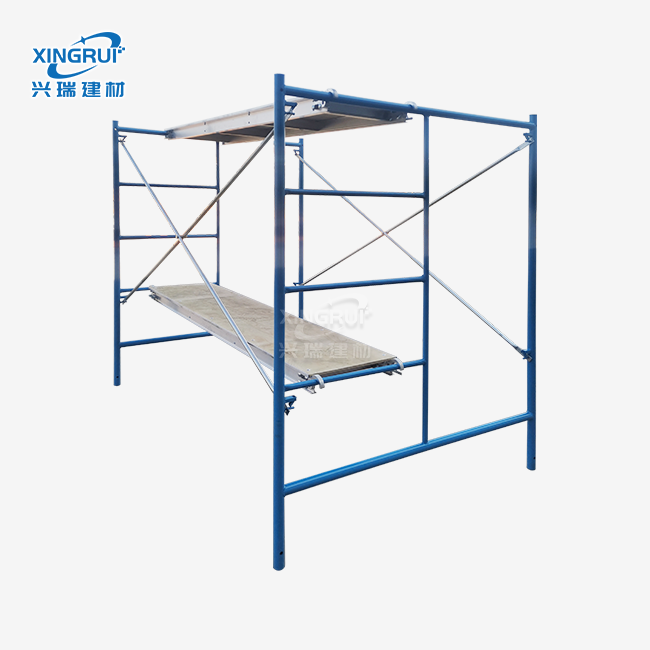
Overview of Door Frame and Ringlock Scaffolding Systems
If you know how each part of your site was put together, you can guess how it will work.
What Is Door Frame Scaffolding?
There is a door frame scaffold system made up of H-shaped vertical frames that are already welded together. Cross braces and coupling pins connect them. The open doorway form lets people and things move through without having to step over supports. Its frames are made of high-strength Q235 steel and have a step height of 1.93m and a distance of 914mm between each upright. Tool-free assembly cuts setup time by about 40% compared to the old tube-and-clamp method. This is a clear benefit for jobs that need to be done quickly.
What Is Ringlock Scaffolding?
Ringlock scaffolding is based on a vertical standard with welded rosette plates that are spaced out irregularly. There are eight places where the ledgers and diagonal braces can join so that they can lock into the rosette at the same time. The system can follow curved walls, raked surfaces, and odd floor plans that a rectangular frame would have trouble with because of its shape. The people working on it need to be smarter and plan ahead more.
Shared Safety Baseline
It is possible for both systems to meet the performance standards set by OSHA 29 CFR 1926 Subpart Q and EN 12810-1 if they are made according to the plans. It matters if the seller provides load estimation records and traceable material certificates. Before the work begins, these are the things that project owners and outside testers will ask for.
Comparative Analysis: Door Frame vs Ringlock Scaffolding
A side-by-side look at performance metrics gives procurement teams a clear decision framework.
Assembly Speed and Labor Cost
Door frame systems win on speed. Gravity-lock pins and standardized frame dimensions mean a trained crew can erect 50 meters of platform in under two hours. Ringlock systems take longer to plan and configure because each node connection must align with the rosette layout. On a straightforward interior renovation or facade finishing project, the labor saving from a door frame system is real and repeatable across multiple site cycles.
Load Capacity and Structural Adaptability
Ringlock scaffolding generally carries higher distributed loads and handles more complex geometrical configurations. Its multi-directional node transfers force evenly across the rosette, making it preferable for heavy industrial maintenance or infrastructure shoring. Door frame scaffolding, with a safety factor exceeding 3:1 and wall thickness between 2.0mm and 3.5mm, handles the dynamic loads typical of masonry, plastering, and MEP installation work without issue.
Durability and Cycle Reuse
Both systems offer strong reuse value when components are manufactured to tight tolerances. Xingrui door frames are hot-dip galvanized or powder-coated, providing corrosion protection suited to tropical and coastal environments. Standardized components fit interchangeably across projects — if one frame is damaged, you replace only that unit without dismantling adjacent bays. Ringlock components are equally durable but carry a higher unit cost, which affects the total asset value for rental fleet operators.
Procurement Considerations for B2B Clients
Beyond technical specs, procurement managers need to evaluate supply chain reliability and total cost of ownership.
Cost Structure: Purchase vs. Rental
Door frame scaffolding carries a lower unit price per square meter of platform coverage, making it the preferred choice for rental companies building large inventories. Ringlock commands a premium justified by its versatility on complex projects. For EPC contractors running multiple simultaneous sites, mixing both systems in the fleet gives flexibility without overcommitting capital to a single product type.
Supplier Evaluation Criteria
When shortlisting a door frame scaffolding manufacturer, verify the following before placing a trial order. These criteria directly affect your risk exposure on international procurement:
- Certification documentation: ISO 9001, ISO 14001, and ISO 45001 management system certificates, plus CE marking and batch-level quality inspection reports.
- Production capacity: Can the factory sustain delivery during peak construction seasons? Xingrui operates 12 welding robots across 6 automated lines inside a 79,800-square-meter facility with a workforce of 920, including 180 technicians.
- Customization capability: Does the supplier accept customer drawings for OEM/ODM orders? Xingrui processes drawing-based orders and provides samples with full technical documentation before mass production begins.
- Logistics position: Factory location relative to port matters. Xingrui sits in Rizhao, Shandong — a city with its own seaport, airport, and high-speed rail, reducing inland freight exposure.
Evaluating these factors systematically shortens the vetting cycle and reduces the chance of receiving non-conforming goods.
Lead Times and After-Sales Support
Standard production runs at Xingrui take 15–30 days after order confirmation. Sample delivery runs 7–14 days. After-sales support includes replacement component sourcing and technical consultation. Buyers should confirm in writing that the supplier will issue a Declaration of Performance (DoP) for CE-marked products — a document required in most European and GCC project contracts.
How to Choose the Right Scaffolding System for Your Project?
The decision tree is straightforward once you map your project variables against system strengths.
Match System to Site Geometry
If your project involves flat facades, standard floor-to-ceiling heights, and repetitive bay layouts — interior decoration, secondary structure work, MEP installation — door frame scaffolding delivers the fastest return on investment. If the structure has curved surfaces, varying heights, or requires the scaffold to carry loads from multiple directions simultaneously, ringlock is worth the additional cost.
Assess Your Crew's Skill Level
Door frame systems require minimal training. Workers familiar with basic scaffolding safety can erect and dismantle them without specialist supervision. Ringlock systems demand a higher level of planning literacy. If your crews rotate frequently or work across low-skill-intensity projects, the simpler system reduces incident risk.
Plan for Scalability
For companies expanding their project portfolio, starting with a door frame system is lower risk. Components are reusable across different project types, and the lower unit cost allows you to build inventory gradually. Once your pipeline includes heavier industrial or infrastructure work, adding ringlock to the fleet makes operational sense without retiring the existing door frame stock.
Maintenance and Safety Best Practices for Long-Term Use
If you take good care of your scaffold system, it will protect both the workers and your investment.
Routine Inspection Protocol
Before each flight, check the frames and cross braces. You should look for cracks in the welds, rust at the pin connections, and wear on the parts that connect the parts. Parts that are clearly broken should not be used at all right away. In order to follow OSHA 1926.451, a qualified person must check each ladder before each work shift.
Storage and Handling
Make sure the frames don't touch the ground when you lay them out flat on dry, level ground. Hot-dip galvanized parts don't rust easily, but if you store them near chemicals or industrial acids, the zinc will break down faster. A powder-coated finish should be checked for chips every so often, especially after being moved.
Worker Training and PPE Requirements
OSHA rules say that everyone working on scaffolding that is more than 10 feet high must wear fall protection. Every three months, training on how to set up, how much weight can be put on it, and what to do in an emergency cuts down on accidents by a large amount. Every shipment from Xingrui comes with technical paperwork and building directions to help with on-site training programs.
Conclusion
For quick, simple, and affordable building projects, door frame scaffolding works well. This includes finishing the inside, working on the outside, and putting up extra structures. Ringlock structure is best for jobs that are hard, complicated, or have odd shapes. The higher cost is worth it because it can move weight in more than one direction. For most business buyers working on a range of projects, a door frame system is the best place to start. That they can offer customization and keep up production at the level your business needs. Make sure that the certifications they have can be checked.
FAQ
Q1: Can door frame scaffolding handle heavy industrial loads?
A: Doors that have safety factors greater than 3:1 are made with walls that are between 2 mm and 3 mm thick. This means they can handle most of the loads that come with building. For heavy industrial shoring where loads need to move in more than one way, they aren't the best choice. They're good for building with bricks, tiling, and MEP work.
Q2: What certifications should I require from a scaffolding supplier?
A: For managing quality, ask for ISO 9001, ISO 14001, and ISO 45001. For managing safety at work, ask for CE marking for European markets and inspection reports at the batch level. To get a job in the US, make sure that your paperwork meets the requirements of ANSI A10.8.
Q3: How quickly can I receive samples before placing a bulk order?
A: Seven to fourteen days after expert proof, Xingrui sends samples. A full run takes 15–30 days to make. Trial orders can be given before a large-scale commitment.
Q4: Is ringlock always more expensive than door frame?
A: Yes, in terms of price per unit. Rosettes are more difficult to weld, so it costs more to make ringlock parts. But for long-term industrial projects, the system's ability to handle different loads can mean that less scaffolding is needed, which helps to make up for some of the extra cost.
Q5: Can components from both systems be used on the same site?
A: Because the two systems don't join in the same way, they shouldn't be physically put together. They can be used in different parts of the same spot and are handled like separate scaffolding.
Request a Quote from GREEN FORMWORK — Certified Door Frame Scaffolding Supplier
Shandong Xingrui Building Materials Co., Ltd. is the company behind GREEN FORMWORK. They make door frame scaffolding out of Q235 steel and are certified by ISO 9001, ISO 14001, and ISO 45001 programs. We offer models before big sales and can make changes based on plans. We also use Rizhao Port to send goods to more than 100 countries. Our tech team can be reached at sdxingruiqp@126.com to get a copy or price quote for our goods.
References
1. American National Standards Institute. ANSI/SSFI A10.8: Scaffolding Safety Requirements. ANSI, 2019.
2. British Standards Institution. BS EN 12810-1: Facade Scaffolds Made from Prefabricated Components. BSI, 2003.
3. Occupational Safety and Health Administration. OSHA 29 CFR 1926 Subpart Q: Scaffolds. U.S. Department of Labor, 2020.
4. European Committee for Standardization. EN 12811-1: Temporary Works Equipment — Scaffolds. CEN, 2003.
5. Construction Industry Research and Information Association. CIRIA C611: Proprietary Temporary Works Systems. CIRIA, 2004.
6. Standards Australia. AS/NZS 1576.1: Scaffolding — General Requirements. Standards Australia, 2010.
Learn about our latest products and discounts through SMS or email