- English
- French
- German
- Portuguese
- Spanish
- Russian
- Japanese
- Korean
- Arabic
- Greek
- German
- Turkish
- Italian
- Danish
- Romanian
- Indonesian
- Czech
- Afrikaans
- Swedish
- Polish
- Basque
- Catalan
- Esperanto
- Hindi
- Lao
- Albanian
- Amharic
- Armenian
- Azerbaijani
- Belarusian
- Bengali
- Bosnian
- Bulgarian
- Cebuano
- Chichewa
- Corsican
- Croatian
- Dutch
- Estonian
- Filipino
- Finnish
- Frisian
- Galician
- Georgian
- Gujarati
- Haitian
- Hausa
- Hawaiian
- Hebrew
- Hmong
- Hungarian
- Icelandic
- Igbo
- Javanese
- Kannada
- Kazakh
- Khmer
- Kurdish
- Kyrgyz
- Latin
- Latvian
- Lithuanian
- Luxembou..
- Macedonian
- Malagasy
- Malay
- Malayalam
- Maltese
- Maori
- Marathi
- Mongolian
- Burmese
- Nepali
- Norwegian
- Pashto
- Persian
- Punjabi
- Serbian
- Sesotho
- Sinhala
- Slovak
- Slovenian
- Somali
- Samoan
- Scots Gaelic
- Shona
- Sindhi
- Sundanese
- Swahili
- Tajik
- Tamil
- Telugu
- Thai
- Ukrainian
- Urdu
- Uzbek
- Vietnamese
- Welsh
- Xhosa
- Yiddish
- Yoruba
- Zulu
What Should You Check Before Buying Combined Steel Formwork for Use?
Before purchasing combined steel formwork, you need to verify material grade, dimensional accuracy, load-bearing certification, anti-corrosion treatment, modular compatibility, reuse cycle data, and supplier credentials. Every element has a direct impact on your project's structural safety and on your budget and on-site productivity. Missing even a single checkpoint results in expensive rework, safety issues or supply chain delays. This book addresses all the key considerations so you can be certain that your purchase choice is based on sound technical and commercial foundations.
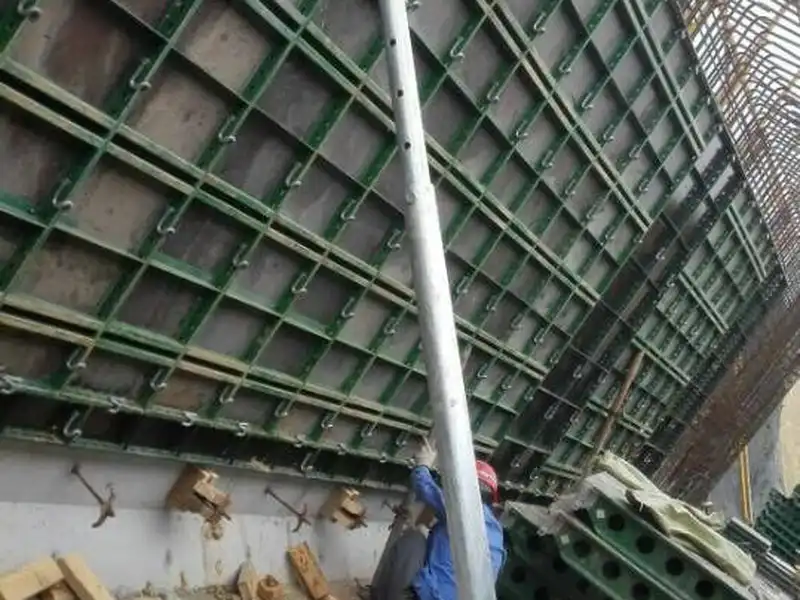
Understanding Combined Steel Formwork: Key Features and Benefits
What It Is and How It Works?
A modular integrated steel formwork system includes standardised Q235 carbon steel panels, connection pieces and support structures constructed on site. Each component is factory produced to strict tolerances - ± 0.5mm dimensional precision - so that panels lock together reliably, pour after pour, unlike site built wood shuttering. Thanks to the peripheral flange design with conventional P-hole spacing, it may be freely assembled into walls, columns, beams and slabs without any special cutting.
Why Steel Outperforms Timber and Aluminum in Demanding Projects
Timber formwork may normally be used during 5–10 reuse cycles before warping reduces surface quality. Aluminium panels are superior performing but are more expensive per unit and rated for lighter loads in heavy pours. The Q235 steel panels with a thickness of 2.5mm-3.0mm have a bearing capacity of 60-80 KN/m² and a modulus of elasticity of 206 GPa, and may be used in high-rise shear walls and bridge piers under great hydrostatic pressure. If you reuse it 200-300+ times then the cost per usage is far lower than any of them.
Performance Advantages Relevant to B2B Buyers
Tight joint sealing of steel panels for EPC contractors minimises concrete leakage saving time on surface repair. For rental organisations, a 200-300 cycle lifetime indicates that a single pool of assets is used for many project rotations before being replaced. The national standard modulus: 100/150/200/250/300mm in width and 900/1200/1500/1800mm in length, basically covering all the specifications that a downstream customer may ask for, which is convenient for distributors’ inventory planning.
Critical Factors to Evaluate Before Purchasing Combined Steel Formwork
Material Grade and Surface Treatment
Always request the steel mill certificate confirming Q235 carbon steel composition. Surface treatment matters equally: panels should undergo industrial-grade pickling and phosphating followed by high-temperature baking, achieving a salt spray test rating exceeding Grade 8. This protects against rust during outdoor storage and repeated concrete contact. A panel that corrodes within two project cycles destroys the cost-per-use economics that justify combined steel formwork over timber.
Dimensional Accuracy and Joint Integrity
The cumulative assembly mistake is a serious concern of site . If each panel is wrong by 1mm then a 20 panel wall run will be 20mm offset that no shim can rectify. The flatness tolerance should be ≤2mm according to GB/T 50214 and the dimensional accuracy should be ±0.5mm. Ask the supplier how they verify weld integrity . Good manufacturers utilise CO2 shielded welding with non-destructive testing ( NDT ) on crucial joints to ensure every seam holds under concrete vibration .
Certifications and Compliance Documentation
Your principal contractor or project owner will probably ask for proof of third party certification. Check that the supplier has ISO 9001 for quality management, ISO 14001 for environmental management and ISO 45001 for occupational health and safety. For projects that are European or North American standard, enquire whether they have EN 12811 structural calculation reports or CE Declaration of Performance (DoP) documentation. A good product might be disqualified if you forget to submit the documentation with your tender.
Comparative Analysis: Combined Steel Formwork vs. Alternative Formwork Solutions
Life Cycle Cost vs. Upfront Investment
Steel formwork carries a higher purchase price than plywood or timber systems. However, the total cost of ownership of combined steel formwork tells a different story. Spread across 200–300 reuse cycles, the per-use cost of a steel panel is a fraction of timber that needs replacement every 5–10 uses. For large-volume procurement—typical of EPC contractors and rental fleets—this gap compounds into substantial savings over a three-to-five-year project horizon.
Strength-to-Weight Ratio and Site Practicality
Aluminium is lighter and simpler to work by hand, which is excellent for low-rise residential projects. For buildings with a pour rate exceeding 1.0 m/h or lateral pressures above 40 KN/m2 the higher stiffness of steel is non-negotiable. The modular steel system allows for the creation of irregular structures, including curved sections and non-standard column cross-sections, by use of customisable corner and filler modules derived from CAD designs. This is a limitation for aluminium and wood, which are confined to conventional geometries.
Environmental and Sustainability Considerations
ISO 14001 accreditation assures that the production process adheres to the environmental management regulations. High reusability immediately minimises the amount of construction waste generated on-site, a criterion that is appearing more often in green building grading systems such as LEED. For procurement managers working under corporate sustainability regulations, a 200-cycle lifetime for a steel system creates measurable material waste savings per square metre of formed concrete compared to single-use plywood solutions.
How to Select Reliable Combined Steel Formwork Suppliers and Brands?
Verifying Manufacturing Capability
A credible supplier manufactures at scale with automated quality controls. Shandong Xingrui Building Materials Co., Ltd. operates across more than 40,000 square meters of standardized production facilities, running 12 welding robots and 6 automatic welding lines staffed by 180 professional technicians. This production infrastructure means dimensional consistency of combined steel formwork holds across large batch orders—critical when you're sourcing panels for a multi-tower project where mismatched batches create site chaos.
Evaluating Customization and Sample Response Time
Rarely do your project designs match conventional catalogue measurements exactly. Ask the supplier directly can they produce to my CAD files, how fast? A good supplier to deal with will provide samples within 7 to 14 days following design submission. GREEN FORMWORK allows you to customise the project for your needs – using corner modules, infill panels, circular column forms – so you don’t have to adapt the structure to the formwork. A technical backup during the sample period, including on-site advice when needed, is a hallmark of a supplier that invests in long-term collaborations.
Logistics, Delivery, and After-Sales Support
Also, Xingrui’s facilities are located in Rizhao, Shandong, which has its own ports, minimising interior transportation legs and cutting lead times to FOB loading. Confirm that the supplier can provide all the shipping papers including commercial invoice, packing list, bill of lading, certificate of origin, and quality inspection report, to facilitate customs clearance without any problems. Equally important is the response post-sale; enquire what the escalation procedure is when there's a batch problem occurring post-delivery. Suppliers with established export networks in over 100 countries usually have defined after-sales systems.
Practical Tips and Precautions for Buying and Using Combined Steel Formwork
Pre-Purchase Checklist
Before placing an order for combined steel formwork, run through these checkpoints:
- Confirm steel grade: Request the mill certificate for Q235 carbon steel composition and thickness measurements (2.5mm–3.0mm).
- Inspect surface coating: Verify pickling, phosphating, and baking treatment with salt spray test documentation (Grade 8 or above).
- Review certification documents: ISO 9001, ISO 14001, ISO 45001; request EN 12811 calculation reports if required by your project specification.
- Order a sample batch first: Test fit, joint tightness, and surface flatness before committing to full production volume.
- Clarify MOQ and lead time: Align production scheduling with your project milestones to avoid on-site delays.
On-Site Maintenance and Storage
Use a release agent before to each pour to prevent concrete from sticking and to decrease wear on the panel. The panels should be cleaned promptly after being stripped, since dried concrete deposits hasten surface damage. Lay panels flat on wood bearers in a covered area to avoid moisture infiltration and warping. Dimensional checks should be made every 50 cycles; panels with flange deformation or surface pitting more than 1mm depth should be removed from structural usage. With proper care, service life may be extended toward the high end of the 200 to 300 cycle range.
Common Procurement Mistakes to Avoid
The most common mistake is to underestimate the overall cost of ownership by comparing unit pricing solely. A less expensive panel that cycles just 50 times costs more per usage than a more expensive panel that cycles 250 times. Likewise, ordering without a sample verification step runs the risk of finding a compatibility problem after a whole container has delivered. Always verify the measurements of the panel modules to your project structural grid before ordering a bulk purchase.
Conclusion
Buying modular combined steel formwork is a capital decision that affects safety, schedule, and budget across your entire project lifecycle. The checks outlined here—material grade, dimensional accuracy, surface treatment, certifications, supplier capacity, and total cost of ownership—give you a structured framework for evaluating any supplier. Steel's mechanical properties and reuse potential make it the most cost-effective choice for demanding pours, provided you source from a manufacturer with verified production controls and responsive technical support.
FAQ
Q1: How many times can steel formwork panels realistically be reused?
A: With proper maintenance—cleaning after each strip, applying release agents before each pour, and storing panels correctly—Q235 steel panels can achieve 200–300 reuse cycles of combined steel formwork. Panels that sustain flange damage or surface pitting beyond acceptable tolerances should be removed from structural rotation earlier.
Q2: Can the panels be customized for non-standard project geometries?
A: Yes. Standard modulus panels cover widths of 100–300mm and lengths of 900–1800mm, but suppliers like Shandong Xingrui can manufacture custom corner, filler, and curved modules from submitted CAD drawings. Sample turnaround typically runs 7–14 days from drawing confirmation.
Q3: What certifications should I request from the supplier?
A: At minimum, ask for ISO 9001, ISO 14001, and ISO 45001 certificates. For projects under European jurisdiction, request EN 12811 structural calculation reports and a CE Declaration of Performance. Always ask for batch-level quality inspection reports tied to your specific order.
Q4: How do I verify weld integrity without visiting the factory?
A: Ask the supplier for NDT (non-destructive testing) reports covering critical weld zones. Reputable manufacturers who run automated welding lines document weld parameters and test results per production batch. You can also request third-party factory audit reports from recognized inspection bodies.
Q5: What is the standard connection method for these panels?
A: U-clips and L-shaped bolts are the standard connection hardware. The peripheral flange with P-hole spacing ensures that all panels within the same modular system connect without adapters, maintaining joint tightness under pour pressure.
Ready to Source Combined Steel Formwork? Contact GREEN FORMWORK Today
GREEN FORMWORK, backed by Shandong Xingrui Building Materials Co., Ltd., delivers combined steel formwork to buyers in over 100 countries with ISO 9001, ISO 14001, and ISO 45001 certification, full customization from your project drawings, and sample dispatch within 7–14 days. Whether you need a trial order or full-scale EPC supply, our team is ready to support your procurement process. Send your project requirements to sdxingruiqp@126.com to request a quote from a verified combined steel formwork manufacturer today.
References
1. European Committee for Standardization. EN 12811-1: Temporary Works Equipment — Scaffolds — Performance Requirements and General Design. CEN, 2003.
2. International Organization for Standardization. ISO 9001:2015 Quality Management Systems — Requirements. ISO, 2015.
3. International Organization for Standardization. ISO 14001:2015 Environmental Management Systems — Requirements with Guidance for Use. ISO, 2015.
4. International Organization for Standardization. ISO 45001:2018 Occupational Health and Safety Management Systems — Requirements with Guidance for Use. ISO, 2018.
5. American Concrete Institute. ACI 347R-14: Guide to Formwork for Concrete. ACI, 2014.
6. Construction Industry Research and Information Association. CIRIA C703: Formwork — A Guide to Good Practice. 3rd ed., CIRIA, 2012.
Learn about our latest products and discounts through SMS or email