- English
- French
- German
- Portuguese
- Spanish
- Russian
- Japanese
- Korean
- Arabic
- Greek
- German
- Turkish
- Italian
- Danish
- Romanian
- Indonesian
- Czech
- Afrikaans
- Swedish
- Polish
- Basque
- Catalan
- Esperanto
- Hindi
- Lao
- Albanian
- Amharic
- Armenian
- Azerbaijani
- Belarusian
- Bengali
- Bosnian
- Bulgarian
- Cebuano
- Chichewa
- Corsican
- Croatian
- Dutch
- Estonian
- Filipino
- Finnish
- Frisian
- Galician
- Georgian
- Gujarati
- Haitian
- Hausa
- Hawaiian
- Hebrew
- Hmong
- Hungarian
- Icelandic
- Igbo
- Javanese
- Kannada
- Kazakh
- Khmer
- Kurdish
- Kyrgyz
- Latin
- Latvian
- Lithuanian
- Luxembou..
- Macedonian
- Malagasy
- Malay
- Malayalam
- Maltese
- Maori
- Marathi
- Mongolian
- Burmese
- Nepali
- Norwegian
- Pashto
- Persian
- Punjabi
- Serbian
- Sesotho
- Sinhala
- Slovak
- Slovenian
- Somali
- Samoan
- Scots Gaelic
- Shona
- Sindhi
- Sundanese
- Swahili
- Tajik
- Tamil
- Telugu
- Thai
- Ukrainian
- Urdu
- Uzbek
- Vietnamese
- Welsh
- Xhosa
- Yiddish
- Yoruba
- Zulu
How Does Multi-Layer Multi-Directional Crab Scaffolding Work Safely?
Multi-layer multi-directional crab scaffolding works safely by combining a self-locking rosette node system with diagonal and horizontal bracing bars across vertical layers. Each disc-shaped connection point accepts ledgers and braces at 45-degree increments across a full 360-degree range, distributing loads evenly throughout the entire frame. The hammer-locked wedge mechanism eliminates bolt loosening, a leading cause of scaffold failure on active job sites. Built from Q235 premium steel and hot-dip galvanized to 60–80μm, the system maintains structural integrity up to 24m in height, making it the preferred choice for bridges, domes, and high-rise factory projects.
Understanding Multi-Layer Multi-Directional Crab Scaffolding
It's helpful to know what makes a high-performance scaffolding system different from a generic one before picking one for a big job. This system isn't just an improvement on ringlock scaffolding; it's a whole new way of thinking about engineering.
What the "Crab" Node Actually Does?
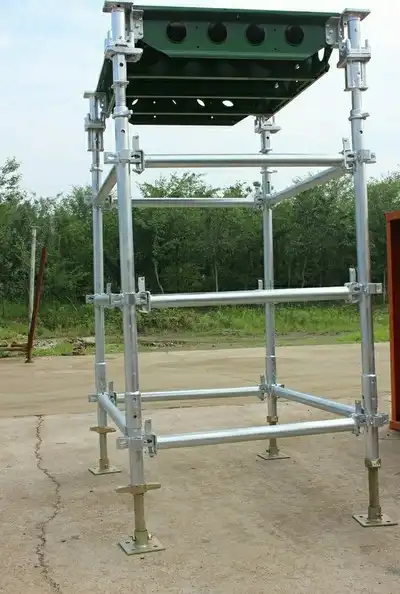
The disc-shaped rosette node at each joint is what the word "crab" refers to. This node can handle up to eight connections at the same time, with a connection range of 360 degrees. Because of its shape, that node can hold both straight standards and angled braces in place without having to be made from scratch, which is very important for curved bridge piers or stadium canopies.
Material Composition and Corrosion Resistance
All of the parts are made from high-quality Q235 steel, and the vertical tubes are 48.3 mm in diameter and 3.25 mm thick. The American Galvanizers Association says that hot-dip galvanization (HDG) adds a protected layer of 60–80μm, which makes steel last longer than 15 years in normal weather conditions. This is a clear benefit for projects that will be used more than once.
Why It Outperforms Tube-and-Clamp Systems?
Tube-and-clamp scaffolding depends on how tight the bolts are, which can change depending on how skilled and tired the workers are. On the other hand, this self-locking wedge mechanism only needs one hammer blow to securely lock each joint. Node spacing stays at 500 mm intervals with ±1 mm accuracy in dimensions. This stops positional errors that add up over time in multi-layer builds that could otherwise mess up vertical alignment.
How Does the System Maintain Safety During Installation?
Safe assembly doesn't happen by accident; it follows a set order of steps, and each one has built-in checks. Here's how the system makes sure safety at every step of the erection process.
Step-by-Step Erection Sequence
The assembly of multi-layer multi-directional crab scaffolding starts with base plates on packed-down ground. Next, vertical standard placement is done at set distances. With wedge pins, ledgers are held in place before any top layer is added. They fit into rosette nodes. Before the team moves on to the next layer, each finished layer is checked for plumb and node engagement. The steps in this staged proof process are the same as what OSHA 1926.451 says must be done for progressive load verification during assembly.
Bracing Patterns That Resist Lateral Forces
Stable triangular brace cells are made up of vertical diagonal bars and horizontal support bars. The European standard for temporary work structures, EN 12811-2, says that triangulated bracing is the best way to resist lateral sway loads. This is because wind, equipment vibration, and concrete pour pressure all create lateral force that a frame that isn't braced can't safely handle.
Load Capacity Calculation and Transfer
The crab-style frame spreads stress evenly among all the connected nodes instead of concentrating it in one place. The system can be set up in ultrahigh heavy-load configurations for engineers who are making load charts. Loads move vertically from the ledger to the standard to the base plate along straight axial paths. Any shear force that would bend the vertical members is stopped by diagonal bars. The system has a great safety record because of this dual-path load transfer.
Comparative Insights: Crab Scaffolding vs. Other Scaffolding Types
A lot of the time, procurement teams wonder if the extra cost of a specialized system is worth it. That question is directly answered by the information below.
As you can see, these two companies are very similar in three important ways:
- Multi-directional load resistance: Ringlock and cuplock systems manage loads primarily in the vertical axis. The crab frame handles simultaneous horizontal, vertical, and diagonal forces, which is necessary for irregular structures like curved bridge decks and dome roofs where load angles constantly change.
- Assembly efficiency: The hammer-lock wedge reduces erection time by 40–60% compared to tube-and-clamp. For a mid-size EPC contractor managing a 12-week bridge project, that speed difference can mean meeting a milestone payment or missing it.
- Lifecycle cost: The HDG surface treatment and reusable, built-to-spec components reduce per-cycle material cost over time. A system that survives 15+ years of repeated assembly and disassembly requires far fewer replacement parts than standard painted scaffolding subject to rust and surface degradation.
Because of these performance differences with multi-layer multi-directional crab scaffolding, there are fewer accidents, less waste, and more accurate budgeting, all of which are benefits that procurement directors and project engineers like.
Best Practices for Maintenance and Safe Operation
Even the best scaffolding system requires disciplined upkeep. The following practices protect both workers and the investment.
Routine Inspection Intervals
Site managers should inspect all nodes, wedges, and base plates before each new project use. OSHA recommends scaffolding inspection by a competent person before each work shift and after any event — weather, impact, or load change — that could affect structural integrity. Pay particular attention to wedge deformation and rosette weld condition, as these are the primary stress concentration points.
Identifying Wear Before It Becomes Failure
Worn wedge pins show visible elongation of the locking hole. Bent ledgers indicate overloading history. Any component showing visible cracking at the weld zone between the rosette and the standard should be removed immediately from inventory. Tracking serial batches by purchase date allows teams to retire components systematically rather than reactively.
Certified Installation Teams and Training
The self-locking mechanism is straightforward, but multi-layer erection to 24m height introduces sequencing complexity. Installation teams should complete manufacturer-provided training covering load chart reading and bracing interval requirements for tall configurations. ISO 45001 — the occupational health and safety management standard — requires that organizations verify worker competency for safety-critical tasks, and scaffold erection above six meters qualifies as such.
Procurement Guide: Selecting a Reliable Crab Scaffolding Supplier
The company that produces multi-layer multi-directional crab scaffolding — the multilayer, multidirectional crab scaffolding — is just as important as the system itself. The following factors protect both the results of the project and the budgets for buying things.
Certification Verification
Check to see if the company has ISO 9001 certification for quality management, ISO 14001 certification for environmental management, and CE marking. Shandong Xingrui Building Materials Co., Ltd. sells all three, and if you ask, you can get batch-level quality check records. Third-party factory surveys and Declaration of Performance (DoP) papers are often required by contracts for US-based EPC companies working on infrastructure that is paid for by the federal government.
Customization and Sample Availability
For projects with complex shapes, like stadium canopies, cable-stayed bridge pylons, and curved industrial roofs, parts must be made according to engineering drawings instead of catalog dimensions. Shandong Xingrui lets you fully customize any of its more than 1,000 accessory specifications by drawing it on your computer. Samples can be sent to you within 7–14 days of the drawing being approved. For pre-construction plans to stay on track, this reaction time is very important.
Bulk Order Logistics and Lead Times
Shandong Xingrui has a 40,000-square-meter factory in Rizhao, Shandong, which has its own airport, seaport, and high-speed rail system. This means that the company can reliably ship large orders on time. FOB and CIF terms are both offered for US buyers, and full documentation packages (including packing lists, test reports, and CE certificates) are sent out at the time of shipping. For regular orders, the standard lead time for production is 15 to 30 days.
Conclusion
With rosette nodes that lock at exact angles, Q235 steel that fights corrosion for 15+ years, and a self-locking wedge system that eliminates human error from joint security, Multi-layer multi-directional crab scaffolding provides safety. This system has the load capacity, geometric flexibility, and long-term longevity that normal scaffolding can't match. It doesn't matter if your next project is a highway viaduct, a sports venue, or an ultra-high-rise factory shell. The right supplier can make the difference between a project finishing on time and not. They should have ISO 9001 certification, CE compliance, and the ability to fully customize their products.
FAQ
Q1: What safety standards does crab scaffolding meet?
A: The system is checked against the CE certification framework, OSHA 1926.451, and EN 12811-1. Shandong Xingrui is also certified by ISO 9001 for quality management and ISO 14001 for environmental management. For every production run, there is test documentation at the batch level.
Q2: How long does it take to receive samples?
A: Samples are usually ready between 7 and 14 days after the drawing confirmation. This timeline shows both standard and custom node setups.
Q3: Can the system integrate with other scaffolding brands?
A: It's not a good idea to mix parts from different makers. Brands have different rosette sizes and wedge thicknesses, and putting them together doesn't count toward approved load rates. The structure calculations are kept when single-source components are used.
Q4: How many reuse cycles does the system support?
A: With the right insp5ection and HDG surface treatment, parts usually last longer than 15 years across many project cycles. Physical examination, not just age, should be used to decide when someone can retire.
Get a Quote for Multi-Layer Multi-Directional Crab Scaffolding
With the help of Shandong Xingrui Building Materials Co., Ltd., GREEN FORMWORK can build multi-layer, multi-directional crab scaffolding that fits your exact project plans. We are a verified manufacturer with ISO 9001, CE, and export history in more than 100 countries. We can send you samples within 7–14 days and can handle both standard and OEM orders. You can email our technical team at sdxingruiqp@126.com to get cost information, specs, and a load calculation reference for your project.
References
1. American Galvanizers Association. Corrosion Protection: The Role of Zinc Coatings. 2021.
2. British Standards Institution. BS EN 12811-1: Temporary Works Equipment — Scaffolds. 2003.
3. Occupational Safety and Health Administration. OSHA Standard 1926.451: Scaffolding in Construction. 2019.
4. International Organization for Standardization. ISO 45001: Occupational Health and Safety Management Systems. 2018.
5. Construction Industry Research and Information Association (CIRIA). Scaffold Design and Safety Management on Complex Structures. 2020.
6. European Committee for Standardization. EN 1004: Mobile Access and Working Towers Made of Prefabricated Elements. 2004.
Learn about our latest products and discounts through SMS or email