- English
- French
- German
- Portuguese
- Spanish
- Russian
- Japanese
- Korean
- Arabic
- Greek
- German
- Turkish
- Italian
- Danish
- Romanian
- Indonesian
- Czech
- Afrikaans
- Swedish
- Polish
- Basque
- Catalan
- Esperanto
- Hindi
- Lao
- Albanian
- Amharic
- Armenian
- Azerbaijani
- Belarusian
- Bengali
- Bosnian
- Bulgarian
- Cebuano
- Chichewa
- Corsican
- Croatian
- Dutch
- Estonian
- Filipino
- Finnish
- Frisian
- Galician
- Georgian
- Gujarati
- Haitian
- Hausa
- Hawaiian
- Hebrew
- Hmong
- Hungarian
- Icelandic
- Igbo
- Javanese
- Kannada
- Kazakh
- Khmer
- Kurdish
- Kyrgyz
- Latin
- Latvian
- Lithuanian
- Luxembou..
- Macedonian
- Malagasy
- Malay
- Malayalam
- Maltese
- Maori
- Marathi
- Mongolian
- Burmese
- Nepali
- Norwegian
- Pashto
- Persian
- Punjabi
- Serbian
- Sesotho
- Sinhala
- Slovak
- Slovenian
- Somali
- Samoan
- Scots Gaelic
- Shona
- Sindhi
- Sundanese
- Swahili
- Tajik
- Tamil
- Telugu
- Thai
- Ukrainian
- Urdu
- Uzbek
- Vietnamese
- Welsh
- Xhosa
- Yiddish
- Yoruba
- Zulu
How Does Coupler Type Round Tube Scaffolding Improve Site Safety?
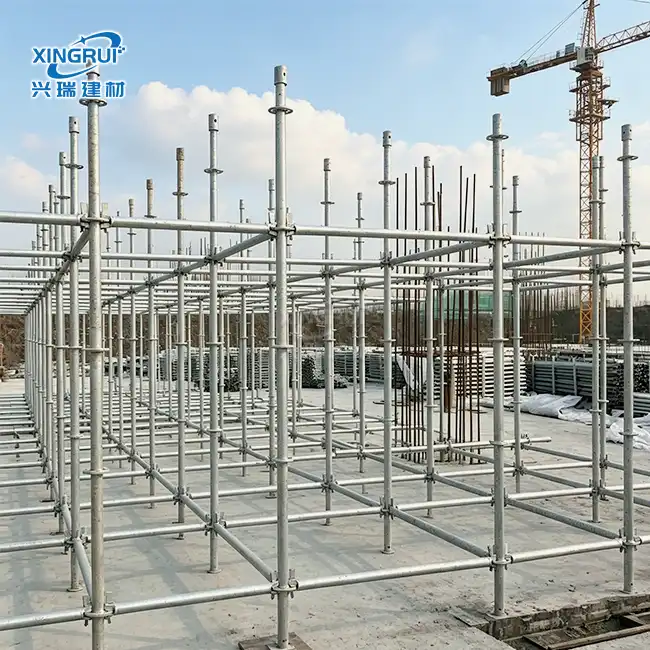
Coupler type round tube scaffolding improves site safety by creating mechanically secured, load-distributing connections across the entire scaffold structure. Each coupler is made of malleable cast iron and holds the Φ48mm Q235 steel tube tightly to prevent it from slipping under the dynamic loads of the construction. Workers and engineers have precise control over the structural geometry, since they may install each node wherever along the tube, on uneven facades or bridge formwork for example. Built correctly and checked regularly this system is compliant with OSHA 1926, BS1139 & EN74-1.451 criteria, giving procurement teams measurable confidence in worker safety.
Understanding Coupler Type Round Tube Scaffolding
It is helpful to know precisely what this system is composed of and why engineers on the ground care about its material choices before comparing safety performance.
Composition and Structure
Straight steel tubes joined at different angles by mechanical couplers make up tube and clamp scaffolding. The installer selects each connection point, in contrast to modular systems with preset node spacing. This freeform geometry works well for intricate projects where pre-engineered spans just do not fit, such as curving facades, cast-in-place box girders, and tunnel secondary lining.
Material Standards That Matter
These tubes, which have an outside diameter of Φ48mm and wall thicknesses of 3.2mm or 4.0mm, are made from Q235 national standard carbon steel by Shandong Xingrui Building Materials Co., Ltd. The system has a service life of more than ten years, even in coastal settings, thanks to hot-dip galvanisation (HDG) of the surface with a zinc coating of 40–60 microns.
Load Capacity and Compliance
The system can support loads more than 2.5 kN/m² when properly constructed. For EPC contractors to achieve milestone-based delivery deadlines, component compliance with EN74-1 (couplers), EN39, and BS1139 (tubes) allows engineers to immediately refer to published mechanical values in their structural calculations.
How Coupler Design Enhances Site Safety?
The coupler is the safety-critical part. We know how it operates in actual site circumstances and that's why this technology is still the standard option in bridge shoring and facade construction across the globe.
Mechanical Locking Under Load
Malleable cast iron couplers for coupler type round tube scaffolding grip the tube circumferentially. Research cited by the European Committee for Standardization confirms that right-angle couplers compliant with EN74-1 must withstand a slip load of at least 6.1 kN. This figure directly limits the risk of tube movement that could cascade into a partial or full collapse.
Standards Alignment and Regulatory Confidence
OSHA 29 CFR 1926.451 requires scaffolding support four times the maximum designed load. The system complies. They define couplers certified to EN74-1, and provide paperwork to support regulatory inspections. This traceability is a particularly useful tool for major EPC contractors whose customers need third-party audit trails.
Even Load Distribution Across the Frame
Tubes may be spaced at any interval and the installer can space verticals and horizontals to the actual load map of the structure – not a manufacturer’s preset grid. This planned spacing decreases stress concentration in individual nodes, one of the main reasons of scaffold failure on irregular locations.
Step-by-Step Guide: Proper Assembly
Correct assembly is where safety theory becomes field reality. The following process reflects best practices for bridge shoring and facade scaffold projects.
Pre-Assembly Site Assessment
Before any tube is inserted, ground bearing capability must be established and base plates or sole boards measured correspondingly. OSHA data suggests that a large amount of scaffold occurrences are due to poor foundation preparation, not component failure.
These are the three pre-assembly tests that Xingrui field managers always undertake at client sites:
- Ground truth: Bearing pressure should be measured and foundation plates of at least 150 x 150 x 8mm to be installed to securely distribute vertical loads into the sub-strata.
- Component inspection: Any tube with obvious deformation of more than 3 mm over a length of 1.5 m will be rejected. Couplers displaying fractured lugs or stripped bolt threads shall be discarded before installation starts.
- design confirmation Confirm that the authorised structural design fits the site measurements, particularly for uneven facades where the distance between the bays may not be the same as the conventional grid.
Skipping any one of these steps shifts the risk profile of the entire structure, so field supervisors should treat them as non-negotiable before the first tube is lifted.
Coupler Tightening Protocol
Tighten every coupler of coupler type round tube scaffolding to a torque of 40–60 Nm. Under-tightening below 40 Nm allows slip under live loads; over-tightening above 65 Nm can deform the tube wall and reduce the connection's rated capacity. A calibrated torque wrench, not a standard adjustable spanner, is the correct tool.
Vertical Alignment and Bracing
Plumb each standard to within 1:200 of vertical using a spirit level. Fit ledger bracing at every fourth bay horizontally and at every third lift vertically. Bracing converts an array of loosely connected tubes into a three-dimensional frame capable of resisting lateral wind loads and accidental impact.
Comparing Coupler Scaffolding with Other Systems for Safety
Procurement teams often weigh tube-and-clamp against ringlock and kwikstage systems. Each has a specific safety profile.
Where Tube and Clamp Leads
The ringlock and kwikstage systems are supplied with preset rosette spacings for the locking connections, often 500mm vertically. Those regular intervals create gaps or overhangs on a curving bridge pier or a historic façade with unequal setbacks, calling for costly adapter pieces. Tube and clamp avoids this problem entirely, reducing the need for innovative solutions that tend to include structural defects concealed by the design.
Where Modular Systems Have an Edge
Moreover, pre-engineered modular systems provide quicker installation durations and less dependence on expert workers for connection options. If your project has a recurring regular floor plate, kwikstage or ringlock might assist reduce assembly errors. The danger of tube-and-clamp is human judgement at every connection, which is why the guidelines above for tightening and alignment are non-negotiable.
Long-Term Cost and Safety Value
Q235 HDG tubes from Xingrui for coupler type round tube scaffolding carry a documented service life above 10 years. The total cost of ownership over a 10 year cycle is favourable considering replacement, inspection and down-time. This is compared to modular systems where patented rosette heads need brand matched components and are more costly to get worldwide.
Maintenance and Inspection Best Practices
Sustained safety depends on what happens between projects, not only during erection.
Inspection Checklist Before Each New Project
Every tube and coupler must pass a visual and dimensional check before being deployed again. Tubes with dents deeper than 3mm, visible cracks, or significant corrosion breaching the zinc layer should be taken out of service. Couplers with bolt thread wear, hairline fractures in the casting, or seized pivot joints must be replaced, not repaired in the field.
Scheduled In-Use Inspections
The Prefabricated Access Suppliers’ and Manufacturers’ Association (PASMA) advises that industry guidance recommends a full technical inspection every seven days during active use, plus further checks after any event – high winds above Beaufort scale 6, accidental impact or abnormal loading – that could have disturbed the structure.
Building a Safety-Conscious Site Team
“Equipment is only as good as the people who put it together and watch it.” Operators should be trained and training recorded on coupler torque values, tube rejection criteria and emergency reporting protocols. Written inspection records also satisfy third-party auditors, which is important to EPC contractors that have quality duties under contracts.
Conclusion
When building something complicated with coupler type round tube scaffolding, it's important to make sure that the scaffold system's parts are certified, its connections are safe, and its shape fits the building that's being built. This is what happens when you connect Q235 steel tubes with EN74-1 certified couplers produced from malleable cast iron. Tube-and clamp scaffolding may be utilised on bridges, uneven walls and tunnel lining provided the necessary inspections are made before it is put together and every seven days. GREEN FORMWORK is an excellent option for purchasing teams who want constant safety documentation since it is able to generate and has been authorised in the past.
FAQ
Q1: How often should tube and clamp scaffolding be inspected?
A: A thorough inspection should happen before every new project installation and every seven days while the structure is in active use. Any severe weather event or accidental impact warrants an immediate unscheduled inspection regardless of schedule.
Q2: Can this system be customized for irregular facades?
A: Yes. Because each tube can be cut to an exact length and the coupler can be fixed at any position along the tube, the system adapts to curved, angled, or step-profile facades without requiring special adapter components.
Q3: What risks come from improper coupler tightening?
A: Under-tightened couplers slip under load and can trigger progressive collapse. Over-tightened couplers deform the tube wall, reducing the connection's certified load rating. Both conditions violate EN74-1 compliance thresholds and OSHA load capacity requirements.
Q4: Does the system meet international safety standards?
A: Components manufactured to EN74-1, EN39, and BS1139 meet European requirements. When the assembly design meets OSHA 29 CFR 1926.451 load factors, the structure satisfies U.S. federal site safety rules as well.
Q5: What is the minimum order quantity for a custom project?
A: Shandong Xingrui accepts custom orders based on client drawings and samples. Contact the team directly at sdxingruiqp@126.com to discuss project-specific quantities and lead times.
Get a Safe, Certified Scaffold System from GREEN FORMWORK
Shandong Xingrui Building Materials Co., Ltd. runs the company. It also provides coupler type round tube scaffolding to projects in more than 100 countries and is CE and ISO certified. Need a test order or a complete project package? Our IT staff will get in touch within one business day. Send your drawings or RFQ to sdxingruiqp@126.com to get information about the product and a price from a reputable company that makes coupler type round tube scaffolding.
References
1. European Committee for Standardization. EN 74-1: Couplers, Spigot Pins and Baseplates for Use in Falsework and Scaffolding. CEN, 2005.
2. British Standards Institution. BS 1139-1.1: Metal Scaffolding — Tubes. BSI, 2010.
3. European Committee for Standardization. EN 39: Loose Steel Tubes for Tube and Coupler Scaffolding. CEN, 2001.
4. Occupational Safety and Health Administration. OSHA 29 CFR 1926.451: Scaffolding Standards for the Construction Industry. U.S. Department of Labor, 2011.
5. Prefabricated Access Suppliers' and Manufacturers' Association (PASMA). Code of Practice for the Use of Tube and Fitting Scaffolding. PASMA, 2019.
6. European Committee for Standardization. EN 12811-1: Temporary Works Equipment — Scaffolds: Performance Requirements and General Design. CEN, 2003.
Learn about our latest products and discounts through SMS or email