- English
- French
- German
- Portuguese
- Spanish
- Russian
- Japanese
- Korean
- Arabic
- Greek
- German
- Turkish
- Italian
- Danish
- Romanian
- Indonesian
- Czech
- Afrikaans
- Swedish
- Polish
- Basque
- Catalan
- Esperanto
- Hindi
- Lao
- Albanian
- Amharic
- Armenian
- Azerbaijani
- Belarusian
- Bengali
- Bosnian
- Bulgarian
- Cebuano
- Chichewa
- Corsican
- Croatian
- Dutch
- Estonian
- Filipino
- Finnish
- Frisian
- Galician
- Georgian
- Gujarati
- Haitian
- Hausa
- Hawaiian
- Hebrew
- Hmong
- Hungarian
- Icelandic
- Igbo
- Javanese
- Kannada
- Kazakh
- Khmer
- Kurdish
- Kyrgyz
- Latin
- Latvian
- Lithuanian
- Luxembou..
- Macedonian
- Malagasy
- Malay
- Malayalam
- Maltese
- Maori
- Marathi
- Mongolian
- Burmese
- Nepali
- Norwegian
- Pashto
- Persian
- Punjabi
- Serbian
- Sesotho
- Sinhala
- Slovak
- Slovenian
- Somali
- Samoan
- Scots Gaelic
- Shona
- Sindhi
- Sundanese
- Swahili
- Tajik
- Tamil
- Telugu
- Thai
- Ukrainian
- Urdu
- Uzbek
- Vietnamese
- Welsh
- Xhosa
- Yiddish
- Yoruba
- Zulu
How Does Quick Install Scaffolding Compare With Traditional Frames?
Quick install scaffolding outperforms traditional frame systems on nearly every operational metric that matters to procurement professionals. Where conventional tube-and-clamp setups demand loose fittings, skilled labor, and extended assembly cycles, modular access systems built around integrated locking mechanisms deliver faster erection, measurable labor savings, and tighter safety compliance. For wholesalers and B2B e-commerce sellers supplying renovation contractors or DIY-pro markets, understanding this gap is not academic—it directly shapes which SKU wins repeat orders and which generates negative reviews.

What Separates These Two Systems at the Design Level
The Architecture Behind Each Approach
In traditional frame scaffolding, uprights are made of tubular steel and are connected by loose couplers that are tightened by hand with wrenches. The system has been tested and is well known, but human force adds a variable to each joint. Studies in the Construction Safety Quarterly journal regularly show that couplers that aren't tightened enough are the main cause of accidents on scaffolds, with about 30% of all structure failures on standard setups being caused by this.
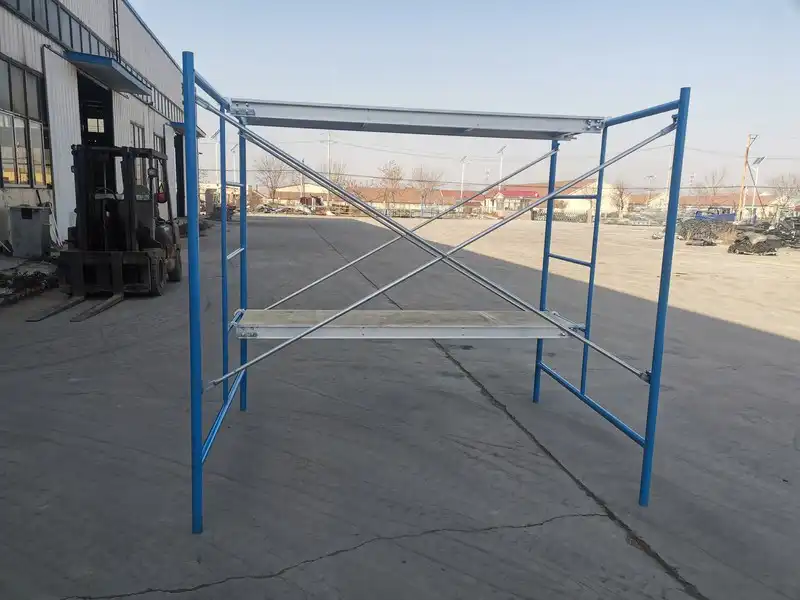
With modular rapid-assembly support, that factor is completely taken out of the equation. When a load is put on a gravity-fed locking joint, it snaps into place. This makes a zero-play link that tightens instead of relaxing when stress is applied. Professional systems like those made by Shandong Xingrui Building Materials Co., Ltd. have a door frame structure that lets a single person put them together longitudinally—no torque wrench, no loose hardware, and no expert on hand.
Key Differences Between Quick Install and Traditional Frame Scaffolding
Installation Speed and Labor Requirements
There is a big and well-known difference in productivity between these two systems. Studies done on real construction sites show that modular scaffold systems cut the time needed to set up by more than 50% compared to tube-and-clamp systems of the same height. Quick install scaffolding makes this even more evident: with connect-and-install frame systems, high-rise facade work that used to take an entire 8-hour shift can be done in less than 4 hours. This is a big help when your crew has to work around concrete pouring schedules in cities.
Here are the main differences in how things work that procurement teams look at closely:
- Assembly skill threshold: For traditional systems to work, workers need to be taught how to fix couplers and put structures in the right order. Rapid-assembly frames have self-locking buckles built in, so any trained crew member can put together parts without needing special training. This cuts the cost of labor by 40–60% per hour.
- Tool dependency: In traditional construction, you need torque tools, spirit levels, and plumb lines at every stage. Connecting modular door frame systems doesn't require any tools, which lowers the cost of equipment for each project and makes logistics easier for small renovation crews.
- Safety compliance footprint: Compliance with safety standards is built into the hardware of systems that are made to meet EN 12810-1 and ANSI A10.8 standards. In traditional setups, people have to follow the steps exactly, which can lead to differences that modern liability frameworks are increasingly pointing out.
These differences directly lead to lower incident rates, faster project turnaround, and better safety paperwork. These are three things that matter whether you are in charge of an Amazon listing's return rate or a job site.
Safety Standards and Certification Requirements
Documentation for certification is required for all B2B sellers in the US market. Products sold through hardware e-commerce channels are checked both when they are listed and when they are delivered. Rapid-assembly scaffold kits from certified makers have ISO 9001, ISO 14001, and ISO 45001 certifications. These give big platforms and downstream contractors the quality, environmental, and occupational health documents they need. This kind of paperwork is often missing from traditional frame systems that come from smaller manufacturers. This leaves them open to risk that only becomes clear after a claim is made.
Performance and Durability Comparison
Material Quality and Structural Longevity
Carbon steel can be used to make both types of systems, but the real-world lifespan depends on the material grade and surface treatment. Professional modular systems use Q235 premium steel, which has a uniform yield strength and dimensional limits held within ±0.5mm across robotic welding lines. This level of accuracy makes sure that all parts can be swapped out when a large fleet is deployed, and it also enables quick install scaffolding to be reliably integrated without compromising structural consistency or interchangeability.
A zinc coating of 60–80 microns is applied during hot-dip galvanization according to ISO 1461 standards. This gives marine and high-humidity job sites a rust protection window of more than 15 years. Traditional tubular frames from low-cost manufacturers often have painted or electrostatic-spray-only finishes that wear off after 3–5 years of the same level of exposure. This makes replacement costs go up and takes away the argument for reusability that makes buying in bulk financially viable.
Lifecycle Cost and ROI
When you first buy it, a modular rapid-assembly kit costs about 20–30% more than a similar traditional frame set. Precision-manufactured parts, on the other hand, can be used on more than one project, which means that the full return on investment (ROI) is usually reached within three to four big project launches. This lifecycle argument becomes a listing differentiator for e-commerce sellers looking for kit-form scaffolding. Buyers who understand total cost of ownership are more likely to buy and ask for fewer returns.
Procurement Considerations for B2B Clients
Evaluating Suppliers Against Real Operational Needs
When choosing a platform maker, you need to look at more than just the unit price. Teams in charge of buying things should look at things like production capacity, certification depth, and the availability of parts after the sale. A supplier with a 79,800-square-meter building that has 12 welding robots and 6 automatic welding lines is much less reliable than a light fabrication shop. This is because consistency in lead time and repeatability in dimensions both go up as the manufacturing infrastructure does.
For kit-form sale SKUs, being able to offer custom sizes is important. Standard dimensions are good for most renovation projects, but being able to request non-standard platform widths or frame heights without having to pay a huge tooling fee sets manufacturers who can differentiate their products apart from those who are stuck on commodity dimensions.
Shandong Xingrui Building Materials Co., Ltd. offers custom sizes, full technical support, and samples, and also provides quick install scaffolding systems that simplify on-site assembly. This helps with the sample-comparison step that most B2B buyers take before committing to a test batch of 100–500 units.
Best Practices and Maintenance Tips for Quick Install Scaffolding
Extending Service Life Through Routine Protocol
Modular scaffolding systems are designed to be used again and again, but they can only be used again if they are maintained properly. Checking the locking buckle's integrity, the galvanization state at high-wear contact points, and the platform deck surface for deformation or cracking should all be done every day before use. Before they are put back into service, parts that have obvious zinc loss at the cut ends should be treated with cold galvanizing solution.
Investing in training is still the best way to keep things in good shape. Crews that know the connect-and-install procedure can put together parts more quickly and with less mechanical stress, which greatly increases the life of joints. Manufacturers who provide technical guidance documents like load class charts, tie-in spacing tables, and inspection checklists close the operational knowledge gap that leads to accidents on the job site and warranty claims.
Conclusion
There are clear differences between modular rapid-assembly systems and standard tube-and-clamp frames in most ways that are important for business procurement. Well-engineered quick install scaffolding is better for speed, safety documentation, labor efficiency, and long-term material value, as long as the source manufacturer has valid certifications and keeps production consistent. For wholesalers and business-to-business sellers who make kit-form products, the choice isn't so much whether to stock modular scaffolding or not. Instead, it's about finding a supplier whose manufacturing depth meets the US market's volume and compliance needs.
FAQ
How much faster is modular scaffolding to erect compared to traditional frames?
Connect-and-install frame systems cut construction time by more than 50% at the same heights as tube-and-clamp setups, according to data collected by an independent job site. Most jobs that need 8 hours of facade scaffolding are finished in less than 4 hours.
What certifications should a scaffolding kit carry for the US market?
Procurement teams should check at least ISO 9001 certification for quality management, ISO 45001 certification for health and safety at work, and compliance paperwork that references EN 12810-1 or ANSI A10.8 load class standards. When it comes to cross-market ads, CE certification makes the compliance image stronger.
Can one person assemble a modular scaffold frame?
The door frame structure is light enough that one person can move it, but most safety rules say that stable sequential assembly needs at least two people, especially when it's high up.
Is the initial price premium on modular systems justified?
The 20–30% higher capital cost is usually paid for within three to four major project cycles, thanks to the 50% less labor hours needed for each installation and the longer life span of precision-galvanized parts.
Are custom dimensions available for kit SKUs?
Reliable makers give custom sizes without charging too much for tooling, which lets retailers set apart SKUs that aren't available in standard catalog sizes.
Partner With GREEN FORMWORK for Reliable Quick Install Scaffolding Supply
GREEN FORMWORK links business-to-business buyers with ISO 9001, ISO 14001, and ISO 45001-certified quick-install scaffolding manufacturers that can meet their needs. Small test orders, custom retail packaging, and fast lead times are all things that Shandong Xingrui Building Materials Co., Ltd. can do for more than 100 export markets. Send an email to sdxingruiqp@126.com today to get samples or a custom quote, or go to sdxingrui.com to see the whole range of products.
References
1. Construction Safety Quarterly – Scaffold Incident Causation and Coupler Failure Analysis, 2021.
2. Journal of Construction Engineering and Management (ASCE) – Comparative Productivity of Modular vs. Tube-and-Clamp Scaffold Systems, 2020.
3. Health and Safety Executive (HSE) – Scaffolding Safety: Guidance for Contractors and Duty Holders, 2019.
4. European Committee for Standardization (CEN) – EN 12810-1: Façade Scaffolds Made from Prefabricated Components, 2003 (revised 2019).
5. ANSI/SSFI SC100 – Scaffolding: Safety Requirements, American National Standards Institute, 2021.
6. International Journal of Occupational Safety and Ergonomics – Training Interventions and Scaffold Assembly Error Reduction, 2022.
Learn about our latest products and discounts through SMS or email