- English
- French
- German
- Portuguese
- Spanish
- Russian
- Japanese
- Korean
- Arabic
- Greek
- German
- Turkish
- Italian
- Danish
- Romanian
- Indonesian
- Czech
- Afrikaans
- Swedish
- Polish
- Basque
- Catalan
- Esperanto
- Hindi
- Lao
- Albanian
- Amharic
- Armenian
- Azerbaijani
- Belarusian
- Bengali
- Bosnian
- Bulgarian
- Cebuano
- Chichewa
- Corsican
- Croatian
- Dutch
- Estonian
- Filipino
- Finnish
- Frisian
- Galician
- Georgian
- Gujarati
- Haitian
- Hausa
- Hawaiian
- Hebrew
- Hmong
- Hungarian
- Icelandic
- Igbo
- Javanese
- Kannada
- Kazakh
- Khmer
- Kurdish
- Kyrgyz
- Latin
- Latvian
- Lithuanian
- Luxembou..
- Macedonian
- Malagasy
- Malay
- Malayalam
- Maltese
- Maori
- Marathi
- Mongolian
- Burmese
- Nepali
- Norwegian
- Pashto
- Persian
- Punjabi
- Serbian
- Sesotho
- Sinhala
- Slovak
- Slovenian
- Somali
- Samoan
- Scots Gaelic
- Shona
- Sindhi
- Sundanese
- Swahili
- Tajik
- Tamil
- Telugu
- Thai
- Ukrainian
- Urdu
- Uzbek
- Vietnamese
- Welsh
- Xhosa
- Yiddish
- Yoruba
- Zulu
Is Round Tube Scaffolding Safe for Commercial Construction Projects?
Round tube scaffolding is absolutely safe for commercial construction projects — when sourced from a verified manufacturer, assembled correctly, and maintained to standard. Built from structural steel tubes connected by mechanical couplers, this system has supported road construction, municipal works, and high-rise building projects across Africa, South Asia, and beyond for decades. Its circular cross-section distributes load uniformly in every direction, and when produced to Φ48×3.0mm specifications using Q235 premium steel with a yield strength of ≥235 MPa, it meets the structural demands of demanding commercial sites.
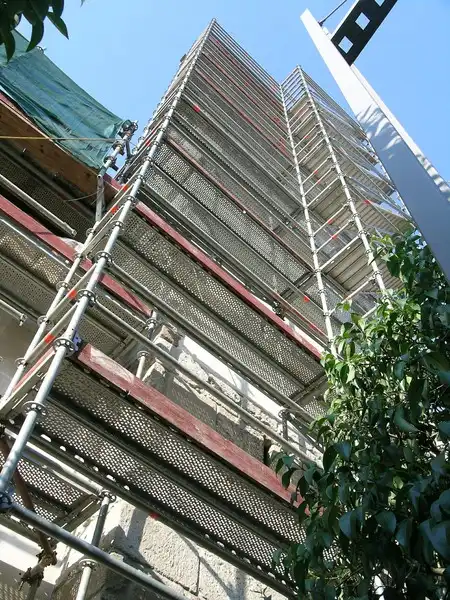

Understanding Round Tube Scaffolding: Basics and Safety Overview
One of the oldest and most flexible temporary building methods used in business construction is round tube scaffolding. Unlike prefabricated modular options, it is made up of separate steel tubes connected by both rotating and fixed couplers. This gives engineers full control over the shape, height, and direction of the load.
What Makes the Circular Tube Profile Structurally Reliable?
The cross-section is spherical not because it looks nice, but because it is better for engineering. There is a constant moment of inertia around the whole circumference of a hollow round tube. This means that it doesn't bend or compress in any way, no matter what direction the load is coming from. On real building sites, where forces don't always come from a single, predictable angle, this trait is very important. The tube has a wall thickness of 3.0mm and is made of Q235 steel. It can hold a working load that meets both OSHA 1926 Subpart Q requirements and EN 39 dimensional standards.
This type of round tube scaffolding is the most popular temporary work solution in South Asia, East Africa, and West Africa. This isn't just because it's cheap; the system is also very flexible. It works with uneven facades, last-minute changes to the design, and mixed-use sites where a rigid modular frame would need to be reconfigured, which would be expensive.
Evaluating the Safety of Round Tube Scaffolding in Commercial Settings
Three factors affect how safe a round tube scaffolding system is: the quality of the material, the accuracy of the measurements, and the stability of the connections. On a business site, each variable is given the same amount of weight.
Load Capacity: What the Numbers Actually Mean
Up to 40 kN can be supported by a single standard (vertical tube) in a coupler scaffold that is properly braced. The amount of weight it can hold depends on the ledger spacing and tie frequency. Structure analysis rules, such as the UK's TG20:21 and the European standard EN 12811-1, back up that range. The course of the load goes from the work platform, down through the transoms and ledgers, and onto base plates that are firmly on the ground. Each link in that chain has to work. The whole chain is damaged by a coupler that slips under torque or a tube whose walls are not all the same thickness.
To tell the difference between trustworthy sellers and shady ones, this is where material approval comes in. The most common problem with cheap scaffold tubes is that the wall width changes. A tube that says it is 3.0mm but is actually 2.5mm loses about 17% of its cross-sectional area, which makes it less resistant to bending. The only way to catch this before the tubes get to the site is to use ultrasonic thickness gages when they are being made.
How Does Tube-and-Coupler Compare to Other Systems?
A lot of the time, procurement managers compare cuplock, ringlock, and frame scaffold systems to round tube scaffolding. Here is an honest comparison in three areas that are important for business projects:
- Geometric flexibility: round tube scaffolding wins hands down. It can be set up around round columns, soffits that slope, and uneven facades that modular rosette or cup systems can't reach or need expensive adapter parts for.
- Unit cost and reusability: Round steel tubes usually have the lowest prices per ton of all the types of scaffolding. When properly maintained, the parts can be used dozens of times, which makes the lifecycle cost very attractive for contractors and distributors who buy a lot of products.
- Assembly speed: Cuplock and ringlock systems can be put together more quickly on squares that are the same shape over and over. For complicated shapes, round tube scaffolding needs more skilled workers, but this is a small price to pay for the ability to change the shape easily.
These comparisons make it clear that round tube scaffolding occupies a distinct niche — it is not the fastest system, but it is the most adaptable and the most economical at scale.
Best Practices for Safe Assembly and Maintenance
Just picking the right product isn't enough to keep the site safe. The other half comes from strict assembly rules and a regular inspection schedule.
Pre-Assembly Checks That Prevent Failures
Before any round tube scaffolding tube is lifted into place, the following checks protect workers and the building:
- Use an ultrasonic gage to check the wall thickness of a representative sample. Any tube that is less than 2.8 mm should be kept in a special area.
- Check the jaw faces of the couplers for cracks, wear, or warping. The 45–50 N·m torque specification set by EN 74 can't be met by a coupler whose jaw is broken.
- Make sure the base plates are on solid, level ground or sole boards that are wide enough to spread the weight without going through.
- Make sure that none of the tubes have any deformation, sharp notches, or corrosion pits that are more than 0.5 mm deep.
Once the system is put together, regular maintenance checks its safety over a number of release rounds. TG20:21 upkeep guidelines say that in warm or seaside areas, visual checks should be done every six months and dimensional thickness checks should be done every two years. Paint-based tubes only last two to three years outside, but hot-dip galvanized tubes last ten to fifteen years.
Procurement Considerations for Safe Round Tube Scaffolding
It takes more than checking prices per ton to find safe round tube scaffolding. When the product gets to the job site, it will either work as planned or not depending on the documentation the provider gives and the manufacturing system that supports it.
What Certifications and Documentation Actually Protect You?
A reliable company that makes round tube scaffolding will give you a material test certificate that says the steel is Q235 or a similar grade, a dimensional inspection report that lists the outside diameter and wall thickness, and ISO 9001 quality management approval from a third party. The manufacturer's ISO 14001 environmental management and CE marks show that their production controls have been checked by outsiders, not just what they say they do.
GREEN FORMWORK, which is based in Shandong, has ISO 9001, ISO 14001, and CE certifications. The business has a standard workshop that is over 40,000 square meters and has 12 welding robots and 6 automatic welding lines. The workshop is in Rizhao, Shandong, which is a port city with direct access to the ocean for freight. With 920 workers, 180 of whom are expert staff, and a product line that ships to more than 100 countries, the manufacturing scale allows for large-order consistency that smaller mills can't provide. Before committing to a large sale, you can get samples with all the technical information you need.
Decision-Making Framework: Is Round Tube Scaffolding the Best Choice for Your Project?
Is round tube scaffolding right for your project? This answer is contingent upon three project-specific elements: the shape of the site, the budget cycle, and the frequency of reuse.
If your project involves uneven surfaces, apartment buildings with multiple stories, or public works infrastructure with columns spaced differently than usual, round tube scaffolding is better than hard modular options just because it can be adjusted to fit your needs. It's hard to beat the economics of steel round tubes if your procurement cycle focuses on getting the lowest landed cost per ton while still maintaining Q235 material certification. If you rent or sell things and need them to last 20 or more times at different locations, properly coated tubes are the way to go because they are built to last and can be used again and again.
round tube scaffolding doesn't work as well on fast-track, repetitive grid structures where speed of assembly is the most important factor. In those situations, cuplock or ringlock methods might cut down on work hours by a lot.
Conclusion
Round tube scaffolding is still one of the most affordable and stable temporary work systems that commercial contractors and material distributors around the world can use. Its track record for safety relies on the quality of the materials used, especially the consistency of the wall thickness and the certified steel grade, as well as careful assembly and regular inspection. The system meets and goes beyond the structural needs of difficult business sites in the road, municipal, and building construction sectors when it comes from a maker with quality management systems that have been inspected and production records that can be tracked.
FAQ
Does round tube scaffolding meet international safety standards?
Yes. Made from Q235 steel and measuring Φ48x3.0mm, it meets the dimensions of EN 39 and works with OSHA 1926 Subpart Q load and construction guidelines. Products that are CE-certified have been checked by a third party.
How do I verify that wall thickness matches the specification?
Ask the maker for a report on an ultrasound thickness test. Reliable sellers do this check while the goods are being made and include the results in the paperwork for the shipment.
What is the typical service life of galvanized scaffold tubes?
When left outside, hot-dip galvanized tubes usually last 10 to 15 years. Painted tubes that aren't galvanized break down a lot faster in hot or ocean areas.
Can these tubes be reused across multiple projects?
Tubes that are built to order can be used again and again. Between launches, check for deformation and corrosion. Any tube with a wall thickness less than the minimum allowed level should be thrown away.
What payment terms do manufacturers typically offer for bulk orders?
Letter of Credit (L/C) arrangements are available for most well-known makers for big orders. These cover both the buyer and the seller throughout the transaction cycle.
Get Certified Round Tube Scaffolding from GREEN FORMWORK
GREEN FORMWORK sells high-quality round tube scaffolding that is made to meet the exacting standards of Φ48×3.0mm Q235 and comes with ISO 9001, ISO 14001, and CE approval. As a reliable company that makes round tube scaffolding and ships to more than 100 countries, we offer discounts for large orders, full material documentation, and samples with technical support before you make a decision. To get a quote that fits the size of your project, email our team at sdxingruiqp@126.com or go to sdxingrui.com.
References
1. Health and Safety Executive (HSE). The TG20:13 Guide to Good Practice for Scaffolding with Tubes and Fittings. NASC, 2013.
2. British Standards Institution. BS EN 39:2001 — Loose Steel Tubes for Tube and Coupler Scaffolds. BSI, 2001.
3. European Committee for Standardization. EN 12811-1: Temporary Works Equipment — Scaffolds. CEN, 2003.
4. Occupational Safety and Health Administration. OSHA 1926 Subpart Q — Concrete and Masonry Construction and Scaffolding Standards. U.S. Department of Labor, 2011.
5. Peng, J. L., Pan, A. D., & Chan, S. L. Simplified Models for Analysis and Design of Modular Falsework. Journal of Constructional Steel Research, 1998.
6. International Organization for Standardization. ISO 9001:2015 — Quality Management Systems: Requirements. ISO, 2015.
Learn about our latest products and discounts through SMS or email