- English
- French
- German
- Portuguese
- Spanish
- Russian
- Japanese
- Korean
- Arabic
- Greek
- German
- Turkish
- Italian
- Danish
- Romanian
- Indonesian
- Czech
- Afrikaans
- Swedish
- Polish
- Basque
- Catalan
- Esperanto
- Hindi
- Lao
- Albanian
- Amharic
- Armenian
- Azerbaijani
- Belarusian
- Bengali
- Bosnian
- Bulgarian
- Cebuano
- Chichewa
- Corsican
- Croatian
- Dutch
- Estonian
- Filipino
- Finnish
- Frisian
- Galician
- Georgian
- Gujarati
- Haitian
- Hausa
- Hawaiian
- Hebrew
- Hmong
- Hungarian
- Icelandic
- Igbo
- Javanese
- Kannada
- Kazakh
- Khmer
- Kurdish
- Kyrgyz
- Latin
- Latvian
- Lithuanian
- Luxembou..
- Macedonian
- Malagasy
- Malay
- Malayalam
- Maltese
- Maori
- Marathi
- Mongolian
- Burmese
- Nepali
- Norwegian
- Pashto
- Persian
- Punjabi
- Serbian
- Sesotho
- Sinhala
- Slovak
- Slovenian
- Somali
- Samoan
- Scots Gaelic
- Shona
- Sindhi
- Sundanese
- Swahili
- Tajik
- Tamil
- Telugu
- Thai
- Ukrainian
- Urdu
- Uzbek
- Vietnamese
- Welsh
- Xhosa
- Yiddish
- Yoruba
- Zulu
How Does Round Tube Scaffolding Compare With Frame Scaffolding?
When sourcing scaffolding for large infrastructure or building projects, the choice between round tube scaffolding and frame scaffolding directly affects your cost per ton, site flexibility, and long-term return on investment. Round tube scaffolding — also called tube and coupler scaffolding — uses individual steel pipes connected by loose fasteners, giving workers the freedom to build at virtually any angle or height. Frame scaffolding, by contrast, arrives as pre-welded panels that bolt together in fixed increments. Understanding the structural and commercial differences between these two systems helps procurement buyers make faster, more confident decisions.
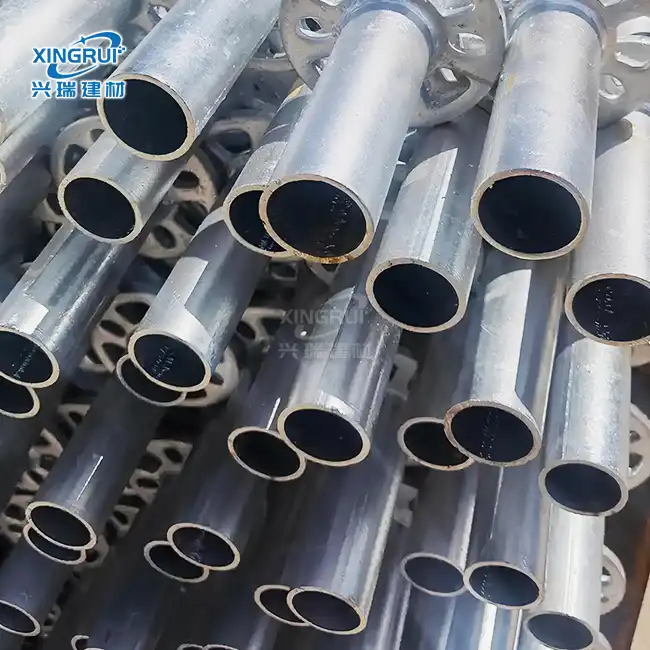
Understanding Round Tube and Frame Scaffolding
What Is Round Tube Scaffolding?
Tube and coupler scaffolding is made of separate steel pipes (usually Φ48×3.0mm) that are joined together with couplers that can rotate or stay in place. Workers can freely change bay lengths, lift heights, and bracing angles on the job site because the system doesn't come with a set grid module. Here it is the main system used in Africa, South Asia, and the Middle East, where buildings often have irregular shapes and different types of projects.
What Is Frame Scaffolding?
Frame scaffolding is made up of H-frames or ladder frames that are already joined together and fit together with cross braces and base plates. It's easy to put together because the sizes are set at the mill. The downside is that these set sizes mean that the system can only be used on projects with standard floor-to-floor heights and normal footprints. This means that it can't be used on industrial or complex sites.
Key Structural Differences at a Glance
The round shape of a round tube scaffolding cross-section spreads bending and compression loads evenly in all directions. This is known as uniform moment of inertia by engineers. A welded frame, on the other hand, fights loads best along the axis that was built for it. This physical difference is what makes tube and coupler systems better at handling uneven force lines on places with more than one use than frame systems.
Performance and Safety Comparison
Load-Bearing Capacity
TG20:21 guidelines say that a single standard in a properly braced tube and coupler system can hold between 20 and 40 kN. This has been checked by a structural engineer. Frame scaffolding leg ratings are about the same per bay, but getting those ratings depends on installing the cross-braces correctly, which is something that workers sometimes skip when they are in a hurry. By design, the coupler-based system needs each connection to be torqued separately, which makes it important to pay attention to every joint.
International Safety Standards
En 39, BS 1139, and GB/T 13793 all say that tube and coupler scaffolding made of Q235 steel with a minimum yield strength of 235 MPa is the right size. In North America, frame scaffolding made of the same grade of material meets ANSI/SSFI SC100 standards. The only difference between the two types of systems is that standard frame layouts come with load tables that have already been approved, while tube and coupler systems need to be set up by a qualified scaffold designer.
Height and Environmental Stability
Tube and coupler systems are often used above 40 meters if they are built properly and are tied to the structure at regular intervals. Most of the time, frame scaffolding is only used for low- to medium-rise residential work that is less than 20 meters high. The narrower surface area of individual tubes lowers wind loads in coastal or offshore areas with a lot of wind, compared to pre-welded frames with their wider surface area.
Cost, Procurement, and Maintenance Insights
Price Per Ton and Total Landed Cost
For large buyers who care about price, round tube scaffolding components like standard pipes, couplers, and base plates usually cost less per ton than frame panels of the same size because they are easier to make. When buying in full container loads, buyers can mix pipe lengths (1.5m, 2.0m, 3.0m, 4.0m, and 6.0m) to get the most out of each container and lower the cost of freight per unit.
Supplier Availability and Bulk Orders
There are hundreds of Chinese mills that make tube and coupler parts to widely standard sizes. This means that you can find spare parts and suitable couplers in West Africa, Nigeria, Ghana, and South Asia. Frame scaffolding parts are more different between brands, which means you can only get new parts from one place and can't resell them in as many places.
Lifecycle and Maintenance Costs
These are the main things that affect the total cost of ownership for each system when it comes to upkeep costs:
Tubes made of round steel that have been hot-dip galvanized last 10–15 years outside, while painted tubes only last 2–3 years. According to TG20:21, annual upkeep includes an eye check every six months and an ultrasonic check of the wall thickness every two years.- The welded joints of frame scaffolding panels collect dirt and water, which speeds up corrosion inside the panels. It costs more per unit to replace broken frames because the pre-welded assembly can't be fixed on site like a bent tube can be swapped out one at a time.
- Round steel tubes with hot-dip galvanized coating achieve a service life of 10–15 years outdoors, compared to 2–3 years for painted tubes. Annual maintenance involves visual inspection every six months and a wall-thickness check every two years using an ultrasonic gauge, per TG20:21 recommendations.
- Frame scaffolding panels collect debris and moisture in their welded joints, which accelerates internal corrosion. Replacement of damaged frames is more expensive per unit because the pre-welded assembly cannot be repaired on site the way a bent tube can be swapped out individually.
Over the course of several project rounds, these changes in cost become important. When distributors sell to contracting firms, having inventory that lasts longer means less replacement orders from site managers and a better reputation for the quality of the products.
Application Suitability and Use Case Scenarios
Where Tube and Coupler Systems Lead?
Round tube scaffolding works great in places with odd shapes or big loads. West African road and bridge projects often have bent abutments and different soffit heights. This is an environment where a tube and coupler system can be set up perfectly but a fixed-module frame cannot. This method is also better for industrial upkeep in cement plants and refineries because the pipes can fit around existing equipment without having to be spaced out in a rigid way like welded frames do.
Where Frame Scaffolding Works Best
Frame scaffolding works well for building groups of similar townhomes or low-rise apartment buildings with the same width and height of each floor. Faster assembly cuts down on labor costs for simple projects, and pre-approved load tables make the paperwork process easier for small contractors who don't have a dedicated scaffold designer.
Procurement Lesson From the Field
In a seaside market in West Africa, a wholesaler who works with city road projects had both types of systems in stock. They found that tube and coupler parts were changed three times a year across a range of project types. Frame parts, on the other hand, were mostly changed during the housing boom during the dry season. This pattern shows that tube and coupler parts can be sold in more ways by large importers who serve a variety of building markets.
Making the Right Choice: How to Decide Between Round Tube and Frame Scaffolding
Evaluate Your Project Mix First
When your customers work on big building projects, industrial maintenance, or historic renovations, tube and coupler scaffolding gives them the freedom they need on the job site. Frame scaffolding may be worth the slightly higher cost per unit if your customers are small home builders who are short on time.
Factor in Supplier Reliability and Certification
Before you place a bulk order, you should always ask for mill test certificates that prove the Q235 material grade, wall thickness readings from a third party that you can trust, and copies of the ISO 9001 and CE certifications. These papers will protect you if local customs officials or project workers check the goods on site.
Consider Reusability and Resale Value
Because they can be used with different brands, tube and adapter parts have a high secondary market value. Frame panels from non-standard sources don't have much value when it comes to reselling if the cross-brace shape doesn't match what's available locally. Importers who need to keep track of their cash flow across multiple projects should keep standardized tube and coupler stock on hand.
Conclusion
Frame scaffolding and round tube scaffolding are both useful for construction, but they are best used for different types of projects. Tube and coupler systems are the best choice for bulk importers who serve the building and infrastructure markets because they are more flexible, last longer, and can be sold again and again. Assembly is faster with frame platforms on low-rise home sites where work is done over and over again. For most procurement buyers in Africa and South Asia, a stock of tubes and couplers is the most stable part of their product line. Frame framing is added for specific customer groups as an extra.
FAQ
Is round tube scaffolding stronger than frame scaffolding?
Per structural design, a single tube and coupler standard can carry 20 kN to 40 kN depending on bracing configuration, comparable to frame scaffolding leg ratings. The advantage of the tube system is that its circular cross-section handles multi-directional loads consistently, while frame panels are optimized for loads along a single axis.
How long does galvanized tube scaffolding last outdoors?
Hot-dip galvanized steel tubes with a zinc coating thickness of ≥60μm typically achieve a service life of 10–15 years in outdoor environments, compared to 2–3 years for painted tubes.
Can tube and coupler components mix with other scaffolding brands?
Yes. Components built to Φ48×3.0mm or Φ48.3mm outer diameter standards are compatible with universal couplers available globally, making on-site repairs and extensions straightforward.
What certifications should I ask for when buying in bulk?
Request the mill test certificate for Q235 material grade, an independent wall-thickness inspection report, and copies of ISO 9001 quality management and CE product certifications.
How often should scaffolding tubes be inspected?
Per TG20:21 guidelines, visual inspection every six months and an ultrasonic wall-thickness check every two years are recommended in normal environments. In coastal or high-humidity zones, increase inspection frequency accordingly.
Get a Competitive Quote From GREEN FORMWORK — Trusted Round Tube Scaffolding Supplier
Since 2007, GREEN FORMWORK (Shandong Xingrui Building Materials Co., Ltd.) has been making approved round tube scaffolding that is backed by ISO 9001, ISO 14001, and CE certifications. Our normal Q235 steel tubes in ¥48×3.0mm size ship to over 100 countries and come with full material test certificates. Samples are also available upon request. For bulk pricing, L/C payment terms, and scheduling for container loads, please contact our team directly at sdxingruiqp@126.com.
References
1. Construction Industry Scaffolding Safety Manual — Health and Safety Executive (HSE), 2021.
2. TG20:21 Guide to Good Practice for Scaffolding with Tubes and Fittings — National Access & Scaffolding Confederation (NASC), 2021.
3. EN 39: Loose Steel Tubes for Tube and Coupler Scaffolding — European Committee for Standardization (CEN), 2001.
4. BS 1139-1: Metal Scaffolding — Tubes — British Standards Institution (BSI), 1990.
5. GB/T 13793: Welded Steel Tubes for Scaffolding — Standardization Administration of China (SAC), 2016.
6. ANSI/SSFI SC100: Safety Requirements for Scaffolding — Scaffolding, Shoring & Forming Institute (SSFI), 2012.
Learn about our latest products and discounts through SMS or email