- English
- French
- German
- Portuguese
- Spanish
- Russian
- Japanese
- Korean
- Arabic
- Greek
- German
- Turkish
- Italian
- Danish
- Romanian
- Indonesian
- Czech
- Afrikaans
- Swedish
- Polish
- Basque
- Catalan
- Esperanto
- Hindi
- Lao
- Albanian
- Amharic
- Armenian
- Azerbaijani
- Belarusian
- Bengali
- Bosnian
- Bulgarian
- Cebuano
- Chichewa
- Corsican
- Croatian
- Dutch
- Estonian
- Filipino
- Finnish
- Frisian
- Galician
- Georgian
- Gujarati
- Haitian
- Hausa
- Hawaiian
- Hebrew
- Hmong
- Hungarian
- Icelandic
- Igbo
- Javanese
- Kannada
- Kazakh
- Khmer
- Kurdish
- Kyrgyz
- Latin
- Latvian
- Lithuanian
- Luxembou..
- Macedonian
- Malagasy
- Malay
- Malayalam
- Maltese
- Maori
- Marathi
- Mongolian
- Burmese
- Nepali
- Norwegian
- Pashto
- Persian
- Punjabi
- Serbian
- Sesotho
- Sinhala
- Slovak
- Slovenian
- Somali
- Samoan
- Scots Gaelic
- Shona
- Sindhi
- Sundanese
- Swahili
- Tajik
- Tamil
- Telugu
- Thai
- Ukrainian
- Urdu
- Uzbek
- Vietnamese
- Welsh
- Xhosa
- Yiddish
- Yoruba
- Zulu
Best Modular Steel Formwork Systems for Reusable Concrete Molds
When procurement managers ask which reusable concrete mold system delivers the best return across large-scale projects, modular steel formwork consistently tops the list. Built from high-grade structural steel, these systems offer dimensional precision within ±1.0mm, lateral pressure resistance of 60–80 kN/m², and 300–500 reuse cycles per panel set. For contractors working on bridges, tunnels, high-rise towers, or Belt and Road infrastructure, that combination of strength, repeatability, and cost control is difficult to match with any alternative.
Understanding Modular Steel Formwork Systems
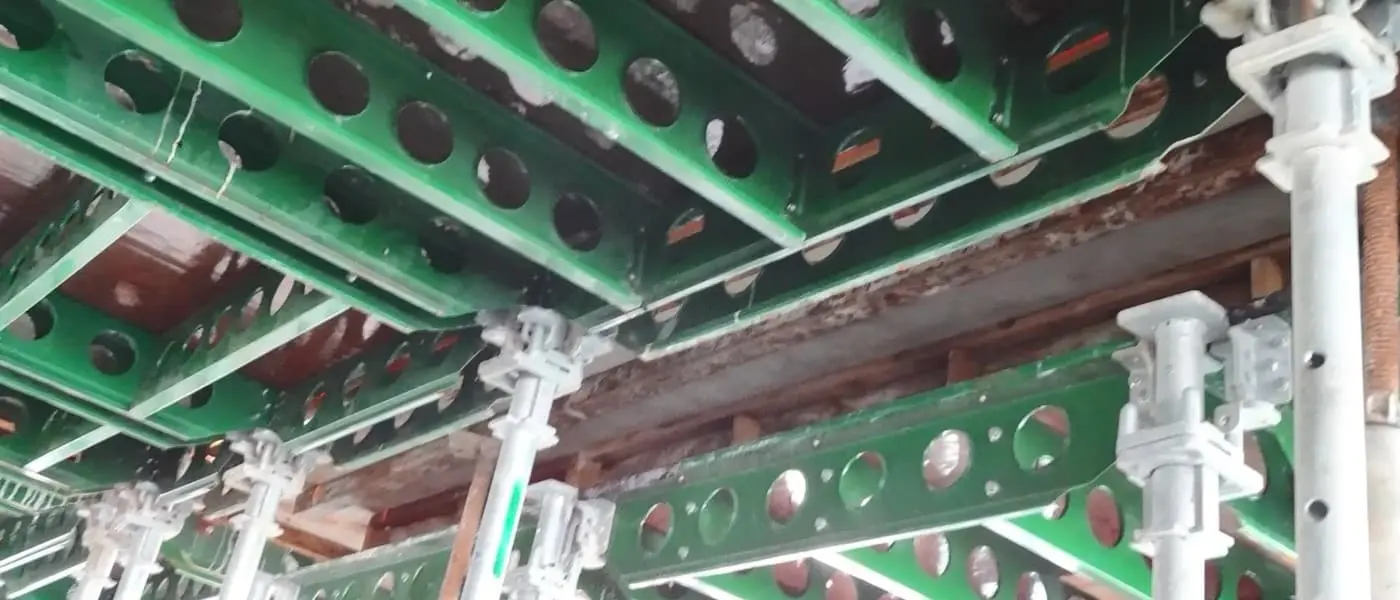
Modular steel formwork is a temporary construction carefully designed to hold concrete in place. It is made up of standard, interlocking steel pieces and hardware for joining them. You can think of it as a strong, reusable mold system that gets rid of the need to cut wood on-site for every pour.
Core Design Principles
The system depends on 1500x300mm or 1800x300mm interchangeable panel units that are made to very tight tolerances so that field teams can put together setups without having to cut them to fit. Behind each 3.0 mm face panel, there are 5 mm thick reinforcing ribs that make the cross-section stiff so that it doesn't bend when fresh concrete is pressed on it.
Common System Types
Most projects can be done with three main configurations. Standard face sheets are used by panel systems to work with flat walls, blocks, and columns. Beam-and-panel combos add horizontal carriers that can be adjusted for slab decks on frames with more than one story. For round shafts and underground holes, special cylindrical or tunnel lining systems use curved geometry. The standard stock of parts is used by all of them, so it's easy to keep track of spare parts across a collection of projects.
Quantified Benefits for B2B Buyers
The European Federation of Foundation Contractors reports that modular steel formwork systems can cut the cost of finishing the surface of concrete by up to 30% compared to timber systems. This is because the smooth, fair-faced steel face means that secondary plastering is rarely needed. Panels don't have to be hand-fitted and nailed together; instead, they clip together. This cuts down on labor hours even more. These savings add up quickly for procurement teams that are in charge of multiple project sites at the same time.
Comparing Modular Steel Formwork with Traditional Alternatives
Many contractors still default to timber or plywood because the upfront purchase price looks lower. That logic breaks down quickly when you account for the full project lifecycle.
Steel vs. Timber and Plywood
Timber formwork typically yields 8–15 reuse cycles before dimensional accuracy degrades. At that rate, a contractor pouring 60 floors needs to replace the entire system four times or more. Steel panels rated for 300–500 cycles change that math entirely. Waste generation drops, landfill costs disappear, and the cost-per-pour falls below timber after roughly 50–70 uses.
Steel vs. Aluminum
Aluminum formwork is lighter and resists corrosion well, making it popular for residential repetitive-floor systems. However, aluminum panels deform more readily under heavy hydrostatic loads — a real problem when pouring thick bridge piers or tunnel linings where concrete pressure exceeds 60 kN/m². Q235 structural steel panels maintain shape under those loads without additional backing frames.
Steel vs. Plastic Composite Systems
Plastic composite panels offer easy cleaning and low weight but carry lower load ratings and a narrower temperature tolerance range. For infrastructure projects in desert heat or northern winters, steel maintains consistent mechanical properties across a wider operating range, reducing the risk of unexpected panel deflection mid-pour.
Evaluating and Selecting the Best Modular Steel Formwork System
Not just panel price should be used to choose a supplier. Before sending out a buy order, procurement managers at big general contractors usually look at five decision factors.
Here are the main factors that project managers with a lot of experience use to judge candidates:
- Deep-drawing design capability: The supplier must read your structural drawings and produce a panel layout plan — not just ship standard sizes. Tailored-to-order configuration reduces site waste and prevents costly rework when non-standard wall thicknesses or curved elements appear on the drawings.
- Certified quality management: ISO 9001 confirms production process control. ISO 14001 addresses environmental compliance, which matters for projects seeking green certification. ISO 45001 covers occupational health and safety — a requirement on many international tenders. CE marking under EN 12812 satisfies European owner compliance checks.
- Production capacity and delivery guarantees: An automated plant with robotic welding lines can hold output consistent through peak demand seasons. Ultrasonic weld testing on every batch provides documented evidence of panel integrity before shipment.
- Sample availability and technical support: Suppliers who provide free prototype panels and on-call engineering support shorten the qualification cycle from months to weeks. This matters when project start dates are fixed.
- Payment terms and after-sales logistics: Large orders shipped in stages to multiple project sites need clear delivery scheduling. Suppliers located near a seaport — such as Rizhao, which has direct port access — reduce lead time variability on international orders.
Payment terms and how to handle things after the sale for modular steel formwork: Clear delivery dates are needed for big orders that are sent in stages to different project sites. When an international order comes from a supplier near a seaport, like Rizhao, which has direct access to the port, lead times are less likely to change.
Installation and Maintenance of Modular Steel Formwork
How close you get to the 300–500 refill cycles depends on how well you handle it in the field. If you want steel panels to work as planned, you have to take good care of them all the time.
Installation Protocol
A spirit level should be used to make sure that all panels are level and that all wedge pins are fully engaged before each pour. Putting a release agent on the steel face keeps the concrete from sticking and keeps the coating on the surface safe. The rate of pouring should not go over the lateral pressure design limit. One of the most common reasons formwork fails on the job site is rushing a pour beyond the panel's rated 60–80 kN/m².
Routine Maintenance Practices
Panels should be cleaned with high-pressure water to get rid of any leftover concrete before it sets after they have been stripped. If the powder coating or zinc layer is scratched, you should add a touch-up coat of industrial primer to keep rust from forming while the item is being stored. A thin layer of form release oil put on the panels before they are stacked stops corrosion between the faces of the panels during long-term storage.
Compliance and Safety Standards
EN 12812 spells out the standards for design proof for falsework and formwork sold in Europe. If a manufacturer has ISO 45001 certification, it means that safety management is built into the process, not added on after the fact. When looking for suppliers for projects in regulated markets, procurement teams should ask for third-party inspection reports along with self-certifications from the suppliers.
Environmental and Future Trends of Modular Steel Formwork
About 30% of the world's solid waste comes from the building business, and single-use timber formwork is a measured part of that. That number goes down directly at the project level when you switch to a modular steel formwork reuse concrete structure system.
Sustainability Profile
The World Steel Association says that more than 85% of steel in the world is recycled every year. This makes steel one of the most recycled materials in the world. When their time is up, worn-out steel panels go back into the scrap supply chain instead of being thrown away. Formwork reuse rates can be used as proof of waste removal for projects that want to get LEED or BREEAM approval.
BIM Integration and Digital Planning
Suppliers of frameworks now offer digital panel sets that work with BIM tools. Before a single piece ships, project engineers can run a virtual pour sequence to find clashes and find the best number of panels. With this one step alone, modeling before construction can cut repairs on-site by tens of percent for complicated buildings.
Market Outlook
According to Grand View Research (2023), the global construction formwork market was worth about USD 5.2 billion in 2022. It is expected to grow at a rate close to 5% per year until 2030, mainly because of spending on urban infrastructure in Asia, the Middle East, and Africa. When procurement professionals are making lists of suppliers to work with, locking in capacity deals with high-output makers puts their companies ahead of expected demand pressure.
Conclusion
When compared to wood or plywood, modular steel formwork systems offer procurement managers and project engineers a clear path to lower per-pour costs, better physical control, and less site waste. The business case for switching is easy to see: each panel can hold more than 60kN of weight, can be used 300–500 times, and comes with full ISO and CE certification from well-known manufacturers. Check providers' drawing support, production capacity, and level of certification, and then choose a partner who can deliver regularly across many project sites and seasons.
FAQ
What is the expected reuse life of a steel panel system?
If you clean and recoat high-quality Q235 steel panels on a regular basis, they can be used 300–500 times without any problems. When compared to wooden forms, the break-even point usually happens after 50 to 70 uses. After that, each extra pour lowers the total cost-per-m² poured.
Can the system handle non-standard structural shapes?
Yes, suppliers who can review drawings and make products in-house (this is called "tailored-to-order production") can make panels that fit curved walls, tapered columns, or cross-sections that aren't typical. The important thing is to give full structure plans early on in the buying process.
What certifications should I require from a supplier?
ISO 9001 covers production quality for projects in China. Add ISO 14001, ISO 45001, and CE approval under EN 12812 for foreign bids. Buyers who care about quality usually ask for third-party plant inspection records and material mill certificates for the base steel.
How do I verify panel quality before accepting a large batch?
Ask for a first-article inspection report that includes testing for panel flatness (within 1.0 mm), weld penetration using ultrasonic waves, coating thickness using magnetic induction, and putting together a trial sample. If the supplier is trustworthy, they will give you this paperwork as standard, not as an extra.
Partner with GREEN FORMWORK for Your Next Project
Shandong Xingrui Building Materials Co., Ltd. makes GREEN FORMWORK, which gives purchasing teams direct access to a qualified modular steel formwork maker with a 79,800 m² production base, 12 welding robots, and experience exporting to more than 100 countries. The standards that our panels meet are ISO 9001, ISO 14001, ISO 45001, and CE/EN 12812. You can get free samples and help from engineers. To get a quote for your job right away, email our team at sdxingruiqp@126.com.
References
1. Grand View Research. Construction Formwork Market Size, Share & Trends Analysis Report. 2023.
2. World Steel Association. Steel Recycling Rates and Environmental Performance. 2023.
3. European Federation of Foundation Contractors (EFFC). Guide to Formwork and Falsework in Foundation Engineering. 2020.
4. British Standards Institution. EN 12812: Falsework — Performance Requirements and General Design. 2008.
5. International Organization for Standardization. ISO 45001: Occupational Health and Safety Management Systems. 2018.
6. Chandrangsu, T., & Rasmussen, K.J.R. Structural Modelling of Formwork and Falsework Systems. Journal of Constructional Steel Research. 2011.
Learn about our latest products and discounts through SMS or email