- English
- French
- German
- Portuguese
- Spanish
- Russian
- Japanese
- Korean
- Arabic
- Greek
- German
- Turkish
- Italian
- Danish
- Romanian
- Indonesian
- Czech
- Afrikaans
- Swedish
- Polish
- Basque
- Catalan
- Esperanto
- Hindi
- Lao
- Albanian
- Amharic
- Armenian
- Azerbaijani
- Belarusian
- Bengali
- Bosnian
- Bulgarian
- Cebuano
- Chichewa
- Corsican
- Croatian
- Dutch
- Estonian
- Filipino
- Finnish
- Frisian
- Galician
- Georgian
- Gujarati
- Haitian
- Hausa
- Hawaiian
- Hebrew
- Hmong
- Hungarian
- Icelandic
- Igbo
- Javanese
- Kannada
- Kazakh
- Khmer
- Kurdish
- Kyrgyz
- Latin
- Latvian
- Lithuanian
- Luxembou..
- Macedonian
- Malagasy
- Malay
- Malayalam
- Maltese
- Maori
- Marathi
- Mongolian
- Burmese
- Nepali
- Norwegian
- Pashto
- Persian
- Punjabi
- Serbian
- Sesotho
- Sinhala
- Slovak
- Slovenian
- Somali
- Samoan
- Scots Gaelic
- Shona
- Sindhi
- Sundanese
- Swahili
- Tajik
- Tamil
- Telugu
- Thai
- Ukrainian
- Urdu
- Uzbek
- Vietnamese
- Welsh
- Xhosa
- Yiddish
- Yoruba
- Zulu
How to make steel formwork
High-strength steel panels are fabricated and assembled to produce temporary molds for new concrete walls, columns, slabs, and other structural elements. Steel formwork is accurate, moisture-resistant, and has no bending from wet concrete hydrostatic pressure, unlike wooden or plywood. The technique may be reused over 50 times in Q235 carbon steel with robotic welding and precision stamping, cutting the steel formwork construction per-pour cost for big infrastructure and commercial construction projects globally.
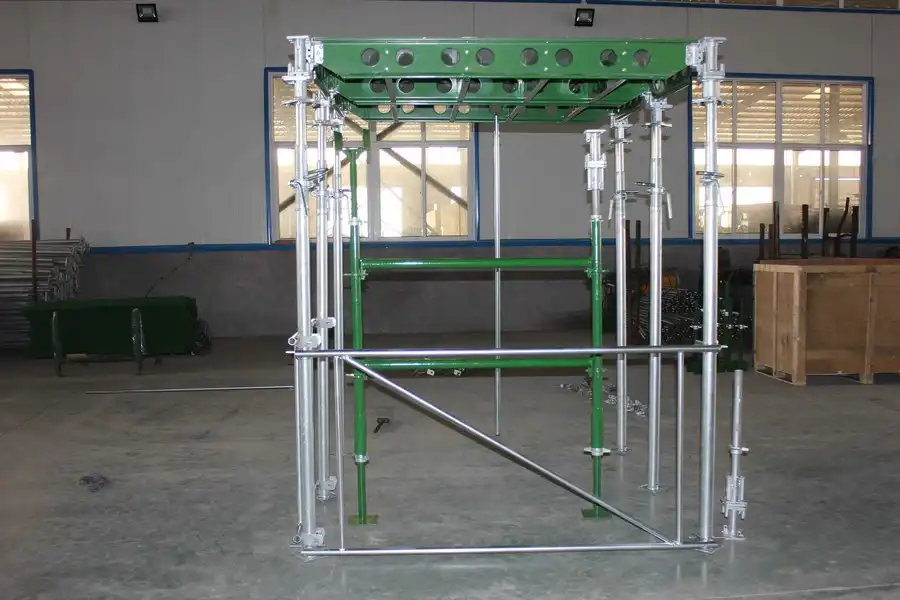
Understanding Steel Formwork Construction
What Steel Formwork Is and How It Works
Flat-face panels, edge frames, linking tools, and supporting props make up a steel formwork system. Together, they form a rigid mold. New concrete is put inside, pressed down, and then left to dry. As soon as the concrete is strong enough, the panels are taken apart and moved to the next pour site. The steel surface doesn't absorb water, so it leaves a smooth concrete finish that doesn't need as much patching and saves time on the job site.
Why Engineers Prefer Steel Over Other Options
Even after being loaded and unloaded many times, steel pieces keep their flat surfaces within a 2 mm range. This level of accuracy has a direct effect on the quality of walls and towers made of cast-in-place concrete. This level of accuracy helps contractors avoid costly rework and schedule penalties that can reach millions of dollars on large EPC contracts on infrastructure projects in the Middle East and Southeast Asia, where government contracts demand strict dimensional compliance.
Types of Steel Formwork Systems
Standardized panel forms, like 1500x300mm and 1200x200mm, are used in modular systems. These panels can be put together in any shape, which makes them useful for high-rise buildings or bridge piers with repeating floor plans. Systems that are fixed or made to order are made for shapes that aren't possible with normal modules, like bent dam faces, silo walls, or tunnel linings. Which type to use depends on the size of the project, how complicated the geometry is, and how many times it will be used.
Step-by-Step Process to Make Steel Formwork
Design and Engineering
An in-depth engineering review is the first step in the steel formwork construction fabrication process. Load estimates must be done to make sure that the frame spacing and panel width are safe enough to handle the lateral pressure of the concrete pour, which changes depending on the rate of pour, the density of the concrete, and the temperature of the environment.
There are standard thicknesses ranging from 2.3mm to 3.0mm, and each one works well in a variety of pressure situations. At this stage, engineers also plan the layout of the pin holes to make sure that the unit is always lined up correctly on site.
Material Cutting, Welding, and Surface Treatment
Once the design is approved, cold roll forming lines cut Q235 superior carbon steel sheets to the right size. The face plate is then joined to the stamped frame using robotic welding equipment, which makes sure that every unit has the same amount of weld penetration.
One of the main reasons panels fail during a pour is inconsistent welds, so automated welding with real-time tracking is a great quality boost. After being welded, panels go through an electrostatic painting workshop where an anti-rust layer sticks tightly to the steel surface. This keeps the steel from rusting on job sites that are damp or near the coast.
Installation, Safety, and Maintenance
Cleaning the bearing surface and putting a release agent on the panel face are the first steps in a proper fitting. After using the bolt hole grid to line up the panels, workers fix the joints to the right torque and put in back-ups or tie rods before any concrete is poured.
Safety rules say that people who handle panels, which can weigh 15–30 kg each, must wear PPE like hard hats, gloves, and steel-toed boots. Crews should wash panels, check for distortion, and re-coat them with release agent after cleaning them before putting them away. This process makes the circle of reuse last much longer than 50 pours.
Comparing Steel Formwork with Other Formwork Materials
Steel vs. Timber and Plywood
Wood and plywood are cheap when you first buy them, but after a few uses, they soak up water, swell, and come apart. For projects that need 20 or more pours, the total cost of replacing plywood usually goes over the initial cost of steel panels. A 2019 study in the Journal of Construction Engineering and Management found that switching from plywood to steel formwork construction cut down on material waste on a mid-rise residential project by as much as 40%.
Here's a direct look at how the key success factors compare:
- Reuse cycle: Steel can be poured more than 50 times, while plywood can be poured 5–8 times before the surface quality starts to decline.
- Surface finish: Steel gives a Class A smooth finish; wood often needs extra work to be finished to meet standards.
- Environmental impact: Steel can be recycled in its entirety when it's time to retire, but plywood creates solid waste that is hard to handle on job sites that are far away.
- Weight and handling: Wood is easier to move by hand, but steel modular systems with motorized lifting tools can be put together faster for big jobs.
Because of these differences, steel is the best choice for builders who are working on several projects at once and need a formwork product that will hold its value across a portfolio.
Steel vs. Aluminum
Aluminum formwork is often used in high-rise apartment building construction because each panel is lighter. But steel panels are stiffer than aluminum when the pour is very thick, like in raft supports or heavy bridge piers, because aluminum can bend when it's under pressure. When it comes to buying in bulk, steel is also cheaper, especially when FOB prices are discussed directly with a maker who has automated production lines.
Procurement Guide for Steel Formwork
Evaluating Suppliers
Before a purchase order is placed, a reputable seller should show proof of CE certification, EN-standard compliance, and third-party inspection reports from companies like SGS or Bureau Veritas. Directors of procurement should also check the supplier's production capacity, such as the number of welding robots, forming lines, and workshop space, to see if they can ship large orders within the lead time that was agreed upon.
Customization and Delivery Reliability
For projects with non-standard structural parts, you need a seller who can make things based on your plans. Shandong Xingrui Building Materials Co., Ltd. (sdxingrui.com) takes custom orders based on drawings and samples provided by the customer. The company runs a 79,800 m² plant with 4 cold roll forming lines and 12 welding robots.
This production capacity lets large orders get delivered on time without sacrificing accuracy in measurements for steel formwork construction. The business has ISO 9001, ISO 14001, and ISO 45001 standards, which cover managing quality, the environment, and workers' health and safety.
Pricing Strategies and Trial Orders
To buy something, most EPC contractors go through the following steps: inquiry → drawing approval → sample testing → factory inspection → trial order of one to two containers → full project batch. It is common to ask for a sample before placing a large order. This is a responsible way to check the quality of the welds and the flatness of the panels. FOB pricing with well-defined Incoterms makes it clear how to divide up freight costs and is the shipping method most international project buyers prefer.
Addressing Challenges in Steel Formwork Construction
Panel Misalignment and Joint Leakage
When panels aren't lined up right, they leave gaps at the joining joints. This lets cement slurry leak and makes surface flaws that need to be ground down or fixed. Most of the time, this problem is caused by manufacturing flaws in the size or alignment of the bolt holes. Panels made on automated pressing lines with tight size tolerances—for example, surfaces that are flat within ≤2mm—avoid most alignment problems in the field before the panels even get to the job site.
Corrosion in Harsh Environments
Steel panels rust faster in projects that are located near the coast in the Middle East or in Southeast Asia, where it is humid and tropical. When applied in a controlled factory setting, electrostatic powder coating is much more resistant to corrosion than paint that is put on in the field. Also, crews should check the panels every time they are used and fix any places where the covering has chipped so that rust doesn't damage the face of the panels.
On-Site Safety Protocols
Larger jobs need motorized help, like cranes or trucks, to move big steel panels. Clear lift plans, drop zones, and making sure workers wear the right PPE are all things that site managers need to make sure happen. Project engineers can back up their shoring and bracing plans with evidence that they follow EN 12812 (Europe) or similar local falsework standards.
Conclusion
When the system is properly designed, built, and maintained, steel formwork construction offers quantifiable benefits in terms of concrete quality, panel longevity, and project cost control. When procurement teams choose Q235 carbon steel panels with tight dimensional tolerances, robotic welding, and a proven anti-corrosion coating, they get a formwork asset that can be used over and over again. When paired with a supplier that can make to specific drawings and meet delivery deadlines for large international orders, the right steel formwork construction system gives EPC infrastructure projects around the world a long-term competitive edge.
FAQ
How many times can steel formwork panels be used again?
If you clean, inspect, and re-coat well-made panels made from Q235 carbon steel with an electrostatic coating between pours, they can be used more than 50 times. The exact number depends on how carefully the panels are moved, stored, and taken care of on site.
Can steel formwork be changed to fit buildings that aren't standard?
Yes, suppliers with CNC cutting and cold roll forming tools can make panels that match plans given by clients for curved walls, circle columns, and other non-standard shapes. Before starting full production, you should always send specific shop plans and ask for samples to check the sizes.
What kinds of licenses should a company that sells steel forms have?
At the very least, look for ISO 9001 for quality management and CE approval for projects that need to meet European or EU contract requirements. ISO 14001 and ISO 45001 are certifications that show the manufacturer takes care of worker and environmental issues in a way that meets the needs of international projects.
How does weather change the time it takes to strip?
Steel is a good heat conductor, so panels can cool or heat up depending on the temperature outside. When it's cold, it takes longer for concrete to hit its breaking strength, which is usually 1.2 MPa for walls that don't hold weight. To avoid removing concrete too soon, choices about stripping should always be based on how strong the concrete is on the job site, not on a set timeline.
What needs to be fixed after each pour?
After removing the old concrete, use a scraper to get rid of any leftover concrete. Check the panel face and frame for distortion, re-coat the face with a good release agent, and store the panels flat or upright in a dry place. If you catch small deformations early, they don't get worse over time and shorten the panel's useful life.
Request a Custom Steel Formwork Quote from GREEN FORMWORK
GREEN FORMWORK makes steel formwork construction panels from Q235 carbon steel that are CE-certified and ISO 9001/14001/45001-compliant. The surface is kept within ≤2mm of being flat. Our team answers quickly with technical support and sample arrangements, whether you need standard modular panels or sizes made to fit your project plans. Get in touch with our export team at sdxingruiqp@126.com or visit sdxingrui.com to talk about your project needs with a qualified steel formwork construction source right away.
References
1. Journal of Construction Engineering and Management — American Society of Civil Engineers, 2019.
2. Concrete Construction: Methods and Costs — Gillette, H.P. & Hill, C.S., Revised Edition, McGraw-Hill, 2017.
3. Formwork for Concrete Structures — Hurd, M.K., 4th Edition, American Concrete Institute, 2005.
4. EN 12812: Falsework — Performance Requirements and General Design — European Committee for Standardization (CEN), 2008.
5. Construction Technology and Management — Jha, K.N., PHI Learning, 2012.
6. Global Construction 2030: A Global Forecast for the Construction Industry — Global Construction Perspectives and Oxford Economics, 2015.
Learn about our latest products and discounts through SMS or email