- English
- French
- German
- Portuguese
- Spanish
- Russian
- Japanese
- Korean
- Arabic
- Greek
- German
- Turkish
- Italian
- Danish
- Romanian
- Indonesian
- Czech
- Afrikaans
- Swedish
- Polish
- Basque
- Catalan
- Esperanto
- Hindi
- Lao
- Albanian
- Amharic
- Armenian
- Azerbaijani
- Belarusian
- Bengali
- Bosnian
- Bulgarian
- Cebuano
- Chichewa
- Corsican
- Croatian
- Dutch
- Estonian
- Filipino
- Finnish
- Frisian
- Galician
- Georgian
- Gujarati
- Haitian
- Hausa
- Hawaiian
- Hebrew
- Hmong
- Hungarian
- Icelandic
- Igbo
- Javanese
- Kannada
- Kazakh
- Khmer
- Kurdish
- Kyrgyz
- Latin
- Latvian
- Lithuanian
- Luxembou..
- Macedonian
- Malagasy
- Malay
- Malayalam
- Maltese
- Maori
- Marathi
- Mongolian
- Burmese
- Nepali
- Norwegian
- Pashto
- Persian
- Punjabi
- Serbian
- Sesotho
- Sinhala
- Slovak
- Slovenian
- Somali
- Samoan
- Scots Gaelic
- Shona
- Sindhi
- Sundanese
- Swahili
- Tajik
- Tamil
- Telugu
- Thai
- Ukrainian
- Urdu
- Uzbek
- Vietnamese
- Welsh
- Xhosa
- Yiddish
- Yoruba
- Zulu
Is All-Round Scaffolding Suitable for Industrial Maintenance Work?
Yes — all-round scaffolding is one of the most capable systems available for industrial maintenance work. Its ringlock modular design allows crews to build access platforms around curved surfaces, dense pipe networks, and confined equipment bays with speed and structural precision. Each rosette node accepts connections from up to eight directions, which means the system adapts to geometry that defeats conventional tube-and-clamp setups. For refineries, power plants, and shipyards operating under tight shutdown windows, that flexibility translates directly into fewer labor hours and lower project risk.
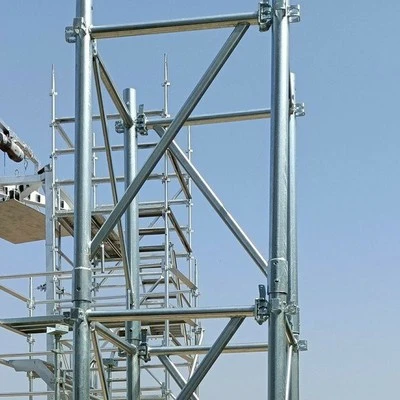
Understanding All-Round Scaffolding in Industrial Maintenance
What the System Actually Is
A ringlock modular system is a ready-made access framework made up of vertical standards, horizontal ledgers, and diagonal braces that all fit into a rosette disk that has been carefully bonded. There are no loose bolts or different couplers with a wedge-lock link because it tightens itself. This lets you know what the geometry is and how the load will move, which is important when safety experts have to approve a temporary building inside a working facility.
Why Industrial Sites Choose It
One thing that both petrochemical shutdowns and port dry-dock processes have in common is that time is more expensive than materials. Field comparisons have shown that ringlock scaffolding cuts erection time by about 50% compared to tube-and-clamp options. The standardized inventory of parts also means fewer lost or mismatched parts, which is a common problem on big industrial sites where many crews are working at the same time.
Load Performance That Matches the Environment
In a well-built ringlock tower, each vertical standard can hold up to 50 kN. When attached to permanent buildings, towers can reach heights of more than 50 meters. When you connect the diagonal bracing directly to the rosette nodes, you get a rigid frame that can handle lateral wind loads and equipment vibration, which are both common in busy industrial settings.
Advantages of All-Round Scaffolding Over Traditional Solutions
When comparing ringlock scaffolding to older systems like tube-and-clamp or frame scaffolding, the ringlock method always wins in industrial settings, especially when all-round scaffolding performance is required. Here are the main differences in performance that procurement teams say they see:
- Assembly speed: The wedge-lock connection requires only a hammer — no spanners, no torque checks. Crews report erection rates that are 40–50% faster than equivalent tube-and-clamp structures on refinery piping projects.
- Structural integrity: Precision-welded rosettes maintain verticality within 0.2% tolerance, which reduces cumulative error in tall shoring towers and eliminates field correction time.
- Corrosion resistance: Hot-dip galvanization to ISO 1461 applies a 60–80 micron zinc coating, extending service life to 15–20 years even in saltwater or chemical exposure environments common in shipyards and petrochemical plants.
- Component compatibility: The system works with both 48 mm and 60 mm tube series, so it integrates with existing site inventory without requiring a full fleet replacement.
Because of these performance benefits, industrial operators spend less time and money replacing corroded parts and fewer shifts putting them together. A steel ringlock fleet pays for itself over a 10-year asset cycle just by lowering the number of times it needs to be replaced.
How to Install and Safely Use All-Round Scaffolding in Industrial Settings
Site Preparation Requirements
Before the tower is put up, the ground-bearing ability must match the loads that are planned for it. Point loads are spread out across the surface by base plates and movable jacks. Sole boards are put under base plates to keep them from moving around in industrial settings with grated floors or uneven concrete. The layout plan should include places for pipes to go through, valve clearances, and escape routes in case of an emergency.
Assembly Sequence
Base jacks, starting standards, ground-level ledgers, diagonal bracing, and then higher standards are the usual steps that are taken from ground level up, following the all-round scaffolding sequence. With one blow from the mallet, each wedge head fits into its place in the rosette slot. Because of its self-locking geometry, the link is physically active right away, without the need for a torque wrench. A spirit level should be used to check the verticality of the structure at the bottom of each lift before moving up.
Inspection and Ongoing Maintenance
After installation, there are three main things that need to be checked: making sure the wedges are properly seated, making sure the diagonal braces are engaged at both ends of the rosette, and looking at the zinc surface to see if there is any damage.
When the project is done, the rosettes should be cleaned of any concrete or chemical buildup and the wedges should be checked for any deformation before being put back into stock. This protocol keeps the system's 15–20-year service life safe, which makes it cost-effective per use.
Procurement Insights: Choosing and Buying All-Round Scaffolding for Industrial Projects
Certifications and Compliance First
Industrial projects in Europe and the Middle East have to follow government rules. Performance standards for wall scaffolding are set by EN 128010, and performance standards for working scaffolding are set by EN 128111. For HSE to sign off, there must be CE certification and load test paperwork with batch tracking. Ask for the test reports from the ringlock scaffolding suppliers you're considering and make sure they cover the specific component grades in your order.
Evaluating Total Cost of Ownership
When deciding whether to buy or rent, deployment frequency should be taken into account. For contractors who do three or more industrial shutdowns a year or more, buying a hot-dip galvanized fleet is usually cheaper in the long run than renting them over and over again. A well-kept steel system will last 15–20 years, which means that the initial cost is spread out over many projects.
What to Confirm Before Ordering
When looking for all-round scaffolding for industrial projects, make sure your supplier knows about these four things: the zinc coating thickness (minimum 60 microns per ISO 1461), the dimensional tolerance on rosette spacing (±1 mm to avoid cumulative error in tall structures), the load test certificates for the specific component series, and the lead time for custom configurations if your project geometry needs bay widths that aren't standard.
Real-World Performance and Client Feedback
Contractors who work in petrochemical plants always say that the multi-directional rosette connection makes it easier to get to areas around spherical storage tanks and dense piping headers, which are obstacles that regular frame scaffolding can't reach. Because links can be set at angles other than 90°, the platform can follow the structure instead of causing the structure to fit the platform.
The HDG finish is the most important thing to shipyard workers who work in dry docks. Within two seasons, saltwater mist and chemical cleaners break down scaffolding that isn't painted or covered. That weakness isn't there in a 60–80 micron zinc layer, so the fleet stays in use and doesn't need to have parts swapped out in the middle of a job.
When industrial repair managers move from tube-and-clamp systems to ringlock systems, they say that crew training time goes down by a lot. The self-indexing wedge connection means that skilled fitters aren't needed as much for regular work. This cuts down on the cost of labor per square meter of erected area without lowering safety standards.
Conclusion
The needs of industrial maintenance are well suited for All-round scaffolding in its ringlock modular form. Its multidirectional link geometry can work with complicated site plans that other systems can't. The normal load rate of 50 kN per side and the verticality tolerance of less than 0.2% meet the structural needs of refineries, power plants, and shipyards.
With certifications that meet European compliance standards and a service life of 15–20 years after proper hot-dip galvanization, the system makes a strong case for contractors looking to invest in a fleet for the long term. The last step that makes sense is to find a supplier with verified certifications, technical support in English, and batch traceability.
FAQ
What load capacity does a ringlock standard support?
Under engineered conditions, each vertical standard can hold up to 50 kN. The actual site capacity depends on how well the foundations are prepared, how often the ties are made, and the structural calculation for the tower configuration in question. Before committing to a safety-critical application, you should always ask your provider for proof of load tests.
Can components from different manufacturers be mixed?
Mixing is usually not a good idea unless technology compatibility is officially proven through load testing. Many systems use the same 48.3 mm OD tube standard, but each maker has their own rosette geometry and wedge thickness. Also, mixing that hasn't been approved can weaken connections when they're under a lot of stress.
How long does hot-dip galvanization last in industrial environments?
A zinc coating of 60–80 microns that is applied according to ISO 1461 standards protects against corrosion for 15–20 years in normal construction settings. If something is exposed to harsh chemicals or saltwater, its service life relies on how often it is checked and fixed if any mechanical damage is found. Custom orders can be made by manufacturers like Shandong Xingrui Building Materials Co., Ltd. using client drawings or samples. This lets projects have bay widths and ledger lengths that are just right without changing the certified node geometry.
Is customization available for non-standard bay widths?
For sales in Europe and the Middle East, you need to have CE certification, ISO 9001 quality management paperwork, and EN 12810/12811 compliance test reports that can be used to track each batch. The factory has environmental and worker safety management systems in place because it has ISO 14001 and ISO 45001 certifications.
What certifications should I require from a supplier?
For European and Middle Eastern markets, require CE certification, ISO 9001 quality management documentation, and EN 12810/12811 compliance test reports with batch traceability. ISO 14001 and ISO 45001 certifications indicate environmental and occupational safety management systems are in place at the manufacturing facility.
Request a Quote from GREEN FORMWORK — All-Round Scaffolding Supplier
GREEN FORMWORK sells ringlock scaffolding that is CE-certified and made from high-quality Q235 steel that has been hot-dipped galvanized 60–80 microns thick. It is certified by ISO 9001, ISO 14001, and ISO 45001, and it is sent to more than 100 different countries. If you ask, you can get sample units and full detailed instructions in English. You can talk to our team about your project needs, get batch tracking papers, or place a trial order by emailing sdxingruiqp@126.com or visiting sdxingrui.com.
References
1. European Committee for Standardization. EN 12811-1: Temporary Works Equipment — Scaffolds — Performance Requirements and General Design. CEN, 2003.
2. International Organization for Standardization. ISO 1461: Hot Dip Galvanized Coatings on Fabricated Iron and Steel Articles. ISO, 2022.
3. Health and Safety Executive (HSE). Scaffolding Safety: General Guidance for Construction and Industrial Sites. HSE Books, 2020.
4. Construction Industry Research and Information Association (CIRIA). Temporary Works: An Introduction to Their Design and Construction. CIRIA, 2018.
5. International Labour Organization. Safety and Health in Construction: ILO Code of Practice. ILO, 2020.
6. American National Standards Institute / Scaffolding Industry Association. ANSI/SSFI SC100: Standard for Scaffolding — Safety Requirements. ANSI, 2021.
Learn about our latest products and discounts through SMS or email