- English
- French
- German
- Portuguese
- Spanish
- Russian
- Japanese
- Korean
- Arabic
- Greek
- German
- Turkish
- Italian
- Danish
- Romanian
- Indonesian
- Czech
- Afrikaans
- Swedish
- Polish
- Basque
- Catalan
- Esperanto
- Hindi
- Lao
- Albanian
- Amharic
- Armenian
- Azerbaijani
- Belarusian
- Bengali
- Bosnian
- Bulgarian
- Cebuano
- Chichewa
- Corsican
- Croatian
- Dutch
- Estonian
- Filipino
- Finnish
- Frisian
- Galician
- Georgian
- Gujarati
- Haitian
- Hausa
- Hawaiian
- Hebrew
- Hmong
- Hungarian
- Icelandic
- Igbo
- Javanese
- Kannada
- Kazakh
- Khmer
- Kurdish
- Kyrgyz
- Latin
- Latvian
- Lithuanian
- Luxembou..
- Macedonian
- Malagasy
- Malay
- Malayalam
- Maltese
- Maori
- Marathi
- Mongolian
- Burmese
- Nepali
- Norwegian
- Pashto
- Persian
- Punjabi
- Serbian
- Sesotho
- Sinhala
- Slovak
- Slovenian
- Somali
- Samoan
- Scots Gaelic
- Shona
- Sindhi
- Sundanese
- Swahili
- Tajik
- Tamil
- Telugu
- Thai
- Ukrainian
- Urdu
- Uzbek
- Vietnamese
- Welsh
- Xhosa
- Yiddish
- Yoruba
- Zulu
Facade Scaffold Tube Scaffolding Benefits for Building Renovation
When a building renovation project demands safe, code-compliant access to every inch of an exterior wall, facade scaffold tube scaffolding is the system most project managers trust. This type of external wall scaffolding combines Q235 carbon steel tubes, friction-grip couplers, and integrated safety accessories into one orderly protection frame.
Whether the job involves masonry repair, plaster application, or insulation cladding, tube-and-coupler scaffold systems give teams the structural capacity and geometric freedom that prefabricated alternatives often cannot match. The following guide walks procurement managers, engineers, and distributors through everything they need to make a confident sourcing decision.
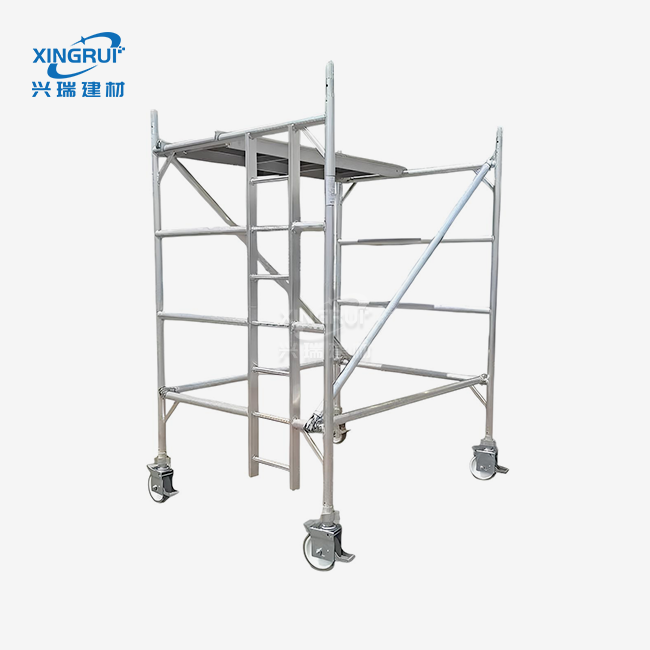
Understanding Facade Scaffold Tube Scaffolding
Before calling around to different suppliers or comparing prices, it's helpful to know what this system is and why it works the way it does on the job site.
What the System Is
Facade scaffold tube scaffolding is a temporary work platform made of steel tubes that are joined together with mechanical couplers. Each joint is put together on-site, which is different from frame or modular scaffolding. This means that the shape can be changed at any time during the building process. The normal tube width is 48.3 mm, which is the same size for EN 39, BS 1139, and AS 1576 so that parts can be used anywhere in the world.
Core Structural Principles
The load path goes up and down through upright standards, across and under ledgers, and finally down and across base plates or adjustable jacks. The safety barrier is made up of dense mesh safety nets, foot pedals, and guard bars around the edges. Shandong Xingrui has uprights that are 1.5 m apart and steps that are 1.8 m apart. This layout has been tried for work on external walls, plastering, and insulation protection.
Material Impact on Performance
The tubes have a 4:1 safety factor under stated loads because they are made of Q235 quality carbon steel, which has a tensile strength of up to 490 MPa. With the right care, the hot-dip galvanization layer (at least 40 microns) on each facade scaffold tube scaffolding component will protect against corrosion for 10 to 15 years in maritime and industrial settings. The total cost of ownership for a business that buys instead of rents is directly related to how long the coating lasts.
Key Benefits of Facade Scaffold Tube Scaffolding for Building Renovation
When renovating the outside of a building, project managers always worry about three things: the safety of the workers, meeting deadlines, and being ready for inspections. Here are the main benefits that cover all three at the same time.
- Regulatory compliance from day one. Tubes manufactured to EN 39 and BS 1139 tolerances (±0.5 mm on outer diameter) meet inspection requirements in European, North American, and Asian markets without additional testing. ISO 9001, ISO 14001, and ISO 45001 certifications at the manufacturing level give procurement teams documented proof of process control.
- Geometric freedom for irregular facades. Friction-grip couplers allow scaffolding to wrap balconies, cornices, and recessed window frames that stop rigid modular systems cold. On heritage restoration work, this precision prevents direct contact with fragile architectural surfaces.
- Visible protection for street-facing projects. Dense mesh safety nets and orderly guard rail lines create a tidy site appearance. For urban renovation contracts where the building owner, neighbors, and inspectors can all see the scaffold from the street, a well-ordered protection frame directly affects acceptance sign-off and payment timelines.
These benefits lead to real results in terms of schedule and price. It is cheaper to just put the system up again if it passes review the first time. When builders buy their own tools, a scaffold that stays in good shape for 10 to 15 years is seen as an asset rather than a regular cost.
Comparing Facade Scaffold Tube Scaffolding with Other Systems
Picking the right access system is a real purchase decision, not just a formality. The pros and cons of each method are different.
Tube-and-Coupler vs. Ringlock
Because the rosette node can handle multiple ledgers at once, Ringlock scaffolding can be put together more quickly. But it can only go up by the module increments that are already set in its nodes. Tube-and-coupler scaffolding lets engineers set any spacing the structure needs for uneven surfaces with non-standard bay widths. Additionally, it saves money when the tools stay on site for months during long-term repair jobs.
Tube-and-Coupler vs. Frame Scaffolding
Inside fit-outs and low-rise work go well with frame platforms. On exterior walls with more than one story, where wind loads rise with height and the shape of the facade changes from floor to floor, the independent facade scaffold tube scaffolding system works better because each joint can be torqued to exactly 40–60 Nm with a calibrated wrench, and any worn-out part can be replaced on its own.
Weight and Logistics Considerations
A normal Q235 tube that is 6 meters long weighs about 14 kg. That's doable for most sites to handle by hand, and it keeps freight costs low for buyers from other countries. Since the tubes and couplers are sold separately, buying teams can only order the amount and design that their structural engineer specifies. This way, there are no extra parts that end up in a yard gathering dust.
Procurement Considerations for Facade Scaffold Tube Scaffolding
Once the project manager chooses tube-and-coupler scaffolding, the sourcing process follows a set pattern: specifications, seller review, and placing an order.
Buy vs. Rent Decision
When a company has more than one contract at the same time, keeps tools between projects, and plans to use the system for more than two or three job cycles, it makes financial sense to buy. Single-project workers who don't need a lot of storage space should rent instead of own. Shandong Xingrui's tubes are made to be used again and again; the hot-dip galvanizing surface doesn't scratch or rust even after many times of assembly.
Supplier Evaluation Criteria
A reliable company that makes wall scaffold tube scaffolding should give you mill certificates with chemical makeup data, dimensional inspection reports, and copies of their most recent ISO and CE certifications. Buyers should be clear about how thick the zinc coating is and ask if samples can be sent before a full order is placed. Shandong Xingrui can provide samples and give expert support for projects that don't follow standard layouts.
Customization and Global Logistics
Shandong Xingrui can take orders based on plans given by the customer. This is useful for projects that need wall-tie brackets or bays with odd sizes. The company ships facade scaffold tube scaffolding to more than 100 countries from its base in Rizhao, Shandong, which is a port city with easy access to the sea. Before you confirm your order, you can talk to the technical team directly about lead times and plans for packing containers.
Ensuring Safety and Compliance in Facade Scaffold Tube Scaffolding
Safety is not an option; it's a must, and the paperwork that supports it must be able to stand up to scrutiny from regulators.
Key Standards and Certifications
EN 39 controls the shape of steel tubes, and BS 1139 specifies the materials and performance standards for parts used in tube-and-coupler scaffolding. Safety rules for platforms on US job sites are set by OSHA 29 CFR 1926 Subpart Q. When products with the CE mark and ISO 45001 occupational health and safety management are inspected, site safety officers can see a clear paper trail.
On-Site Safety Protocols
Before any platform level is loaded, all wall-tie connections should be checked against the drawing made by the engineer-of-record. According to EN 13374 Class A, guard rail heights must be at least 950 mm to protect against vertical falls. Attachment rules in EN 1263-1 should be followed when installing a safety net. It takes less than 30 minutes to do these checks on each lift, and they greatly lower the risk of responsibility.
Inspection and Maintenance Schedule
Before using again, each tube should be checked for damage to the ends, surface rust that has broken through, and distortion that can be seen. Check the tightening pressure of the couplers and replace them if the jaw shows more than 10% wear. A reuse log that keeps track of the history of projects, the state of the zinc coating, and any impact events helps meet the standards of ISO 9001 for tracking and makes the equipment always ready for an audit.
Conclusion
Facade scaffold tube scaffolding is still one of the most flexible and affordable systems for renovating the outside of a building. With its hot-dip galvanized finish, Q235 steel construction, and flexible coupler geometry, it gives project managers the compliance paperwork, structural strength, and freedom in shape that demanding wall work needs. When procurement teams are looking at different system options, tube-and-coupler scaffolding is a good long-term investment because it can be used again and again and meets international standards. This is true for both one-time projects and ongoing renovation programs.
FAQ
How long does a hot-dip galvanized scaffold tube last?
Hot-dip galvanizing Q235 tubes last 10 to 15 years if they are used in dry places and get regular upkeep. Coastal or industrial sites that are more likely to rust may need more frequent inspections of their coatings.
Can tube-and-coupler scaffolding adapt to irregular facade profiles?
Yes. It can wrap around balconies, decorative cornices, and recessed window bays that modular systems can't cleanly reach because each tube length and coupler angle can be set separately.
What torque is correct for scaffold couplers?
A calibrated torque wrench is used to apply 40 to 60 Nm, which is what is standard in the industry. Couplers that are too loose can slip when there is a dynamic load, and couplers that are too tight could crack the collar.
How do I verify a supplier's quality compliance?
Ask for copies of the mill certificates, ISO and CE certificates, and test reports on the thickness of the zinc coating. Before you place a full order, ask the seller to send you a real sample. Shandong Xingrui offers both detailed documents and samples that can be ordered ahead of time.
Is it better to buy or rent for a 6-month renovation contract?
If the company wants to use the equipment again, buying usually wins for a 6-month job. When you use Q235 tubes with a coating that lasts 10 to 15 years, you usually get your money back by the second or third deployment.
Partner with GREEN FORMWORK for Your Next Renovation Project
With the help of Shandong Xingrui Building Materials Co., Ltd., GREEN FORMWORK provides approved exterior scaffold tube scaffolding that is made in a 79,800 m² factory with 12 welding robots and full ISO 9001, ISO 14001, and ISO 45001 compliance. As a reliable supplier of facade scaffold tube scaffolding that ships to more than 100 countries, we offer custom configurations, sample supplies, and direct technical support. To get a price, email our team at sdxingruiqp@126.com or go to sdxingrui.com.
References
1. Construction Industry Research and Information Association (CIRIA). Scaffolding Safety Guidance for Renovation Projects. CIRIA, 2021.
2. British Standards Institution. BS 1139-1: Metal Scaffolding — Tubes. BSI, 2019.
3. European Committee for Standardization. EN 39: Loose Steel Tubes for Tube and Coupler Scaffolding. CEN, 2001.
4. Occupational Safety and Health Administration. OSHA 29 CFR 1926 Subpart Q: Scaffolding. U.S. Department of Labor, 2020.
5. International Organization for Standardization. ISO 45001: Occupational Health and Safety Management Systems. ISO, 2018.
6. Hadipriono, F.C., & Wang, H.K. Analysis of Causes in Scaffolding Accidents in the United States. Journal of Construction Engineering and Management, ASCE, 2014.
Learn about our latest products and discounts through SMS or email