- English
- French
- German
- Portuguese
- Spanish
- Russian
- Japanese
- Korean
- Arabic
- Greek
- German
- Turkish
- Italian
- Danish
- Romanian
- Indonesian
- Czech
- Afrikaans
- Swedish
- Polish
- Basque
- Catalan
- Esperanto
- Hindi
- Lao
- Albanian
- Amharic
- Armenian
- Azerbaijani
- Belarusian
- Bengali
- Bosnian
- Bulgarian
- Cebuano
- Chichewa
- Corsican
- Croatian
- Dutch
- Estonian
- Filipino
- Finnish
- Frisian
- Galician
- Georgian
- Gujarati
- Haitian
- Hausa
- Hawaiian
- Hebrew
- Hmong
- Hungarian
- Icelandic
- Igbo
- Javanese
- Kannada
- Kazakh
- Khmer
- Kurdish
- Kyrgyz
- Latin
- Latvian
- Lithuanian
- Luxembou..
- Macedonian
- Malagasy
- Malay
- Malayalam
- Maltese
- Maori
- Marathi
- Mongolian
- Burmese
- Nepali
- Norwegian
- Pashto
- Persian
- Punjabi
- Serbian
- Sesotho
- Sinhala
- Slovak
- Slovenian
- Somali
- Samoan
- Scots Gaelic
- Shona
- Sindhi
- Sundanese
- Swahili
- Tajik
- Tamil
- Telugu
- Thai
- Ukrainian
- Urdu
- Uzbek
- Vietnamese
- Welsh
- Xhosa
- Yiddish
- Yoruba
- Zulu
Steel Formwork Construction Uses in High-Rise Concrete Projects
There is almost no room for error when your team is looking for formwork systems for a 30-story building or a government contract for infrastructure. High-rise concrete work needs precise measurements, reliable load-bearing, and the ability to be used again and again. Steel formwork construction meets these needs. From pouring core walls to building bridge pier columns, modular steel panel systems are now the most important part of vertical construction all over the world. This guide walks buying directors, project engineers, and site managers through every step of the decision-making process, from technical specs to checking out suppliers, so you can feel confident about your sources.
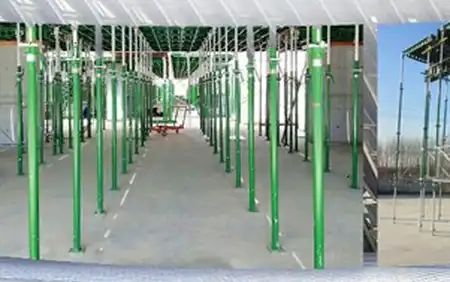
Understanding Steel Formwork in High-Rise Construction
What Steel Formwork Actually Does on a High-Rise Site?
A steel formwork system is a temporary mold made of high-strength steel plates and stiffeners that keeps fresh concrete in the shape that was planned until it hardens enough to support itself. Steel panels keep their tight splicing joints and flat face surface throughout the whole drying cycle, while wood shuttering absorbs water and warps under hydraulic pressure. This directly leads to smoother concrete finishes, tighter standards for size, and fewer hours of corrective grinding per floor, which are all gains that can be seen on a 40-story plan [²].
There are three pressure spots in high-rise building that show how limited other materials are. Plywood breaks down after 5 to 8 uses, while metal, even though it's light, bends when very thick self-compacting concrete is poured on top of it. Modular steel systems, on the other hand, keep their shape after more than 50 reuse cycles without deforming. This is a huge cost savings when you use the same panels up 20 floors.
There are three main types of steel formwork systems: modular panel systems, which come in standard sizes and are put together on-site; custom-fabricated systems, which are built from architectural drawings specific to the project; and hybrid configurations, which are a mix of standard modules and custom corner and junction pieces. All three must meet EN 12812 (falsework performance) or the safety standards that are used where the project is located. Steel formwork construction relies on these system types, with each configuration requiring proper load calculations and compliance with local safety codes to ensure structural stability during concrete pours.
Advantages of Steel Formwork Over Traditional Formwork Methods
Durability, Finish Quality, and Total Cost of Ownership
For high-rise projects, the economic case for steel formwork is simple: a system that can be used more than 50 times lowers its unit cost over the life of the project much more quickly than replacing boards over and over again. A 2022 industry study in Construction and Building Materials found that projects that moved from wood to steel panel systems had 23% less money spent on floor forms over the whole building cycle [²].
When it comes to performance, these are the main reasons why EPC contractors in the Middle East, Southeast Asia, and Africa choose steel:
- Dimensional stability under load: Because Q235 carbon steel has a high modulus of elasticity, panels don't bulge outwards even when concrete is poured quickly. Holding the surface flatness limit at or below 2 mm gets rid of the step flaws that need expensive repairs.
- Watertight joint design: Flat panel faces and precisely stamped frames stop slurry bleed at panel connections, which is important for waterproofing material bonding in basement and platform pours.
- Corrosion resistance: Electrostatic powder-coat treatment improves the service life of panels in humid tropical and seaside areas. Untreated steel would otherwise pit and warp within two to three project cycles.
- Faster cycle times: When bolt holes are aligned by robotic welding, assembly crews spend less time adjusting and more time pouring concrete, which directly shortens the cycle time from floor to floor.
All of these benefits lower both the direct cost of materials and the risk of unpaid labor across the whole concrete package of a project. This is a big win for procurement directors who are in charge of $50M or more contracts.
Key Considerations for Purchasing Steel Formwork for High-Rise Projects
Certifications, Customization, and Supplier Verification
For foreign infrastructure projects, certification paperwork is a must. For government projects in the GCC, Sub-Saharan Africa, and Southeast Asia, it is common for the requirements to include ISO 9001 quality management, CE marking, and proof of third-party quality checks by SGS or Bureau Veritas [³]. If a supplier can't show clear records of weld inspections and material test papers, it can cause compliance issues further down the line, which can lead to project hold points. Steel formwork construction suppliers must provide these certifications upfront, as missing weld records or material test reports often trigger project delays and re-inspection costs.
Customization is what sets a real production partner apart from a dealing middleman. It's rare for high-rise projects to only use normal panel sizes. Architectural setbacks, core walls that aren't square, and MEP penetrations all need custom junction pieces. Before you place a trial order, make sure that your supplier has their own CNC stamping and robotic welding lines and doesn't hire outside companies to do the work.
The decision to buy vs. rent is based on how long the project will last and how often the panels will be used. For a single 18-month tower job, it might make more sense to rent from a nearby yard. For moving multi-project EPC contracts, where the same panel inventory moves from one site to three or four in a row, buying directly from the maker at FOB prices always results in a lower total ownership cost.
Buyers usually compare direct manufacturers with similar technical standards to well-known European brands like Doka, Peri, and ULMA when they are looking for suppliers. Some of the things that make one company better than another are their production capacity (can they confirm batch delivery within your mobilization window?), the time it takes to go from drawing to delivery for custom pieces, and how quickly they respond during the technical confirmation phase.
Optimizing Steel Formwork Use in High-Rise Concrete Projects
Installation Protocols, Maintenance, and BIM Integration
Getting the most reuse cycles starts before the first panel is put together. A pre-pour inspection schedule checks for bolt-hole alignment, panel planarity, and the application of a release agent. This stops the small flaws that add up to structural errors by the tenth floor. After being stripped, panels need to be cleaned right away to get rid of any leftover cement. Hardened laitance speeds up corrosion at weld lines and makes the next use less flat [⁴].
Adding BIM has really helped boost production on complicated high-rise projects. Digital panel-layout modeling finds places where the schedules for the formwork and rebar don't match up before the actual assembly starts. This avoids having to do extra work on core walls that are already crowded. Smart load-monitoring sensors built into climbing formwork platforms also give site managers real-time pressure data that helps them figure out the best pour rates and stripping times, which lowers the risk of overloading and cuts down on waiting time that isn't necessary.
When working with high-rise forms, safety rules must be based on EN 12812 or area standards that are the same. Any project that needs to meet the standards for foreign insurance or a developer audit must have load-bearing verification testing, edge-protection procedures, and crew qualifications for operating the climbing system.
Future Trends and Procurement Outlook for Steel Formwork
By 2030, the world market for concrete forms is expected to be worth $8.2 billion. This is because new cities in the Gulf, East Africa, and Southeast Asia are growing more densely. The way procurement teams find panel systems is changing because of three trends that are coming together. Steel formwork construction stands at the center of this growth, with its durability and reusability making it the preferred choice for large-scale urban development projects across these rapidly expanding regions.
Robotic welding and cold roll forming are two examples of automation in fabrication that are helping manufacturers keep tolerances tighter at scale. This means that buying directly from high-capacity plants is now more technically reliable than it was ten years ago. Sustainability requirements are pushing procurement teams to figure out how much of a material can be recycled. For example, steel formwork panels can be recycled in their entirety when they're no longer needed. This is a metric that is being asked for more and more in ESG-linked project financing documents. Composite hybrid panels, which are made up of steel frames attached to polymer-coated faces, are coming out on the market as a way to make upper-floor climbing systems lighter. However, their ability to last for multiple uses in tropical UV light is still being studied in the field [⁋].
The main idea for EPC procurement directors is clear: build a verified, direct-manufacturer supply relationship now, with completed factory audits, confirmed custom-drawing capability, and negotiated framework pricing. This will allow your procurement team to act quickly when a project is awarded and your mobilization window shrinks to 90 days or less.
Conclusion
For high-rise concrete projects requiring accuracy, sturdiness, and repeatable quality over dozens of floor cycles, steel formwork construction continues to be the most technically reliable and cost-effective option. The right panel system has a direct impact on the quality of the pour, the schedule, and the total cost of the project. This is true whether it's core wall systems in a Gulf tower or pier columns on an African highway bridge. Check for certifications, make sure the supplier can do custom fabrication, and build relationships with them before your mobilization window opens, not after.
FAQ
What thickness of steel formwork panel is appropriate for high-rise core walls?
The normal thickness is between 2.3 mm and 3 mm. When there is a lot of hydrostatic pressure, like when thick shear walls are filled quickly, 2.75mm or 3.0mm panels with stamped-frame support are the best choice. Always check the load-bearing estimate data from the source against the pour rate and wall thickness.
How many times can a steel formwork panel realistically be reused?
With the right care for cleaning, maintaining the corrosion coating, and storing, quality Q235 steel panels can be used more than 50 times. Some systems on controlled sites that are well taken care of reach much higher counts.
What certifications should I require from a steel formwork supplier?
At the very least, you should demand ISO 9001 (quality management), ISO 14001 (environmental management), and CE approval. Third-party inspection reports from SGS or Bureau Veritas add an extra layer of security to projects that are being financed from outside the country.
Can panels be fabricated to match non-standard architectural drawings?
Yes. Reliable manufacturers with their own CNC stamping and robotic welding lines will take custom orders based on drawings provided by the customer. Check that this is possible during the technical quote step.
How does temperature affect stripping time?
Steel is good at moving heat around. Insulation blankets help keep the healing temperature steady in cold places. Concrete compressive strength tests—usually 1.2 MPa for non-load-bearing walls—should be used to decide when to strip, not set schedules alone.
Partner with GREEN FORMWORK for Your Next High-Rise Project
Shandong Xingrui Building Materials Co., Ltd. backs GREEN FORMWORK, which sells approved steel formwork building systems made from Q235 premium carbon steel. These systems are certified by ISO 9001, ISO 14001, and ISO 45001, and they are made in China. We make direct steel formwork for building and have a 79,800 m² production plant with 12 welding robots, 4 cold roll forming lines, and the ability to make custom-drawn panels with a surface flatness of ≤2mm and 50+ reuse cycles. You can get samples and full expert help. To begin your expert study, email us at sdxingruiqp@126.com.
References
1. Hurd, M. K. (2005). Formwork for Concrete (7th ed.). American Concrete Institute.
2. European Committee for Standardization. (2011). BS EN 12812: Falsework — Performance Requirements and General Design. BSI Standards.
3. Concrete Construction Staff. (2019). "Choosing the Right Formwork Material." Concrete Construction Magazine.
4. International Organization for Standardization. (2015). ISO 9001:2015 Quality Management Systems — Requirements. ISO.
5. Peurifoy, R. L., & Oberlender, G. D. (2010). Formwork for Concrete Structures (4th ed.). McGraw-Hill.
6. Construction Industry Research and Information Association (CIRIA). (2012). Report C654: Concrete Formwork — Guide to Good Practice. CIRIA.
Learn about our latest products and discounts through SMS or email