- English
- French
- German
- Portuguese
- Spanish
- Russian
- Japanese
- Korean
- Arabic
- Greek
- German
- Turkish
- Italian
- Danish
- Romanian
- Indonesian
- Czech
- Afrikaans
- Swedish
- Polish
- Basque
- Catalan
- Esperanto
- Hindi
- Lao
- Albanian
- Amharic
- Armenian
- Azerbaijani
- Belarusian
- Bengali
- Bosnian
- Bulgarian
- Cebuano
- Chichewa
- Corsican
- Croatian
- Dutch
- Estonian
- Filipino
- Finnish
- Frisian
- Galician
- Georgian
- Gujarati
- Haitian
- Hausa
- Hawaiian
- Hebrew
- Hmong
- Hungarian
- Icelandic
- Igbo
- Javanese
- Kannada
- Kazakh
- Khmer
- Kurdish
- Kyrgyz
- Latin
- Latvian
- Lithuanian
- Luxembou..
- Macedonian
- Malagasy
- Malay
- Malayalam
- Maltese
- Maori
- Marathi
- Mongolian
- Burmese
- Nepali
- Norwegian
- Pashto
- Persian
- Punjabi
- Serbian
- Sesotho
- Sinhala
- Slovak
- Slovenian
- Somali
- Samoan
- Scots Gaelic
- Shona
- Sindhi
- Sundanese
- Swahili
- Tajik
- Tamil
- Telugu
- Thai
- Ukrainian
- Urdu
- Uzbek
- Vietnamese
- Welsh
- Xhosa
- Yiddish
- Yoruba
- Zulu
TOP 5 American Type Scaffold Frame Benefits for Jobsite Safety
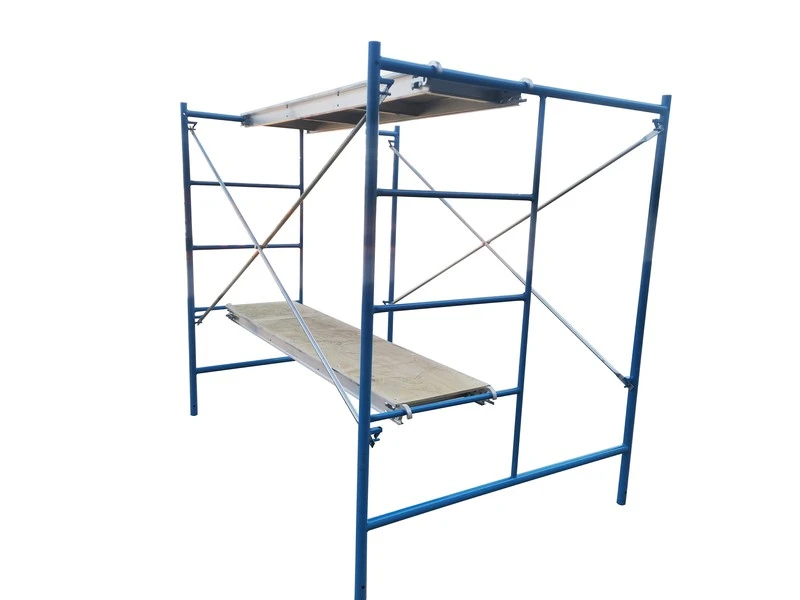
When safety is non-negotiable on a jobsite, the equipment you specify matters as much as the crew you hire. The american type scaffold frame has become the go-to modular steel scaffolding system across North American residential and commercial construction — and for good reason. Engineered to OSHA and ANSI A10.8 standards, this door-type frame system delivers measurable safety gains through sound structural design, fast assembly, and proven material performance. Below are the five most impactful benefits that make it a top specification choice for contractors and distributors alike.
Benefit 1: Enhanced Structural Safety and Stability
Structural failure is the leading cause of scaffold-related fatalities, according to OSHA data. A well-engineered frame system addresses this risk at the design stage.
Q235 Steel and Load-Bearing Performance
Our frames are manufactured from Q235 premium steel with a 42.4 × 2.0 mm tube specification, achieving an ultimate load capacity exceeding 50,000 lbs per tower. This grade of structural steel provides consistent tensile strength across the full production run — batch to batch.
CO2 Shielded Welding for Joint Integrity
All header-to-leg connections are CO2 shielded welded, which increases fatigue resistance compared to standard MIG welding. Connection pin alignment is held to a ±0.5 mm tolerance, so vertical stacking in multi-story configurations stays true without shimming or field correction.
OSHA and ANSI A10.8 Compliance Built In
Every american type scaffold frame ships dimensioned to the North American standard 1700 × 1219 mm (5'7" × 4') format. Meeting OSHA 1926 Subpart Q and ANSI A10.8 from day one means contractors skip the compliance guesswork that often delays project start-up.
These structural properties combine to give procurement managers documented evidence — not just verbal assurances — that the frames they are importing can carry the loads and meet the regulations their downstream contractors depend on.
Benefit 2: Ease of Assembly and Time Efficiency
Most of the time, labor is the most changeable cost on a scaffold job. Cutting down on setup time directly improves the economics of the job site and lowers the risk of accidents that happen during assembly.
Tool-Free Diagonal Brace Connection
You don't need tools or hammers to connect and disconnect diagonal braces when they have American-style lock pins, like flip-lock or C-lock. A normal 5-frame tower can be put up by a two-person crew in less than 20 minutes. This is a measure that rental companies often use in NAHB field reports.
Standardized Frame Geometry Reduces Errors
Since every frame has the same pin spacing and tube OD (1.69"), field crews put frames together without reading instructions. There will be fewer mid-project collapses if there are fewer choice points during erection. This is because there will be fewer wrong links.
Custom Configuration for Project-Specific Demands
You can order frames in either a mason frame (5' × 5') or a walk-thru frame (5' × 6'4") shape, depending on whether the most important thing is maximum platform load or clear ground-level pedestrian passage. This gives North American contractors the freedom to work with just one seller on most types of projects.
Assembling things quickly and repeatedly is not only useful, it's also safe. A fall or structural mistake during building is less likely to happen if workers spend less time at height joining parts.
Benefit 3: Compatibility and Interchangeability
When they are in charge of multiple projects, procurement managers need a system that can work with what they already have on hand instead of having to replace the whole fleet.
Cross-Brand Pin Compatibility
Frames from different makers can use the same cross braces and base plates as long as the tube outside diameter is 1.69" and the pin spacing is the standard 4 feet, or 27.75 inches. This cuts the cost of entry for wholesalers who already have some stock on hand.
Comparison with European and Tube-and-Clamp Systems
The american type scaffold frame doesn't need any special couplers or node points like European-type ringlock or cuplock systems do. Studies by the scaffold trade group show that it can be set up about three times faster than tube-and-clamp systems. With its speed and ease of use, the frame method is best for North American projects.
Inventory Consolidation Benefits
One frame size can be used for most home and light business projects, so sellers can keep less stock on hand without lowering fill rates. Having fewer SKUs makes it easier to store items and process orders faster, which directly increases the profit margin.
Getting all of your accessories from a single ISO-certified manufacturer—base plates, screw jacks, side brackets, and guard rail frames—tightens up the supply chain and lowers the chance that parts will not fit together correctly.
Benefit 4: Cost-Effectiveness and Procurement Flexibility
The real cost of a frame scaffold system is not the price you pay for it, but the total cost split by the number of times you rent or use it.
Reusability Extends ROI Over Decades
Our frames are made and tested to be used over and over again. A hot-dip galvanized zinc covering of at least 65 microns protects against rust for more than 20 years, even when stored near the coast. Rental companies say frames can be used again and again for more than 15 years if they are kept according to the manufacturer's instructions.
Bulk Order and Container Loading Efficiency
Standard 1700 × 1219 mm frames fit easily into 20' and 40' containers, and our shipping team gives buyers full load plans to help them figure out the exact landed costs of an order before they place it. Clear container use lowers the cost of freight per unit, which is important when tariffs are already putting pressure on margins.
Custom Orders and Sample Availability
Custom orders for american type scaffold frame can be made using drawings or sample frames provided by the customer. Before approving a full container, quality control managers can look at pre-shipment samples to make sure the weld finish, measurement accuracy, and covering thickness are all correct. This step is part of our normal process; it's not an exception.
These procurement benefits help wholesalers keep their profit margins while still giving competitive prices to contractors, which is what every purchasing director wants.
Benefit 5: Improved Jobsite Safety Through Design Innovation
Following safety rules is the floor, not the ceiling. Things that go above and beyond the basic requirements for design are what set good scaffold systems apart from great ones.
Integrated Guardrail Frame Options
Standard guardrail frames can be attached to walk-thru frames without any extra tools because they have end-rail connection points built right in. Fall protection at 6 feet is required by OSHA 1926.502, and this standard can be met without any changes if guardrail frames are part of the original plan for putting up the structure.
Anti-Slip Platform and Locking Mechanisms
Side-bracket platforms and plank decks have rough surfaces that make them less likely to slip when they're wet. Lock pins engage when there is gravity and don't let vibrations loosen them, which is a way that lower-quality competitor frames have been found to fail in OSHA investigations.
Supplier-Supported Training and Technical Documentation
We offer English-language technical data sheets, assembly guides, and load charts that are set up to support OSHA competent-person inspections. Often, procurement managers tell us that English-language paperwork is what makes a seller go from being on the shortlist to being on the accepted list.
New design ideas for a scaffold system are only useful if they can be made consistently. Our 79,800 m² building has 12 welding robots, 6 automatic welding lines, and an ISO 9001 quality management system. This means that the safety features on the sample frame are the same as those on the 500th frame in the container.
Conclusion
This article talks about five reasons why the american type scaffold frame has been the most popular system on North American job sites for decades: its stability, ease of assembly, compatibility with other systems, low cost, and focus on safety. When contractors and wholesalers look at direct-source providers, they can see the difference in performance between a well-engineered frame and a cheap import by looking at the number of incidents, the number of times the frame is used, and the total landed cost per project. GREEN FORMWORK frames are made to work in all five directions. They have ISO 9001, ISO 14001, and ISO 45001 standards, and they have been used in more than 100 countries.
FAQ
What is the standard size of an American type scaffold frame?
The North American standard size is 1700 × 1219 mm (approximately 5'7" × 4'). Mason frames and walk-thru frames follow this footprint with height variations to suit load and clearance requirements.
What lock types are used on these frames?
The two most common are flip-lock and C-lock. Flip-lock uses a gravity toggle for rapid brace connection; C-lock uses a sliding collar preferred for vibration-resistance in high-traffic zones.
How often should frames be inspected?
OSHA requires a competent person to inspect scaffolding before every work shift, checking for bent rungs, cracked welds, corrosion pitting, and coupling-pin deformation.
What surface finish is best for outdoor storage?
Hot-dip galvanization (≥65 microns) provides self-healing corrosion protection lasting 20+ years and protects the interior of the tube. Powder coating is cost-effective for conventional indoor or sheltered applications.
Can I mix frames from different manufacturers?
Mixing is only recommended when tube OD (1.69") and pin spacing are identical across brands, and when a qualified engineer verifies the assembled system meets OSHA 1926 Subpart Q requirements.
Request a Quote from GREEN FORMWORK — American Type Scaffold Frame Manufacturer
Shandong Xingrui Building Materials Co., Ltd. runs GREEN FORMWORK and offers direct-from-factory prices on American-style scaffold frame systems that are made to meet ANSI A10.8 and OSHA standards. Every order comes with Q235 steel, an HDG finish of 65 microns or less, output that is ISO-certified, and paperwork written in English. You can get samples before you buy your first container. You can email our export team at sdxingruiqp@126.com to get prices, specs, and plans for loading containers.
References
1. Occupational Safety and Health Administration (OSHA). Scaffolding Safety: OSHA Standards 1926 Subpart Q. U.S. Department of Labor, 2021.
2. American National Standards Institute (ANSI). ANSI A10.8: Scaffolding Safety Requirements. ANSI, 2019.
3. National Association of Home Builders (NAHB). Residential Construction Productivity Report. NAHB Research Center, 2022.
4. Occupational Safety and Health Administration (OSHA). Fall Protection in Construction. OSHA Publication 3146, 2020.
5. Steel Structures Research Laboratory. Fatigue Performance of CO2 Shielded Welded Steel Joints in Modular Scaffolding. Journal of Constructional Steel Research, 2020.
6. Scaffold & Access Industry Association (SAIA). Frame Scaffold System Standards and Best Practices Guide. SAIA, 2021.
Learn about our latest products and discounts through SMS or email