- English
- French
- German
- Portuguese
- Spanish
- Russian
- Japanese
- Korean
- Arabic
- Greek
- German
- Turkish
- Italian
- Danish
- Romanian
- Indonesian
- Czech
- Afrikaans
- Swedish
- Polish
- Basque
- Catalan
- Esperanto
- Hindi
- Lao
- Albanian
- Amharic
- Armenian
- Azerbaijani
- Belarusian
- Bengali
- Bosnian
- Bulgarian
- Cebuano
- Chichewa
- Corsican
- Croatian
- Dutch
- Estonian
- Filipino
- Finnish
- Frisian
- Galician
- Georgian
- Gujarati
- Haitian
- Hausa
- Hawaiian
- Hebrew
- Hmong
- Hungarian
- Icelandic
- Igbo
- Javanese
- Kannada
- Kazakh
- Khmer
- Kurdish
- Kyrgyz
- Latin
- Latvian
- Lithuanian
- Luxembou..
- Macedonian
- Malagasy
- Malay
- Malayalam
- Maltese
- Maori
- Marathi
- Mongolian
- Burmese
- Nepali
- Norwegian
- Pashto
- Persian
- Punjabi
- Serbian
- Sesotho
- Sinhala
- Slovak
- Slovenian
- Somali
- Samoan
- Scots Gaelic
- Shona
- Sindhi
- Sundanese
- Swahili
- Tajik
- Tamil
- Telugu
- Thai
- Ukrainian
- Urdu
- Uzbek
- Vietnamese
- Welsh
- Xhosa
- Yiddish
- Yoruba
- Zulu
Top 48 Series Ringlock Scaffolding Uses for Safer Construction
When procurement managers and rental fleet owners ask me which modular access system consistently delivers on safety, speed, and long-term asset value, my answer is always the same: 48 series ringlock scaffolding. Built from Q235 premium steel with a 48.3 mm outer diameter standard, this system handles a rated single-upright load of 60 kN, assembles up to 40% faster than tube-and-clamp alternatives, and survives 15-plus years of repeated project cycles under hot-dip galvanization. Whether you oversee a thousand-ton rental inventory or manage material procurement for large civil contracts across Southeast Asia or the Middle East, this guide walks you through what matters most before you commit to a bulk order.
Understanding 48 Series Ringlock Scaffolding: Components and Functionality
A few carefully designed parts make up the whole system. They work together to safely carry loads and put together quickly on any spot.
Vertical Standards and Wall Thickness
The straight tube has a wall thickness of 3.2 mm and an outside diameter of 48.3 mm. That size isn't just a guess—it fits the world market for accessories, making it easy to find new ledgers or diagonal braces from suppliers in your area. The Q235 carbon steel grade gives each upright a tensile strength of 60 kN axially, which is enough for residential tower formwork with multiple floors without needing sections that are too big.
Rosette Disc and Self-Locking Wedge
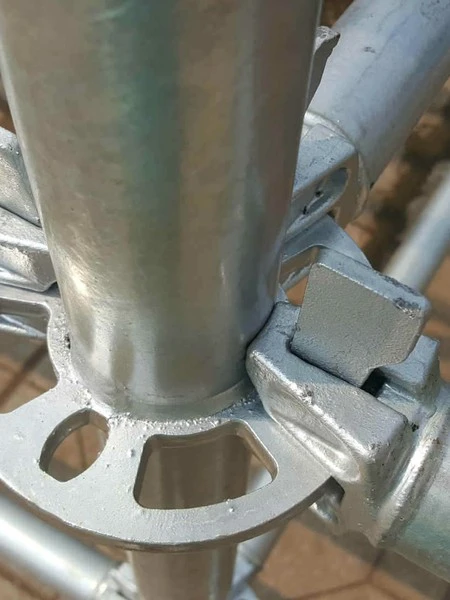
At 500 mm intervals, each pole has a formed rosette disk. There can be up to eight connection points on each disk at the same time. This means that stair stringers, diagonal braces, and horizontal ledgers can all lock into the same node. The wedge pin slides down through the ledger head and rests against the disk. With one hammer hit, it's locked in place. No loose nuts, bolts, or fittings with the wrong threads.
Hot-Dip Galvanization Surface Treatment
Every part of a 48 series ringlock scaffolding is protected from rust by a zinc coating that is at least 80 microns thick and is put on using full-immersion hot-dip galvanization. Spraying or electroplating is not as good for framing as this method because the zinc bonds mechanically to the steel, covering both the inside and outside of the tubes. For rental companies that go to coastal or humid job sites often, this safety directly makes each piece last longer.
Top 5 Uses of 48 Series Ringlock Scaffolding for Safer Construction
This modular system appears across a wide range of project types, but five application categories account for the majority of B2B procurement decisions worldwide.
High-Rise Residential and Civil Building Construction
The most common deployment is multi-story residential tower construction, exactly the primary application this system is engineered for. The 500 mm rosette spacing aligns with standard floor-to-floor heights, letting crews build working platforms and shoring frames without cutting or splicing uprights. A 60 kN per-upright capacity provides solid margin under concrete pour loads while keeping individual component weight manageable for manual handling.
Bridge and Viaduct Falsework
Bridge projects demand high axial shoring capacity under heavy concrete deck pours. The rosette node distributes shear forces across all eight connection points rather than concentrating stress at a single weld, which reduces the risk of local joint failure during continuous pours. Cross bar length options of 0.9 m, 1.2 m, and 1.5 m give engineers the bay-width flexibility to match variable pier spacing without custom fabrication.
Industrial Maintenance and Petrochemical Facilities
Petrochemical plants and power stations require access scaffolding that navigates tight pipe corridors and large spherical vessels. The 360-degree connection capability at each rosette lets erectors offset ledgers at non-orthogonal angles, producing fan-shaped platforms around curved structures. The HDG finish also resists the chemical splash and humidity present in these environments, reducing maintenance costs on the scaffolding assets themselves.
Facade Access on Urban Construction Sites
In dense urban environments, footprint constraints limit the base area available for scaffolding. Because this system ties directly to building anchors at every rosette level, it can be erected with a narrow ground footprint and still achieve heights well above 50 m with proper engineering sign-off. The quick wedge assembly shortens the road-closure window needed during erection, which matters significantly on city-center projects.
Renovation and Heritage Structure Work
48 series ringlock scaffolding is ideal for renovation sites that demand a system that can be adapted to irregular geometry without damaging existing finishes. The modular bay widths and adjustable base plates accommodate uneven ground and non-standard building grids. Because components are reusable and made to order, procurement teams can specify exact quantities per project phase, reducing excess material on sensitive historic sites where storage space is limited.
Advantages of 48 Series Ringlock Scaffolding Over Other Systems
When making decisions about what to buy, the cost per safe working hour over the asset's life is what matters most. These are the main reasons why this system is better than Cuplock and simple tube-and-clamp options:
- Assembly speed: The self-locking wedge mechanism requires no additional tools. Field data from multiple large contractors indicates erection time reductions of up to 40% compared with right-angle clamp systems, directly cutting labor costs per project cycle.
- Component interchangeability: The 48.3 mm diameter matches global accessory standards, meaning replacement parts flow freely through the open market. Rental operators avoid being locked into single-source supply chains, which protects margins when steel prices fluctuate.
- Structural consistency under repeated use: Each rosette is welded to the upright and load-tested. Unlike cast clamps that loosen over time, the fixed-node design maintains dimensional tolerance within ±1 mm through hundreds of project cycles, preserving the safety factor without additional site inspection labor.
These benefits directly lead to lower total costs of ownership for rental fleets and a higher asset utilization rate. Procurement directors pay close attention to both of these metrics when they are considering adding new items to their inventory.
Installation, Maintenance, and Safety Standards
Getting the system onto site correctly and keeping it safe through its service life requires discipline at three stages.
Step-by-Step Installation Procedure
Begin with a level base plate on compacted ground or a slab for 48 series ringlock scaffolding. Insert the upright, fit the first rosette level of ledgers, and seat each wedge pin with a single hammer blow. Check vertical plumb before proceeding upward. Add diagonal braces at every third bay minimum, or as specified by the structural engineer. Tie to the building structure at intervals no greater than those defined in the project-specific scaffold design.
Routine Inspection and Maintenance
Inspect wedge pins after every project cycle. Deformed or thinned pins are the primary failure risk in ringlock systems and must be replaced before re-deployment. Check galvanization integrity annually using a magnetic thickness gauge; any reading below 60 microns warrants re-evaluation of that component's remaining service life. Document findings per component batch to maintain full traceability.
International Safety Compliance
The system meets EN 12810-1 structural performance requirements and aligns with OSHA 1926 Subpart Q guidelines for scaffolding used on US-accessible projects. Shandong Xingrui Building Materials Co., Ltd. also holds ISO 9001, ISO 14001, and CE certifications, supporting compliance documentation for tender submissions in Europe, the Middle East, and Southeast Asia.
Procurement Insights: Buying, Renting, and Choosing the Right Supplier
Rental companies that manage thousand-ton inventory cycles base their purchase decisions on checking the wall thickness, the quality of the rosette welds, and the ability to deliver in bulk. Ask suppliers for spectrometer test reports that confirm the chemical make-up of Q235 and records of ultrasonic weld tests for joints from rosette to standard. These two papers tell the difference between companies that really care about quality control and those that only care about price.
Shandong Xingrui Building Materials Co., Ltd. has a factory in Rizhao, Shandong Province, that is 79,800 square meters big and has 12 robot welders and 6 automatic welding lines. The company does custom production runs, gives samples before shipping the whole batch, and provides expert help during the whole procurement process. The business ships goods to over 100 countries, so it can meet the delivery schedules for full containers during peak seasons and stick to the lead times that were agreed upon.
Conclusion
Rental fleets and large construction companies choose the 48 series ringlock scaffolding system as their modular access solution of choice because it has a proven load capacity, is easy to set up, and lasts a long time. The 48.3 mm diameter, 3.2 mm wall thickness, 10 mm rosette disk, and ≥ 80-micron HDG coating are not just claims made by the company; you can check them at the time of incoming inspection. When procurement teams put these factors ahead of the headline price, they regularly report lower total ownership costs and better fleet utilization rates across project cycles.
FAQ
What is the rated load capacity of the 48 series system per upright?
The maximum horizontal load that each normal upright can hold is 60 kN. The safe working load for a whole scaffold rests on how the bays are set up, how far apart the ties are, and the plan approval of a qualified engineer.
Can components from different 48-series manufacturers be mixed?
A lot of makers use the same 48.3 mm OD and 500 mm rosette spacing, but the wedge angle and width of the rosette can be different. Before putting together parts from different sources or production batches, you should always do an actual fit test to make sure they will work together.
What certifications should I request before placing a bulk order?
Ask for records of the ISO 9001 quality management system, the CE certification, the raw material spectrometer tests, and the weld integrity tests. If the project is in an area regulated by OSHA, make sure the system also meets the structural performance standards set by EN 12810-1.
How long does hot-dip galvanized scaffolding last in coastal environments?
If you store HDG-treated ringlock parts properly and give them a zinc coating of at least 80 microns, they will stay structurally sound for over 15 years in humid or coastal areas, as long as they pass yearly thickness gage checks.
Is made-to-order production available for non-standard bay widths?
Yes, Shandong Xingrui Building Materials Co., Ltd. can do custom work based on plans and samples given by the customer. This includes making cross bars that aren't the standard length and changing the way accessories are set up.
Request a Quote from GREEN FORMWORK — Your Trusted 48 Series Ringlock Scaffolding Manufacturer
Contractors and renting companies in over 100 countries buy 48 series ringlock scaffolding from GREEN FORMWORK, which is backed by Shandong Xingrui Building Materials Co., Ltd. This scaffolding is ISO 9001 and CE approved. You can get samples before you commit to buying a lot, and our expert team is here to help you from the design stage through delivery. You can email our team at sdxingruiqp@126.com to get cost information, technical datasheets, or a plan for custom production.
References
1. European Committee for Standardization. EN 12810-1: Facade Scaffolds Made of Prefabricated Components — Part 1: Products Specifications. CEN, 2003.
2. Occupational Safety and Health Administration. OSHA 1926 Subpart Q — Scaffolds. U.S. Department of Labor, 2019.
3. Standards Australia / Standards New Zealand. AS/NZS 1576: Scaffolding — General Requirements. SAI Global, 2010.
4. International Organization for Standardization. ISO 9001: Quality Management Systems — Requirements. ISO, 2015.
5. International Organization for Standardization. ISO 1461: Hot Dip Galvanized Coatings on Fabricated Iron and Steel Articles. ISO, 2009.
6. Chandrangsu, T., and Rasmussen, K. J. R. "Investigation of Geometric Imperfections and Joint Stiffness of Support Scaffold Systems." Journal of Constructional Steel Research, Elsevier, 2011.
Learn about our latest products and discounts through SMS or email