- English
- French
- German
- Portuguese
- Spanish
- Russian
- Japanese
- Korean
- Arabic
- Greek
- German
- Turkish
- Italian
- Danish
- Romanian
- Indonesian
- Czech
- Afrikaans
- Swedish
- Polish
- Basque
- Catalan
- Esperanto
- Hindi
- Lao
- Albanian
- Amharic
- Armenian
- Azerbaijani
- Belarusian
- Bengali
- Bosnian
- Bulgarian
- Cebuano
- Chichewa
- Corsican
- Croatian
- Dutch
- Estonian
- Filipino
- Finnish
- Frisian
- Galician
- Georgian
- Gujarati
- Haitian
- Hausa
- Hawaiian
- Hebrew
- Hmong
- Hungarian
- Icelandic
- Igbo
- Javanese
- Kannada
- Kazakh
- Khmer
- Kurdish
- Kyrgyz
- Latin
- Latvian
- Lithuanian
- Luxembou..
- Macedonian
- Malagasy
- Malay
- Malayalam
- Maltese
- Maori
- Marathi
- Mongolian
- Burmese
- Nepali
- Norwegian
- Pashto
- Persian
- Punjabi
- Serbian
- Sesotho
- Sinhala
- Slovak
- Slovenian
- Somali
- Samoan
- Scots Gaelic
- Shona
- Sindhi
- Sundanese
- Swahili
- Tajik
- Tamil
- Telugu
- Thai
- Ukrainian
- Urdu
- Uzbek
- Vietnamese
- Welsh
- Xhosa
- Yiddish
- Yoruba
- Zulu
Types of Scaffolding Used in Construction Projects
Construction projects across the United States rely on scaffolding as the structural backbone of safe, efficient work at height. Choosing the right scaffold system is not simply a logistics decision — it directly affects worker safety, project timelines, and total cost. Among the systems gaining significant traction in heavy civil and infrastructure work, crab type scaffolding stands out for its high axial load capacity, self-locking node connections, and speed of assembly. This guide walks procurement professionals and technical leads through the primary scaffold categories, helping you match the right system to your project's actual demands.
Key Types of Scaffolding Used in Construction Projects
Scaffolding systems are not interchangeable. Each type carries distinct structural logic, and selecting the wrong one can compromise safety margins or inflate costs. Below are the four systems most relevant to large-scale U.S. construction procurement.
Frame Scaffolding
Frame scaffolding uses pre-welded steel frames connected by cross braces. It assembles quickly and suits residential and light commercial work well. Load capacity per leg typically ranges from 18kN to 25kN, which makes it inadequate for heavy shoring applications like bridge girder support or deep basement formwork.
Tube and Clamp Scaffolding
Tube and clamp systems offer geometric flexibility, letting crews build around irregular structures. However, joint integrity depends entirely on the torque applied during assembly — a human-error variable that creates inconsistent structural performance. On high-risk projects, this variability is a liability that rigorous inspection cannot fully eliminate.
System Scaffolding (Ringlock / Cuplock)
System scaffolding uses pre-engineered rosette or cup connections to eliminate loose fittings. Ringlock and cuplock variants are widely used in mid-rise construction and formwork support. They offer faster assembly than tube and clamp while providing more consistent node strength. Most system scaffolds have upper axial load limits between 30kN and 50kN per standard.
Crab-Style Modular Shoring
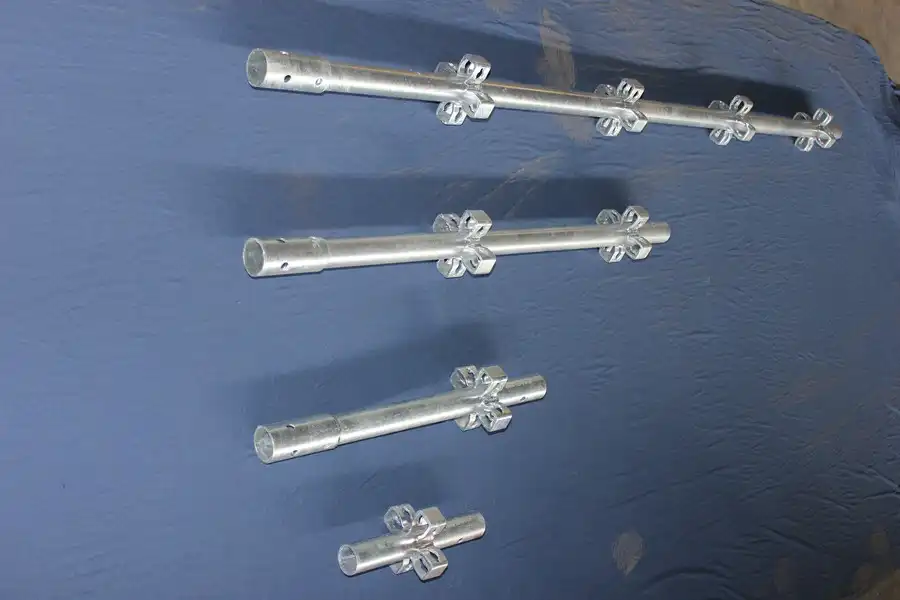
The heavy-duty modular shoring category — often called crab-style or crab-system scaffolding — was engineered specifically for high-clearance formwork, bridge shoring, and industrial plant support. Its eight-hole chrysanthemum disc allows ledger placement in any horizontal direction, and the self-locking wedge node tightens under vertical load rather than loosening. Per standard load capacity reaches 40kN to 75kN depending on configuration, which is 35% higher than comparable 48mm diameter systems in axial load tests. This makes it the preferred choice when traditional systems cannot meet structural calculation requirements.
Beyond these four primary systems, the market also includes suspended scaffolding for facade work, cantilever scaffolding for bridge deck access, and mobile tower scaffolds for maintenance tasks. Each has a defined role, but none carries the vertical load performance of a 60-series heavy modular shoring tower with crab type scaffolding.
Comparing Popular Scaffolding Types: Making the Right Choice for Your Project
Procurement decisions at the technical level come down to four variables: structural capacity, modularity, assembly time, and total cost of ownership. Here is how the systems compare when your project pushes past standard load thresholds.
Structural Integrity Under High Load
Frame scaffolding and basic cuplock systems reach their design limits well below what bridge box girder or thick-slab formwork demands. A 60mm outer diameter heavy-duty shoring tower with a 3.0mm to 3.5mm wall thickness maintains verticality under sustained loads that would cause measurable deflection in lighter systems. The safety factor of ≥3:1 (ultimate load vs. allowable) in EN 12810-1 and ANSI/SSFI SC100-5/05 compliant systems provides the documented proof that owners and inspectors require.
Modularity and Assembly Speed
Pre-engineered node connections reduce assembly time by approximately 40% compared to tube and clamp systems. Standard 1.5m step distances and compatible U-head jacks, base jacks, and steel planks mean your procurement team sources a complete system rather than mixing components from multiple suppliers — a common source of site delays and compatibility disputes.
Rent vs. Buy: Financial Consideration
For rental companies investing in scaffold inventory as a high-value asset, the calculation favors heavy modular shoring towers. Hot-dip galvanized components with a zinc coating of 60 to 80 microns carry a documented service life exceeding 15 years, even in coastal or chemically aggressive environments. That durability supports favorable rental yield over time. General contractors running multiple concurrent projects often find that a purchased inventory of standardized tower units eliminates the scheduling risk that comes with rental availability constraints.
Safety Guidelines and Performance Standards for Type Scaffolding
When doing high-load temporary support work with crab type scaffolding, safety must come first. According to the U.S. Occupational Safety and Health Administration (OSHA), about 4,500 injuries and 60 deaths happen every year on American construction sites because of incidents involving scaffolding. Your main tool for managing liability is making sure that load ratings, inspection intervals, and erection protocols are followed.
Load-Bearing Documentation Requirements
When you give a structural engineer of record a shoring plan, it has to come with full structural math data and data from component load tests. Systems made according to ISO 9001 quality control standards have test results that can be tracked from the time they are made until they are delivered. This paperwork backs up both the engineer's approval and the owner's insurance needs.
Compliance with International Standards
Some basic certifications that most U.S. project requirements accept are those that meet EN 12810-1 and ANSI/SSFI SC100-5/05. The manufacturer's ISO 14001 environmental management certification and ISO 45001 occupational health and safety certification show that not only the product itself, but also the way it is made meets international standards that have been checked.
Maintenance and Inspection Protocols
Before every deployment cycle, locking pins, base plates, and disk joints on hot-dip galvanizing steel parts need to be looked at visually. A system that can be used again and again and comes with clear inspection guidelines cuts down on guesswork on the job site and keeps the structure strong over the course of multiple projects. If the maker gives you physical samples before you buy, your technical team can check that the parts fit and finish correctly against the project plans before committing to buying a lot of them.
Procurement Considerations for Type and Crab Scaffolding
Sourcing heavy modular shoring for a major infrastructure project involves more than price comparison. Your procurement cycle — typically one to three months from technical comparison to first site delivery — requires a supplier who can support both the engineering review phase and the logistics execution phase for crab type scaffolding.
Evaluating Supplier Qualifications
Certified manufacturers holding ISO 9001, ISO 14001, and ISO 45001 certifications provide the audit trail that owner representatives and insurers increasingly require. Verify that the supplier can provide third-party load test reports, CE certification documentation, and a full bill of materials for every component in the system. Suppliers who cannot provide this documentation create compliance gaps that surface during project inspections at the worst possible time.
Custom Fabrication and Component Compatibility
High-clearance bridge shoring or airport terminal formwork often requires non-standard tower heights or specialized connection geometry. A manufacturer with in-house cold roll forming equipment, welding robots, and automatic welding lines can fabricate custom components to drawing tolerances that match your structural engineer's specifications. Component interchangeability across tower configurations also reduces your spare parts inventory burden over the life of the asset.
Delivery Volume and Logistics Coordination
Large-scale infrastructure procurement means coordinating multi-batch deliveries timed to construction sequences. A supplier operating from a seaport city with direct access to shipping lanes and rail connections — like Rizhao, Shandong — can stage and dispatch batches against your project schedule rather than forcing a single consolidated shipment that arrives before site conditions are ready.
Conclusion
Every big building project's safety margin, timeline, and budget depend on the type of scaffolding that is chosen. Frame and tube-and-clamp systems are good for everyday tasks. But heavy modular shoring towers with crab type scaffolding, which are made with self-locking nodes, high-strength steel, and documented load ratings, are better for bridge shoring, ultrahigh formwork, and industrial plant construction. Lighter systems can't handle these needs. When purchasing choices have long-lasting effects, a provider that is worth working with is one that has certified manufacturing, traceable test data, and the ability to handle transportation. Pick out your scaffolding system with the same care that you use to plan your building.
FAQ
How much load can a crab-style shoring standard carry?
A single standard in a properly configured 60mm outer diameter heavy modular shoring system carries between 40kN and 75kN depending on ledger spacing and tower height. This range covers most bridge girder shoring and ultra-high formwork applications that lighter systems cannot handle.
How does assembly time compare to tube and clamp?
Pre-engineered disc connections reduce assembly time by approximately 40% versus tube and clamp systems. Crews do not need torque verification tools, and the self-locking wedge mechanism produces consistent joint quality regardless of individual worker experience levels.
What certifications should I require from a supplier?
Require ISO 9001 for quality management, ISO 14001 for environmental management, ISO 45001 for occupational safety management, and CE certification for the product itself. Third-party structural load test reports and a complete calculation package are also standard requirements for high-load shoring procurement.
Can non-standard components be fabricated to drawing?
Yes. Manufacturers with in-house cold roll forming and welding automation can produce non-standard tower heights, custom base plates, and specialized connectors to your structural engineer's drawings. Request physical samples and dimensional inspection reports before full-volume order placement.
What is the expected service life of hot-dip galvanized components?
Components with a zinc coating of 60 to 80 microns carry a documented service life exceeding 15 years under regular inspection and maintenance, including in coastal and industrial environments where corrosion rates accelerate.
Connect with GREEN FORMWORK for Your Next Scaffolding Project
With full ISO 9001, ISO 14001, and ISO 45001 paperwork, GREEN FORMWORK provides approved crab type scaffolding manufacturer-grade systems made from Q235 premium steel. The people on our team are ready to help you with your purchase from the specification stage all the way through delivery, whether you need a technical sample, a quote for custom fabrication, or a full-volume delivery schedule for a bridge or formwork project. You can email us at sdxingruiqp@126.com to get prices and product information.
References
1. Peng, J. L., Pan, A. D., & Chan, S. L. (1996). Simplified models for analysis and design of modular falsework. Journal of Constructional Steel Research.
2. Occupational Safety and Health Administration (OSHA). (2020). Scaffolding Safety in Construction. U.S. Department of Labor.
3. American National Standards Institute / Scaffold & Access Industry Association. (2019). ANSI/SSFI SC100-5/05: Standard for Steel Scaffolding.
4. British Standards Institution. (2004). EN 12810-1: Facade Scaffolds Made from Prefabricated Components — Part 1: Products Specifications. BSI Standards.
5. Construction Industry Institute. (2018). Temporary Structures in Construction: Managing Risk in Shoring and Formwork Systems. University of Texas at Austin.
6. National Institute for Occupational Safety and Health (NIOSH). (2015). Preventing Injuries and Deaths from Scaffold Collapses. Centers for Disease Control and Prevention.
Learn about our latest products and discounts through SMS or email