- English
- French
- German
- Portuguese
- Spanish
- Russian
- Japanese
- Korean
- Arabic
- Greek
- German
- Turkish
- Italian
- Danish
- Romanian
- Indonesian
- Czech
- Afrikaans
- Swedish
- Polish
- Basque
- Catalan
- Esperanto
- Hindi
- Lao
- Albanian
- Amharic
- Armenian
- Azerbaijani
- Belarusian
- Bengali
- Bosnian
- Bulgarian
- Cebuano
- Chichewa
- Corsican
- Croatian
- Dutch
- Estonian
- Filipino
- Finnish
- Frisian
- Galician
- Georgian
- Gujarati
- Haitian
- Hausa
- Hawaiian
- Hebrew
- Hmong
- Hungarian
- Icelandic
- Igbo
- Javanese
- Kannada
- Kazakh
- Khmer
- Kurdish
- Kyrgyz
- Latin
- Latvian
- Lithuanian
- Luxembou..
- Macedonian
- Malagasy
- Malay
- Malayalam
- Maltese
- Maori
- Marathi
- Mongolian
- Burmese
- Nepali
- Norwegian
- Pashto
- Persian
- Punjabi
- Serbian
- Sesotho
- Sinhala
- Slovak
- Slovenian
- Somali
- Samoan
- Scots Gaelic
- Shona
- Sindhi
- Sundanese
- Swahili
- Tajik
- Tamil
- Telugu
- Thai
- Ukrainian
- Urdu
- Uzbek
- Vietnamese
- Welsh
- Xhosa
- Yiddish
- Yoruba
- Zulu
What Are Multi-Layer Multi-Directional Crab Scaffolding Main Benefits?
Multi-layer multi-directional crab scaffolding delivers a measurable edge on complex construction sites where standard systems fall short. Built from Q235 premium steel with rosette node technology, it supports simultaneous horizontal, vertical, and diagonal configurations — all within a single modular framework. The self-locking wedge design cuts assembly time by 40–60% compared to tube-and-clamp alternatives, while hot-dip galvanization extends service life beyond 15 years. For procurement managers sourcing support systems for bridges, stadiums, or ultra-high-rise factories, this system addresses load distribution, safety compliance, and cost efficiency within one proven platform.
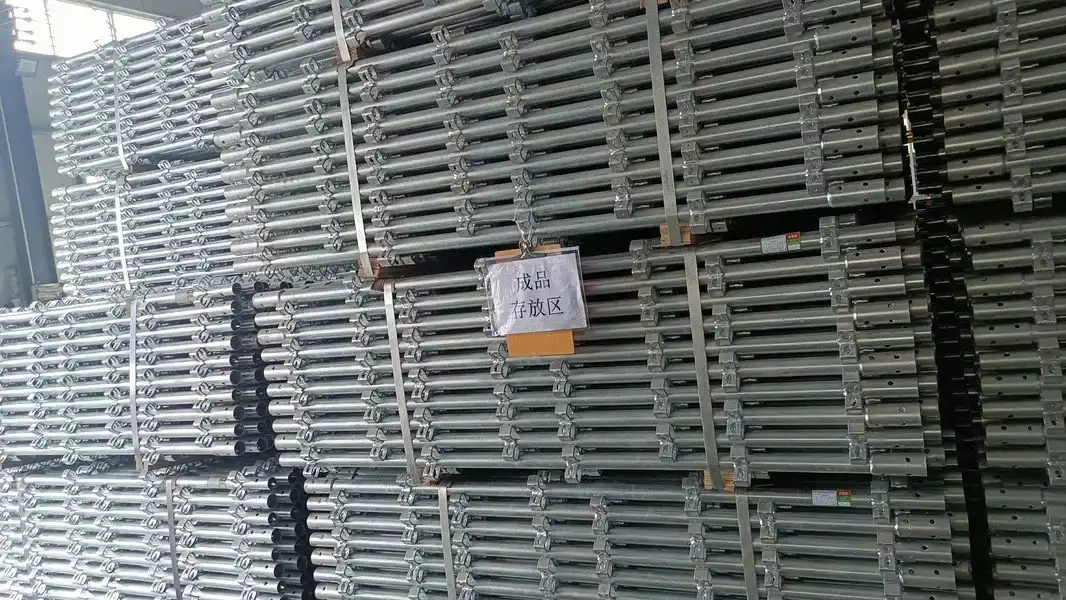
Understanding Multi-Layer Multi-Directional Crab Scaffolding
Before looking at the pros, it's helpful to know what structurally makes this system different from regular scaffolding.
What Makes It "Multi-Directional"?
At each connecting point, there is a disc-shaped rosette node that can take ledgers and diagonal braces at 45-degree intervals over a full 360-degree range. This shape lets the frame fit around curved surfaces, sloped planes, and oddly shaped architectural profiles. With regular ringlock or cuplock systems, you'd have to pay a lot of money to get around these problems.
Core Material and Construction
These frames are made by Shandong Xingrui Building Materials Co., Ltd. out of high-quality Q235 steel. The vertical standards are 48.3 mm in diameter and 3.25 mm thick. The distance between nodes stays at 500 mm, and the accuracy of the measurements is within ±1 mm. This stops errors from adding up in multi-layer designs that are up to 24 m tall.
How the Self-Locking Wedge Works?
Because threaded bolts come loose when they're moved around, the hammer-locked wedge system physically locks each connection. This gets rid of a common failure point where bolts coming loose has led to close calls in places with a lot of load or shaking, like bridge piers and repair areas of industrial plants.
Main Benefits of Multi-Layer Multi-Directional Crab Scaffolding
To figure out why this method works better than others, you need to look at certain success categories. For B2B buyers, these are the main benefits that matter the most:
- Superior load distribution: The upgraded crab-style frame spreads stress evenly across all connection points. Vertical diagonal bars combined with horizontal reinforcement bars form a stable triangular bracing pattern, resisting lateral forces in multi-span arrangements. This balanced stress distribution makes the system suited to large commercial complexes and ultra-high-rise factories where uneven loading is a daily reality.
- 40–60% faster assembly: The hammer-locked wedge mechanism removes the need for skilled bolt torquing. Field crews report significantly reduced erection time, which translates directly to lower labor costs per project cycle. On a 10,000 m² commercial site, this time saving can represent weeks of schedule improvement.
- 15+ year service life with HDG protection: Hot-dip galvanization at 60–80μm coating thickness protects Q235 steel in corrosive industrial and maritime environments. Unlike painted finishes, the zinc layer metallurgically bonds to the steel substrate, maintaining protection even at cut edges and weld zones.
- Built to spec and fully reusable: Each component meets specification-grade tolerances, enabling repeated teardown and reuse across multiple project cycles. The return on capital improves with each deployment, which is a key consideration for rental companies and EPC contractors managing asset turnover.
HDG safety for multi-layer multi-directional crab scaffolding lasts 15 years or more of work life: Hot-dip galvanization with a coating layer of 60–80μm shields Q235 steel in harsh industrial and marine settings. Instead of being sprayed on, the zinc layer actually links to the steel, so it stays protected even where the steel is cut or welded.
Comparison and Decision-Making Insights for Procurement Managers
There's more to picking between scaffold systems than just unit price. Total project cost is affected by the type of materials used, the scope of the approval, and how reliable the provider is.
Steel Grade and Coating Performance
When combined with HDG treatment, Q235 premium steel has a yield strength good enough for heavy-duty shoring, and it resists rust better over time than painted mild steel. Many buying teams don't think about how good the coating is; putting "minimum 60 µm zinc thickness" in the purchase order will keep you from getting security that is too small.
Certification Coverage That Matters
The system has both ISO 9001 and ISO 14001 environmental management standards, as well as a CE mark. Following OSHA 1926 rules for projects in the United States.Before you place an order, you should check with your supplier to make sure they meet the 451 structural requirements and ANSI/SSFI SC100 load ratings. When procurement teams ask for batch-level quality inspection reports instead of just factory-level certificates, they can keep track of what's going on when auditors come on site.
Bulk Purchasing Versus Rental
For EPC contractors who are working on multiple projects at once, buying multi-layer multi-directional crab scaffolding that can be used again and again and has a 15-year service life usually saves them money over the next three to five years. When you only need something for a short time, renting makes more sense. By knowing this breakeven point before sending out an RFQ, you can avoid spending too much on short-term contracts.
Procurement and Supply Chain Considerations
Sourcing the right crab scaffolding system requires evaluating supplier depth, not just product specifications.
Customization and Drawing-Based Production
Shandong Xingrui Building Materials Co., Ltd. accepts customer-supplied drawings and produces to specification. With over 1,000 accessory specifications and a 40,000 m² standardized workshop, the factory can respond to custom node configurations within a 7–14 day sample turnaround. This capability is critical for projects with non-standard geometry, such as stadium roof cantilevers or curved bridge decks.
Logistics From Rizhao Port
The factory sits in Rizhao City, Shandong Province, adjacent to its own seaport, airport, and high-speed rail hub. This reduces inland freight distance and shortens container loading lead times, which matters when a project's delivery window is tight. Oversized components and mixed-spec orders can be consolidated at the port before shipping.
OEM/ODM and Confidentiality
For buyers who require private-label products or proprietary node modifications for multi-layer multi-directional crab scaffolding, Shandong Xingrui supports OEM and ODM arrangements with NDA coverage. This protects client-developed improvements from being replicated for competitors — a concern frequently raised by engineering firms that have invested in node design refinements.
Real-World Applications and Case Studies
The system's geometry makes it the default choice in three high-demand construction categories.
Bridge and Viaduct Shoring
On bridge pier construction with curved cross-sections, multi-directional bracing prevents lateral buckling during concrete pours. The rosette node's angular flexibility allows diagonal members to match the pier's actual geometry rather than approximating it with additional clamps, reducing material waste and inspection failures.
Industrial Plant Access and Maintenance
In refineries and power stations, pipe racks and equipment clusters create obstructions that block standard scaffold runs. The multi-span, multi-layer configuration navigates these constraints without requiring custom tube cutting, maintaining the system's reusability for the next maintenance cycle.
Stadium and Dome Structures
Domed roof construction requires scaffolding that follows a radial geometry. The 360-degree connection range at each rosette node allows contractors to erect fan-shaped bays that track the dome's curvature accurately, a capability that conventional frame scaffolding cannot match without extensive fabrication.
Conclusion
Incorrect load paths, challenging geometries, and high labor costs on complicated sites are all issues that Multi-layer multi-directional crab scaffolding addresses. The system is made of high-quality Q235 steel and has self-locking wedge nodes. It is approved to ISO 9001 and CE standards and can be customized based on drawings. This system provides procurement managers with a safe way to go from RFQ to on-site deployment. It is a good long-term investment because it is structurally sound, can be used again and again, and has a deep supply chain. This is true whether you are in charge of building a stadium, managing bridge contracts, or industrial maintenance schedules.
FAQ
Q1: How many times can the components be reused?
A: If you store and take care of parts made to specification-grade standards the right way, they can usually be used 30 to 50 times before they need to be replaced. Hot-dip galvanized surfaces don't rust between uses, which is what usually happens to used steel scaffolding that breaks down.
Q2: Does the system meet U.S. safety requirements?
A: The structure is built to meet the standards set by OSHA 1926.451 and has been tested to meet the requirements of ANSI/SSFI SC100. Before deploying on federally regulated job sites, buyers should ask the supplier for documentation of batch-level load tests.
Q3: What is the minimum order quantity?
A: Shandong Xingrui Building Materials Co., Ltd. can handle both small orders for new customers and big orders for a lot of materials. Talk to the team directly about the project's unique lead time and quantity needs.
Q4: Can the system integrate with existing ringlock or cuplock components?
A: Rosette sizes and wedge thicknesses vary from one manufacturer to the next. When you mix parts from different suppliers, the certified load ratings are null and void. To keep structural responsibility in multi-layer designs, we suggest using parts from a single manufacturer.
Q5: How long does sample production take?
A: For standard node configurations, the time it takes to go from drawing to sample is usually 7–14 days. Tooling may take longer if the shape is custom or if secret node changes need to be made.
Get a Quote on Multi-Layer Multi-Directional Crab Scaffolding From GREEN FORMWORK
Green Formwork, which is run by Shandong Xingrui Building Materials Co., Ltd., sells multi-layer, multi-directional crab scaffolding to contractors and procurement teams in over 100 different countries. We deliver quality products on time because we are ISO 9001 certified, CE marked, allow customization based on drawings, and have direct port access in Rizhao. To get samples and technical information right away, email your project drawings or RFQ to sdxingruiqp@126.com.
References
1. Construction Industry Institute — Best Practices in Scaffolding Safety and Load Management, 2021.
2. European Committee for Standardization (CEN) — EN 12811-1: Temporary Works Equipment — Scaffolds, 2003.
3. Occupational Safety and Health Administration (OSHA) — Scaffolding Standards 29 CFR 1926 Subpart Q, 2020.
4. American National Standards Institute (ANSI) / Scaffold & Access Industry Association (SAIA) — ANSI/SSFI SC100 Safety Requirements for Scaffolding, 2019.
5. International Organization for Standardization — ISO 9001: Quality Management Systems — Requirements, 2015.
6. Engineering News-Record (ENR) — Modular Scaffolding Systems in Large-Scale Infrastructure Projects, 2022.
Learn about our latest products and discounts through SMS or email