- English
- French
- German
- Portuguese
- Spanish
- Russian
- Japanese
- Korean
- Arabic
- Greek
- German
- Turkish
- Italian
- Danish
- Romanian
- Indonesian
- Czech
- Afrikaans
- Swedish
- Polish
- Basque
- Catalan
- Esperanto
- Hindi
- Lao
- Albanian
- Amharic
- Armenian
- Azerbaijani
- Belarusian
- Bengali
- Bosnian
- Bulgarian
- Cebuano
- Chichewa
- Corsican
- Croatian
- Dutch
- Estonian
- Filipino
- Finnish
- Frisian
- Galician
- Georgian
- Gujarati
- Haitian
- Hausa
- Hawaiian
- Hebrew
- Hmong
- Hungarian
- Icelandic
- Igbo
- Javanese
- Kannada
- Kazakh
- Khmer
- Kurdish
- Kyrgyz
- Latin
- Latvian
- Lithuanian
- Luxembou..
- Macedonian
- Malagasy
- Malay
- Malayalam
- Maltese
- Maori
- Marathi
- Mongolian
- Burmese
- Nepali
- Norwegian
- Pashto
- Persian
- Punjabi
- Serbian
- Sesotho
- Sinhala
- Slovak
- Slovenian
- Somali
- Samoan
- Scots Gaelic
- Shona
- Sindhi
- Sundanese
- Swahili
- Tajik
- Tamil
- Telugu
- Thai
- Ukrainian
- Urdu
- Uzbek
- Vietnamese
- Welsh
- Xhosa
- Yiddish
- Yoruba
- Zulu
What Are the Main Benefits of Using a Ringlock Scaffolding System?
The ringlock scaffolding system delivers measurable advantages for construction and industrial projects that demand both speed and structural reliability. Built around a rosette connector with up to eight connection points per node, this modular system allows fast, tool-light assembly without sacrificing load-bearing strength. Self-locking wedge pins tighten under vibration and load, which directly reduces the risk of component failure at height. For EPC contractors, rental companies, and procurement teams managing tight delivery schedules, a well-specified ringlock system translates into lower labor hours, fewer site incidents, and better long-term asset value.
Understanding the Ringlock Scaffolding System
Before you look at the pros, it's helpful to know how this system is physically different from some that have come before.
Core Components and Their Functions
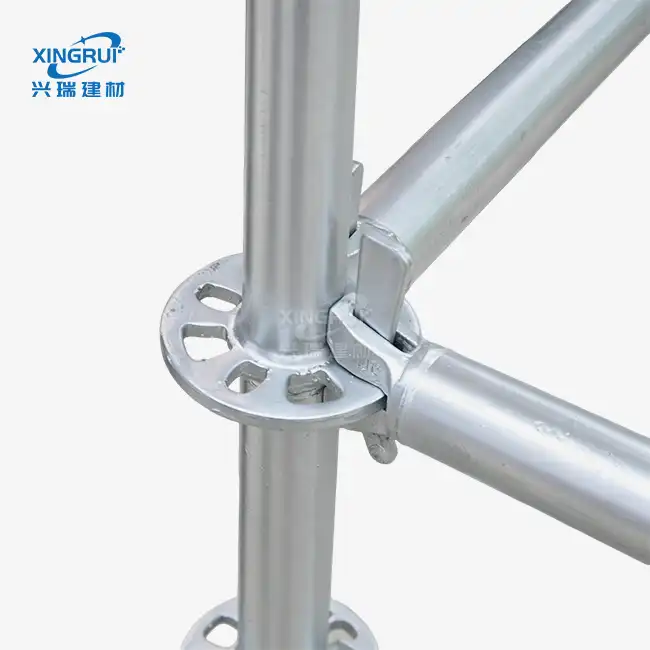
A ringlock system is made up of base jacks, vertical standards, horizontal ledgers, and diagonal braces. The vertical standards push the load down, and the rosette disk, which is welded at regular intervals, can hold the ledgers and braces at different angles. With base jacks, you can move heavy things to the ground and level things that aren't level on soft ground. Each part was made with great care so that it will work together in a way that can be predicted. This lessens the need to guess on-site.
The Rosette Connection Mechanism
This method is different because it has eight holes. It can hold up to eight pieces at once, which lets site builders use geometry to build around obstacles or against floor plans that aren't straight. You don't need any tools or loose nuts for the wedge-pin method. When workers put the wedge in place and hit it once, the connection is safe. This lock that works with gravity gets even tighter when it's loaded, which is a lot safer than locks that use nuts.
Compliance With International Standards
Ringlock scaffolding system that is made to EN 12810-1, EN 12811-1, and ISO 9001 standards meets the wants of project owners in North America and Europe. Buyers can meet the needs of third-party checks with the help of quality records at the batch level and CE certification. The goods made by Shandong Xingrui Building Materials Co., Ltd. have ISO 9001 and CE marks, which help with paperwork for projects all over the world.
Key Benefits of Using Ringlock Scaffolding
Buyers, project engineers, and site supervisors all have unique problems that they have to deal with every day. This system's benefits help them do their jobs better.
The most important reasons to look into this method are the ones below:
- Structural safety through self-locking joints: The wedge-pin mechanism tightens under vibration, preventing accidental disconnection at height. Xingrui's system uses Q235 high-strength steel with 48×3.2mm vertical standards and a 10mm rosette disc wall thickness, delivering consistent load-bearing performance across multiple project cycles.
- Speed of assembly: Compared to tube-and-clamp systems, ringlock assembly requires fewer individual parts per connection. Site crews report significantly reduced erection times, which directly lowers labor costs and keeps projects on schedule.
- Reusability and lifecycle value: Because components are standardized and hot-dip galvanized, the system resists corrosion and tolerates repeated dismantling. Rental companies particularly benefit from lower replacement rates and predictable maintenance intervals.
- Adaptability across applications: The same set of components works for exterior wall protection, full interior scaffolding, and elevated working platforms. Refineries, power plants, shipyards, and high-rise building contractors all use ringlock configurations because the geometry adapts without requiring a different product family.
Building it faster: Ringlock devices need fewer separate parts for each link than tube-and-clamp ones. Teams on the job site say that the time it takes to build things has been cut down a lot. This saves money on labor costs and keeps projects on schedule.
Ringlock Scaffolding vs. Other Popular Scaffolding Systems
When buying teams know the areas where Ringlock does better than its competitors, they can better explain to project owners why they made the choices they did.
Ringlock vs. Cuplock
There is a top cup that can be turned that holds ledgers in place. It works well in simple vertical applications, but there aren't as many direction options at each node. Because Ringlock's eight-hole rosette has more holes, diagonal members can be set at more accurate angles. This is useful for buildings that are curvy or for places with rough geometry. Putting together Ringlock is also faster because the wedge pin doesn't have to turn a cup to hold the ledger in place.
Ringlock vs. Traditional Frame Scaffolding
Because frame framing comes in pieces that are already put together, it can only be used in certain shapes. It works well for building surfaces that are the same over and over, but not so well for industrial maintenance where pipes, tanks, and structural steel get in the way of the work. Ringlock can get around these issues since each node and bay size can be changed separately. This means that unique production on-site isn't needed as much when chemical plants or power plants are being fixed up.
Ringlock vs. Kwikstage
There is no solid rosette disk used by Klikstage. Instead, a pressed-steel spigot connector is used. The link works well for light to medium loads, but it's not as stiff when bent as a rosette that was forged or precision-welded. As long as the steel grade and ledger spacing are right, the ringlock scaffolding system can handle up to 70kN of axial load, which makes it better for heavy-duty tasks like bridge decks, transfer slabs, and big concrete pours.
Procurement Considerations for Ringlock Scaffolding
Selecting the right supplier involves more than comparing unit prices. Certification status, production capacity, and after-sales responsiveness all affect the real cost of ownership.
Certification and Documentation Requirements
European and North American project owners routinely request CE declarations of performance (DoP), EN 12811 calculation reports, and ISO 9001 quality management certificates before approving a scaffold supplier. Buyers should confirm that the manufacturer can provide batch-specific test reports, not just general certificates. Shandong Xingrui holds ISO 9001 certification and CE marks across its product lines, and the company supports custom drawing-based production with sample availability in 7–14 days.
Supplier Capacity and Delivery Reliability
A manufacturer's production footprint matters for large EPC contracts. Xingrui operates across 79,800 square meters of total area, with over 40,000 square meters of standardized workshop space, 12 welding robots, and 6 automatic welding lines. Located in Rizhao, Shandong—a city with its own seaport, airport, and high-speed rail access—the company ships to more than 100 countries. That port proximity reduces inland logistics risk for bulk container orders.
Flexible Order Options and OEM Support
Procurement teams managing varied project sizes for a ringlock scaffolding system benefit from flexible MOQ policies and OEM/ODM capabilities. Xingrui accepts custom orders based on buyer-supplied drawings and offers NDA arrangements for proprietary connection geometry. Horizontal ledger lengths of 0.9m, 1.2m, and 1.5m are standard; other dimensions are available on request.
Best Practices for Installation, Maintenance, and Safety Compliance
After making a system well, it is very important to install it correctly if you want it to work well.
Installation Sequencing
Make sure the base jacks are level on solid ground before you start putting things together. Then, raise the horizontal ledgers and vertical standards for the first time. In order to follow the engineer's plan drawing, diagonal bracing needs to be put in place at regular times. Make sure the wedge pins are fully in place and hit each connection with a hammer before the next lift starts. Most software mistakes on busy sites happen when this step is skipped.
Routine Maintenance and Storage
As the project comes to a close, parts should be checked for twisted wedge pins, bent standards, and broken rosette welds. Even though hot-dip galvanized surfaces don't rust, you should fix any coats that are broken before putting them away. Parts should be stacked horizontally on level racks and put in order by type to keep things from moving around and make inventory management easier. If you take care of your hot-dip galvanized system, it should last between 10 and 15 years.
OSHA and EN Compliance on Active Sites
In the United States, OSHA 1926 Subpart Q sets rules for construction work. EN 12811-1 tells people in Europe what kinds of work scaffolds must be able to do. Frames of both types must have load estimates, fall safety plans, and regular checks by a qualified person. When procurement teams choose a system, they need to make sure that it comes with engineering documentation that lets them do calculations that are unique to the site. This is usually something that the project owner wants.
Conclusion
The best choice for tough industrial and building environments is the ringlock scaffolding system. This is because it meets the needs of procurement teams in terms of safety, speed of assembly, paperwork compliance, and long-term asset value. The system works well for many project cycles as long as the parts are made from Q235 steel, have smooth edges, are hot-dip galvanized, and are approved by both ISO 9001 and CE. Older systems didn't have as many geometric and load-bearing choices as rosette-based modular design. This makes it useful for a wide range of projects, from turning a power plant around to pouring a bridge floor.
FAQ
Q1: What load capacity does a ringlock standard typically support?
A: A single standard can support between 40kN and 70kN depending on the steel grade, ledger spacing, and configuration, as verified against EN 12812 shoring standards. Xingrui's Q235 steel standards with 48×3.2mm tube dimensions are rated for high-bearing performance across standard bay configurations.
Q2: How long does a hot-dip galvanized ringlock system last?
A: Under regular maintenance and proper storage, a hot-dip galvanized system typically reaches a service life of 10 to 15 years. This significantly outperforms painted or electro-galvanized alternatives in corrosive or outdoor environments.
Q3: Can components from different brands be mixed?
A: While many manufacturers follow the standard rosette pattern, dimensional tolerances vary between brands. Structural compatibility testing is required before mixing components from different suppliers to confirm safe load transfer at each connection node.
Q4: Does Xingrui offer samples before a bulk order?
A: Yes. Shandong Xingrui Building Materials Co., Ltd. offers sample dispatch within 7–14 days and provides full technical support throughout the evaluation process. Custom dimensions based on buyer drawings are also available.
Q5: What certifications should I request from a supplier?
A: Request ISO 9001 quality management certification, CE declaration of performance, EN 12811 calculation reports, and batch-specific material test certificates. These documents satisfy most third-party inspection requirements on European and North American project sites.
Partner With GREEN FORMWORK for Your Next Ringlock Scaffolding Order
With help from Shandong Xingrui Building Materials Co., Ltd., GREEN FORMWORK sells ringlock scaffolding system parts that are ISO 9001-certified to builders and EPC clients in over 100 countries. We can always deliver high-quality work on time because we have a 40,000 production facility with 12 welding robots and expert support. Today, ask for examples, models made just for you, or a price quote on a big order. You can email our team at sdxingruiqp@126.com to start your question.
References
1. European Committee for Standardization. EN 12811-1: Temporary Works Equipment — Scaffolds — Performance Requirements and General Design. CEN, 2003.
2. European Committee for Standardization. EN 12810-1: Facade Scaffolding Made of Prefabricated Components — Part 1: Product Specifications. CEN, 2003.
3. Occupational Safety and Health Administration. OSHA 1926 Subpart Q — Scaffolding Standards for Construction. U.S. Department of Labor, 2011.
4. International Organization for Standardization. ISO 9001:2015 — Quality Management Systems: Requirements. ISO, 2015.
5. European Committee for Standardization. EN 12812: Falsework — Performance Requirements and General Design. CEN, 2008.
6. Construction Industry Research and Information Association. Temporary Works: Principles of Design and Construction. CIRIA Report C703, 2012.
Learn about our latest products and discounts through SMS or email