- English
- French
- German
- Portuguese
- Spanish
- Russian
- Japanese
- Korean
- Arabic
- Greek
- German
- Turkish
- Italian
- Danish
- Romanian
- Indonesian
- Czech
- Afrikaans
- Swedish
- Polish
- Basque
- Catalan
- Esperanto
- Hindi
- Lao
- Albanian
- Amharic
- Armenian
- Azerbaijani
- Belarusian
- Bengali
- Bosnian
- Bulgarian
- Cebuano
- Chichewa
- Corsican
- Croatian
- Dutch
- Estonian
- Filipino
- Finnish
- Frisian
- Galician
- Georgian
- Gujarati
- Haitian
- Hausa
- Hawaiian
- Hebrew
- Hmong
- Hungarian
- Icelandic
- Igbo
- Javanese
- Kannada
- Kazakh
- Khmer
- Kurdish
- Kyrgyz
- Latin
- Latvian
- Lithuanian
- Luxembou..
- Macedonian
- Malagasy
- Malay
- Malayalam
- Maltese
- Maori
- Marathi
- Mongolian
- Burmese
- Nepali
- Norwegian
- Pashto
- Persian
- Punjabi
- Serbian
- Sesotho
- Sinhala
- Slovak
- Slovenian
- Somali
- Samoan
- Scots Gaelic
- Shona
- Sindhi
- Sundanese
- Swahili
- Tajik
- Tamil
- Telugu
- Thai
- Ukrainian
- Urdu
- Uzbek
- Vietnamese
- Welsh
- Xhosa
- Yiddish
- Yoruba
- Zulu
Why Combined Steel Formwork Improves Concrete Quality and Safety
Combined steel formwork is one of the most dependable solutions for achieving consistent concrete quality on demanding construction sites. Made from Q235 carbon steel panels with strict connection tolerances and a modular assembly mechanism, it regulates the conditions for placing concrete significantly more accurately than lumber or plywood alternatives. When the formwork can retain its shape under hydrostatic pressure, the concrete cures with fewer voids, greater surface polish and more exact dimensions. Whether it’s high-rise shear walls or bridge piers, this system is a protector of the structure and the personnel creating it.
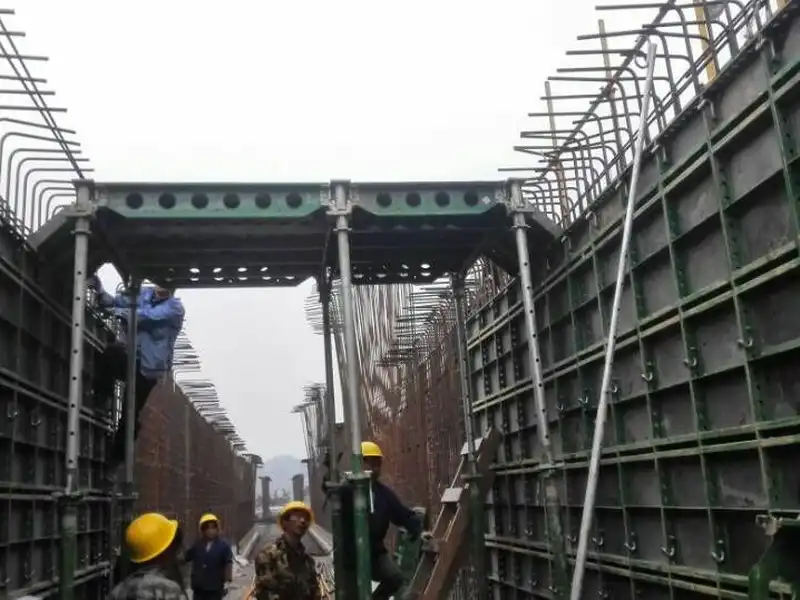
Understanding Combined Steel Formwork and Its Impact on Concrete Quality
The quality of the finished concrete is highly dependant on what surrounds it throughout the curing process. If the mould deflects, leaks or vibrates unevenly, the outcome is honeycombing, surface cracking or off spec dimensions. Most of these uncertainties are removed before the pour begins using a well-engineered steel panel system.
How Rigid Steel Panels Reduce Concrete Defects
The elastic modulus of Q235 carbon steel is 206 GPa. At this stiffness, panels with 2.5-3.0 mm thickness and capacity of 60-80 KN/m2 deflect very little under pressure of wet concrete. The flatness tolerance of ≤2 mm per GB/T 50214 ensures that the created concrete surface seldom requires supplementary plastering, hence reducing labour and material expense.
Tight Joints Prevent Slurry Loss
Surface pitting is mostly caused by slurry leakage via gaps. The peripheral flange design and regular P-hole spacing provide a strong mechanical seal between neighbouring panels. U-clips and L-shaped bolts seal connections without gaps to retain cement paste within the form where it belongs for a cleaner fair-faced concrete finish.
Dimensional Accuracy Across Repeated Pours
The formwork is fabricated to ±0.5 mm dimensional precision using cold roll forming machinery, so each panel reproduces the same shape pour after pour. Over the course of 200 to 300 reuse cycles, this consistency becomes important: wall thicknesses are within spec, column cross sections are square, slab surfaces abut at construction joints without step flaws.
Why Combined Steel Formwork Enhances Construction Safety?
Formwork failure is one of the most serious hazard categories in concrete construction with combined steel formwork. The American Society of Civil Engineers has documented that a significant share of structural collapses during construction trace back to inadequate temporary works. A properly rated steel formwork system reduces that risk substantially.
Load-Bearing Standards and Certification Backing
The Shandong Xingrui system is in accordance with ISO 9001 (Quality Management), ISO 14001 (Environmental Management) and ISO 45001 (Occupational Health and Safety) management systems. It’s not just paperwork. These certifications demand documented production controls, weld inspection records, and traceable batch quality data that procurement teams can provide to project owners and third-party auditors.
Modular Design Reduces Onsite Handling Risk
Each panel is sized in standard widths of 100/150/200/250/300 mm and lengths of 900/1200/1500/1800 mm which makes individual pieces managable by a two person crew without mechanical lifting. The free-assembly arrangement allows site teams to assemble walls, beams, columns and slabs from the same component inventory, minimising the clutter of mixed system types that may cause tripping hazards and faulty installations.
Corrosion Resistance Preserves Structural Integrity Over Time
Every panel is industrially pickled and phosphated and then baked at a high temperature to achieve a salt spray rating of more than Grade 8. A corrosion resistant panel preserves its section characteristics and weld integrity throughout its service life. A routine examination, such as checking for deformation, wear in the pins, and the state of the surface coating is all that is required to maintain the system running to rated capacity and to avoid the progressive deterioration that leads to unexpected failure.
Comparative Analysis: Combined Steel Formwork vs Traditional Formwork Solutions
Many project teams default to plywood or timber for combined steel formwork because the upfront purchase price is lower. That calculation changes significantly once you account for the full project lifecycle.
Here is a direct comparison across the criteria that matter most to procurement managers:
- Reuse cycles: Plywood typically lasts 5–15 pours before it warps or delaminates. A modular steel panel system reaches 200–300+ cycles with standard maintenance, reducing the per-pour material cost by an order of magnitude.
- Concrete surface quality: Timber absorbs moisture and swells, creating uneven surfaces. Steel panels maintain flatness tolerance across the entire run, delivering consistent surface quality without additional finishing work.
- Waste and sustainability: Plywood is disposed of as construction waste after each project. Steel panels are fully recyclable at end of life and conform to ISO 14001 environmental management requirements, supporting project sustainability documentation.
- Irregular structure adaptability: The modular system accommodates non-standard geometries through configurable corner pieces, filler modules, and curved inserts, making it practical for bridge piers, tunnel linings, and irregular column layouts where timber cutting would generate significant on-site waste.
These differences compound across a multi-story or infrastructure project. A procurement director managing several concurrent sites will find that standardized steel inventory can rotate between projects, reducing total capital tied up in temporary works.
Procurement Insights for Combined Steel Formwork: What B2B Clients Need to Know
B2B clients evaluating a steel panel system should consider more than unit price. Lead time, customization capacity, and supplier documentation capabilities all affect project risk.
Customization and Drawing-Based Production
Shandong Xingrui can make custom order based on customer design and sample. For non-standard geometries - curving retaining walls, unusual column cross-sections, unique slab thicknesses - the engineering team may build bespoke panel combinations to the same dimensional precision as ordinary catalogue items. Typical turn around time is 7-14 days following confirmation of the draw.
Supplier Reliability Metrics Worth Checking
When qualifying any combined steel formwork supplier, request batch quality inspection reports, welding procedure records, and a copy of current ISO certifications. Shandong Xingrui's 12 welding robots and 6 automatic welding lines produce traceable, consistent welds that hold up under third-party NDT review. With export history spanning 100+ countries, the company's shipping documentation — commercial invoices, packing lists, certificates of origin, and test reports — meets the requirements of most customs regimes.
After-Sales and Technical Support
Technical help: Guidance for first-time installation on-site and timely support on drawing adjustments. EPC contractors with tight milestone timelines are relieved to know that a supplier can respond to technical queries without major delays, hence decreasing the likelihood of expensive site stoppages.
Real-World Applications That Confirm the Quality and Safety Case
The practical benefits of modular steel panel formwork show up clearly in high-demand application categories.
High-Rise Shear Walls
Absolute verticality and uniform wall thickness are essential in the pouring of multi-storey shear walls. The rigid panel system maintains geometry under the lateral pressure of a full-story pour, eliminating the “bulging” that flexible systems allow. High-rise engineers say using steel formwork instead of plywood has led to fewer remedial cycles beyond the first few floors of a building.
Bridge Piers and Infrastructure
The formwork for large volume concrete parts like bridge columns must be capable of resisting fast pour rates without joint openings. Under pressure, the mechanical connection mechanism, U-clips and L-shaped bolts, locks all joints, giving the smooth fair-faced finish required by structural engineers for exposed concrete infrastructure.
Tunnel and Underground Utility Structures
Underground environments add humidity and chemical exposure to the challenge. The Grade 8+ salt spray rating keeps panels functional in wet conditions, and configurable corner modules handle the curved internal geometries common in tunnel linings and culvert sections.
Conclusion
Concrete quality with combined steel formwork starts with what contains it. A steel panel system built to tight tolerances, backed by certified production controls, and designed for 200–300 reuse cycles gives construction teams a material advantage over disposable alternatives. The safety argument is just as simple: approved loadings, corrosion resistant surfaces and manageable panel sizes decrease both structural and handling risk onsite. It makes sense, as a standard, for procurement experts who assess value over the whole project lifecycle, not just the purchase order, to have a certified modular steel formwork system in place.
FAQ
Q1: How many times can steel formwork panels be reused?
A: With proper use of release agents and routine maintenance checks, Q235 carbon steel panels achieve 200–300+ reuse cycles. That compares favorably with plywood at 5–15 cycles, making the per-pour cost significantly lower across any multi-story or infrastructure project.
Q2: What standards does this formwork system meet?
A: The system conforms to ISO 9001, ISO 14001, and ISO 45001 management systems. Panels are produced to GB/T 50214 flatness tolerances and carry CE certification, supporting compliance documentation for projects in Europe, the Middle East, and Latin America.
Q3: Can panels be configured for irregular or curved structures?
A: Yes. The modular design accommodates non-standard geometries through customized corner, filler, and curved modules produced from client CAD drawings. Sample production runs 7–14 days from drawing confirmation.
Q4: How are the joints sealed to prevent concrete leakage?
A: The peripheral flange with standard P-hole spacing, combined with U-clips and L-shaped bolts, creates a tight mechanical connection. This design keeps cement slurry inside the form and produces a clean surface finish without additional sealing strips in most applications.
Q5: What surface treatment protects panels during outdoor storage?
A: Each panel undergoes industrial-grade pickling and phosphating followed by high-temperature baking, achieving a salt spray resistance rating exceeding Grade 8. This treatment keeps panels serviceable through extended outdoor storage and repeated field exposure.
Get Your Combined Steel Formwork Quote from GREEN FORMWORK
GREEN FORMWORK by Shandong Xingrui Building Materials Co., Ltd. supplies combined steel formwork to construction teams across more than 100 countries. Our ISO-certified production, Q235 steel panels, 200–300+ cycle durability, and drawing-based customization make us a dependable combined steel formwork manufacturer for EPC contractors, rental companies, and regional distributors. Request a sample or project quote today — contact us at sdxingruiqp@126.com.
References
1. American Concrete Institute. ACI 347R: Guide to Formwork for Concrete. 2014.
2. American Society of Civil Engineers. Construction Loads on Structures and Structural Failures. Journal of Performance of Constructed Facilities, 2018.
3. British Standards Institution. BS EN 12812: Falsework — Performance Requirements and General Design. 2008.
4. Hurd, M.K. Formwork for Concrete, 7th Edition. American Concrete Institute, 2005.
5. International Organization for Standardization. ISO 45001: Occupational Health and Safety Management Systems. 2018.
6. Peurifoy, R.L. & Oberlender, G.D. Formwork for Concrete Structures, 4th Edition. McGraw-Hill, 2011.
Learn about our latest products and discounts through SMS or email