- English
- French
- German
- Portuguese
- Spanish
- Russian
- Japanese
- Korean
- Arabic
- Greek
- German
- Turkish
- Italian
- Danish
- Romanian
- Indonesian
- Czech
- Afrikaans
- Swedish
- Polish
- Basque
- Catalan
- Esperanto
- Hindi
- Lao
- Albanian
- Amharic
- Armenian
- Azerbaijani
- Belarusian
- Bengali
- Bosnian
- Bulgarian
- Cebuano
- Chichewa
- Corsican
- Croatian
- Dutch
- Estonian
- Filipino
- Finnish
- Frisian
- Galician
- Georgian
- Gujarati
- Haitian
- Hausa
- Hawaiian
- Hebrew
- Hmong
- Hungarian
- Icelandic
- Igbo
- Javanese
- Kannada
- Kazakh
- Khmer
- Kurdish
- Kyrgyz
- Latin
- Latvian
- Lithuanian
- Luxembou..
- Macedonian
- Malagasy
- Malay
- Malayalam
- Maltese
- Maori
- Marathi
- Mongolian
- Burmese
- Nepali
- Norwegian
- Pashto
- Persian
- Punjabi
- Serbian
- Sesotho
- Sinhala
- Slovak
- Slovenian
- Somali
- Samoan
- Scots Gaelic
- Shona
- Sindhi
- Sundanese
- Swahili
- Tajik
- Tamil
- Telugu
- Thai
- Ukrainian
- Urdu
- Uzbek
- Vietnamese
- Welsh
- Xhosa
- Yiddish
- Yoruba
- Zulu
What Features Should a Commercial Frame Scaffolding System Include?
A dependable frame scaffolding system is the backbone of safe, efficient commercial construction. At its core, it must deliver structural integrity, OSHA-compliant load capacity, modular assembly speed, corrosion-resistant surface treatment, and full accessory compatibility. For masonry contractors, renovation crews, and MEP teams working at height, these are not optional extras—they are the baseline requirements that separate a productive jobsite from a liability. This guide breaks down every feature that matters, so procurement managers like you can source with confidence.
Understanding Commercial Frame Scaffolding Systems
What Is a Frame Scaffolding System?
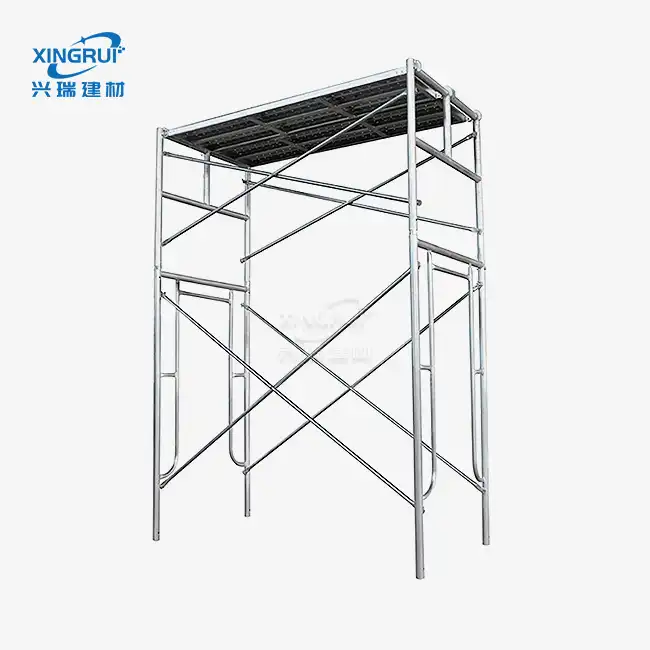
A frame scaffolding system is a temporary structure that is made up of vertical door frames, horizontal cross-braces, and work platforms. It is pre-built and modular. It lets people safely and steadily work at height on projects like brickwork, facades, finishing the inside, and installing MEP systems. OSHA data shows that falls are still the main reason people die in the construction industry, killing 36.4% of all workers each year. A modular scaffold system that is properly set up takes that risk directly on.
Core Applications in Commercial Construction
These systems are standard for masonry work on the outside of walls, ceiling work on the inside, and mechanical, electrical, and plumbing installations. Their walk-through portal design lets people and tools move horizontally along the platform without having to jump over bracing, which is useful on busy business sites with a lot of people.
Industry Trends and Regulatory Context
OSHA 29 CFR 1926 Subpart Q controls the use of scaffolding on all North American job sites. In foreign markets, EN 12810 and EN 12811 set similar standards. Both frameworks need load ratings that are written down, guardrail systems, and regular inspection protocols. When distributors keep OSHA-compliant goods in stock, their contractor customers don't have to worry about getting tickets.
Core Features Every Commercial Frame Scaffolding System Must Include
High-Grade Steel and Verified Load Capacity
Everything that happens after that depends on the quality of the materials. The tensile strength needs of industrial load situations are met by round tube scaffolding 42×2.0mm (O.D. × wall thickness) Q235 carbon steel tubes. Load capacity should not be guesses; it should be planned and recorded according to OSHA and EN 12810 rules. A 4:1 safety factor is the standard for structure pressure in the business world.
Modular Design With Secure Locking Mechanisms
When things go quickly on the job site, worker costs go down straight. A frame scaffolding system molded door frame that is made of a single piece and has standard closing links takes the guessing out of putting it together. Every time a contractor uses a system that cuts setup time by 50–70% compared to tube-and-clamp structures, they get more work done. Standardized pin-to-pin dimensional tolerance within ±1mm stops uneven loading when stacking vertically.
Safety Components and Compliance Features
To make sure that a commercial scaffold system is safe, it must have the following safety features:
- Guardrails and toe boards: Required by OSHA at all open sides and ends of platforms more than 10 feet above a lower level.
- Cross-braces with positive locking: Prevent lateral racking under wind or dynamic load.
- Base plates and adjustable screw jacks: Distribute vertical loads evenly and compensate for uneven ground.
- Walk-through frame width: 914mm is the North American standard, allowing unobstructed movement.
All of these safety features work together to keep contractors out of trouble and workers safe. Without them, one event could lead to OSHA fines of more than $15,625 per violation under the present penalty schedules.
Corrosion Resistance for Long-Term ROI
Hot-Dip Galvanization (HDG) with a coating thickness of at least 60μm forms a strong metal link that protects the tube from the inside and the outside. In places that are wet, near the coast, or chemically active, HDG works much better than powder coating and can prevent rust for more than 15 years. This durability immediately lowers the cost of replacement after each cycle for sellers who manage hire teams or resale inventory.
Accessory Compatibility and Full-System Supply
A platform system is only useful if it has the right environment of accessories. Frames, cross-braces, foot planks, couplers, and wheels must all be the same size and be bought as a set. If you don't get a licensed engineer's OK before mixing parts from different manufacturers, even if they say they're compatible, you could damage the structure.
How to Choose the Right Commercial Frame Scaffolding System
Match the System to Your Project Scale and Environment
Before you place an order, you should look at three things: the highest working height, the expected platform load, and the conditions of the spot. Standard frame designs up to 125 feet (about 38 meters) are allowed by OSHA rules without a site-specific engineering design. After that point, structural tie-ins and a stamp from a professional engineer are required.
Premium Versus Budget Models: What the Numbers Say?
When you add up the total cost of ownership, the price difference between high-end and low-end frame scaffolding system gets smaller very quickly. Premium systems made from checked Q235 or Q345 steel and treated with HDG have higher unit costs, but they can be used more than once, which lowers the total cost over the course of a year. When budget options are used, coatings often fail after two to three seasons, which leads to warranty claims and contractor returns that cut into distributors' profits.
Supplier Credentials and Certification Requirements
Procurement managers should make sure that any supplier they are considering has documented ISO 9001 Quality Management certification, ISO 14001 Environmental Management certification, and ISO 45001 Occupational Health and Safety certification. A typical due diligence step in a 4–8 month B2B procurement cycle is for a third party to inspect the factory and provide proof of product liability insurance. Buyers are less likely to be disappointed when suppliers allow sample orders and third-party tests before full container agreements.
Common Mistakes to Avoid When Procuring Frame Scaffolding Systems
Skipping Compliance Verification
The most expensive mistake a procurement manager can make is to buy scaffolding parts without checking the OSHA and EN load rating paperwork first. When non-compliant equipment is used in a fall, the legal responsibility moves down to the distributor and contractor.
Ignoring System Scalability
Locking your contractors into a frame size or locking-pin configuration that they can't mix with what you already have in stock makes it harder for them to reorder and causes problems with your customers. The normal cross-brace lengths and 914mm walk-through frame width should match what your end users are already using.
Overlooking Total Cost of Ownership
The purchase price by itself is not a good way to choose scaffolding. Think about the coating's lifespan, the availability of new parts, the space needed for keeping, and how often it needs to be inspected. In the short term, a system that saves $8 per frame is cheaper, but it costs a lot more in the long run because it needs to be replaced after three rental cycles.
Procurement and Logistics: Streamlining Your Frame Scaffolding Purchase
Bulk Ordering and CIF Pricing
Full-container-load (FCL) buying lowers the cost per unit at the port and limits the amount of freight that can go wrong during busy shipping times for frame scaffolding system orders. Negotiate CIF terms that cover insurance and freight to the port you choose, and make sure that all of the packaging has barcode labels that are set up to be read directly by the warehouse. With OEM private-label printing, distributors can strengthen their own brand identity without having to do extra work.
Lead Times and Shipping Planning
Standard production lead times for a confirmed factory order are between 30 and 45 days after the deposit is confirmed. This depends on the number of items ordered and any customizations that need to be made. Booking container space 6–8 weeks before the planned arrival date lowers your risk of having to pay high rates during peak season on Trans-Pacific lanes.
Initiating an Inquiry
When you ask for a price, you should include the frame's height and width, the surface treatment you want, your estimated annual volume, and the place where the goods will be shipped. When suppliers reply within 48 hours with thorough technical datasheets, production photos, and sample availability, they show that they are ready to do business, which is what a high-volume distributor relationship needs.
Conclusion
When choosing the right frame scaffolding system for business distribution, you need to look at the grade of the materials, the compliance paperwork, the number of accessories that come with the system, and the reliability of the seller. We must have Q235 steel, an HDG surface treatment, OSHA-recorded load values, and one-piece molding construction as a minimum. When purchasing managers look at the total cost of ownership instead of just the unit price and work with ISO-certified manufacturers, they consistently see lower return rates and more loyal contractors. The features listed here give you a clear list of things to do starting with your next sourcing cycle.
FAQ
What load capacity should a commercial frame scaffolding system meet?
Standard business systems are made to meet the load standards of OSHA and EN 12810 with a safety factor of 4:1. Before completing an order, you should always ask the seller for proof of a load test.
Can I order frame scaffolding with private-label branding?
Yes, OEM private-label printing is available from companies like Shandong Xingrui. This lets distributors put their own logos on frames and packaging without changing the structural specifications.
How do I verify that a supplier's product meets OSHA standards?
Ask for test results from a third party, certificates for an ISO management system, and proof of product liability insurance. In a responsible buying cycle, a sample is sent to an outside lab for testing before a full container order is made.
What is the maximum safe height for a standard frame scaffold?
As long as the standard frame configuration doesn't go over 125 feet (38 meters), OSHA will let it happen. For heights above that, you need a site-specific engineering design and structural tie-ins.
What surface treatment lasts longest in humid or coastal environments?
Hot-Dip Galvanization (HDG) with a covering thickness of 60µm or more protects against corrosion for more than 15 years in naval and industrial settings, making it much better than powder coating in those settings.
Partner With GREEN FORMWORK for Your Next Frame Scaffolding Order
GREEN FORMWORK sells industrial-grade frame scaffolding systems made by Shandong Xingrui Building Materials Co., Ltd., a company that is ISO 9001, ISO 14001, and ISO 45001 approved and has 40,000 m² of production space, 12 welding robots, and a standard of ±1mm for measurement tolerance. We offer OEM private-label choices, FCL pricing, sample sales, and expert help that you can call at any time. To get a quote from a reliable frame scaffolding system manufacturer, email our team at sdxingruiqp@126.com.
References
1. Occupational Safety and Health Administration (OSHA). OSHA Construction Industry Standards: 29 CFR 1926 Subpart Q – Scaffolds. U.S. Department of Labor, 2023.
2. European Committee for Standardization. EN 12810-1: Facade Scaffolds Made of Prefabricated Components – Part 1: Product Specifications. CEN, 2003.
3. Bureau of Labor Statistics. Census of Fatal Occupational Injuries Summary. U.S. Department of Labor, 2023.
4. Scaffold & Access Industry Association (SAIA). Supported Scaffold Systems: Safety and Compliance Guide. SAIA Publications, 2022.
5. International Organization for Standardization. ISO 9001:2015 – Quality Management Systems: Requirements. ISO, 2015.
6. Construction Industry Institute (CII). Prefabricated Modular Construction and Scaffold Efficiency in Commercial Projects. CII Research Report, 2021.
Learn about our latest products and discounts through SMS or email