- English
- French
- German
- Portuguese
- Spanish
- Russian
- Japanese
- Korean
- Arabic
- Greek
- German
- Turkish
- Italian
- Danish
- Romanian
- Indonesian
- Czech
- Afrikaans
- Swedish
- Polish
- Basque
- Catalan
- Esperanto
- Hindi
- Lao
- Albanian
- Amharic
- Armenian
- Azerbaijani
- Belarusian
- Bengali
- Bosnian
- Bulgarian
- Cebuano
- Chichewa
- Corsican
- Croatian
- Dutch
- Estonian
- Filipino
- Finnish
- Frisian
- Galician
- Georgian
- Gujarati
- Haitian
- Hausa
- Hawaiian
- Hebrew
- Hmong
- Hungarian
- Icelandic
- Igbo
- Javanese
- Kannada
- Kazakh
- Khmer
- Kurdish
- Kyrgyz
- Latin
- Latvian
- Lithuanian
- Luxembou..
- Macedonian
- Malagasy
- Malay
- Malayalam
- Maltese
- Maori
- Marathi
- Mongolian
- Burmese
- Nepali
- Norwegian
- Pashto
- Persian
- Punjabi
- Serbian
- Sesotho
- Sinhala
- Slovak
- Slovenian
- Somali
- Samoan
- Scots Gaelic
- Shona
- Sindhi
- Sundanese
- Swahili
- Tajik
- Tamil
- Telugu
- Thai
- Ukrainian
- Urdu
- Uzbek
- Vietnamese
- Welsh
- Xhosa
- Yiddish
- Yoruba
- Zulu
What Features Matter in a Steel Building Formwork System Purchase?
When procurement managers evaluate a steel building formwork system for large-scale EPC projects—whether in the Middle East, Southeast Asia, or Sub-Saharan Africa—the decision goes far beyond price per square meter. The right system must deliver dimensional precision across wall, beam, column, and slab applications; withstand repeated concrete pours without deformation; and arrive on schedule to match the pour cycle. From material grade and joint tightness to ISO certification compliance and supplier responsiveness, every specification carries financial weight. This guide breaks down exactly what to assess before committing to a purchase.
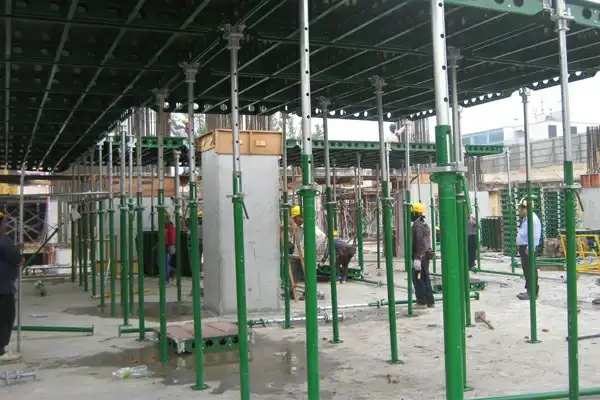
Understanding Steel Building Formwork Systems
What the System Actually Does?
A steel formwork system is a pre-made set of steel panels, stiffening ribs, and interlocking connectors that hold freshly poured concrete until it can support itself on its own. The steel shell keeps its shape even when it's under hydraulic pressure. This makes a smooth concrete finish that greatly lowers the cost of sealing after the concrete has been poured.
How Steel Differs from Timber and Aluminum?
After five to ten pours, the wood forms will soak up water, swell, and break down. When there is a lot of pressure on the sides, aluminum is less strong but lighter. When properly cared for, Q235 hot-rolled steel plate—the grade used in professional-grade systems—keeps its structural integrity through 300 or more pours. The whole total cost estimate is based on this important difference.
Why It Matters for EPC Projects?
International EPC contractors who are in charge of multiple building projects need a single steel building formwork system forming solution that can be used for wall, column, beam, and slab pours without having to rearrange their inventory. A standard modular system gets rid of the need for ad hoc carpentry on-site, cuts down on waste, and keeps pour schedules stable, which is very important when concrete placement windows depend on weather, crane availability, or worker shifts.
Key Features to Consider When Purchasing Steel Formwork Systems
Modularity and Dimensional Precision
The most important technical factor is system modularity. International modular sizing, especially 300-series and 200-series panel shapes with 150mm splicing holes, lets teams set up any cross-section of a structure without having to cut or shimmy. Professional-grade systems are distinguished from regular ones by having dimensions that are accurate to within ±2mm over a 2-meter span.
Load-Bearing Capacity and Joint Tightness
A pour of concrete puts a lot of pressure on the sides. Well-designed systems must be able to handle loads of more than 60 kN/m² without deforming. This pressure is spread out equally by frame-and-rib integrated welding, which is done by automatic welding lines. When panel seams are tight, grout doesn't leak out, which would cause surface flaws that would need expensive repairs. There can be no clearance at all for joint gaps in shear walls and elevator cores.
Corrosion Resistance and Maintenance Requirements
Steel formwork that is used in tropical or coastal areas rusts more quickly. A cleaned face plate and the use of anti-rust oil between pours greatly increase the service life. Buyers should make sure that the supplier's surface treatment meets a minimum standard for corrosion resistance and that new panels, such as ribs, pins, and wedge bolts, are in stock and ready to be sent quickly to places overseas.
Comparing Steel Formwork Systems with Other Materials
Steel vs. Timber: The Lifecycle Argument
Buying a steel concrete making system up front costs about three to four times as much as buying similar wooden forms. Wood, on the other hand, can only be used five to ten times before it breaks. If you take good care of steel, it can go through 300 to 500 cycles. This means that the cost-per-use will go down by more than 70% on a 200,000 m² residential EPC project. This is a number that quantity surveyors always use for high-turnover projects.
Steel vs. Aluminum: Rigidity Under Pressure
Because it is light, aluminum formwork is becoming more popular in routine home building. But when it comes to extreme hydrostatic load, its yield strength is lower than that of carbon steel. The stiffness-to-weight ratio of Q235 steel gives it a safety cushion that aluminum can't match for bridge piers, thick shear walls, or industrial utility tubes with pour depths greater than 3 meters.
Environmental and Regulatory Factors
Environmental compliance requirements are becoming more and more common for procurement teams working on international projects. The supplier's ISO 14001 certification shows that the manufacturing process meets standards for environmental management. This seems to be a hard requirement on many government-backed infrastructure bids in Africa and the Middle East. Full recycling of steel at the end of its useful life also makes the environmental case stronger.
Procurement Considerations and Supplier Insights
Certification as a Hard Entry Requirement
Before the technical review starts, procurement teams usually check the management system certifications of steel building formwork system sellers. International bids usually need three types of certifications: ISO 9001 for quality management, ISO 14001 for environmental management, and ISO 45001 for health and safety at work. Suppliers who don't have all three licenses are usually thrown out during the shortlisting process, even if their prices are reasonable.
Here are some practical criteria that experienced procurement managers use to judge suppliers during the comparison stage:
- Production capacity verification: A supplier with 40,000+ m² of standardized workshop space, 12 welding robots, and 6 automatic welding lines can realistically commit to large-order delivery schedules. Confirm this through factory audit or third-party inspection, not brochure claims alone.
- Custom order responsiveness: Projects change. When architectural drawings are revised mid-procurement, the supplier must demonstrate the ability to process incremental orders—additional panel sizes, corner pieces, or slab soffit forms—within an agreed turnaround. CNC-cut custom steel panels for radial walls or non-standard column sections should be within the supplier's scope.
- Logistics and customs support: International shipments require packing lists, HS code declarations, and certificate-of-origin documentation matched to the destination country's import rules. Suppliers experienced in exporting to more than 100 countries carry institutional knowledge that reduces port delays and demurrage costs.
When these criteria are strictly followed, they protect project schedules and budgets throughout the whole procurement process.
Sample Confirmation and Technical Support
Suppliers with a good reputation offer real samples before signing the outline contract. Before committing to full production volume, this step lets the project's chief engineer check the flatness of the panels, the quality of the welds, the finish on the surface, and the fit of the connectors. It's just as important to have expert help on-site during the first installation cycle. This keeps people from making mistakes during assembly that could affect the quality of the pour or put workers in danger.
Installation and Practical Use Guidelines
Preparation and Pre-Pour Inspection
Before each pour cycle, all wedge nuts and pins must be checked for wear, and panels must be checked for flatness variations greater than ±2mm. Release agent, a chemical oil that is put on the steel face, stops the concrete from sticking and lets the steel be stripped cleanly without damaging the surface. On busy job sites, skipping this step is the most common way for the surface of the panel to wear down.
Assembly Sequence and Safety
Assembling panels should be done by following a set of pre-engineered drawings that the manufacturer gives you. For wall forms, adjustable props are used to line up the panels straight, and then they are cross-braced before the concrete is poured. It is important for workers to make sure that all of the splicing connections are fully engaged. A partially seated link under 60 kN/m² force can cause damage to the structure. Load-rated tie rods spaced at certain intervals and protecting against wind loads during the open pour window are safety measures.
Maximizing Cycle Efficiency
A plastic brush should be used to remove any concrete dust that is left over after stripping. A steel blade would damage the face plate. The anti-rust oil is then put on again before the stacking. A well-organized site with clearly labeled panel inventory by size and series can cut re-assembly time by 20 to 30% compared to storage that isn't sorted, which has a direct effect on the number of pour cycles and the overall schedule for the project.
Conclusion
To choose a steel building formwork system for an international EPC project, technical requirements must be matched to structural needs, supplier certifications must be checked against tender requirements, and the supplier's ability to handle logistics and respond quickly must be put to the test. The standard for specifications is Q235 hot-rolled steel panels with a tight-joint modular design, three ISO certifications, and a history of plant capacity. When buyers carefully consider these factors instead of just going for the cheapest unit price, they protect both the quality of the pour and the overall cost-effectiveness of the project.
FAQ
How does initial cost compare to timber formwork?
The upfront cost of a steel forming system runs three to four times higher than equivalent timber forms. However, with 300 or more reuse cycles versus timber's five to ten, the cost-per-use drops by over 70% on volume programs. For multi-building EPC contracts, the return on investment typically materializes within the first two project rotations.
Can the system be customized for irregular architectural shapes?
Yes. Standard modular panels cover most rectangular wall and column sections. For non-standard geometries—radial walls, tapered columns, or parabolic arches—CNC-cut custom steel panels are engineered to drawing. Buyers should confirm this capability and the associated lead time during supplier qualification.
What maintenance is required between pours?
After each pour, remove concrete residue with a plastic scraper, inspect panel flatness, check connector condition, and reapply anti-rust protective oil. This routine, performed consistently, keeps a quality system within its 300 to 500 cycle lifespan.
Is the system suitable for humid or high-temperature climates?
Steel does not absorb water or swell, making it more stable than timber in monsoon conditions. In extreme heat environments, thermal expansion must be factored into panel joint calculations. A supplier with export experience across tropical and arid regions will have standard guidance for both scenarios.
Get a Tailored Quote from GREEN FORMWORK
International EPC companies can get a certified steel building formwork system maker from GREEN FORMWORK, which is backed by Shandong Xingrui Building Materials Co., Ltd. We can perfectly fit your pour plan and requirements because we are certified by ISO 9001, ISO 14001, and ISO 45001, and our products have been used over 300 times. To start your sourcing review today, email sdxingruiqp@126.com to get a sample or full project price.
References
1. Peurifoy, R. L., & Oberlender, G. D. Formwork for Concrete Structures. McGraw-Hill Education, 2011.
2. Hurd, M. K. Formwork for Concrete (7th ed.). American Concrete Institute (ACI SP-4), 2005.
3. British Standards Institution. BS EN 12812: Falsework – Performance Requirements and General Design. BSI, 2008.
4. Construction Industry Research and Information Association (CIRIA). Formwork: A Guide to Good Practice (3rd ed.). CIRIA, 2012.
5. American Concrete Institute. ACI 347R-14: Guide to Formwork for Concrete. ACI Committee 347, 2014.
6. Ratay, R. T. (Ed.). Handbook of Temporary Structures in Construction (2nd ed.). McGraw-Hill, 1996.
Learn about our latest products and discounts through SMS or email