- English
- French
- German
- Portuguese
- Spanish
- Russian
- Japanese
- Korean
- Arabic
- Greek
- German
- Turkish
- Italian
- Danish
- Romanian
- Indonesian
- Czech
- Afrikaans
- Swedish
- Polish
- Basque
- Catalan
- Esperanto
- Hindi
- Lao
- Albanian
- Amharic
- Armenian
- Azerbaijani
- Belarusian
- Bengali
- Bosnian
- Bulgarian
- Cebuano
- Chichewa
- Corsican
- Croatian
- Dutch
- Estonian
- Filipino
- Finnish
- Frisian
- Galician
- Georgian
- Gujarati
- Haitian
- Hausa
- Hawaiian
- Hebrew
- Hmong
- Hungarian
- Icelandic
- Igbo
- Javanese
- Kannada
- Kazakh
- Khmer
- Kurdish
- Kyrgyz
- Latin
- Latvian
- Lithuanian
- Luxembou..
- Macedonian
- Malagasy
- Malay
- Malayalam
- Maltese
- Maori
- Marathi
- Mongolian
- Burmese
- Nepali
- Norwegian
- Pashto
- Persian
- Punjabi
- Serbian
- Sesotho
- Sinhala
- Slovak
- Slovenian
- Somali
- Samoan
- Scots Gaelic
- Shona
- Sindhi
- Sundanese
- Swahili
- Tajik
- Tamil
- Telugu
- Thai
- Ukrainian
- Urdu
- Uzbek
- Vietnamese
- Welsh
- Xhosa
- Yiddish
- Yoruba
- Zulu
What Is Coupler Type Steel Tube Scaffolding? A Buyer’s Guide
Coupler type steel tube scaffolding is a modular access system built from standardized steel tubes—typically Φ48×3.0mm Q235 steel—joined by three primary coupler types: right-angle, swivel, and butt joint. This system is one of the oldest and most widely adopted scaffolding forms globally, prized for its geometric adaptability across civil engineering, industrial maintenance, and high-rise construction projects. Unlike fixed-frame alternatives, it allows crews to adjust configurations on-site to match irregular facades or complex structural geometries. For procurement teams balancing safety compliance with budget constraints, understanding this system's components and standards is the first step toward a confident buying decision.
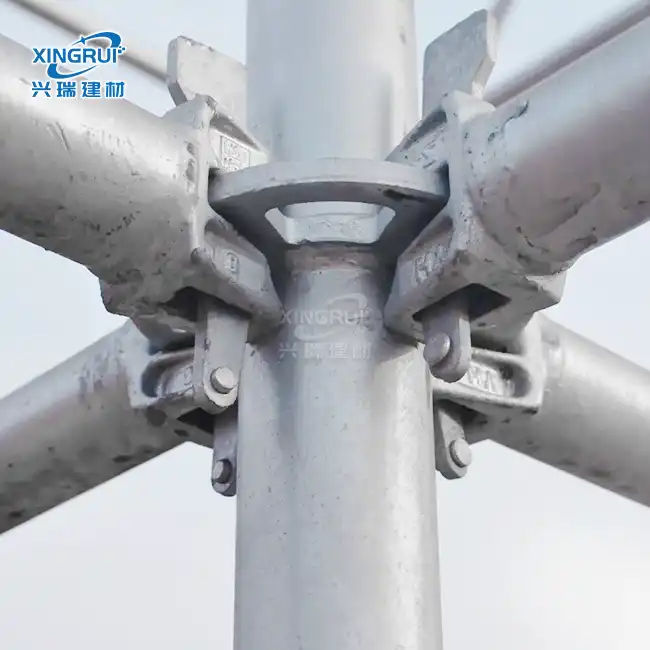
Understanding Coupler Type Steel Tube Scaffolding
What It Is Made Of?
The main part of the system is a steel tube that is 48x3.0mm or 48x3.5mm wide and made of Q235 carbon steel. This type of steel has a steady compressive strength of 375–500 MPa. ISO 1461 says that tubes must be hot-dip galvanized so that they have at least 40 microns of zinc covering them. This keeps them from rusting near the water or outside. EN74 Class A or B steel that has been machined or cast is used to make couplers. They connect tubes straight on at a right angle.
Three Core Coupler Types
A right-angle coupler joins two tubes at a 90° angle. This is the main joint that can hold weight. The swivel coupler lets you connect at any angle, which is why it's needed to brace structures that aren't straight across. With the butt joint coupler, tube lengths can be made longer from one end to the other while still being straight along the axis. The EN74 testing rules say that each type of coupler must have a slip resistance of at least 15kN in right-angle forms. This gives engineers a clear place to start with the structure.
Applicable Standards and Certifications
When you sign off on a coupler type steel tube scaffolding project, compliance is very important. The system's steel tubes are checked against BS1139, the connectors are checked against EN74, and the performance standards for working and access scaffolds are checked against EN12811-1. The rules for tube-and-coupler scaffolds in the US are set by OSHA 29 CFR 1926 Subpart Q. For third-party checks to work, sellers who do business with other countries should also show CE Declaration of Performance (DoP) paperwork and quality management records that are ISO 9001-certified.
Benefits and Limitations of Coupler Type Steel Tube Scaffolding
Tube-and-coupler scaffolding is used on job sites all over the world because it is useful. These are the main reasons why it's a good choice for tough projects:
- Geometric adaptability: Because every joint is individually adjustable, crews can wrap scaffolding around curved facades, bridge piers, or reactor vessels where prefabricated frame systems simply cannot fit.
- High load capacity: Forged couplers with slip resistance exceeding 15kN, combined with Q235 steel tubes, support heavy industrial loads in refineries, shipyards, and power stations.
- Cost-effective logistics: Individual components stack flat in containers. Compared to pre-assembled frame panels, this reduces freight volume and storage footprint on site.
- Long service life: Properly galvanized tubes maintain structural integrity for over 10 years with routine inspection, delivering strong lifecycle value for rental fleets and repeat project deployments.
This is why tube-and-coupler is often used for long-term repair, restoring history, and big building projects where rigid systems can't be changed.
How to Assemble Coupler Type Steel Tube Scaffolding?
Site Assessment and Base Preparation
A trained person must check how much weight a tube can hold on the ground and look for risks above before it goes high. Base plates and bottom boards spread the load up and down over the ground. According to EN12811.1, the base must be strong enough to hold the expected working load plus a safety factor. It must also not settle more than what is allowed.
Erection Sequence
The standards and ledgers go up first at each lift level for coupler type steel tube scaffolding, then the transoms. Every 30 meters of facade length, diagonal bracing tubes are added at set times to protect against side wind loads. One coupler joint at a time is tightened until it fits snugly. A calibrated torque wrench is then used to reach a range of 40–65 Nm. If the fit is too tight, the bolt threads or tube wall will break. If it's not tight enough, things will slip.
Final Safety Inspection
This is what EN12811.1 says should be checked before use: the tube should be straight within a certain range; the coupler bolts should be in good shape; the fence should be at least 950 mm high; and the toe board should be in place. In order to fix a large petrochemical plant, scaffolding has to go through many pipes at different heights. This step of checking makes sure that the pipes are lined up correctly before they are loaded with heavy things. This keeps the project on track and lowers the chance of accidents.
Buying Guide for Coupler Type Steel Tube Scaffolding
Key Supplier Evaluation Criteria
There are four things that will always let you know which sellers of tube-and-coupler scaffolds are safe and which ones are not for sure. The company should have ISO 9001 certification and be able to give you batch-level Mill Test Certificates (MTCs) that show how thick the tube walls are and how much they can bend. When you buy couplers, make sure they have EN74 Class A or B test reports from a reliable third-party lab. Ask for a sample order before you decide to buy a lot. Samples from reputable companies are usually sent out between 7 and 14 days.
Pricing Structure and Procurement Terms
If you need to do heavy-duty work, the extra cost of forged couplers is worth it because they can handle more weight than pressed steel ones. This kind of goods are usually sold with FOB or CIF. You need to pay a 30% to 50% T/T deposit before production starts. The rest is due when you get the shipping papers. Most of the time, it takes 15 to 30 days from the time the order is confirmed until the container is loaded with stock items. Please allow an extra 7 to 14 days for first-article approval if you have specific needs.
Customization and OEM Options
Well-known manufacturers of coupler type steel tube scaffolding can work on plans for different coupler shapes, different tube lengths, or private-label branding as long as they sign an NDA. When rental companies build fleets, this helps them keep each one separate. It also helps EPC contractors use the same standard part sizes at different sites. Check to see if the seller can meet your busy times without having to change the delivery dates.
Maintenance and Safety Best Practices for Long-Term Use
Routine Inspection Protocols
Inspections that follow a set plan keep workers safe and assets' value high. Before each shift, you should check the coupler bolts to make sure they are tight, the zinc surfaces for rust, and the tubes for damage from being hit. Regularly, at least once every two weeks, check the thread condition on coupler bolts and the zinc coating thickness on active sites by comparing it to a 40-micron baseline.
Corrosion Prevention Techniques
It's hard to get around because of hot-dip galvanization, but field maintenance makes it last longer. The threads on coupler bolts should be oiled every so often to keep them from getting galled and to make sure the right amount of pressure is used. Tubes should be kept off the ground in a dry, well-ventilated rack when they're not in use. This will keep white rust from forming in places where water gets stuck. Do not store tubes next to concrete or dirt, as these will quickly take the zinc from any points where they touch.
Worker Training and Safety Protocols
OSHA data shows that most scaffolding accidents happen because the structure wasn't set up right or wasn't inspected, not because the materials failed. It is directly safer for workers to be trained to meet the competent-person level set by OSHA (29 CFR 1926.454) or the EN12811 training rule. In the same way, keeping a written escape plan for tube-and-coupler designs cuts down on the time it takes to deal with accidents.
Conclusion
For building and industry, coupler type steel tube scaffolding is still the most shape-adaptable way to get to high places. To make it, they used Q235 steel, Y48×3.0mm tubes, and EN74-rated forged couplers. These have been tested to make sure they can handle loads in cultural, industrial, and urban areas. The trade-offs of the system in terms of assembly time can be dealt with as long as workers are properly trained and couplers are tightened. With the help of approved sellers, test reports from a third party, and a sample order stage, buy teams can make a low-risk purchase before committing fully. The thing you buy will help you in the long run if you do those things right.
FAQ
Q1: What tightening torque do couplers require?
A: Professional rules say that the range should be between 40 and 65 Nm. There is a chance that the joint will slip if it is less than 40 Nm. If you use more torque than 65 Nm, the bolt threads may come loose or the tube wall may bend, which makes the joint less strong.
Q2: How many times can components be reused?
A: If you hot-dip galvanize and take care of Q235 steel tubes the right way, they can last more than 10 years. Every time a coupler is used, it should be checked for thread wear, bolt lengthening, and body distortion before being put back into the current inventory.
Q3: What is the difference between forged and pressed couplers?
A: Forged couplers are made by putting a lot of pressure on metal and shaping it. This makes the grain structure thicker, which makes it less likely to slip (usually more than 15kN for right-angle types). pressed-steel couplers are less expensive, but they can't hold as much weight and are only used for short-term or light-duty jobs most of the time.
Q4: Can this system mix with other scaffolding types?
A: With tubes that have an outside diameter of 48.3 mm, most systems will work, but it's not a good idea to mix coupler standards. Always ask for couplers that are made to fit tubes with an outside diameter of exactly 48.3 mm to get the best load performance and to avoid liability gaps during checks.
Q5: Does the system comply with U.S. OSHA requirements?
A: Subpart Q of OSHA 29 CFR 1926 talks about tube-and-coupler scaffolds in detail. As part of their U.S. projects, buyers should also make sure that the paperwork their supplier sends them includes records of where the materials came from that meet OSHA's standards for a competent person inspection.
Partner with GREEN FORMWORK for Your Next Scaffolding Project
GREEN FORMWORK sells approved coupler type steel tube scaffolding to people in over 100 countries with the help of Shandong Xingrui Building Materials Co., Ltd. Our factory is more than 40,000 square meters, we follow CE rules, and our expert team is made up of 180 people. We are ISO 9001 approved. This means your package will arrive on time and with all the paperwork it needs. Use the form below to get a quote or sample today. Our export team can be reached at sdxingruiqp@126.com.
References
1. British Standards Institution. BS 1139-1: Metal Scaffolding — Specification for Steel Tubes. BSI, 2010.
2. European Committee for Standardization. EN 74-1: Couplers, Spigot Pins and Base Plates for Use in Falsework and Scaffolding. CEN, 2005.
3. European Committee for Standardization. EN 12811-1: Temporary Works Equipment — Scaffolds — Performance Requirements and General Design. CEN, 2003.
4. Occupational Safety and Health Administration. OSHA 29 CFR 1926 Subpart Q: Scaffolding Standards for the Construction Industry. U.S. Department of Labor, 2013.
5. International Organization for Standardization. ISO 1461: Hot Dip Galvanized Coatings on Fabricated Iron and Steel Articles — Specifications and Test Methods. ISO, 2009.
6. Peng, J. L., Pan, A. D., & Chan, S. L. "Scaffold design and advanced analysis of modular tube-and-coupler scaffolding systems." Journal of Constructional Steel Research, 2005.
Learn about our latest products and discounts through SMS or email