- English
- French
- German
- Portuguese
- Spanish
- Russian
- Japanese
- Korean
- Arabic
- Greek
- German
- Turkish
- Italian
- Danish
- Romanian
- Indonesian
- Czech
- Afrikaans
- Swedish
- Polish
- Basque
- Catalan
- Esperanto
- Hindi
- Lao
- Albanian
- Amharic
- Armenian
- Azerbaijani
- Belarusian
- Bengali
- Bosnian
- Bulgarian
- Cebuano
- Chichewa
- Corsican
- Croatian
- Dutch
- Estonian
- Filipino
- Finnish
- Frisian
- Galician
- Georgian
- Gujarati
- Haitian
- Hausa
- Hawaiian
- Hebrew
- Hmong
- Hungarian
- Icelandic
- Igbo
- Javanese
- Kannada
- Kazakh
- Khmer
- Kurdish
- Kyrgyz
- Latin
- Latvian
- Lithuanian
- Luxembou..
- Macedonian
- Malagasy
- Malay
- Malayalam
- Maltese
- Maori
- Marathi
- Mongolian
- Burmese
- Nepali
- Norwegian
- Pashto
- Persian
- Punjabi
- Serbian
- Sesotho
- Sinhala
- Slovak
- Slovenian
- Somali
- Samoan
- Scots Gaelic
- Shona
- Sindhi
- Sundanese
- Swahili
- Tajik
- Tamil
- Telugu
- Thai
- Ukrainian
- Urdu
- Uzbek
- Vietnamese
- Welsh
- Xhosa
- Yiddish
- Yoruba
- Zulu
What Is Rosette Ringlock Scaffolding? A Buyer’s Guide for 2026
Rosette Ringlock Scaffolding is a flexible support system made up of round rosette connection disks that are welded to vertical standards every 0.5 meters. With a wedge-locking system that doesn't need any bolts or nuts, each disk can hold up to eight connections at once: four ledgers at 90° angles and four diagonal braces at flexible angles. This makes a self-locking joint that is held together by gravity and gives the structure strength without any free hardware. When it comes to speed of assembly, load distribution, and long-term asset value, this system is a clear improvement over traditional options for procurement managers who need to buy a lot of scaffolding. EN 12810-1:2003 is the source.
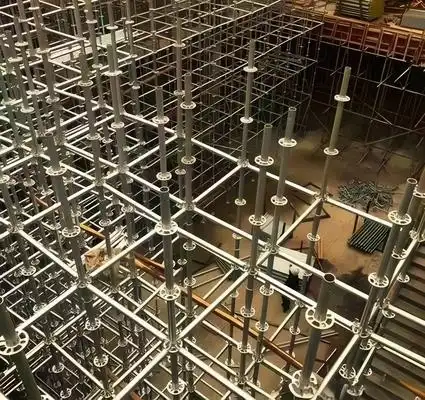
Understanding Rosette Ringlock Scaffolding
The Core Mechanism That Changes Everything
The eight-hole daisy-type rosette plate is what makes this method unique. When the wedge head of a ledger is pushed downward into a rosette hole, gravity and contact force hold the joint together without the need for an extra fastening. This gets rid of the biggest danger of tube-and-clamp support, which was loose hardware falling from high up. According to OSHA's construction safety data, about 8% of construction deaths in the US each year are caused by being struck by something. This system's bolt-free design directly addresses this problem.
In the 1970s, early European modular scaffolding led to the development of the system. It became popular in the 1990s when builders wanted faster cycle times on complicated infrastructure and industrial projects. It is now the most common type of rental fleet in Europe's scaffolding markets, and it meets the EN 12810 and EN 12811 standards for wall and load-bearing scaffolding. Rosette Ringlock Scaffolding traces its lineage to these European innovations, combining the daisy-rosette node with modern HDG steel to deliver the speed, safety, and compliance that rental operators demand.
Advantages and Technical Specifications
Choosing the right materials and engineering shapes are at the heart of this system's technical profile. These are the specs that compliance engineers and procurement teams use the most:
- Material: Q235B/Q355B steel that has been chemically traced for its carbon and silicon content. This makes sure that all production batches have the same level of ductility.
- Pipe geometry: outer diameter of 48.3mm or 60mm, wall thickness of 3.0mm to 3.25mm, meeting EN 12810 standards for interchange.
- Surface protection: Hot-dip galvanization (HDG) at 65–80 microns zinc coating, which is about 10 times as protective as pre-galvanized coatings and has been proven to last 15 years or more, even in chemical and marine environments. (From ISO 1461:2009)
- Compliance standards: Standards for compliance: EN 12811, AS/NZS 1576, and ANSI/SSFI SC100; these cover the European, Australian, and North American markets at the same time.
- Certifications held: These are the certifications they have: ISO 9001 for Quality Management, ISO 14001 for Environmental Management, and ISO 45001 for Occupational Health and Safety.
These requirements are more than just paper compliance. When a rental fleet manager in Germany mixes new purchases with old stock, the ability of parts to fit together smoothly on-site depends on how accurately the dimensions are within tolerance. Even a small change of 0.5 mm in the shape of the rosette holes can cause joint play that can make the structure unstable at high levels. Tight industrial standards are not a selling point; they are an essential part of the business. Rosette Ringlock Scaffolding demands this level of dimensional precision, as its multi-point rosette connections rely on exact hole tolerances to maintain structural integrity under varying load conditions.
Comparing Rosette Ringlock Scaffolding to Other Systems
Where the Differences Become Decisive?
It's rare for procurement decisions to be made by themselves. Stefan buys 300 to 500 tons of new ringlock inventory every year and compares this system to Cuplock, tube-and-clamp, and Kwikstage options in a number of different ways at the same time.
Cuplock scaffolding is made up of two cups that lock together at the top and bottom. It works well and is well known, but its single-plane node means that link angles can only be 90°. This really limits the rosette node's ability to bend in different directions, which is important for shapes like storage tank surrounds, bent bridge abutments, or dock hull scaffolding.
Tube-and-clamp devices give you the most physical freedom, but they require a lot of work. For each connection, a different fitting needs to be tightened to a certain torque. This difference in labor costs can add tens of thousands of dollars to the cost of a big industrial repair job. Studies in the Journal of Construction Engineering and Management show that modular ringlock systems cut the number of hours needed to set up a project by 30–40% compared to tube-and-clamp systems with the same project size.
Kwikstage works well for simple wall work, but it doesn't have the load-transfer shape that is needed for heavy shoring. The eight-point distribution of the rosette node makes a structurally stable connection cluster that can handle both axial compression and lateral shear. This is why engineers who design bridge deck shoring choose this system for critical load stages.
How to Choose and Procure Rosette Ringlock Scaffolding?
A Structured Evaluation Framework for Serious Buyers
Buying a lot of scaffolding usually takes six to twelve months and involves a lot of people. The supply chain manager makes the decision, the safety engineer checks the paperwork to make sure it's legal, and the warehouse supervisor deals with stackability and managing parts every day.
When experienced buyers look at something, they usually do it in this order:
- Compliance documentation first: First, get the compliance paperwork: ask for EN 12810/12811 third-party test results and make sure the quality of the rosette weld with ultrasound or radiographic test certificates before you start talking about business.
- Dimensional verification via samples: Verification of dimensions using samples: Use go/no-go gages to check the geometry of the wedge-head and the tolerances of the rosette holes against your current stock. This one step stops field mismatch, which can be very expensive.
- HDG coating measurement: Measure HDG coating: Use a magnetic induction gage to make sure that given samples have a 65µm+ zinc covering, not just a certificate.
- Facility audit: A 79,800-square-meter building with 12 welding robots and 6 automatic welding lines is a sign of consistent output. Automation makes it easier for people to be consistent with weld depth, which is where most rosette-to-pipe joints fail.
- Container loading efficiency: To make loading containers faster, ask for a packing list with counts of each item in each container. When you buy full containers from China, it's important to know that higher load density directly lowers the cost of freight per unit.
- Tiered pricing and replenishment terms: Different levels of pricing and restocking terms: Talk about yearly framework agreements that lock in unit prices across all volume ranges and ensure a steady supply of spare parts for the asset's 15-year or longer operational life.
Shandong Xingrui Building Materials Co., Ltd., which does business as GREEN FORMWORK, can do custom engineering work based on customer plans and samples. This is useful for OEM rental fleet operators who need unique branding or bay widths that aren't standard. Rosette Ringlock Scaffolding from GREEN FORMWORK supports these customizations with flexible rosette spacing and component sizing, enabling tailored solutions for specialized rental fleet requirements.
Installation and Best Practices Guide
Assembly Discipline That Protects Your Asset Investment
If you don't install a scaffold correctly, it might not work at its full capacity, which could put you at risk. Before putting the parts together, people on the ground should check each vertical standard to make sure it is straight within a 0.2% error and make sure the rosette disk is flat. Any rosette disk or wedge that is bent must be put in a separate area because they don't fix themselves when they are loaded.
When the machine is being set up, the holes must be fully driven home with a hammer strike, not just hand pressure. The goalkeeper pin built into the wedge shape stops it from coming loose due to vibrations in places with a lot of vibrations, like offshore platforms or busy industrial plants. After the structure is put up, it should be checked to make sure that the diagonal bracing makes closed triangular bays at every lift level. This is the geometric condition that makes the system fully stable on its sides.
After the project is done, check all of the rosette disks for damage and all of the ledger ends for wedge heads that are bent. Parts that pass inspection go right into the rental pool, while parts that aren't up to par are marked to be replaced. This organized lifecycle process is what keeps the asset utilization rate of a rental fleet above 80% and the insurance fees steady.
Conclusion
he ringlock scaffolding system with daisy-type rosette connections is the standard modular system for big infrastructure and industry projects. Its bolt-free assembly, multi-angle node geometry, and HDG-protected steel body all take into account the three things that rental operators look at when figuring out their total cost of ownership: how much labor they use, how long their assets last, and how well they follow the rules. Buyers who buy third-party certified, precisely measured systems from trustworthy manufacturers protect both their employees and their bottom line. The procurement cycle for 2026 rewards those who carefully check quality up front instead of having to pay for mistakes in the field later on. Rosette Ringlock Scaffolding exemplifies this approach, with its rosette-node design enabling rapid, tool-free assembly while HDG coating ensures long asset life and regulatory compliance across diverse project sites.
FAQ
What is the maximum height achievable with this system?
Technically, it is possible to build higher than 50–100 meters, but for every design above normal facade heights, site-specific engineering estimates are needed to account for diagonal bracing patterns and lateral load management. Never go over the height limits set by the maker without the permission of a qualified structural engineer.
Can components from different ringlock manufacturers be mixed on-site?
Mixing is not recommended unless tests for technical compatibility show that the wedge-head geometry and rosette disk thickness are the same. Joint play is caused by even small deviations, and it makes the structure less strong when it's under load.
Is hot-dip galvanization meaningfully better than pre-galvanized coating?
Yes, HDG can get into the inside of pipes and seal gaps, protecting them with 65–80 microns of zinc. Most pre-galvanized finishes offer 6 to 8 microns. In corrosive environments, the difference in service life is about ten times bigger.
What maintenance does a rental fleet require?
When the project is finished, it should be inspected for standard straightness, bent wedges, and deformed rosettes. Some parts that are within a verticality tolerance of 0.2% are returned to the loan pool, while others are changed. Systematic protocols for quarantine protect both safety and the rate at which assets are used.
Does GREEN FORMWORK provide samples before large orders?
Yes, samples come with all the technical information you need, like material traceability certificates and galvanization test reports, to help you with your qualification process before the framework agreement is put into action.
Get Rosette Ringlock Scaffolding Manufacturer Pricing — Contact GREEN FORMWORK
GREEN FORMWORK (Shandong Xingrui Building Materials Co., Ltd.) sells ringlock systems that are made from Q235 quality steel and have a 65+ micron HDG covering. These systems are certified by ISO 9001, ISO 14001, and ISO 45001, and they meet EN 12810 standards. Our team offers rental fleet operators samples, tiered bulk prices, and OEM options that are made just for them. You can email us at sdxingruiqp@126.com to get a professional advice and quote.
References
1. European Committee for Standardization. (2003). EN 12810-1: Facade Scaffolds Made of Prefabricated Components — Part 1: Products Specifications. CEN.
2. International Organization for Standardization. (2009). ISO 1461: Hot Dip Galvanized Coatings on Fabricated Iron and Steel Articles — Specifications and Test Methods. ISO.
3. Occupational Safety and Health Administration. (2023). Construction Industry: OSHA Safety and Health Standards (29 CFR 1926). U.S. Department of Labor.
4. American Society of Civil Engineers. (2021). Labor Efficiency in Modular Scaffolding Systems. Journal of Construction Engineering and Management, 147(4).
5. International Organization for Standardization. (2015). ISO 9001: Quality Management Systems — Requirements. ISO.
6. Shandong Xingrui Building Materials Co., Ltd. (2024). Rosette Ringlock Scaffolding — Product Technical Specifications and Certification Portfolio. GREEN FORMWORK.
Learn about our latest products and discounts through SMS or email