- English
- French
- German
- Portuguese
- Spanish
- Russian
- Japanese
- Korean
- Arabic
- Greek
- German
- Turkish
- Italian
- Danish
- Romanian
- Indonesian
- Czech
- Afrikaans
- Swedish
- Polish
- Basque
- Catalan
- Esperanto
- Hindi
- Lao
- Albanian
- Amharic
- Armenian
- Azerbaijani
- Belarusian
- Bengali
- Bosnian
- Bulgarian
- Cebuano
- Chichewa
- Corsican
- Croatian
- Dutch
- Estonian
- Filipino
- Finnish
- Frisian
- Galician
- Georgian
- Gujarati
- Haitian
- Hausa
- Hawaiian
- Hebrew
- Hmong
- Hungarian
- Icelandic
- Igbo
- Javanese
- Kannada
- Kazakh
- Khmer
- Kurdish
- Kyrgyz
- Latin
- Latvian
- Lithuanian
- Luxembou..
- Macedonian
- Malagasy
- Malay
- Malayalam
- Maltese
- Maori
- Marathi
- Mongolian
- Burmese
- Nepali
- Norwegian
- Pashto
- Persian
- Punjabi
- Serbian
- Sesotho
- Sinhala
- Slovak
- Slovenian
- Somali
- Samoan
- Scots Gaelic
- Shona
- Sindhi
- Sundanese
- Swahili
- Tajik
- Tamil
- Telugu
- Thai
- Ukrainian
- Urdu
- Uzbek
- Vietnamese
- Welsh
- Xhosa
- Yiddish
- Yoruba
- Zulu
What Safety Standards Should a Modular Scaffolding System Meet on Site?
Building regulations and technical criteria should be met by a modular scaffolding system. Many U.S. site owners list ANSI/ASSP A10.8 and OSHA 29 CFR 1926 Subpart L. Export projects generally need EN 12810 and EN 12811 proof. However, paperwork does not guarantee scaffold safety. The system requires good parts, an engineering design, solid foundations, competent erectors, and recorded inspections. I prepared this guide to help procurement and engineering teams verify these issues before buying.
The stakes are real. OSHA reports that about 2.3 million construction workers, roughly 65 percent of the industry, work on scaffolds frequently. It also estimates that its scaffold rules prevent about 4,500 injuries and 50 deaths every year.
Which Safety Standards Apply to a Modular Scaffolding System?
OSHA Rules for U.S. Job Sites
OSHA 29 CFR 1926 Subpart L governs scaffolds on U.S. building sites. Scaffolds and components must sustain their own weight plus four times the maximum load per Section 1926.451. Workers above 10 feet above ground must wear fall protection. A skilled worker must examine the scaffold before each shift. Training obligations are included in 1926.454. Legal responsibilities cannot be replaced by a supplier brochure. Buyers should match design inspections to these parts.
ANSI/ASSP A10.8 and Owner Specifications
The consensus scaffolding safety standard for construction and demolition is ANSI/ASSP A10.8. Owners, insurers, and general contractors commonly include it in site guidelines, even though it's not legislation. Refineries and power plants may impose permission and labelling requirements. First, read the contract and note each standard and edition year. If two regulations overlap, follow the tougher one. Before ordering, check with your engineer of record to ensure the governing version.
EN 12810, EN 12811, and CE Evidence
Outside the US, many EPC owners select European norms for the modular scaffolding system. EN 12810 covers prefabricated façade scaffolds. EN 12811 establishes performance standards, design guidelines, and load testing for service load classes ranging from 0.75 to 6 kN/m². CE marking and test reports complement site design evaluation, not replace it. We supply CE-certified GREEN FORMWORK items. Our factory has ISO 9001, ISO 14001, and ISO 45001, which demonstrate process control, not scaffold load capacity. The table below illustrates where every requirement fits.
| Standard | Typical Use | What Buyers Should Request |
|---|---|---|
| OSHA 29 CFR 1926 Subpart L | U.S. construction sites (legal duty) | Load calculations, inspection records, training proof |
| ANSI/ASSP A10.8 | U.S. owner and contractor specifications | Edition year confirmed in the contract |
| EN 12810 / EN 12811 | European and export projects | Test reports, load class, design drawings |
| ISO 9001 / 14001 / 45001 | Supplier management systems | Valid certificates with issuer and scope |
What Components Must Meet Safety Requirements?
Core Components of a Full System
Compliance requires more than vertical norms. The ledgers, diagonal brace, base jacks, platforms, fencing, toe boards, stairs, and ladders must fit together. Missing braces or stair units might stall construction, so I examine the bill of goods line by line against the design. OSHA requires 3.5-inch midrails and toe boards and a top rail height of 38–45 inches. Platforms require complete planking with 1-inch spacing.
Steel Grade, Welds, and Coating
Material and welding determine part strength. GREEN FORMWORK uses Q235 carbon steel, which has a maximum yield strength of 235 MPa, for its modular scaffolding. Request mill certifications, such as EN 10204 type 3.1, linking steel batches to manufacturing. Get weld inspection records. At our plant, 12 welding robots and 6 robotic production lines provide uniform welds. Parts are hot-dip galvanised or powder coated with 60–80 micron zinc.
Locking Nodes and Compatibility
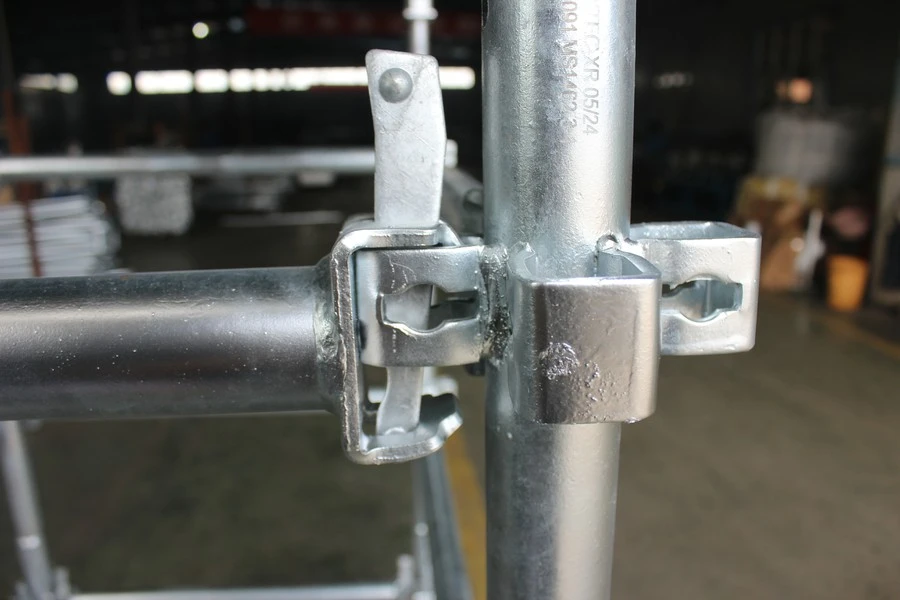
Nodes are critical connections. Crews may brace around pipelines, tanks, and curved walls without fittings with our eight-hole disc node, which connects rods at 0 to 360 degrees. Locks must stay put and not release accidentally. Fit also important. OSHA prohibits mixing components from different manufacturers unless they fit without force and maintain structural integrity. Ask for the tolerance sketch and never mix batches without engineering permission since disc and wedge dimensions determine fit.
How Is a Modular Scaffolding System Designed for Site Safety?
Load Calculations
Design begins with working height, bay size, station width, duration, and exposure for the modular scaffolding system. Engineers calculate worker, material, tool, wind, and impact loads for each platform and bay. As connection strength, buckling, and settling affect performance, nominal steel value is not system capacity. Our research shows a normal load capacity over 40 kN, which varies by arrangement. I use it as a starting point and have the engineer check the layout.
Foundations, Ties, and Stability
Soft ground breaks even strong scaffolds. OSHA requires legs to rest on base plates, mud sills, or other stable foundations. Guys, ties, or bracing must prevent a scaffold with a height-to-base ratio exceeding 4:1 from tipping. Netting and sheeting enhance wind load, therefore the tie design must account for that. Scaffolds must be 10 feet from 50 kV power lines in power plants. Base jack extension limits are manufacturer-set.
Complex and Irregular Structures
Oil refineries, docks, and curving structures seldom have neat rectangles. The eight-hole disc node helps since ledgers and braces may exit in numerous ways. Designers can accommodate tanks, pipelines, and arc walls. Our approach works for complicated and irregular constructions, and we create pieces from blueprints. However, flexibility does not eliminate approval. Every custom plan requires a sketch and calculation, therefore purchasers should supply site geometry early.
What Are the Mandatory Assembly, Inspection, and Maintenance Controls?
Erection and Handover
OSHA mandates competent supervision and skilled personnel for erection, change, and deconstruction. Set base jacks, level the first lift, or lift, add ledgers and diagonal braces, ties, platforms, stairs, and edge protection in the manufacturer's order. Proceed to check all locks. Climbing cross braces is prohibited. When platforms are greater than 2 feet above or below the access point, OSHA mandates a ladder, stair tower, or similar access. A status tag and signed inspection indicate the transfer.
Inspection and Maintenance
OSHA requires inspection before each shift and after any occurrence that might damage structural integrity, such as severe weather or an accident. Inspections follow modification, relocation, and idle periods. Remove bent, cracked, rusted, or unmarked pieces. Reusable steel requires batch-traceable stock records, and galvanised components need coating damage inspections. Keep an inspection journal the owner's inspector may view anytime.
Common Failures and a Quick Site Checklist
Site choices, not the modular scaffolding system, cause most failures. Overloaded platforms, stacked materials, missing ties, fragile foundations, extended jack extensions, inadequate guardrails, dangerous access, and unauthorised adjustments are common causes. Mixing ringlock, cuplock, frame, or tube-and-clamp pieces without engineering permission may disguise load-transfer issues. Check the authorised drawing, foundation, ties and braces, locks, guardrails and toe boards, load limit and exclusion zones before each usage.
How Should You Compare Systems and Evaluate a Modular Scaffolding System Supplier?
Comparing Ringlock, Cuplock, Frame, and Tube-and-Clamp
No scaffold is default-safe. In industrial and maintenance operations, Ringlock scaffolding provides versatile multi-directional connections. Cuplock fits rapid assembly and repetitive layouts. Frame scaffolding suits ordinary facades. Tube-and-clamp allows the most unique designs but requires expert personnel and coupler control. Our disc-node technology supports refinery shutdowns, bridge and viaduct repair, commercial landmarks, grandstands, and stage towers. Check geometry, connection dependability, load tables, erection acceleration, and technical support before buying.
Documents and Factory Audits
Request drawings, load tables, assembly instructions, mill certificates, welding and coating records, test results, and traceability data. Verify certificate issuer, validity, breadth, and product coverage. EPC shipments should include a packing list and the loading of containers plan that fit your vessel timetable. GREEN FORMWORK sells to over 100 countries and regions from its 79,800-square-meter Rizhao plant with 920 people, including 180 technicians. Whoever you choose, request an on-site or live video audit for materials inspection, weld inspections, coating, and final testing.
Total Cost and Specification Check
Unit cost is just half of the story. Cost covers freight, setup, service life, repairs, replacement parts, training, and technical support. Well-inspected and stored reusable components distribute project costs. GREEN FORMWORK offers samples and technical support. The table shows our published data; verify each number for your setup.
| Parameter | Specification |
|---|---|
| Material | Q235 carbon steel, yield ≥235 MPa |
| Node | Eight-hole disc, 0–360° connection |
| Surface treatment | Hot-dip galvanizing or powder coating |
| Zinc coating | 60–80 microns |
| Height capacity | Above 50 m (confirm by design) |
| Load capacity | Above 40 kN per standard; varies by configuration |
| Temperature range | −40°C to +60°C |
| Reusability | 100+ assembly cycles |
| Management systems | ISO 9001, ISO 14001, ISO 45001 |
Conclusion
A compliant modular scaffolding system fulfils US OSHA 29 CFR 1926 Subpart L and ANSI/ASSP A10.8 or EN 12810 and EN 12811 when contracts need them. Compliance goes beyond certification. It begins with confirmed components, Q235 steel quality, weld and coating records, and suitable nodes. Engineered load calculations, sturdy foundations, ties, trained, supervised installation, and recorded inspections follow. Heavy loads, missing links, soft ground, and unauthorised part mixing cause failures. System types vary in fit, not automatic safety, so purchasers should consider project geometry. Check a supplier's papers, production controls, and support before buying.
FAQ
Which standard applies to my project?
Your contract and project location decide. U.S. sites follow OSHA 29 CFR 1926 Subpart L, and owners may add ANSI/ASSP A10.8. Export projects often name EN 12810 and EN 12811. Confirm the edition year with your engineer before ordering.
How do I verify real load capacity?
Nominal steel strength is not enough. Ask for load tables and calculations that match your layout. Our data lists a capacity above 40 kN per standard, and it varies by configuration.
Is ringlock safer than cuplock?
Neither wins by default. Ringlock suits complex layouts, while cuplock suits repeated layouts. Safety depends on design, loading, and erection quality.
Can I mix components from different suppliers?
Avoid it. OSHA allows mixing only when parts fit together without force and structural integrity holds. Get written engineering approval first, and keep batch records.
What documents should I request?
Request drawings, load tables, manuals, mill certificates, weld and coating records, and test reports. Check each certificate's issuer, validity, and scope.
Request a Compliant Modular Scaffolding System from GREEN FORMWORK for Your Project
Send GREEN FORMWORK your working height, bay dimensions, platform loads, application, destination market, and quantity, and our engineers will review a suitable configuration. As a modular scaffolding system manufacturer working under ISO 9001, ISO 14001, and ISO 45001, we offer Q235 steel parts made to order, sample supply, and technical assistance. Email sdxingruiqp@126.com or visit sdxingrui.com for details.
References
1. Safety and Health Regulations for Construction, 29 CFR 1926 Subpart L: Scaffolds, Occupational Safety and Health Administration, 1996
2. A Guide to Scaffold Use in the Construction Industry (OSHA 3150), Occupational Safety and Health Administration, 2002
3. ANSI/ASSP A10.8 Scaffolding Safety Requirements in Construction and Demolition Operations, American Society of Safety Professionals, 2019
4. EN 12810-1 Façade Scaffolds Made of Prefabricated Components, Part 1: Products Specifications, European Committee for Standardization, 2003
5. EN 12811-1 Temporary Works Equipment, Part 1: Scaffolds, Performance Requirements and General Design, European Committee for Standardization, 2003
6. ISO 45001 Occupational Health and Safety Management Systems: Requirements with Guidance for Use, International Organization for Standardization, 2018
Learn about our latest products and discounts through SMS or email