- English
- French
- German
- Portuguese
- Spanish
- Russian
- Japanese
- Korean
- Arabic
- Greek
- German
- Turkish
- Italian
- Danish
- Romanian
- Indonesian
- Czech
- Afrikaans
- Swedish
- Polish
- Basque
- Catalan
- Esperanto
- Hindi
- Lao
- Albanian
- Amharic
- Armenian
- Azerbaijani
- Belarusian
- Bengali
- Bosnian
- Bulgarian
- Cebuano
- Chichewa
- Corsican
- Croatian
- Dutch
- Estonian
- Filipino
- Finnish
- Frisian
- Galician
- Georgian
- Gujarati
- Haitian
- Hausa
- Hawaiian
- Hebrew
- Hmong
- Hungarian
- Icelandic
- Igbo
- Javanese
- Kannada
- Kazakh
- Khmer
- Kurdish
- Kyrgyz
- Latin
- Latvian
- Lithuanian
- Luxembou..
- Macedonian
- Malagasy
- Malay
- Malayalam
- Maltese
- Maori
- Marathi
- Mongolian
- Burmese
- Nepali
- Norwegian
- Pashto
- Persian
- Punjabi
- Serbian
- Sesotho
- Sinhala
- Slovak
- Slovenian
- Somali
- Samoan
- Scots Gaelic
- Shona
- Sindhi
- Sundanese
- Swahili
- Tajik
- Tamil
- Telugu
- Thai
- Ukrainian
- Urdu
- Uzbek
- Vietnamese
- Welsh
- Xhosa
- Yiddish
- Yoruba
- Zulu
Why Choose a Ringlock Scaffolding System for Industrial Work?
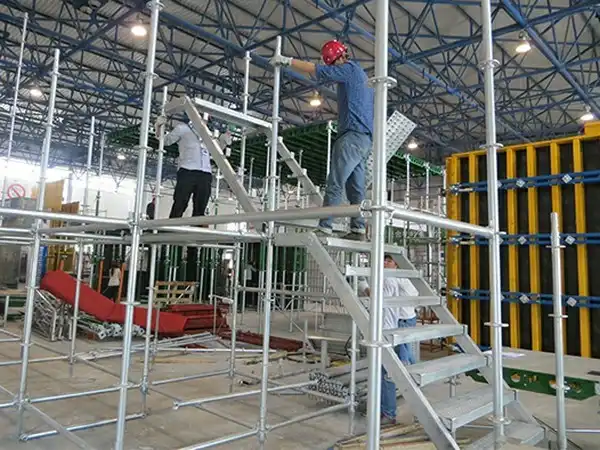
If you manage procurement for a power plant, refinery, or large-scale construction project, you already know that the wrong scaffolding choice costs you time, money, and — in the worst cases — worker safety. A ringlock scaffolding system offers a practical answer to those pressures. Built around a rosette connector that accepts up to eight components at a single node, this modular steel framework delivers the load capacity, assembly speed, and compliance credentials that demanding industrial sites require. The sections below walk you through everything you need to know before placing an order.
Understanding Ringlock Scaffolding Systems
Before comparing products, it helps to understand exactly what makes this system different from older approaches.
What the Rosette Connector Does?
The defining feature is an eight-hole circular rosette disc welded directly onto the vertical standard at fixed intervals. Horizontal ledgers and diagonal braces slot into the holes and lock with a wedge pin. No loose bolts, no wrenches — just a hammer tap and the joint is set.
Core Components You Will Actually Use
A complete system ships with vertical standards (48 × 3.2 mm on our product), horizontal ledgers in 0.9 m, 1.2 m, and 1.5 m spans, base plates, top plates, diagonal braces, and decking planks. Every piece follows the same dimensional logic, so components interchange freely across different project layouts.
How the Geometry Works in Practice?
Because each rosette in a ringlock scaffolding system accepts connections from eight directions at once, site crews can build straight runs, angled facades, and curved tank platforms without ordering special fittings. This 360-degree connection geometry is the primary reason refineries and shipyards favor the system over tube-and-clamp arrangements that require individual coupler fitting for every joint.
Key Benefits of Using Ringlock Scaffolding in Industrial Settings
It's one thing to understand the theory; it's another thing to see how the benefits show up in real projects.
Safety Performance Under Load
As load and pressure rise, the self-locking wedge pin gets tighter. This gravity-assisted mechanism stops the connection from coming loose by accident at height, which is a common place for bolt-style systems to fail. We use high-strength steel Q235 that has a rosette disk wall thickness of 10 mm. These steels meet the structural requirements set out in EN 12811 load calculations and ISO 9001 quality management standards.
Assembly Speed and Labor Cost
Here are the main benefits that will have a direct effect on your on-site work costs:
- Fewer parts per connection: One wedge pin replaces multiple nuts and bolts, cutting fitting time per node by a significant margin versus tube-and-clamp.
- Standardized step distance: The 1.5 m standard step distance keeps crew movements predictable across the full structure height.
- No special tools required: A standard hammer is sufficient to drive wedge pins, reducing equipment rental overhead.
When working on big projects, these time savings add up quickly. It may only take seven days to put up scaffolding for a power plant turnaround that used to take ten days. This frees up the critical path for mechanical work.
Reusability and Total Cost of Ownership
Parts that have been hot-dip galvanized don't rust in salty or industrial environments. A good galvanized ringlock system should last between 10 and 15 years with regular maintenance. This is much longer than painted systems that need to be replaced more often, so the cost per cycle is much lower.
Ringlock Scaffolding Compared to Other Systems: Making the Right Choice
People in charge of buying things often want to know how this method compares to cuplock, frame, or tube-and-clamp choices. The answer is different for each type of job, but the pattern is the same for all industry uses.
Ringlock vs. Cuplock
Cuplock locks ledgers with a top cup that turns, which works well for standard layouts. A ringlock scaffolding system can handle more connection angles at each node, which makes it the better choice when pipe networks or uneven building footprints require bracing that isn't straight.
Ringlock vs. Frame Scaffolding
Frame systems are easy to put together and can be used for repeated low-rise facade work, but they can't be changed to fit complicated shapes because of their set design. The modularity of a rosette-based system makes it very useful in situations where a chemical plant needs to build a scaffold around a distillation column or a bridge deck needs to be supported at different heights.
Ringlock vs. Tube-and-Clamp
Tube-and-clamp is fully flexible, but it takes a lot of work to set up. Each joint needs its own coupler, which must be hand-tightened. The difference in work hours between a tube-and-clamp system and a wedge-pin modular system on an industrial scaffold that covers 10,000 m² can be thousands of person-hours. That gap is very important for EPC contractors who are trying to meet milestone dates.
Procurement Considerations for Ringlock Scaffolding Systems
Picking the right ringlock scaffolding supplier is just as important as picking the right product.
Certification and Traceability
European and North American project owners usually need CE certification, documentation for ISO 9001 quality management, and reports that show how materials are traced back to the batch level. Shandong Xingrui Building Materials Co., Ltd. is ISO 9001 and CE certified, and all of their parts are made in a standardized 40,000 m² workplace with 12 welding robots and 6 automatic welding lines. This level of production control helps EPC compliance teams keep track of the paperwork chains they need.
Custom Orders and Sample Policy
Geometry of a site doesn't always match a catalog exactly. Our factory can take orders based on drawings and samples provided by the customer. It usually takes 7 to 14 days to make a sample. This is important when your technical team needs to compare the size of each node to the structure estimates for the project before starting a full production run.
Pricing Structure and Order Flexibility
Some important things to talk about with any ringlock scaffolding system maker in terms of cost are the material grade (Q235 vs. Q355), the surface treatment specification, the ledger span mix, and the yearly volume. Rental businesses can try out a new line of products without spending too much money when the minimum order numbers are flexible. So that you can make accurate comparisons between suppliers, we suggest that you ask for an itemized quote that breaks down unit prices from freight and documentation fees.
Practical Guide to Installation and Maintenance of Ringlock Scaffolding
If the site team doesn't follow the right steps for installation, even the best-designed scaffold system won't work well.
Site Preparation and Base Setting
Start with a smooth, level surface. When you don't know how much weight the ground can hold, put base plates on wooden sole boards. Before adding height, make sure that the first lift of vertical standards is within a 1:200 tolerance. As the structure rises, errors in the base get bigger.
Assembly Sequence and Load Checks
Set up the vertical standards, connect the base ledgers, and then add the diagonal braces. Only then should you move on to the next lift. To meet a schedule pressure, you should never skip diagonal bracing at intermediate lifts. The axial load capacity of each standard is directly affected by the design of the braces. Our system has a single standard that allows 40 kN to 70 kN based on the distance between the ledgers. This range has been checked against EN 12812 shoring standards.
Inspection, Cleaning, and Storage
Check wedge pins for deformation and rosette disks for cracks at the weld line after each project cycle. Before storing, remove any concrete or mortar deposits. Store parts in racks that keep standards from breaking while they are being stacked. These steps protect the metal surface and keep the measurements accurate even after many uses.
Conclusion
Failures of ringlock scaffolding system, schedule delays, or compliance gaps are all things that industrial projects can't afford. All three risks can be avoided with a modular ringlock system that is properly designed. This is because it has self-locking joint shape, traceable steel material grades, and works with both EN and ISO calculation standards. Whether you're in charge of an EPC procurement desk, a rental fleet, or getting materials for a network of regional distributors, the best way to protect both your project timeline and your bottom line is to match your site's needs with a certified supplier who has real production capacity.
FAQ
Q1: What industrial environments suit this type of scaffold?
A: The rosette-based modular scaffolding is used in ships, refineries, power plants, chemical plants, bridge building sites, and industrial high-rise projects.
Q2: How does the wedge-pin joint improve site safety?
A: The wedge pin slides down through the hole in the rosette due to gravity. As the structure is loaded or shaken, it gets tighter. This behavior is the opposite of a bolt that can loosen over time. This makes it much less likely that the connection will come loose by accident while working at heights.
Q3: Are components from different brands interchangeable?
A: A lot of manufacturers use the standard rosette pattern, but different factories have different size limits. Before putting together a real project with parts from different sources, we suggest getting a sample set and doing a physical fit test.
Q4: What is the expected service life?
A: In a well-kept system, hot-dip galvanized parts usually last 10 to 15 years, which is a lot longer than painted or electro-galvanized parts that are subject to industrial air conditions.
Q5: Can the system double as a shoring tower?
A: Yes, the Q235 and Q355 steel standards can handle axial loads that are good for heavy concrete pours and supporting equipment, as long as the engineering team makes sure that the standard spacing is the right size based on the load calculation according to EN 128112.
Request a Quote from GREEN FORMWORK — Your Ringlock Scaffolding System Supplier
Green Formwork, which is backed by Shandong Xingrui Building Materials Co., Ltd., sells ringlock scaffolding systems that are CE-certified and ISO 9001-compliant to customers in more than 100 countries. We ship from Rizhao port, can make things from your drawings, and offer expert help at every step of the way. You can email our team at sdxingruiqp@126.com to get a sample or a quote for your job right away.
References
1. European Committee for Standardization. EN 12811-1: Temporary Works Equipment — Scaffolds — Performance Requirements and General Design. CEN, 2003.
2. European Committee for Standardization. EN 12812: Falsework — Performance Requirements and General Design. CEN, 2008.
3. British Standards Institution. BS 1139-6: Metal Scaffolding — Prefabricated Scaffolding. BSI, 2014.
4. International Organization for Standardization. ISO 9001: Quality Management Systems — Requirements. ISO, 2015.
5. Pframe, R., & Whittle, R. Scaffolding: Practical Guidance on the Design and Use of Temporary Structures. Thomas Telford, 2004.
6. Construction Industry Scaffolders Record Scheme (CISRS). Scaffolding Industry Safety and Inspection Standards Handbook. CISRS, 2019.
Learn about our latest products and discounts through SMS or email