- English
- French
- German
- Portuguese
- Spanish
- Russian
- Japanese
- Korean
- Arabic
- Greek
- German
- Turkish
- Italian
- Danish
- Romanian
- Indonesian
- Czech
- Afrikaans
- Swedish
- Polish
- Basque
- Catalan
- Esperanto
- Hindi
- Lao
- Albanian
- Amharic
- Armenian
- Azerbaijani
- Belarusian
- Bengali
- Bosnian
- Bulgarian
- Cebuano
- Chichewa
- Corsican
- Croatian
- Dutch
- Estonian
- Filipino
- Finnish
- Frisian
- Galician
- Georgian
- Gujarati
- Haitian
- Hausa
- Hawaiian
- Hebrew
- Hmong
- Hungarian
- Icelandic
- Igbo
- Javanese
- Kannada
- Kazakh
- Khmer
- Kurdish
- Kyrgyz
- Latin
- Latvian
- Lithuanian
- Luxembou..
- Macedonian
- Malagasy
- Malay
- Malayalam
- Maltese
- Maori
- Marathi
- Mongolian
- Burmese
- Nepali
- Norwegian
- Pashto
- Persian
- Punjabi
- Serbian
- Sesotho
- Sinhala
- Slovak
- Slovenian
- Somali
- Samoan
- Scots Gaelic
- Shona
- Sindhi
- Sundanese
- Swahili
- Tajik
- Tamil
- Telugu
- Thai
- Ukrainian
- Urdu
- Uzbek
- Vietnamese
- Welsh
- Xhosa
- Yiddish
- Yoruba
- Zulu
Why Choose Multi-Layer Multi-Directional Crab Scaffolding Systems
If you manage procurement for bridge construction, stadium builds, or ultra-high-rise industrial facilities, you already know that standard scaffolding often falls short. Multi-layer multi-directional crab scaffolding addresses exactly that gap. Built from Q235 premium steel with a self-locking rosette node system, this modular support platform extends up to 24m vertically, spans multiple bays horizontally, and connects at virtually any angle. The result is a system that holds heavy loads, assembles faster than conventional alternatives, and adapts to irregular structures where tube-and-clamp rigs simply cannot perform safely.
Understanding Multi-Layer Multi-Directional Crab Scaffolding Systems
What Makes the Node Technology Different?
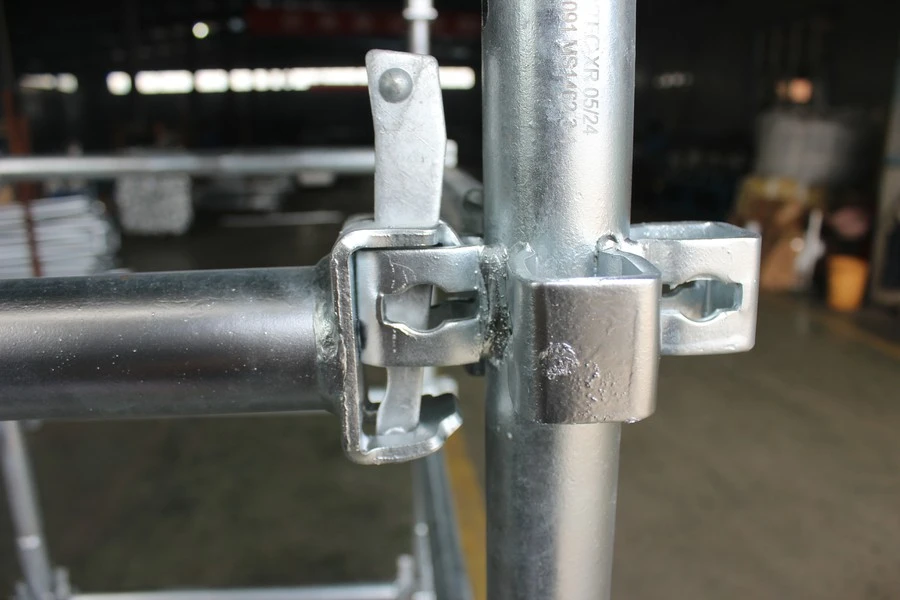
Its core is a rosette node in the shape of a disk, called the "crab" link point. It can hold ledgers and diagonal braces at 45-degree intervals over a full 360-degree range. That shape is important because it lets site engineers set up bracing in flat, tilted, and straight lines without having to cut or bend any parts.
Material Composition and Build Quality
Each standard tube is made from Q235 premium steel and has a diameter of 48.3 mm and a wall thickness of 3.25 mm. At a limit of ±1mm, the distance between nodes stays at 500 mm. Parts are hot-dip galvanized with a coating that is 60–80μm thick. This gives them corrosion resistance that lasts for more than 15 years in normal site conditions, such as industrial and coastal settings.
Self-Locking Wedge Mechanism
The hammer-locked wedge locks securely into the rosette slot, while standard bolt-and-clamp connections come away when the part is shaken. This design gets rid of the chance of bolts slowly coming loose during long heavy pours. This is one of the main reasons why non-standard shoring systems on bridge decks and stadium cantilevers fail.
Key Benefits of Multi-Layer Multi-Directional Crab Scaffolding Systems
When buying multi-layer multi-directional crab scaffolding for big business parks or factories, procurement teams need more than just a structure system. They need a platform that cuts down on labor hours, passes safety checks, and can be used over and over again on the job site. These are the main benefits this system gives you:
- Balanced stress distribution: The upgraded crab-style frame pairs vertical diagonal bars with horizontal reinforcement bars, creating a triangular bracing pattern. This geometry spreads load evenly across every connection point and prevents the localized deformation that causes progressive collapse in single-direction systems.
- Space efficiency and regular assembly: Because nodes accept connections from multiple directions, the frame geometry remains consistent across irregular floor plates and curved slab profiles. Crews erect a symmetrical, predictable grid even on non-rectangular building footprints.
- Assembly speed: The wedge-lock method cuts installation and strip time by 40–60% compared with tube-and-clamp rigs. Fewer specialized scaffolders are needed per shift, which directly reduces labor cost on tight project schedules.
- Long service life and reusability: Built to specification with standardized components, the system supports multiple project cycles. Galvanized steel resists surface corrosion, and modular parts are individually replaceable, keeping the asset on the rental or owned-equipment register for well over a decade.
These benefits directly lead to lower cost-per-use numbers and fewer safety incidents, which are two metrics that every EPC procurement director keeps an eye on in their milestone reports.
Comparing Crab Scaffolding to Other Scaffolding Solutions
Ringlock vs. Crab Scaffolding
A ring plate with eight holes is used to join ringlock scaffolding at set 45- and 90-degree angles. For normal floor heights and rectangular building shapes, that works well. On the other hand, the fixed angles force doesn't work well on curved bridge piers or roofs with domes. The rosette-node crab system can handle more curves in the middle, which means that the support line follows the structure's exact shape instead of trying to fit it.
Cuplock and Frame Scaffolding
Cuplock systems are cheap for standard access to the facade and slab shoring on floor plans that are used over and over again. Frame scaffolding is good for light-duty work around the house. The very high heavy-load shoring needs of a 24 m-tall concrete pour in an industrial plant or a multi-span viaduct falsework scheme are not met by either type. That top level of performance is met by multi-layer multi-directional crab scaffolding.
Cost and Application Fit
When purchasing managers look at the total cost of ownership, the higher initial unit price of crab scaffolding is balanced out by three things: faster assembly cuts down on labor billing days; high reusability spreads the cost of the asset over more project cycles; and fewer non-conformances during safety inspections lower the risk of penalties on EPC contracts.
Installation, Maintenance, and Cost Efficiency
Step-by-Step Deployment
Base plates and movable screw jacks must be set to the slab or ground level before the building can be put up. Before any horizontal ledger loading starts, standards are put in at the right node spacing, wedge-locked into rosette plates, and plumbed vertically. As the height goes up, diagonal braces are added to each layer. According to EN 12811 and OSHA 1926.451, each lift must be approved by a certified scaffolding supervisor before the crew can get on.
Maintenance Best Practices
After every project, parts should be checked visually for galvanization damage, wedge bending, and rosette weld integrity. Every three to five years, rental-fleet parts that work in marine or high-humidity areas should have their rosette welds tested with ultrasound. It's easy to replace individual broken parts because all the specifications are the same.
Procurement Cost Variables
Costs for multi-layer multi-directional crab scaffolding are mostly affected by how complicated the design is, how many items are ordered, and how the surface is treated. Xingrui's 40,000 m² facility has better production scheduling for large orders. For rental companies, the built-to-spec design that can be used again and again spreads the cost of acquisition over more hire cycles, which increases the asset's return on investment.
Choosing the Right Supplier for Your Heavy-Duty Scaffolding Needs
Certifications to Verify First
Before you send a buy order, make sure the supplier is certified in ISO 9001 for quality management, ISO 14001 for environmental management, and CE for the appropriate EN standards. All three are carried by Shandong Xingrui Building Materials Co., Ltd., and the goods are sent with batch quality inspection reports and, if needed, a Declaration of Performance for entering the European market.
Custom Engineering Capability
For complicated projects like bridges with non-prismatic pier geometry or stadium roofs with different rake angles, the node modules need to be rearranged according to the engineering plans. The technical team at Xingrui turns submitted drawings into real samples in 7–14 days. They also accept non-disclosure agreements (NDAs) to protect confidential information about connections. There are over 1,000 accessory specifications on hand and ready to be used right away in custom configurations.
Global Supply and Logistics Track Record
Since its start in 2007, Xingrui has sent goods to more than 100 countries. To get their goods there, they ship them through Rizhao Port in Shandong Province, which is a deep-water port with direct services for containers to major global terminals. You can choose between FOB and CIF terms, and the team takes care of the paperwork for packing oversized parts and loading containers with structural steel shipments.
Conclusion
For complex, heavy-load construction support, Multi-layer multi-directional crab scaffolding truly fills a performance gap. Because it is made of Q235 steel, has rosette nodes, and a self-locking wedge mechanism, it is the best choice for bridge falsework, industrial plant shoring, and uneven architecture structures where other systems need too many compromises. With ISO 9001 and CE certification, traceable batch reporting, and a 40,000 m² factory in Rizhao, Shandong, the Xingrui system gives procurement teams a documented, cost-effective way to meet their most stringent shoring needs.
FAQ
Q1: What safety standards does the crab scaffolding system meet?
A: The system is built to meet the structure requirements of EN 12811-1 and is tested to meet the safety requirements of OSHA 1926.451. The EN product standards are covered by CE certification, and each batch of goods ships with an inspection report that can be tracked. If a buyer needs calculations based on a certain national standard, like BS 1139 or GB, they can ask the Xingrui expert team for a project-specific calculation paper.
Q2: Can specifications be customized for irregular structures?
A: Yes. The rosette node form can naturally handle shapes that aren't square or rectangle. Xingrui can take customer plans and re-configure node modules to fit projects that need angles or bay widths that aren't standard. It takes 7–14 days to make a sample. For private ideas, an NDA can protect them.
Q3: What is the typical lead time from order to delivery?
A: For large orders with normal specifications, production and loading take 15 to 30 days after the order is confirmed and the deposit is received. Orders for the first time that include a sample stage take an extra one to two weeks. From the first RFQ to the goods arriving at the destination port, the whole procurement process usually takes between 60 and 90 days, but this depends on the shipping route and how quickly customs clearance is done.
Q4: Is the system reusable across multiple projects?
A: Yes, built-to-spec parts that have been hot-dip galvanized can be put together and taken apart many times. Service life is longer than 15 years if it is stored and maintained properly. You can replace only the worn-out parts without having to take the whole system apart.
Request a Technical Proposal from GREEN FORMWORK
Certified multilayer multidirectional crab scaffolding is sold by GREEN FORMWORK, which is backed by Shandong Xingrui Building Materials Co., Ltd., to EPC builders, rental companies, and wholesalers in more than 100 countries. Our ISO 9001-certified facility can make custom configurations, produce in bulk, and send samples within 7–14 days. You can email our team at sdxingruiqp@126.com to get a technical proposal, product catalog, or CE documentation package.
References
1. European Committee for Standardization. EN 12811-1: Temporary Works Equipment — Scaffolds — Performance Requirements and General Design. CEN, 2003.
2. Occupational Safety and Health Administration. OSHA 1926.451: General Industry Safety Standards for Scaffolding. U.S. Department of Labor, 2020.
3. International Organization for Standardization. ISO 9001:2015 Quality Management Systems — Requirements. ISO, 2015.
4. Construction Industry Research and Information Association. CIRIA C703: Falsework — A Practical Guide to Safe Design and Use. CIRIA, 2012.
5. American National Standards Institute / Scaffold and Access Industry Association. ANSI/SSFI SC100: Safety Requirements for Scaffolding. SSFI, 2019.
6. Chandrangsu, T., & Rasmussen, K. J. R. "Investigation of geometric imperfections and joint stiffness of support scaffold systems." Journal of Constructional Steel Research, 67(3), 576–584, 2011.
Learn about our latest products and discounts through SMS or email