- English
- French
- German
- Portuguese
- Spanish
- Russian
- Japanese
- Korean
- Arabic
- Greek
- German
- Turkish
- Italian
- Danish
- Romanian
- Indonesian
- Czech
- Afrikaans
- Swedish
- Polish
- Basque
- Catalan
- Esperanto
- Hindi
- Lao
- Albanian
- Amharic
- Armenian
- Azerbaijani
- Belarusian
- Bengali
- Bosnian
- Bulgarian
- Cebuano
- Chichewa
- Corsican
- Croatian
- Dutch
- Estonian
- Filipino
- Finnish
- Frisian
- Galician
- Georgian
- Gujarati
- Haitian
- Hausa
- Hawaiian
- Hebrew
- Hmong
- Hungarian
- Icelandic
- Igbo
- Javanese
- Kannada
- Kazakh
- Khmer
- Kurdish
- Kyrgyz
- Latin
- Latvian
- Lithuanian
- Luxembou..
- Macedonian
- Malagasy
- Malay
- Malayalam
- Maltese
- Maori
- Marathi
- Mongolian
- Burmese
- Nepali
- Norwegian
- Pashto
- Persian
- Punjabi
- Serbian
- Sesotho
- Sinhala
- Slovak
- Slovenian
- Somali
- Samoan
- Scots Gaelic
- Shona
- Sindhi
- Sundanese
- Swahili
- Tajik
- Tamil
- Telugu
- Thai
- Ukrainian
- Urdu
- Uzbek
- Vietnamese
- Welsh
- Xhosa
- Yiddish
- Yoruba
- Zulu
Why Coupler Type Round Tube Scaffolding Matters for Site Safety
When a scaffold fails on a live construction site, the consequences extend far beyond project delays. Coupler type round tube scaffolding has been a trusted structural solution for decades precisely because its tube-and-clamp design gives engineers direct control over connection strength, load distribution, and geometric configuration. Unlike fixed-module systems, each joint in this system can be tightened, inspected, and replaced independently—a property that directly reduces collapse risk on irregular facades, bridge falsework, and tunnel secondary lining work.
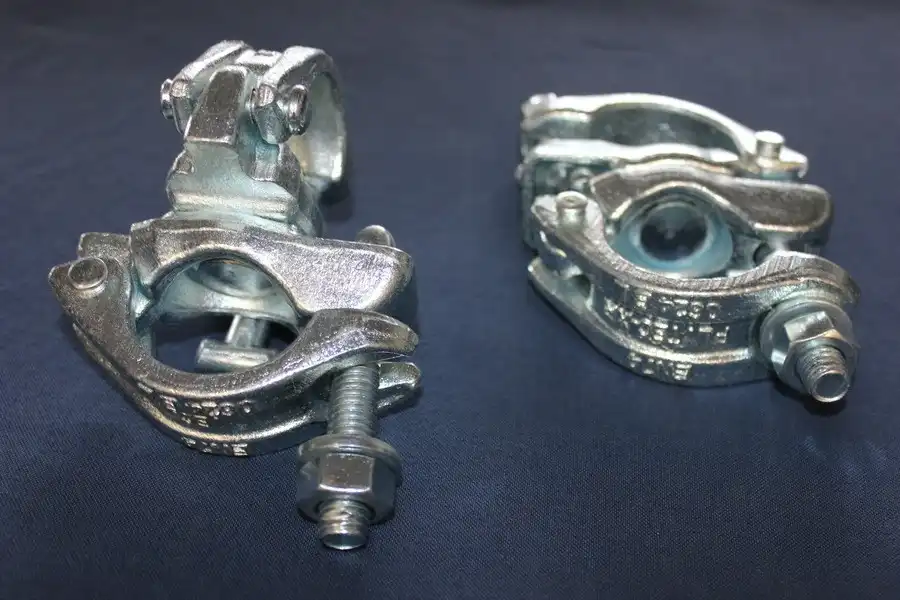
Understanding Coupler Type Round Tube Scaffolding
What makes this type of scaffolding different from the other options you already have on your project list? This will help you when you compare systems or companies.
Core Components and Material Specifications
Round steel tubes with a width of 48 mm and made from Q235 national standard steel are connected to couplers made of cast iron that can be shaped. Walls that are 3.2 mm or 4.0 mm thick can handle different amounts of weight. Hot-dip galvanization (HDG) with a 40–60 micron zinc covering stops rust and has been shown to last more than 10 years near the coast.
How It Differs from Ringlock and Modular Systems?
It's hard to set up ringlock and cuplock systems on uneven ground because they come in sets of pieces. These shapes don't have to be used for tube-and-clamp support. Because tubes can be cut to exact lengths and joined at any angle, they are the best choice for structure with non-standard spans, historical repairs, and building facades that aren't straight.
Load Capacity and Compliance Standards
Coupler type round tube scaffolding should be able to handle loads higher than 2.5 kN/m² if it was built right. The performance of the couplers must meet EN74-1, and the tube specifications must meet BS 1139 and EN39. The levels of tensile strength, torque resistance, and dimensional accuracy that must be met are set by these international standards. This gives procurement engineers a good place to start when they need to write specifications and do calculations for structures.
How Coupler Type Round Tube Scaffolding Enhances Site Safety?
Platform safety isn't just about the materials used; it's also about how they're put together and how well they're taken care of. Both parts are taken care of by this method.
Best Assembly Practices That Reduce Risk
Set the coupler's force to between 40 Nm and 60 Nm. The tube wall will bend if you tighten it too much, making the link less strong. According to OSHA data, most scaffold accidents happen at the connection point. Structured pre-installation processes and precise torque wrenches make it less likely for people to make mistakes there.
Unique Safety Features Built into the Coupler Design
Couplers made of bendable iron spread the binding force out over a large area of the tube's width. This keeps stress from staying in one place. Because of right-angle couplers, the 90-degree shape stays in place without the need for extra support at each point. To work with sloped surfaces, fixed modular systems aren't as good as swivel couplers, which allow for controlled changes in angle while still transferring full load.
Inspection and Maintenance Protocols
Always do a full technical check before putting something in and every seven days while the building is being used. Checkers should look for cracks in the coupler body, zinc covering that is flaking off, oval tubes that are caused by tightening them too much, and any signs of rust at the ends of cut tubes. It costs less money and time to replace just one broken coupler than to fix the whole structure.
Comparing Coupler Type Round Tube Scaffolding with Other Systems
Getting the right system like coupler type round tube scaffolding is a matter of both money and risk management. As you can see from the table below, they are not exactly the same. The geometric flexibility ranges from high to medium to low, and the load capacity ranges from high to medium. The assembly speed ranges from moderate to fast, and the suitability for irregular sites ranges from excellent to limited to poor. You can also change the parts individually or at the module level.
| Factor | Coupler Round Tube | Ringlock | Frame Scaffolding |
|---|---|---|---|
| Geometric Flexibility | High | Medium | Low |
| Load Capacity | >2.5 kN/m² | High | Medium |
| Assembly Speed | Moderate | Fast | Fast |
| Suitability for Irregular Sites | Excellent | Limited | Poor |
| Component Replaceability | Individual | Module-level | Module-level |
In real life, these differences matter because of this. Ringlock scaffolding can be put together faster on flat, level ground, which is great for normal building projects at home or in a business. Engineers have to spend a lot of money on custom manufacturing with fixed-module systems when the project needs a curved bridge abutment, a heritage face with cornices that stick out, or a tunnel invert. Tube-and-clamp support takes care of that problem right at the link level.
In terms of lifetime cost, fixing broken modular frames over time is more expensive than fixing broken couplers one at a time. The people who buy things for rental companies love this because it directly speeds up the rate at which assets are used across a changing project fleet.
Procurement Insights: Sourcing Coupler Type Round Tube Scaffolding
You take a real risk when you choose where to get structural scaffolding. Before a buy order is signed, these things should be given a lot of thought.
Supplier Certification and Traceability Requirements
Make sure the supplier has both ISO 9001 for quality management and ISO 14001 for environmental management. Also, make sure that the products are CE-certified and come with a Declaration of Performance (DoP) for sales in Europe. Ask for more than just a general license. Ask for records of quality inspections that are broken down by batch. Third-party audits of large EPC projects need traceability at the batch level.
Customization, Lead Times, and Logistics
Trustworthy manufacturers of coupler type round tube scaffolding will accept special orders based on technical specifications. Standard samples should be ready in 7–14 days. For big sales, make sure the seller can keep up with production during busy building times. Being close to a harbor is very important for big goods. For example, suppliers in Rizhao, Shandong, can get to the port directly. This lowers the risk of overland freight and makes it easier to pack long steel tubes into containers.
Pricing Benchmarks and Negotiation Strategy
Ask for a price list that shows how much the tube and the coupler cost separately. This lets you accurately compare suppliers who might pack accessories in various ways. Flexible payment terms are usual in the foreign trade of scaffolding. Most of the time, a 30% to 50% TT advance is needed. The rest is due when the shipping documents are ready. If you're bargaining, don't just look at the unit price. A guarantee of a steady supply during project peak times is often more valuable than a small discount per unit.
Ensuring Compliance and Risk Management
Not only is following the rules a formality, it is also the major way that duty is handled on international construction sites.
Applicable International Standards
In Europe, EN 12811-1 spells out how temporary work tools must work. The 29 CFR 1926 is from OSHA.451 makes rules for the US market. In Latin America and the Middle East, EN standards are often used as needs in projects. The buying team should make sure that a product that has been CE-certified comes with papers that show how it is put together. Load diagrams and safety factors will be in these documents, and structural engineers from the client side will ask for them when the project is approved.
Risk Identification and Coupler-Specific Mitigations
Side loads that aren't stable, base settlement, and connection problems that get worse over time are some of the biggest risks in scaffolds. When it comes to impact resistance, drop-forged or malleable iron couplers are better than pressed steel couplers. That means the link is less likely to break when there are moving loads, like wind or building shaking. There should be a list of the type of coupler and the tube width in the technical terms of your purchase order.
Worker Training and Onsite Audit Integration
Last but not least, teach workers the right coupler tightening torque, how often to check it, and how much weight it can hold. To make sure everyone is safe on the job site, scaffold-specific checklists should not be used alone, but as part of the normal HSE review cycle for the project. These lists should include things like anchor points, making sure the base plate is level, and checking the condition of the couplers.
Conclusion
There is good physics behind coupler type round tube scaffolding, which is why it is still used for hard building jobs. It has HDG surface protection, Q235 steel tubes, and couplers made of malleable iron. It also meets EN74-1 and BS 1139 standards. The form of the site can be changed, but the stability of the joint can still be measured and checked. It's the only prefabricated option on the market right now that gives procurement managers and project engineers more geometric freedom than this one. This is very helpful for people who are working on bridge falsework, facades with odd shapes, or any structure that doesn't use standard module spacing. With a qualified provider who can do a lot of work and help with all the paperwork, the places will be safer and the project risk will go down.
FAQ
Q1: What distinguishes coupler scaffolding from ringlock scaffolding?
A: Coupler scaffolding uses individual tube-and-clamp connections that can be positioned at any point along a tube and at any angle. Ringlock scaffolding uses fixed-interval rosette connections, which limits geometric flexibility. For standard rectangular layouts, ringlock assembles faster. For irregular structures, coupler scaffolding is the practical choice.
Q2: How do I confirm that purchased scaffolding meets my project's safety requirements?
A: Request the CE Declaration of Performance, ISO 9001 certification, and batch-level inspection reports from the supplier. Ask for structural calculation documents referencing EN 12811-1 or OSHA 1926.451, depending on your project location. Verify coupler compliance against EN74-1 specifically.
Q3: What is the correct torque for tightening scaffold couplers?
A: The standard range is 40 Nm to 60 Nm. Under-tightening causes the coupler to slip under load. Over-tightening deforms the tube wall. Always use a calibrated torque wrench and document the inspection.
Q4: How often should scaffold components be inspected on an active site?
A: A full technical inspection must occur before every new installation and at minimum every 7 days while the scaffold remains in service, in line with EN 12811 guidance.
Q5: Can coupler scaffolding components from different manufacturers be mixed?
A: Mixing is technically possible if tubes meet EN39 (Φ48.3 mm outside diameter) and couplers meet EN74-1, but a qualified structural engineer must verify load path compatibility before installation.
Request a Quote from GREEN FORMWORK — Certified Coupler Type Round Tube Scaffolding Supplier
GREEN FORMWORK sells coupler type round tube scaffolding that is made by Shandong Xingrui Building Materials Co., Ltd. and is CE-certified. The business has 12 welding robots, over 40,000 m² of workspace, and has been exporting to more than 100 countries for 17 years. We can ship right from Rizhao Port and take special orders based on what the plans say. Today, email sdxingruiqp@126.com about your project to get a technical package at a low price.
References
1. European Committee for Standardization. EN 12811-1: Temporary Works Equipment — Scaffolds: Performance Requirements and General Design. CEN, 2003.
2. British Standards Institution. BS 1139-2.1: Metal Scaffolding — Specification for Steel Tubes. BSI, 1990.
3. European Committee for Standardization. EN 74-1: Couplers, Spigot Pins and Baseplates for Use in Falsework and Scaffolding. CEN, 2005.
4. Occupational Safety and Health Administration. OSHA 29 CFR 1926.451: Scaffolding Standards for the Construction Industry. U.S. Department of Labor, 2020.
5. Hadipriono, F. C., & Wang, H. K. "Analysis of Causes of Falsework Failures in Concrete Structures." Journal of Construction Engineering and Management, 1986.
6. Peng, J. L., et al. "Stability of Coupler Steel Scaffold Systems on Construction Sites." Journal of Constructional Steel Research, 2009.
Learn about our latest products and discounts through SMS or email