- English
- French
- German
- Portuguese
- Spanish
- Russian
- Japanese
- Korean
- Arabic
- Greek
- German
- Turkish
- Italian
- Danish
- Romanian
- Indonesian
- Czech
- Afrikaans
- Swedish
- Polish
- Basque
- Catalan
- Esperanto
- Hindi
- Lao
- Albanian
- Amharic
- Armenian
- Azerbaijani
- Belarusian
- Bengali
- Bosnian
- Bulgarian
- Cebuano
- Chichewa
- Corsican
- Croatian
- Dutch
- Estonian
- Filipino
- Finnish
- Frisian
- Galician
- Georgian
- Gujarati
- Haitian
- Hausa
- Hawaiian
- Hebrew
- Hmong
- Hungarian
- Icelandic
- Igbo
- Javanese
- Kannada
- Kazakh
- Khmer
- Kurdish
- Kyrgyz
- Latin
- Latvian
- Lithuanian
- Luxembou..
- Macedonian
- Malagasy
- Malay
- Malayalam
- Maltese
- Maori
- Marathi
- Mongolian
- Burmese
- Nepali
- Norwegian
- Pashto
- Persian
- Punjabi
- Serbian
- Sesotho
- Sinhala
- Slovak
- Slovenian
- Somali
- Samoan
- Scots Gaelic
- Shona
- Sindhi
- Sundanese
- Swahili
- Tajik
- Tamil
- Telugu
- Thai
- Ukrainian
- Urdu
- Uzbek
- Vietnamese
- Welsh
- Xhosa
- Yiddish
- Yoruba
- Zulu
A Buyer’s Guide to Crab System Scaffolding Components and Costs
Crab system scaffolding has become a go-to solution for procurement managers handling large-scale infrastructure projects. Whether you're sourcing support systems for bridge piers, tunnel shoring, or high formwork applications, this guide breaks down the essential components, real cost drivers, and selection criteria you need. From Q235 steel standards to eight-way disc connections, understanding what separates a dependable modular shoring system from a liability will help you make smarter purchasing decisions and protect your project timeline.
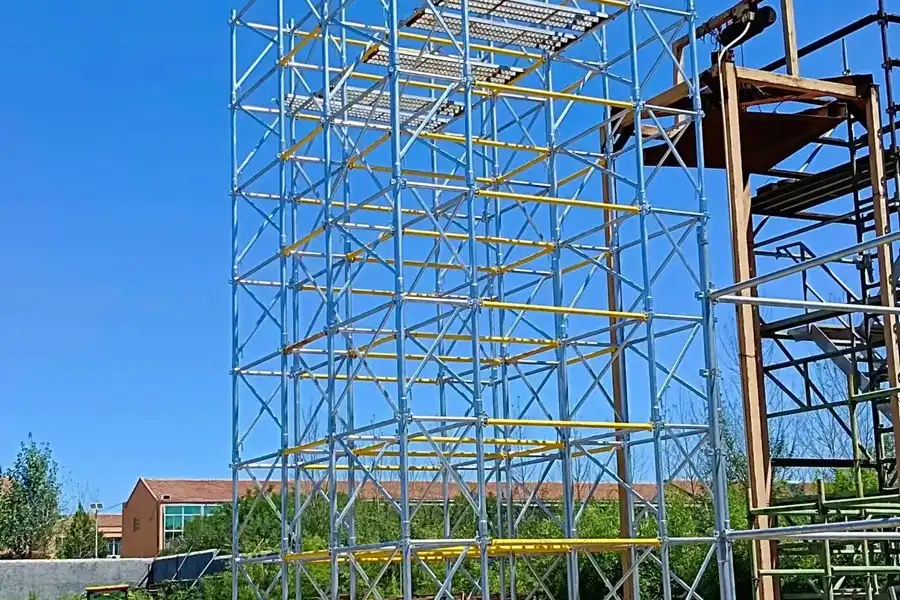
Understanding Crab System Scaffolding: Components and Core Features
What the System Actually Consists Of
The three main parts of a modular disc-lock shoring system are the diagonal braces, the uprights (which are vertical standards), and the flat ledgers. What makes it special is the eight-hole rosette disk that is welded to the standard at regular intervals. Any direction of wedge-head connectors will work with it. Some of the things that hold it up are U-head base jacks for leveling, screw base plates, steel deck planks, and toe boards. Together, these parts make a load path that moves weight straight to the ground without any nuts or clamps.
Material Quality: What to Specify
Strong and durable, the 60-series model is made of Q235 carbon steel, has a 60mm outside diameter, and walls that are 3.2mm thick. For hot-dip galvanization according to ISO 1461, steel gets a 60–80μm zinc covering that stops it from rusting in the ground or outside. This treatment can be used for up to 15 years. Procurement teams that want to rent cars for a long time or sign repeat infrastructure contracts should make sure they have these details in writing before they place an order.
Key Performance Advantages
This tube-and-clamp support is different because it has an eight-way wedge-lock link. These are the most important performance advantages that should be brought up:
- Assembly speed: The gravity-assisted wedge mechanism aligns components automatically, reducing installation time by roughly 50% compared to tube-and-clamp methods, which directly cuts labor costs on multi-span bridge or tunnel projects.
- Load capacity: With proper diagonal bracing, a single tower handles up to 200kN, making it appropriate for supporting cast-in-situ concrete beams where dead loads are substantial and deflection tolerance is tight.
- Geometric flexibility: Eight connection directions allow engineers to configure arched, angled, or irregular frames that conform to non-standard project geometries without fabricating custom pieces.
Capacity to carry for crab system scaffolding: With the right vertical support, a single tower can hold up to 200kN of weight. Because of this, it is a good choice for holding cast-in-situ concrete beams in places with high dead loads and low twisting tolerance.
Cost Breakdown: What Influences Modular Shoring System Pricing?
Component-Level Cost Factors
Prices for each part depend on what kind of steel it is made of, how it is treated, and how it is put together. It costs more up front for a Q235 60mm standard with hot-dip galvanization than a painted 48mm option, but it lasts longer because it doesn't rust. Items that wear out over time, like rosette disks, wedge pins, and U-head jacks, have dimensional tolerances that determine how often you need to replace them. For instance, zero-play pin fit stops structure sway and extends the life of disks over many project cycles.
Project-Scale and Logistics Costs
Scale makes a big difference in unit costs. You can combine FOB or CIF from places like Rizhao in Shandong Province, which has direct sea freight access to many big global destinations. Each piece costs less when you buy more of it. Purchasing managers should also think about the following:
- Import duties and port handling fees, which vary by destination country
- Container loading configuration for oversized or mixed-specification orders
- Certification documentation costs, including CE Declaration of Performance (DoP) and EN 12810/12811 calculation reports required for European project compliance
Hidden Costs That Affect Total Budget
A lot of the time, people don't think about inspection records, training, and maintenance rounds enough for crab system scaffolding. Your workers might mess up when putting together wedge-lock systems if they don't know how to do it. This could lead to safety checks. Make sure that every site group has at least one briefing. To take care of it, look at the zinc finish and wedge-pin wear once a year. Used systems pay for themselves in two to three project cycles, but only if you keep track of your stock and fix broken parts instead of throwing them away.
How to Choose the Right System for Your Project?
Match Specifications to Load Requirements
Figure out the structure first. If the loads that your engineer has planned for the propping are more than 150kN per tower, pick the 60mm heavy-duty series instead of the lighter 48mm choice. Check the OSHA Subpart Q or EN 12811-1 structural design standard to see what the requirements are for wall thickness, disk spacing, and bracing intervals. This is going to depend on where the project is. You should ask sellers for more than just product datasheets. You should also ask for load-bearing test results.
Evaluate Supplier Certification and Traceability
Having at least ISO 9001 certification for quality management, ISO 14001 certification for environmental management, and ISO 45001 certification for health and safety at work is a good sign that the supplier is trustworthy. You have to get CE certification and data on the quality of each batch for jobs in Europe. You should ask for paperwork that shows how each production lot was made, from getting the raw materials to making sure the welds are correct and the end measurements are right. Ultrasound is a good way to check the weld's strength at the joint between the rosette and the pipe because it bends the most when it's weighed down.
Assess Customization and Sample Lead Time
Standard bay lengths aren't always used for crab system scaffolding projects. If a supplier can send samples within 7–14 days and work with customers to make sure the specs fit, buying teams can make sure the samples work before committing to full production runs. For OEM or private label deals, where the rules for node shape or marking are different from those for catalog items, this is very important. Before taking pictures and giving them to you, make sure the seller signs an NDA.
Best Practices for Procurement and Management
Negotiation and Order Structure
Find out how much standards, ledgers, diagonals, and other items cost separately. When you ship accessories with main structural parts in the same package, the cost per unit of freight goes down because volume prices usually start at container-load amounts. If you're placing your first order, you usually have to pay a 30% to 50% TT deposit and the rest when you get the shipping papers. People who buy from you again may be able to get longer terms.
Quality Assurance During Production
Make it clear that you want to see the work that is being done or have a third party check out the business. Some of the most important things that need to be checked are the width and length of the wedge pins, how well the zinc coating sticks, and how stable the weld seam is where the disks are connected. When goals are met, ask for proof in the form of photos or movies from the job site. Before the things leave the plant, this gives your tech team peace of mind.
Lifecycle Management for Maximum ROI
This type of shoring device is great because it can be used over and over again. Set up a way to label each part so you can find it again in other projects. Plan to fix up the space every three to five deployments. Fix parts that have corroded, replace worn wedge pins, and fix standards that are bent. A well-kept fleet can last 15 years or more, compared to systems that are thrown away after one use. In other words, the total cost of ownership is a lot less.
Conclusion
Three things are needed to pick the right crab system scaffolding modular shoring system: make sure the load requirements match certified performance data; get the system from a supplier with quality documentation that can be tracked; and think about how much the whole system will cost over its lifetime, not just the price you pay for it. The 60-series disc-lock system from GREEN FORMWORK meets EN 12810/12811 and ISO management standards. It's ready to use and comes with all the paperwork you need to prove it. Before you decide on a supply chain, you should get a sample and a full drawing for the next job that needs bridge falsework, tunnel shoring, or high formwork.
FAQ
Q1: What is the main advantage of a crab-type system over ringlock scaffolding?
A: Both are disc-lock systems, but the heavy-duty 60mm series is specifically engineered for shoring and falsework with load ratings up to 200kN per tower. Standard ringlock is often sized for access rather than vertical load transfer, making it less suitable for bridge beam support or tunnel shoring applications.
Q2: How do I estimate the total cost for my project?
A: Start with your structural engineer's bay layout to calculate the number of standards, ledgers, and diagonals required. Add 10%–15% for accessories and consumables. Then apply your supplier's FOB unit pricing, add freight and import costs, and factor in labor for assembly. Request an itemized quotation from your supplier with separate line items for each component type.
Q3: Is rental a viable option for large projects?
A: Yes. Rental makes sense for one-time infrastructure projects where capital purchase is difficult to justify. For contractors running multiple concurrent projects or rental companies building an asset fleet, purchase with lifecycle management typically yields better returns over a 3–5 year horizon.
Q4: What certifications should I require from a supplier?
A: At minimum: ISO 9001, CE certification, and EN 12810/12811 test reports. For projects in the United States, confirm OSHA Subpart Q compliance capability. Ask for the Declaration of Performance document for CE-marked products.
Q5: Can the system be customized for non-standard geometries?
A: Yes. Suppliers who accept drawings and provide sample fabrication within 7–14 days can produce custom bay widths, non-standard disc spacing, and special surface treatments. Confirm this capability before signing a supply agreement.
Request a Quote from GREEN FORMWORK — Certified Crab System Scaffolding Supplier
GREEN FORMWORK sells ISO 9001, ISO 14001, and ISO 45001-certified crab system scaffolding to builders and hire trucks in over 100 countries with the help of Shandong Xingrui Building Materials Co., Ltd. The 60-series heavy-duty system goes from Rizhao Port and can handle up to 200kN per tower. It comes with all the necessary CE paperwork. You can get samples in 7–14 days. Our team can be reached at sdxingruiqp@126.com to get a technical datasheet and a quote that is made just for your project.
References
1. European Committee for Standardization. EN 12811-1: Temporary Works Equipment — Scaffolds — Performance Requirements and General Design. CEN, 2003.
2. European Committee for Standardization. EN 12810-1: Facade Scaffolding Made of Prefabricated Components — Product Specifications. CEN, 2003.
3. International Organization for Standardization. ISO 1461: Hot Dip Galvanized Coatings on Fabricated Iron and Steel Articles — Specifications and Test Methods. ISO, 2009.
4. Occupational Safety and Health Administration. OSHA Subpart Q — Concrete and Masonry Construction, 29 CFR 1926.700–706. U.S. Department of Labor, 2015.
5. International Organization for Standardization. ISO 9001: Quality Management Systems — Requirements. ISO, 2015.
6. Peng, J. L., et al. "Structural Behavior of Steel Scaffolding Systems Under Heavy Loading Conditions." Journal of Constructional Steel Research, 2012.
Learn about our latest products and discounts through SMS or email