- English
- French
- German
- Portuguese
- Spanish
- Russian
- Japanese
- Korean
- Arabic
- Greek
- German
- Turkish
- Italian
- Danish
- Romanian
- Indonesian
- Czech
- Afrikaans
- Swedish
- Polish
- Basque
- Catalan
- Esperanto
- Hindi
- Lao
- Albanian
- Amharic
- Armenian
- Azerbaijani
- Belarusian
- Bengali
- Bosnian
- Bulgarian
- Cebuano
- Chichewa
- Corsican
- Croatian
- Dutch
- Estonian
- Filipino
- Finnish
- Frisian
- Galician
- Georgian
- Gujarati
- Haitian
- Hausa
- Hawaiian
- Hebrew
- Hmong
- Hungarian
- Icelandic
- Igbo
- Javanese
- Kannada
- Kazakh
- Khmer
- Kurdish
- Kyrgyz
- Latin
- Latvian
- Lithuanian
- Luxembou..
- Macedonian
- Malagasy
- Malay
- Malayalam
- Maltese
- Maori
- Marathi
- Mongolian
- Burmese
- Nepali
- Norwegian
- Pashto
- Persian
- Punjabi
- Serbian
- Sesotho
- Sinhala
- Slovak
- Slovenian
- Somali
- Samoan
- Scots Gaelic
- Shona
- Sindhi
- Sundanese
- Swahili
- Tajik
- Tamil
- Telugu
- Thai
- Ukrainian
- Urdu
- Uzbek
- Vietnamese
- Welsh
- Xhosa
- Yiddish
- Yoruba
- Zulu
How Does Door Frame Scaffolding Compare to Rolling Towers for Access?
When contractors evaluate access solutions, door frame scaffolding and rolling towers consistently top the shortlist. Door frame scaffolding uses pre-welded H-shaped steel frames with cross braces and coupling pins to form a fixed, walk-through structure with high load capacity. Rolling towers use the same modular components but mount on lockable casters, trading some stability for ground-level mobility. The right choice depends on your site geometry, load requirements, and project duration—and understanding each system's performance profile saves both money and scheduling risk.
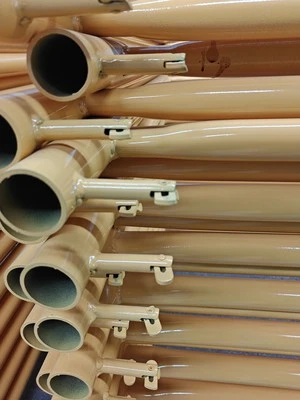
Understanding Door Frame Scaffolding and Rolling Towers
It's helpful to know what the two methods are and where they work best before putting them next to each other.
What Is a Portal Frame System?
You can also call it a walk-through scaffold. A portal frame system is made up of door-shaped frames made of Q235 high-strength steel that are welded together and connected by diagonal cross braces and flat platforms. People and things can move through the building instead of around it because the open base has 914 mm between each upright and a 1.93 m step height. On busy sites like facade masonry or interior fit-out, this plan cuts down on the time it takes to move goods from side to side.
What Is a Rolling Tower?
In a moving access tower, the modular frame parts are the same, but the base frames are on rotating casters that lock into place. Moving the tower from side to side is easy and doesn't require taking it apart. This makes it useful for tasks that need to do a lot of moving, like painting large building walls, keeping up with HVAC runs above, or regularly checking production line equipment.
Typical Industry Applications
It's easy to decorate the outside of walls with portal frame systems, build secondary structures, and put in MEP systems on medium- to large-sized sites where the scaffolding stays up for weeks at a time. When it comes to single-trade maintenance, short-term inspections, and rooms with flat, firm floors, rolling towers are great. They can't be switched out for each other; most procurement teams rent both.
Structural and Safety Comparison Between Door Frame Scaffolding and Rolling Towers
Safety success should be the first thing that any responsible buying director looks at. While both systems can meet ANSI A10.8, EN 12811, and AS/NZS 1576, they do so in very different ways when they are loaded.
Load Capacity and Stress Distribution
The fixed portal frame scaffolding is made of 2.0–3.5 mm thick Q235 steel tubes. All of the welding parts take the same amount of weight. Each bay must have a safety factor of at least 3:1 in order to hold the weight of several workers and heavy items. Rolling towers can only hold lighter loads because the base on the wheels can bend laterally. When compared to a ground-bearing frame, most manufacturers say to lower the working load by 25–30%.
Stability Under Operational Stress
A door frame scaffolding portal frame system that is anchored to the ground can handle wind pressure and uneven loads better than a rolling tower that stands on its own. If a moving tower is higher than 6 m, EN 1004-1:2020 says it needs to be attached to a building or turned off. There are base jacks on fixed doorway scaffolding that can be adjusted to level uneven ground and send loads straight to the ground. In this way, the building stays strong without the need for extra outriggers on places that have a normal slope.
Assembly, Inspection, and Maintenance
Gravity-lock coupling pins on portal frames cut the time it takes to set up by about 40% compared to tube-and-clamp methods. Standardized parts also make it possible to change out a frame without having to take apart bays next to it. Tower falls most often happen because of old bearings or broken brakes, according to the Health and Safety Executive (UK). In other words, casters need to be checked before each shift. Inspection plans that follow ISO 45001 can be used for either way.
Performance & Practical Benefits for B2B Use Cases
Understanding structural specs is necessary, but procurement managers also need to weigh day-to-day operational performance against project cost.
Fixed Frame Efficiency on Dense Sites
On an active construction site with multiple trades working simultaneously, fixed portal scaffolding provides a stable corridor that masons, electricians, and plumbers can share. The walk-through passage eliminates the traffic congestion that plagues single-bay tube scaffolding. Shandong Xingrui's system erects 50 linear meters in under two hours with a three-person crew, directly reducing daily labor cost.
Rolling Tower Flexibility in Maintenance Environments
A rolling tower moves to the next work point in minutes rather than hours, which is genuinely valuable in a warehouse repaint or an airport ceiling inspection where the work front shifts continuously. However, every relocation requires a brake check, a plumb check, and—above 4 m on casters—a documented risk assessment. That overhead adds up over a long maintenance contract and partially offsets the repositioning speed advantage.
Cost-Benefit and Reusability
Here are the factors that most directly affect total cost of ownership for each system:
- Portal frame scaffolding built to spec from Q235 steel with hot-dip galvanization survives 200 + erection cycles under normal site conditions, giving rental companies a predictable asset life. Standardized universal accessories reduce spare-parts inventory cost.
- Rolling towers experience higher wear on casters, braces, and guardrail hooks due to frequent movement. Replacement-part frequency is typically 30–40 % higher per cycle than for fixed-frame equivalents.
- Purchase vs. rental economics favor ownership for contractors running repetitive projects; rental suits one-off or trial deployments before a bulk order commitment.
Both systems support reuse across multiple projects, but the door frame scaffolding portal frame system's lower per-cycle wear rate makes it the stronger long-term asset for rental fleet operators.
Procurement Decision Factors: Which Access Solution Fits Your Needs?
It is up to the project level, not the product level, to choose between the two. You can use the questions below to help you choose.
Site Conditions and Project Duration
Fixed portal scaffolding with adjustable base jacks is safer if the ground at the site isn't level, if there is a lot of wind, or if the installation takes more than a week. If the floors inside are smooth and level and you move things around every day, a rolling tower will save you time and effort. For the building part of a job, a lot of EPC workers pick doorway frames. They picked rolling towers for the last part.
Certification and Supplier Verification
ISO 9001 is for quality management, ISO 14001 is for environmental compliance, and ISO 45001 is for safety at work. This is what people all over the world should look for in a company before they buy from them. When you want to sell something in Europe, you need CE approval along with a Declaration of Performance (DoP). More and more government clients in Southeast Asia want this too. Both batch-level quality reports and help from a third party for inspection are important for projects where the client's owner engineer checks the materials as they come in.
Customization, Scalability, and Delivery
For most jobs, standard door frame scaffolding sizes work. However, drawing-to-sample from the maker is useful for jobs with non-standard bay widths or deck loads. If you tell Shandong Xingrui what you need, they can send samples within 7–14 days. The plant has a 79,800 m² building with 12 welding robots and six automated welding lines. This way, it can handle large orders without having to worry about lead times during busy construction times.
Future Trends and Innovations in Scaffolding Technology
More and more people in the scaffolding business want lighter alloys, digital tracking, and faster ways to put things together. An aluminum frame rolling tower already weighs 40–50% less than a steel frame, which makes them safer to move by hand. It is becoming more and more common for rental companies to ask manufacturers to add RFID tags to individual frames in fixed portal systems so that they can keep track of digital assets and study how the fleet is being used.
Sustainable Materials and Circular Supply Chains
A lot of steel production and powder coating formulas are using less volatile organic compound (VOC). This is mostly for customers in North America and Europe. If a business gets ISO 14001 approval, they will be able to keep track of how they treat the environment all the way through the supply chain.
Modular and Automated Assembly
Gravity-lock and flip-lock links will soon have single-action cam systems that make assembly even faster and easier for workers on the job site who don't have as much experience. These changes are good for models with a fixed frame or a moving tower.
Conclusion
Door frame scaffolding lasts longer, can hold more weight, and can be used on different types of ground. It is the best choice for building jobs that will stay in one place. Rolling stands are easy to move around for short-term work inside on a flat surface. Most businesses that deal with professionals need both kinds of tools. When picking a provider, make sure they have certified production, quality checks for each batch, the flexibility to meet your specific needs, and a track record of delivering on time. Different entry systems have different costs and structures, which helps buying teams pick the best one for each stage of a project.
FAQ
Q1: What load capacity does a portal frame system typically support?
A: It is safer than 3:1 to use a well-designed portal frame system made of Q235 steel with walls that are 2.0 to 3.5 mm thick. Work platform loads are usually between 2.0 and 3.0 kN/m², but this can change based on the design and the standard being used (ANSI A10.8 or EN 12801–1).
Q2: Can door frame scaffolding be used on uneven ground?
A: Yes. It's helpful to have adjustable base jacks and screw jacks on construction sites outside because they can level uneven ground up to 300 mm. This means that frames stay straight without having to be shimmied or the concrete leveled.
Q3: When does a rolling tower make more sense than a fixed frame?
A: You can paint factory ceilings or take care of airport ceilings with a rolling tower. These towers work best for single-trade jobs on flat, hard surfaces inside where the work area moves around a lot. Above 6 m, they are less useful without outriggers or structural ties.
Q4: What certifications should I ask a supplier to provide?
A: Ask for ISO 9001 (quality management), ISO 14001 (environmental management), ISO 45001 (workplace safety), CE certification with DoP, and test reports for every batch of materials. For deals worth a lot of money, it's best to have a third party check things out.
Q5: Is purchase or rental more cost-effective for portal frame scaffolding?
A: It's usually cheaper to buy than to rent when someone has three or more jobs a year that have similar needs. It's best to rent something for test runs, one-time jobs, or when you can't store it yourself.
Request a Quote from GREEN FORMWORK — Certified Door Frame Scaffolding Manufacturer
People in more than 100 countries buy CE- and ISO-certified portal frame scaffolding from Shandong Xingrui Building Materials Co., Ltd., which runs GREEN FORMWORK. Our Q235 steel systems leave Rizhao Port with all the paperwork and help with special requirements. Contact our team at sdxingruiqp@126.com to talk about your project needs with a door frame scaffolding source built for global B2B buying.
References
1. European Committee for Standardization. EN 12810-1: Façade Scaffolding Made from Prefabricated Components. CEN, 2003.
2. American National Standards Institute. ANSI/ASSE A10.8: Scaffolding Safety Requirements. ANSI, 2019.
3. Health and Safety Executive. Tower Scaffolds: Health and Safety Guidance Note GS42. HSE Books, 2018.
4. Standards Australia / Standards New Zealand. AS/NZS 1576.1: Scaffolding — General Requirements. SAI Global, 2010.
5. European Committee for Standardization. EN 1004-1: Mobile Access and Working Towers Made from Prefabricated Elements. CEN, 2020.
6. International Organization for Standardization. ISO 45001: Occupational Health and Safety Management Systems — Requirements. ISO, 2018.
Learn about our latest products and discounts through SMS or email