- English
- French
- German
- Portuguese
- Spanish
- Russian
- Japanese
- Korean
- Arabic
- Greek
- German
- Turkish
- Italian
- Danish
- Romanian
- Indonesian
- Czech
- Afrikaans
- Swedish
- Polish
- Basque
- Catalan
- Esperanto
- Hindi
- Lao
- Albanian
- Amharic
- Armenian
- Azerbaijani
- Belarusian
- Bengali
- Bosnian
- Bulgarian
- Cebuano
- Chichewa
- Corsican
- Croatian
- Dutch
- Estonian
- Filipino
- Finnish
- Frisian
- Galician
- Georgian
- Gujarati
- Haitian
- Hausa
- Hawaiian
- Hebrew
- Hmong
- Hungarian
- Icelandic
- Igbo
- Javanese
- Kannada
- Kazakh
- Khmer
- Kurdish
- Kyrgyz
- Latin
- Latvian
- Lithuanian
- Luxembou..
- Macedonian
- Malagasy
- Malay
- Malayalam
- Maltese
- Maori
- Marathi
- Mongolian
- Burmese
- Nepali
- Norwegian
- Pashto
- Persian
- Punjabi
- Serbian
- Sesotho
- Sinhala
- Slovak
- Slovenian
- Somali
- Samoan
- Scots Gaelic
- Shona
- Sindhi
- Sundanese
- Swahili
- Tajik
- Tamil
- Telugu
- Thai
- Ukrainian
- Urdu
- Uzbek
- Vietnamese
- Welsh
- Xhosa
- Yiddish
- Yoruba
- Zulu
Best Combined Steel Formwork for Reusable Commercial Construction
If you manage procurement for commercial construction projects, you already know how much formwork decisions affect your budget and schedule. Combined steel formwork is a modular panel system built from Q235 carbon steel, designed to pour walls, columns, beams, and slabs with precision and repeatability. Unlike timber or plywood alternatives, a well-made steel panel system can survive 200 to 300+ reuse cycles without losing dimensional accuracy. For EPC contractors and rental fleets alike, that longevity translates directly into lower per-pour costs and fewer material write-offs on every project.
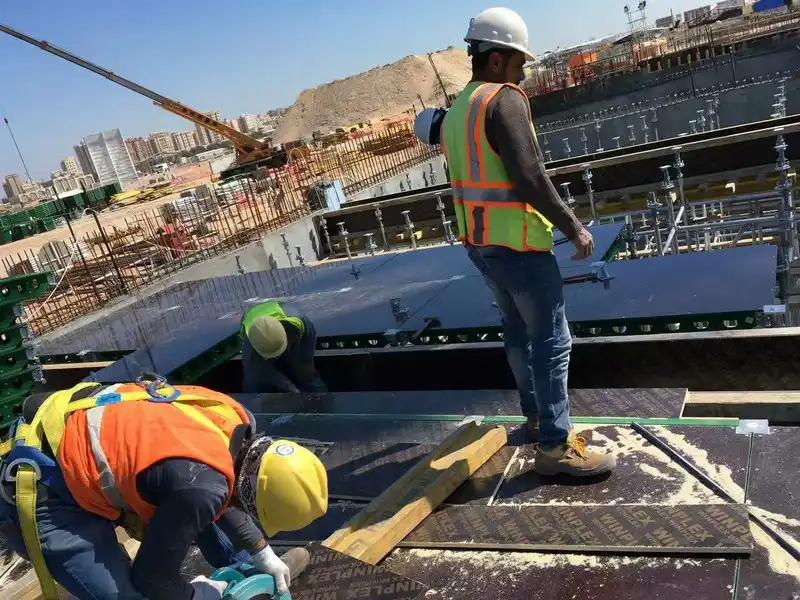
Understanding Combined Steel Formwork: Principles and Benefits
What the System Actually Is?
A modular steel forming system is made up of support parts, joining tools, flat panels, and corner units that can be locked together on-site. Every panel has a ring around the edges with standard P-hole spacing, so every part can fit any other part without any changes. Custom-cut woodwork requires a lot of guesswork, but "factory-manufactured, site-assembled" takes away that problem.
Core Performance Benefits
It's important for buying teams that the benefits are reusable, structurally correct, and safe on the job site. As per GB/T 50214, panels made to a smoothness tolerance of ≤2mm make concrete surfaces that rarely need extra plastering. This saves both labor and finishing materials on each cycle.
Environmental Relevance
Steel panels create a lot less waste on the job site than single-use plywood. One set of steel panels can replace hundreds of plywood sheets over the course of 300 cycles. At the manufacturing level, ISO 14001 environmental management certification adds a level of accountability that can be checked. This level of accountability is being asked for more and more in Latin America and the Middle East project bids.
Comparing Combined Steel Formwork with Other Formwork Types
Steel vs. Plywood and Timber
Usually, plywood can handle 5 to 20 dips before the surface quality starts to get worse. For every new shape, traditional wood needs to be shaped by a skilled carpenter on-site. Both problems are solved by a steel modular panel system. The panels come in pre-cut sizes, connect with U-clips and L-shaped bolts, and keep the joints tight pour after pour.
Steel vs. Aluminum Formwork
Aluminum is lighter, which is helpful for home projects with high floors. However, combined steel formwork using Q235 carbon steel panels with a load-bearing capacity of 60–80 KN/m² performs better than most metal alternatives when it comes to the hydraulic pressure of large-volume infrastructure pours, such as bridge piers, tunnel linings, and industrial slabs. The difference in strength is not small for heavy civil work.
Lifecycle Cost Comparison
A steel panel system costs more per unit up front than plywood, but the per-pour price drops sharply when you divide the total cost by the number of times it can be used. When EPC contractors in the Gulf and Latin America switch to modular steel forming systems, they always report lower annualized material costs, lower waste disposal fees, and shorter cycle times because the systems strip down faster.
Technical Specifications and Installation Process
Design Principles and Key Parameters
The steel forming panels that Shandong Xingrui Building Materials Co., Ltd. makes are made from Q235 carbon steel and are 2.5 mm to 3 mm thick. Standard lengths range from 900mm to 1800mm and widths from 100mm to 300mm. This gives site teams a wide range of sizes to fit almost any floor plan without having to cut. Dimensional accuracy is kept at ±0.5mm, which is done by 12 welding robots and 6 automatic welding lines working in a production center that is over 40,000 m².
Step-by-Step Installation Overview
There is a clear order to installation that keeps workers safe and on task. Here is how most assemblies are put together:
- Site preparation: Verify base lines, set release agent on panel faces, and stage hardware kits by pour zone.
- Panel placement: Stand panels in sequence, engage peripheral flanges, and insert U-clips at each P-hole connection point.
- Corner and filler fitting: Position corner modules and any custom filler panels per the approved shop drawing; check plumb and alignment before proceeding.
- Support installation: Attach wall ties, back-props, or shoring at intervals specified in the structural calculation sheet; torque bolts to rated values.
- Pre-pour inspection: Walk the formed area to confirm joint tightness, tie-rod placement, and that no panel gap exceeds allowable tolerance.
These steps for combined steel formwork work for building walls, columns, beams, and slabs. That's why the system can be used for building irregular structures without having to change the whole forming strategy.
Maintenance for Long Cycle Life
Crews should use a scraper to get rid of any leftover concrete after each strip, check the flanges for deformation, and reapply the release agent before putting the strips away. The panel surface has been treated with industrial-grade pickling, phosphating, and high-temperature baking to get a salt spray test rating above Grade 8. This means that panels that are kept outside between jobs will keep their protective coating even when they are exposed to normal weather.
Procurement Guide: Where and How to Buy Combined Steel Formwork?
Evaluating Supplier Credibility
Four things about a supplier are most important when looking for a steel forming system to export: ISO 9001 quality certification, a history of exporting a lot of goods, the ability to make custom parts, and closeness to a port for easy shipping. Rizhao Port in Shandong Province is where Shandong Xingrui ships goods to more than 100 countries. The city has its own seaport, airport, and high-speed train, which makes it easy to coordinate freight for both FOB and CIF shipping.
Order Structures and Lead Times
There are three useful choices for buyers: buying in bulk to build a fleet, placing a trial order to make sure the product fits before making a big purchase, or placing a custom order based on CAD models made just for the project. For stock sizes, the standard production lead time is 15 to 30 days. For custom specifications, there is an extra window for confirming the drawing and approving the sample. After the first contact, it usually takes between 60 and 120 days to ship a steady large amount of goods, including time for reviewing samples and signing off on the technical agreement.
Custom Orders and OEM Capability
For custom panel layouts, non-standard corner modules, and circular shapes in combined steel formwork, the factory will accept drawings and samples from the customer. OEM processing with NDA protection is available for rental companies that want to build a fleet with their own brand. After the drawing is approved, samples are sent out within 7 to 14 days. This gives the buyer's expert teams real proof that the dimensions are correct before they commit to full production.
Making the Right Choice: Evaluation Criteria for Combined Steel Formwork
Matching Product to Project Demand
Not every type of project works with every type of making method. For high-rise shear wall work, all lifts with more than one floor must be flat. For work on bridge piers and abutments, you need a high pour-speed capacity. In humid conditions, work in an underground utility gallery needs to be done with tight joint sealing. The modular steel system can handle all three situations because it has corner modules, curved fillers, and unique pieces that can be put together in different ways from the same panel family.
Safety and Certification Standards
The system is certified as an ISO 9001 (Quality), ISO 14001 (Environmental), and ISO 45001 (Occupational Health and Safety) management system, which is useful for procurement teams whose clients need proof of third-party certification. There are batch quality inspection records for each shipment, which helps with the tracking needs of government building bids in the Middle East and the Americas.
ROI Evidence from Real Projects
That the product can be used 200–300 times is not just marketing speak; it is a direct result of the 206 GPa modulus of elasticity in the Q235 steel base material and the weld integrity being checked by non-destructive testing after every production run. Rental companies say that repairs and panel replacements happen less often than with aluminum or wood options. This makes it easier to switch out assets and cuts down on downtime between projects.
Conclusion
Combined steel formwork with tightly sized modular steel forming panels is a realistic way for procurement teams to lower per-pour costs, improve safety, and cut down on site waste over the life of a project. The important thing is to find a manufacturer whose quality system, output size, and export infrastructure can work with the time frame you give them. Shandong Xingrui Building Materials Co., Ltd. meets all of these needs with production that is ISO-certified, a factory that is over 40,000 m², and direct port access from Rizhao. If you need a forming system for your next project that can last hundreds of cycles, this is the category to look at first.
FAQ
Q1: How many times can steel forming panels be reused?
A: With proper maintenance—scraping residue after each strip and reapplying release agent—Q235 steel panels from Shandong Xingrui achieve 200 to 300+ reuse cycles. That far exceeds the 5–20 cycles typical for plywood, which is why lifecycle cost calculations favor steel for any project running multiple concrete pours.
Q2: Can panels be customized for non-standard geometries?
A: Yes. The factory accepts CAD drawings and physical samples for custom corner modules, circular sections, and filler pieces. Standard sample turnaround is 7 to 14 days after drawing confirmation, so your engineering team can verify fit before production begins.
Q3: What certifications back the product?
A: The manufacturing facility holds ISO 9001, ISO 14001, and ISO 45001 certifications. Products also carry CE certification. Batch inspection reports are available per shipment for full traceability.
Q4: What is the minimum order quantity?
A: MOQ varies by panel size and configuration. Contact the team directly at sdxingruiqp@126.com or visit sdxingrui.com for a project-specific quotation and feasibility assessment.
Q5: How does the joint sealing work under concrete pressure?
A: The peripheral flange design with standard P-hole spacing, combined with U-clip and L-bolt connections, keeps joints tight under the hydrostatic pressure of wet concrete. This eliminates the grout leakage that commonly occurs with worn timber or mismatched aluminum systems.
Get Your Steel Forming System Quote from GREEN FORMWORK Today
The combined steel formwork manufacturer for GREEN FORMWORK is Shandong Xingrui Building Materials Co., Ltd. They ship to more than 100 countries and offer ISO-certified quality, flexible order sizes, and full technical support from reviewing the drawings to installing the forms on-site. You can send your project plans or RFQ to sdxingruiqp@126.com to see all of their products. After the drawing is confirmed, samples are ready in 7–14 days.
References
1. American Concrete Institute. ACI 347R-14: Guide to Formwork for Concrete. ACI, 2014.
2. European Committee for Standardization. EN 12812: Falsework — Performance Requirements and General Design. CEN, 2008.
3. Hurd, M.K. Formwork for Concrete, 7th ed. American Concrete Institute, 2005.
4. Construction Industry Research and Information Association. CIRIA C633: Concrete Pressure on Formwork. CIRIA, 2003.
5. Peurifoy, R.L., and Oberlender, G.D. Formwork for Concrete Structures, 4th ed. McGraw-Hill, 2011.
6. International Organization for Standardization. ISO 9001:2015 Quality Management Systems — Requirements. ISO, 2015.
Learn about our latest products and discounts through SMS or email