- English
- French
- German
- Portuguese
- Spanish
- Russian
- Japanese
- Korean
- Arabic
- Greek
- German
- Turkish
- Italian
- Danish
- Romanian
- Indonesian
- Czech
- Afrikaans
- Swedish
- Polish
- Basque
- Catalan
- Esperanto
- Hindi
- Lao
- Albanian
- Amharic
- Armenian
- Azerbaijani
- Belarusian
- Bengali
- Bosnian
- Bulgarian
- Cebuano
- Chichewa
- Corsican
- Croatian
- Dutch
- Estonian
- Filipino
- Finnish
- Frisian
- Galician
- Georgian
- Gujarati
- Haitian
- Hausa
- Hawaiian
- Hebrew
- Hmong
- Hungarian
- Icelandic
- Igbo
- Javanese
- Kannada
- Kazakh
- Khmer
- Kurdish
- Kyrgyz
- Latin
- Latvian
- Lithuanian
- Luxembou..
- Macedonian
- Malagasy
- Malay
- Malayalam
- Maltese
- Maori
- Marathi
- Mongolian
- Burmese
- Nepali
- Norwegian
- Pashto
- Persian
- Punjabi
- Serbian
- Sesotho
- Sinhala
- Slovak
- Slovenian
- Somali
- Samoan
- Scots Gaelic
- Shona
- Sindhi
- Sundanese
- Swahili
- Tajik
- Tamil
- Telugu
- Thai
- Ukrainian
- Urdu
- Uzbek
- Vietnamese
- Welsh
- Xhosa
- Yiddish
- Yoruba
- Zulu
Which Tubular Scaffolding Features Matter Most When You Buy Online?
When sourcing tubular scaffolding online, the features that matter most are steel grade, wall thickness, surface treatment, coupler quality, and supplier certifications. For most mid to large building projects, a Q235 or comparable carbon steel tube with an outer diameter of 48.3mm and wall thickness of 3.2mm-4.0mm provides the load bearing capabilities required. The checklist also covers hot-dip galvanisation, ISO certifications and modular coupler compatibility. Getting these specs correct before you purchase saves your project budget, your crew’s safety and your reputation with your customers.
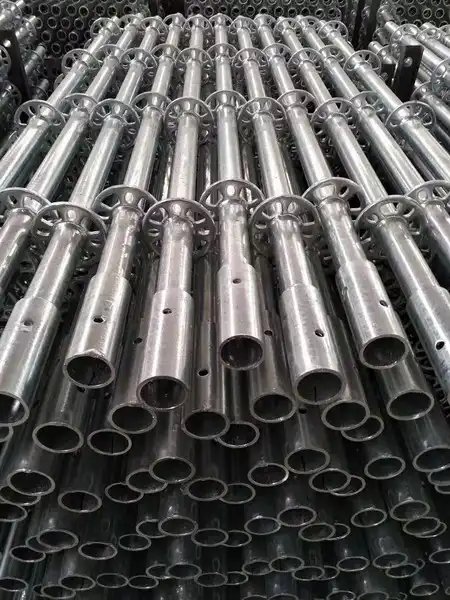
Understanding Tubular Scaffolding: Core Features and Specifications
You should really know how the system works and what the numbers mean for your project before you order something online.
What Tube and Coupler Scaffolding Actually Is?
Tube and coupler scaffolding is flexible in construction. It is comprised of steel pipes, joined together with specific screws. Unlike prefabricated frame systems, the geometry may be entirely altered, therefore it can be used to building surfaces that are not straight or have facades that are not straight. Still the greatest option in South America, the Middle East, Africa and Southeast Asia for the budget-conscious since it is so adaptable.
Standard Dimensions and Why They Matter
Most business people choose 48.3 mm as outer width Walls may be 3.2 mm to 4.0 mm thick depending on the weight they have to support. Having different wall thicknesses in the same structure is not a good idea. It may screw up load-bearing estimations and the consistency of coupler grip. If these values are verified on the mill certificate before the items are transported, the project site will not have to spend a lot of money to reject the goods.
International Standards to Reference
EN 39 gives the standard for tube diameters. EN 74-1 gives the standard for the performance of couplers. BS EN 12811-1 gives the standard for the performance of the overall structure. Companies that have ISO 9001 quality management accreditation have a regulated manner of creating goods. If you are purchasing anything from someone in a foreign nation, you have to ask for copies of these documents.
How to Evaluate Tubular Scaffolding Quality When Buying Online?
Remote purchasing removes the ability to physically inspect goods, so you need a structured verification process.
Steel Grade and Weld Integrity
Q235 premium steel for tubular scaffolding provides high torsional stiffness and a favorable strength-to-weight ratio. When reviewing mill certificates, check that tensile strength and yield strength figures align with the stated grade. Weld seam integrity is equally important: request flattening test reports to confirm that seams won't split under axial load.
Surface Treatment: Hot-Dip vs. Pre-Galvanized
After tube formation, the internal and external surfaces were coated with a zinc coating of 40–60 microns by hot-dip galvanisation. However, pre-galvanized pipes are produced from pre-coated strip steel, which results in higher exposure of the weld seam region to moisture and chemical assault. In coastal, tropical or chemically hostile regions hot dip galvanised tubes have a far longer life than the alternative.
Supplier Certification Checklist
Here is a practical checklist for verifying supplier quality before committing to a trial order:
- ISO 9001 certificate — confirms process-level quality control at the factory
- ISO 14001 certificate — signals responsible environmental management
- ISO 45001 certificate — demonstrates occupational health and safety commitment
- Mill certificates — provide chemical composition and mechanical test data per batch
- Quality warranty letter — documents the supplier's accountability for defects
These documents work together to give you a verifiable picture of factory capability. A supplier who cannot produce all five items on request is a procurement risk, regardless of how competitive the unit price appears.
Comparing Tubular Scaffolding Types and Their Applications
Not every steel access system is right for every job. Knowing the structural differences saves money and time.
Tube and Coupler vs. Frame and System Scaffolding
Frame scaffolding employs welded walk-through frames that are set width allowing for faster assembly on simple residential or shop facades. System scaffolding like ringlock or cuplock include pre-engineered rosette nodes for speedier assembly at height. Tube and coupler scaffolding may lose out on some speed of installation but it gets total flexibility of geometry and is thus the option for complicated industrial maintenance, petrochemical turnarounds and historical restoration (where no two bays are the same).
Lightweight vs. Heavy-Duty Configurations
For tubular scaffolding, a 3.2mm wall tube saves weight per linear meter and lowers shipping cost per ton, making it suitable for working platforms at moderate heights. A 4.0mm wall tube handles greater axial compression and shear from wind loading, which is necessary for structures exceeding 25 meters. According to EN 12811-1, structures above that threshold typically require a structural engineer's sign-off to account for combined dead loads and dynamic wind pressure.
Matching the System to Your Market
In price sensitive developing regions the tube and coupler system wins on total cost of ownership. Local people know how to install it, spare couplers are accessible everywhere and reuse cycles of 50+ are possible with little maintenance. The cheap starting cost and lengthy service life of these units makes it difficult for proprietary systems to compete on an equal tonnage basis.
Procurement Considerations: Buying Tubular Scaffolding Online Efficiently
Smart procurement goes beyond comparing ton prices on a spreadsheet.
Pricing Factors and Market Trends
Ex-factory quotations are directly impacted by steel price fluctuation. You may get a formal purchase agreement from certain suppliers, or you can ask for a price validity provision in your quote to protect yourself from steel coil price fluctuations between the time you enquire and the time you ship. The delivery cost is also influenced by the freight configuration: a provider with a well-thought-out design for container loading may decrease wasted space and hence the cost per tonne significantly.
Buying vs. Renting: A Practical View
If a project lasts longer than six months, or a trading company is supplying several contractors, then the outright purchase will always be cheaper per usage than renting. You may rent which makes sense for short term tasks or when storage logistics are prohibitive. If you are doing between $300,000 and $3,000,000 a year in purchases, the better financial position is to own your own inventory and manage reuse cycles.
Assessing Supplier Credibility
Look beyond price when choosing a tubular scaffolding supplier. Verified export history to your target region, documented quality certifications, sample supply capability, and a clear payment term menu—including L/C and account-period options—are all indicators of a professional trading partner. Factories with automated welding lines and robotics-assisted production tend to deliver tighter dimensional tolerances than manually operated plants.
Making the Final Decision: Features That Impact Long-Term Value
Material Durability and Reuse Potential
HOT-DIP GALANIZED Q235 carbon steel tubes can be used more than 50 times if they are taken care of and checked regularly. The cost of ownership per project goes down because it can be used again and again. This is especially important in markets where margins are always being pushed thin.
Routine Inspection and Lifecycle Management
After the first time it is set up, every seven days while it is being used, and right away after a storm, the industry says that scaffolding should be checked. Parts can be replaced before they become safety hazards if you keep track of the inspection dates and wear patterns for each batch. This also makes the system last longer.
Customization and Modular Adaptability
No need to order extra parts if you build your modular tube combination frame well. It can be used with bays that are different widths and heights. It's much easier for procurement teams to meet the exact requirements of infrastructure contracts when they have suppliers who can take custom orders based on project drawings. This gives them a real competitive edge.
Conclusion
If you know what to look for, it's easy to buy tubular scaffolding support online. If you want to buy something, you should think about the steel grade, wall thickness, surface treatment, coupler compliance, and checked documents. More weight should be given to providers who offer clear paperwork, free samples, and steady terms for prices. For as long as a project lasts, a system made of hot-dip galvanized Q235 steel and made in an ISO-certified facility will always work better than cheaper choices.
FAQ
Q1: What wall thickness should I specify for general-purpose construction use?
A: For most temporary working platforms and support structures at moderate heights, 3.2mm wall thickness is sufficient and cost-effective. Move to 4.0mm when the structure exceeds 25 meters or faces high lateral wind loads. Never mix both thicknesses in the same structural bay.
Q2: Does hot-dip galvanization matter in dry inland climates?
A: Yes. Even in low-humidity environments, concrete alkalinity and site abrasion degrade unprotected steel surfaces. A 40–60 micron zinc coat adds meaningful service life regardless of climate zone.
Q3: How do I verify quality when buying online without visiting the factory?
A: Request mill certificates, third-party inspection reports, and a pre-shipment quality warranty letter. Ordering a trial shipment before committing to full-volume supply is the standard practice for first-time procurement relationships.
Q4: Are ISO certifications a reliable indicator of product quality?
A: ISO 9001, ISO 14001, and ISO 45001 certifications confirm that a factory operates under documented process controls and undergoes third-party audits. They do not replace product-level testing, but they significantly reduce the probability of systemic quality failures.
Q5: What payment terms are standard for cross-border scaffold orders?
A: Letter of credit (L/C) remains the most widely used instrument for first-time orders in emerging markets. Repeat buyers often negotiate 30% deposit with balance against bill of lading, or short-term account periods once a track record exists.
Request a Quote from GREEN FORMWORK — Trusted Tubular Scaffolding Manufacturer
The GREEN FORMWORK is run by Shandong Xingrui Building Materials Co., Ltd., and they sell enterprise-grade tube scaffolding to people in over 100 countries. Our workshop is more than 40,000 square meters and is approved by ISO 9001, ISO 14001, and ISO 45001 for the quality of our work. This means that our orders will always be of the same good quality, even when we ship a lot of them at once. To get a price right away, please email your needs to sdxingruiqp@126.com.
References
1. British Standards Institution. BS EN 12811-1: Temporary Works Equipment — Scaffolds: Performance Requirements and General Design. BSI, 2003.
2. European Committee for Standardization. EN 74-1: Couplers, Spigot Pins and Baseplates for Use in Falsework and Scaffolding. CEN, 2005.
3. European Committee for Standardization. EN 39: Loose Steel Tubes for Tube and Coupler Scaffolding — Technical Delivery Conditions. CEN, 2001.
4. International Organization for Standardization. ISO 9001: Quality Management Systems — Requirements. ISO, 2015.
5. Health and Safety Executive. Construction (Design and Management) Regulations: Scaffolding Safety Guidance. HSE Books, 2015.
6. Peng, J. L., Pan, A. D., & Chen, W. F. "Approximate Analysis Method for Modular Tubular Falsework." Journal of Structural Engineering, ASCE, 1997.
Learn about our latest products and discounts through SMS or email