- English
- French
- German
- Portuguese
- Spanish
- Russian
- Japanese
- Korean
- Arabic
- Greek
- German
- Turkish
- Italian
- Danish
- Romanian
- Indonesian
- Czech
- Afrikaans
- Swedish
- Polish
- Basque
- Catalan
- Esperanto
- Hindi
- Lao
- Albanian
- Amharic
- Armenian
- Azerbaijani
- Belarusian
- Bengali
- Bosnian
- Bulgarian
- Cebuano
- Chichewa
- Corsican
- Croatian
- Dutch
- Estonian
- Filipino
- Finnish
- Frisian
- Galician
- Georgian
- Gujarati
- Haitian
- Hausa
- Hawaiian
- Hebrew
- Hmong
- Hungarian
- Icelandic
- Igbo
- Javanese
- Kannada
- Kazakh
- Khmer
- Kurdish
- Kyrgyz
- Latin
- Latvian
- Lithuanian
- Luxembou..
- Macedonian
- Malagasy
- Malay
- Malayalam
- Maltese
- Maori
- Marathi
- Mongolian
- Burmese
- Nepali
- Norwegian
- Pashto
- Persian
- Punjabi
- Serbian
- Sesotho
- Sinhala
- Slovak
- Slovenian
- Somali
- Samoan
- Scots Gaelic
- Shona
- Sindhi
- Sundanese
- Swahili
- Tajik
- Tamil
- Telugu
- Thai
- Ukrainian
- Urdu
- Uzbek
- Vietnamese
- Welsh
- Xhosa
- Yiddish
- Yoruba
- Zulu
Best Disc Lock Scaffolding for Fast, Safe Industrial Installation
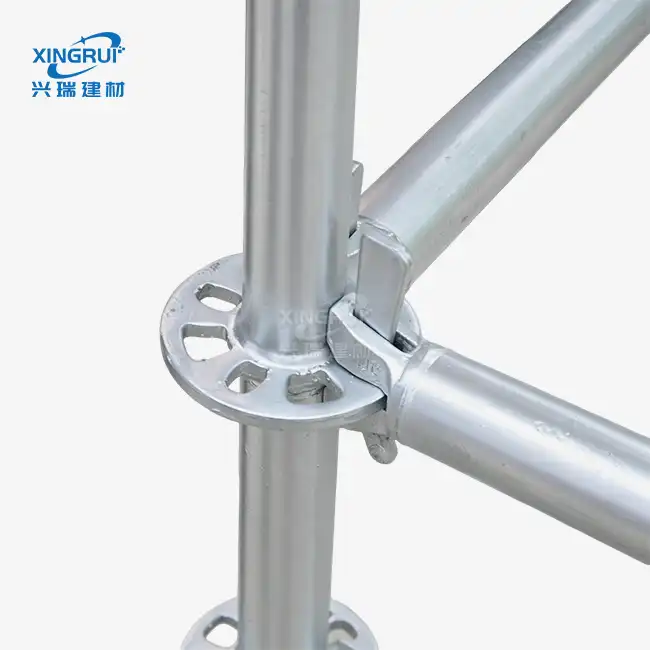
When project deadlines are tight and safety margins are non-negotiable, choosing the right modular scaffolding system can determine whether a job finishes on schedule or runs over budget. Disc lock scaffolding stands out as one of the most dependable access and support solutions available for large-scale industrial construction today. The eight-hole rosette disc and wedge-pin connection provide a visible load channel for workers, and the system assembles about 50% quicker than traditional tube-and-clamp methods—a distinct benefit on high-pressure project sites.
Understanding Disc Lock Scaffolding: Components, Types, and Working Principles
Core Structural Elements
A conventional rosette scaffolding set consists of four basic components: vertical standards, horizontal ledgers, diagonal bracing, and the printed rosette discs which are affixed to each standard at intervals of 500 mm. Each disc features 8 meticulously constructed holes, 4 for 90 degree ledger connections and 4 for diagonal bracing. This provides the node with complete 360 degree flexibility without the need for additional hardware.
Material Grades and Coating
Both the 48 mm light-duty and 60 mm heavy-duty versions of Shandong Xingrui’s system are comprised of Q235 premium carbon steel. All parts are coated with a hot dip galvanising (HDG) coating of 60-80 μm. This is the standard for outdoor structural steel according to ISO 1461. This coating will prevent against rust for 10 to 15 years, even in seashore or industrial plant environments.
How the Wedge-Lock Node Works?
The wedge pin for disc lock scaffolding goes through the hole in the rosette and falls down due to gravity. This makes a self-locking link that gets tighter when it's loaded instead of releasing. This gravity-assisted mechanism gets rid of loose bolts and lowers the risk of disconnecting by accident while in use, which is a very important safety feature for elevated work platforms.
Advantages of Disc Lock Scaffolding for Industrial Installation
A rosette-lock system is faster, safer, and lasts longer than older scaffolding technologies, which gives procurement managers a real cost advantage.
The main things that make this system stand out on industrial job sites are the following:
- Faster assembly cycle: Tool-free wedge connections cut installation labor time by up to 50% compared with tube-and-clamp methods, directly reducing crew hours per floor.
- Even stress distribution: The ring-type joint structure spreads load across all eight contact points simultaneously, preventing localized stress concentrations that can cause node failure under heavy dynamic loads.
- Higher turnover frequency: Shandong Xingrui's system achieves a turnover rate 30% higher than traditional scaffolding, meaning each set of components supports more project cycles over its lifespan—lowering the effective cost per use.
- Standardized compatibility: All accessories share the same 500 mm rosette spacing, so crews can reconfigure layouts without sourcing custom parts, keeping both inventory and downtime low.
All of these benefits directly deal with the two biggest budget problems that industrial projects often face: hiring too many people and replacing materials that weren't meant to be replaced. A system that can be put together more quickly, reliably supports more weight, and stays in use for longer pays for itself over many project cycles.
Comparing Disc Lock Scaffolding with Other Scaffolding Systems
Disc Lock vs. Ring Lock
Ring Lock scaffolding is similar to Rosette scaffolding but with fewer connection holes in each node hence smaller angles for the bracing. The eight-hole disc in a real wedge-lock system makes it simpler to put up structures that aren't straight, such curving bridge piers or setback walls.
Disc Lock vs. Cuplock
Cuplock employs a cup and blade connection. With several usage the blade may wear out and become loose. Independent stress testing published in EN 12811-1 compliance reports demonstrate that wedge-lock nodes retain their rated shear capability for longer assembly cycles than cup-style connectors. Thus the disc system is cheaper to hire for a longer period.
Cost of Ownership
For disc lock scaffolding, contractors with long-term infrastructure projects will find that buying disk lock parts outright is the best value. For short-term industrial maintenance projects, rental agreements that don't require capital are better. In either case, the standard accessories make it easy to find replacement parts, which keeps the cost of maintenance low and predictable.
How to Choose and Procure the Best Disc Lock Scaffolding for Your Project?
Match Load Capacity to Project Type
The light series 48.3 mm can take 30 kN vertically, which is sufficient for working on the exterior of buildings and on slabs within structures. The 60.3 mm heavy series is suitable for bridge decking, industrial shoring and large precast concrete pours since it can carry up to 50 kN. Don’t place an order until you’ve checked the engineering load estimate, and prevent pricey mid-project modifications.
Verify Certifications and Traceability
In addition to the system certifications you should also ask for quality inspection reports every batch. Shandong Xingrui has ISO 9001, ISO 14001 and ISO 45001 management systems. All of their products are CE certified. If you are working on a project that has to comply with EN 12810-1 or EN 12811-1, request the supplier for the appropriate Declaration of Performance (DoP).
Evaluate Supplier Production Capacity
Dependability of lead time is more essential than unit pricing. Located in Rizhao, Shandong Province, Shandong Xingrui’s factories cover 79,800 square meters and include 12 welding robots and 6 automated welding lines. Rizhao has a harbour, thus marine freight may reach Middle East, Southeast Asia and North America more quickly. This decreases the chances of late delivery on contracts that need to be finished by a specified date.
Installation and Maintenance Best Practices for Disc Lock Scaffolding
Step-by-Step Assembly Sequence
Place the base plates and adjustable screw jacks on solid, level ground to start with disc lock scaffolding. Put in the first row of standards, make sure the ledgers are connected to the rosette holes at the right height, and then hammer the wedge pins into place to lock them in place. Then, diagonal braces are put in to make each bay more stable before the next lift starts. Don't skip a bracing bay and always work from the bottom up.
Routine Inspection Checklist
Before each erection, check each wedge pin for cracks, warping, or wear that is getting thinner. If the pin doesn't fit tightly into the disk, it needs to be taken out of service right away. Check the rosette welds for cracks and make sure the HDG layer is still intact. Bare steel patches speed up rust and shorten the service life below the recommended 10–15 years.
Compliance with EN and ANSI Standards
Sites that follow OSHA 1926 Subpart Q or ANSI/SSFI SC100-5/05 must write down the load ratings and tie-back spacing. Shandong Xingrui gives site engineers technical guidance documents and sample kits to help them make scaffold design drawings that are in line with regulations. This speeds up the approval process with project owners or local authorities.
Conclusion
Disc lock scaffolding has a well-known combination of speed, strength, and longevity that works well for industrial construction, bridge infrastructure, and facility maintenance. This system is made of eight-hole rosette nodes, Q235 steel, and 60–80 μm HDG coating, so site teams can trust it to last through hundreds of assembly cycles. With ISO 9001, ISO 14001, ISO 45001, and CE certifications and a 79,800 m² building, Shandong Xingrui can produce a lot of different things. This means that buying teams can get both quality and quantity without any problems.
FAQ
Q1: What safety advantage does a wedge-lock node offer over traditional cup-lock?
A: The wedge pin tightens under load due to gravity, whereas cup-lock blades can back off under vibration or wear. Independent shear tests show wedge-lock nodes maintain rated capacity through more repeated cycles, reducing the risk of connection slip on elevated platforms.
Q2: Can Shandong Xingrui produce custom sizing?
A: Yes. The company accepts orders based on customer-supplied drawings and samples. Custom tube lengths, non-standard rosette spacing, and OEM labeling are all available with NDA protection for proprietary designs.
Q3: How do I decide between the 48 mm and 60 mm series?
A: Use the 48 mm light series for facade access and interior slab forming where vertical loads stay below 30 kN. Choose the 60 mm heavy series for bridge shoring and industrial plant work where loads reach up to 50 kN per standard.
Q4: What certifications should I request before purchasing?
A: Ask for CE certificates, ISO 9001/14001/45001 system certificates, batch inspection reports, HDG coating thickness test records, and—for EN-governed projects—a Declaration of Performance aligned with EN 12810-1 or EN 12811-1.
Q5: Is a sample available before placing a bulk order?
A: Shandong Xingrui provides sample kits and technical guidance documents to support engineering review before any bulk commitment. Sample production typically completes within 7–14 days from drawing confirmation.
Get Certified Disc Lock Scaffolding from GREEN FORMWORK Today
GREEN FORMWORK sells CE-certified disk lock scaffolding directly from Shandong Xingrui's 79,800 m² production base. You can get both the 48 mm and 60 mm types in large sizes. Get in touch with our technical team before you place your next bulk order for a review of your load calculations, competitive pricing, or a sample kit. To send us your project details right away, email us at sdxingruiqp@126.com.
References
1. European Committee for Standardization. EN 12811-1: Temporary Works Equipment — Scaffolds — Performance Requirements and General Design. CEN, 2003.
2. European Committee for Standardization. EN 12810-1: Facade Scaffolding Made of Prefabricated Components — Products Specifications. CEN, 2003.
3. International Organization for Standardization. ISO 1461: Hot Dip Galvanized Coatings on Fabricated Iron and Steel Articles. ISO, 2009.
4. Scaffold & Access Industry Association. ANSI/SSFI SC100-5/05: Scaffolding — Safety Requirements. SAIA, 2005.
5. Construction Industry Research and Information Association. CIRIA C703: Embedded Retaining Walls — Guidance for Economic Design. CIRIA, 2017.
6. International Organization for Standardization. ISO 9001: Quality Management Systems — Requirements. ISO, 2015.
Learn about our latest products and discounts through SMS or email