- English
- French
- German
- Portuguese
- Spanish
- Russian
- Japanese
- Korean
- Arabic
- Greek
- German
- Turkish
- Italian
- Danish
- Romanian
- Indonesian
- Czech
- Afrikaans
- Swedish
- Polish
- Basque
- Catalan
- Esperanto
- Hindi
- Lao
- Albanian
- Amharic
- Armenian
- Azerbaijani
- Belarusian
- Bengali
- Bosnian
- Bulgarian
- Cebuano
- Chichewa
- Corsican
- Croatian
- Dutch
- Estonian
- Filipino
- Finnish
- Frisian
- Galician
- Georgian
- Gujarati
- Haitian
- Hausa
- Hawaiian
- Hebrew
- Hmong
- Hungarian
- Icelandic
- Igbo
- Javanese
- Kannada
- Kazakh
- Khmer
- Kurdish
- Kyrgyz
- Latin
- Latvian
- Lithuanian
- Luxembou..
- Macedonian
- Malagasy
- Malay
- Malayalam
- Maltese
- Maori
- Marathi
- Mongolian
- Burmese
- Nepali
- Norwegian
- Pashto
- Persian
- Punjabi
- Serbian
- Sesotho
- Sinhala
- Slovak
- Slovenian
- Somali
- Samoan
- Scots Gaelic
- Shona
- Sindhi
- Sundanese
- Swahili
- Tajik
- Tamil
- Telugu
- Thai
- Ukrainian
- Urdu
- Uzbek
- Vietnamese
- Welsh
- Xhosa
- Yiddish
- Yoruba
- Zulu
Best Heavy-Duty Formwork for High-Rise Concrete Construction
For building tall buildings out of concrete, the best heavy-duty formwork has thick steel or aluminum panels, a stiff bracing layout, and a design pressure that fits your pour. Heavy-duty steel formwork rated at 80 kN/m² or higher is best for core walls, columns, bridge piers, and deep basements. Heavy-duty aluminum formwork is lighter and can be used for repeated layouts. Before you buy, make sure you look at the load table, tie spacing, panel size, crane capacity, and target number of uses. Always check the capacity of a project's calculations. At GREEN FORMWORK, we build both versions based on your drawings, give you samples, and help your engineers with technical questions.
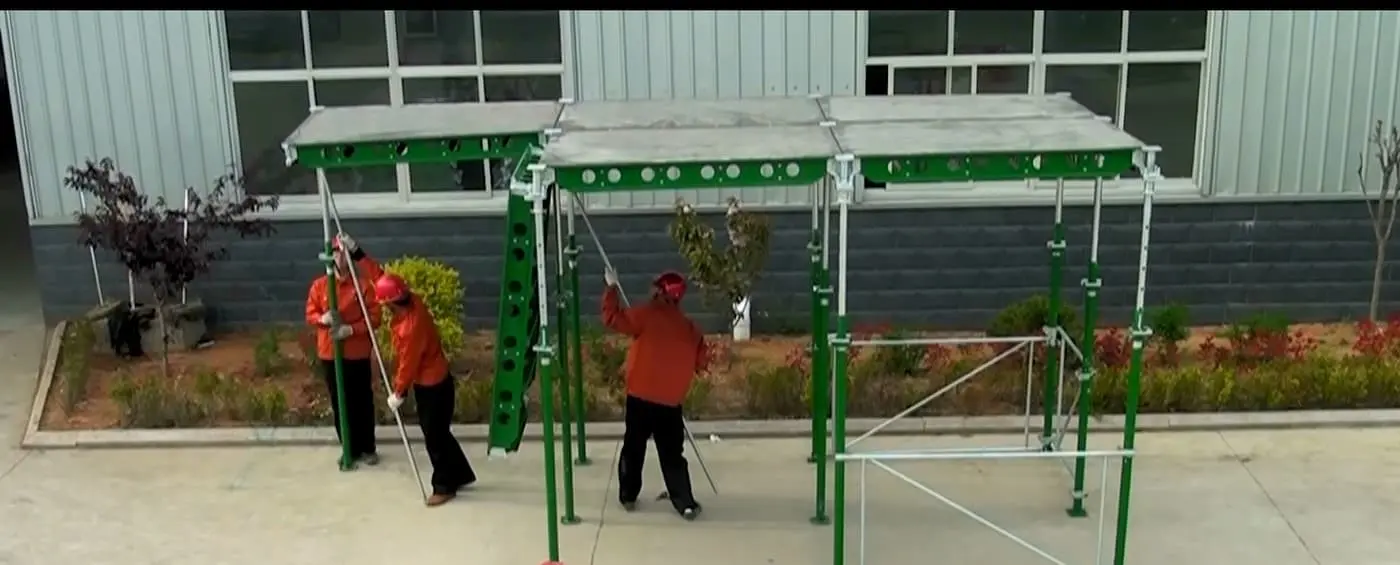
Understanding Heavy-Duty Formwork for Tall Buildings
What Is Heavy-Duty Formwork?
Heavy-duty formwork is a temporary system that has been engineered to withstand high lateral concrete pressure, repeated use, and difficult site conditions. There are more parts to a full system than just panels. It also has anchors, clamps, props, braces, platforms, lifting points, strongbacks, tie rods, and tie rods. It's all about the numbers here. A 3 m (about 10 ft) fluid head presses on the form with about 72 kN/m³ of force. This is because 24 kN/m³ of fresh normal-weight concrete is used. Because of high lifts and quick placement, demand is higher. That's why we make our panels to hold 80 kN/m² or more. As per the U.S. OSHA standard 29 CFR 1926.703, formwork must be able to support all expected vertical and lateral loads. This means that each project needs its own calculations.
Why High-Rise Projects Require Heavy-Duty Formwork
When you work in a high-rise building, you have to do tall pours, fast placement, tight tolerances, repeated floor cycles, little storage, and work at height. So that each lift lands where the drawings say it should, a stiff formwork system stops deformation, keeps things straight, and cuts down on leaks at the joints. Crews set up the system as gang forms, climbing forms, table forms, or crane-lifted assemblies, depending on the building. Our large-format panels can be used to build core walls in either a jumping or climbing configuration, and they can be cast in four days. Early coordination with the concrete supplier, embedded items, reinforcement, and MEP openings keeps crews from getting stuck in the middle of a pour. The floor cycle stays the same because of this coordination.
Heavy-Duty Formwork vs. Other Formwork Systems
Types of formwork are not different based on price alone. Traditional wood forms are cheaper up front, but they can't be used as often and aren't as stiff. Standard panels that aren't very heavy are good for low walls and short pours. The stiffness, pressure resistance, and reuse of heavy-duty formwork are all improved. In that group, aluminum is lighter, which makes hand setting faster for layouts that are used over and over again. Cranes and trucks are heavier when made of steel because it is stiffer and lasts longer. For example, many builders use both aluminum and steel for their floors and cores, transfer beams, and piers. We make heavy-duty steel formwork and heavy-duty aluminum formwork, so you can use the right material for each part of the structure.
Choosing the Best Heavy-Duty Formwork for a High-Rise Project
Define Loads, Geometry, and Site Limits
Do not start with the catalog, but with the structure. Write down the design pressure, the highest pour height, the panel's size, the amount of deflection that is allowed, the connection's strength, the number of reuses that are desired, the surface finish, and the lifting requirements. The American Concrete Institute's guide to formwork, ACI 347R-14, figures out lateral pressure by looking at unit weight, placement rate, concrete temperature, and pour height. Get these numbers from your concrete supplier. Ask each maker for load tables, structural calculations, assembly drawings, instructions on how to install, and records of inspections. Then look at logistics: compare the weight of the panels to the size of the crane, the amount of storage space, the routes that can be used for transport, and the availability of spare parts. Our panels are 2.4 m by 6 m, which means there are fewer joints on large walls but needs a crane plan before delivery.
Components and System Configuration
Every part of a heavy-duty system has to do its part for the whole system to work. The concrete finish and accuracy of the measurements are set by the panels and facing. Strongbacks and walers spread pressure and stop deflection. Anchors, clamps, tie rods, and connectors keep the space between things even after many cycles. Props, platforms, guardrails, and ladders help with alignment and keep people safe while they work at heights. Complex towers might also need fillers, chamfers, block-outs, curved panels, or lifting frames that are made just for them. Our formwork and scaffolding lines have more than a thousand different types of supporting accessories and adjustable shoring props, so you can get the whole system and all of its parts from the same factory.
Steel or Aluminum: Specifications Compared
We got these specs from our product data for both materials.
| Parameter | Steel Formwork | Aluminum Formwork |
|---|---|---|
| Panel thickness | ≥3.0 mm | 6 mm (thickened profile) |
| Design load capacity | ≥80 kN/m² | ≥80 kN/m² |
| Maximum pressure rating | 90–120 kN/m² | 90–100 kN/m² |
| Standard panel size | Up to 2.4 m × 6.0 m | Up to 2.4 m × 6.0 m |
| Frame material | Structural steel | Aviation-grade aluminum alloy |
| Surface treatment | Hot-dip galvanization | Powder coating or anodizing |
| Reuse cycles | 300–500 uses | 200–300 uses |
Steel is best for heavy pours because it can handle more pressure and can be used more than once. The crane hook is lighter when it is made of aluminum. We check the numbers with your engineers before production because the final capacity depends on the tie layout, the pour rate, and the project calculations.
Installation, Quality, and Cost Evaluation
Installation Guide for High-Rise Construction
Safe installation starts with a plan. The shop drawings, lifting instructions, and panel numbering that have been approved come first. Then, the crews put the panels together on a flat surface, making sure they fit the right walers, ties, connectors, braces, and release agent. They also check the lines, levels, plumbness, dimensions, and joint tightness. During positioning, they use approved lifting points and make sure no one is in the exclusion zones. The team does a written inspection before the pour. A spotter watches for movement or leakage while the concrete is poured at the approved rate and in the right order. Crews clean, check, fix, and record each panel after taking them apart so that the next floor can start with sound equipment.
Performance and Quality Indicators
Design calculations that take into account the density, temperature, slump, pour height, placement speed, vibration, support spacing, and connection strength will help you confirm the load capacity. After that, check the hardware. Panel flatness, consistent dimensions, weld quality, coating durability, accurate connection holes, and inspection records that can be tracked are all good signs. We have 12 welding robots, 6 automatic welding lines, and 4 cold roll forming sets in our factory. At every stage of production, we keep track of and test the raw materials and finished goods that come in. Our quality management system is certified by ISO 9001, and all of our products are certified by CE. Before you place an order, ask the seller to show you records like these.
Lifecycle Cost per Use
The price of the item doesn't tell the whole story. In order to find the expected number of reuses, add up the cost of freight, duties, engineering, accessories, installation labor, maintenance, repairs, and crane time. To give you an example, a system that costs 20% more but can be used 300 times instead of 200 times costs about 20% less per use. Keep track of how long it takes to install, how often repairs need to be done, how good the concrete finish is, and how many hours were spent on each project. This will show you how much each system really costs. Our steel formwork can be used 300–500 times, and our aluminum formwork can be used 200–300 times with proper cleaning and maintenance.
Supplier Selection and Buying Options
How to Evaluate a Formwork Manufacturer
A good supplier has both factory skills and engineering support that can be used. Check the capabilities of the company to do fabrication, welding, coating, quality control, production, export packaging, technical documents, and service after the sale. Specifications, inspection records, sample drawings, customer references, and, if possible, a factory audit should all be used to back up claims. Find out if engineering and production work together or if they go to different shops. Then, agree on the business issues, like when the goods will be delivered, how many will be needed at once, warranty terms, OEM capabilities, private label packaging, export paperwork, and making sure the products meet the standards your project needs to. Shandong Xingrui was established in 2007 and is based in Rizhao, which has its own airport, seaport, and high-speed rail hub. Our products are sent to more than 100 countries and regions.
Buy, Rent, or Order Custom Panels
This choice is based on the length of the project, the plan for reuse, the amount of money available, and the space available for storage. When contractors and rental companies buy, they get repeat business and a long-term fleet. If the rental company also offers engineering and inspection, it may be best for a one-time structure. For layouts that aren't straight, transfer beams, curved walls, complex cores, and odd openings, custom systems make sense. We make heavy-duty formwork and can process your drawings and samples in a way that fits your needs. Send drawings, concrete parameters, surface requirements, quantities, delivery location, schedule, Incoterms, and the model you want to buy or an OEM model to get an accurate quote.
Recommended Selection by Project Scenario
In a structural zone, each area sets its own priorities. High-rise cores need panels that are stiff and perfectly aligned so that they can fit climbing platforms or gang-form operations. Columns and transfer beams need to have sizes that can be changed, connections that are strong, high resistance to pressure, and accurate corner solutions. For bridges and other infrastructure, you need steel panels that are strong, can handle a lot of weight, don't rust, and have the right shape. Distributors and rental companies should look for parts that can be switched out, are easy to maintain, have spare parts available, and last a long time. Buyers of OEM and private labels should also look at the branding, packaging, production tolerances, inspection plans, and terms of confidentiality. Before you order, make sure that each priority is matched to a material and a panel layout.
Applications, Common Mistakes, and Why Buyers Choose GREEN FORMWORK
Where Our Heavy-Duty Formwork Performs
Formwork for bridge pylons and huge piers must be able to handle hydrostatic pressure during deep-lift pours and keep vertical tolerances when wind loads are applied at height. When it comes to hydroelectric dams, the system has to be able to handle both high-density mixes and mass-concrete heat of hydration without losing its stability. In commercial towers, our big panels are used in the core walls in jumping or climbing patterns. Deformation-resistant panels with a high safety factor under sustained ground pressure are good for basements of warehouses, parking garages, and industrial plants. In all of these situations, heavy structural pours need material that is thick and solid so it can hold weight and protect against impact.
Common Selection Mistakes and How to Avoid Them
Four mistakes that often lead to extra costs that could have been avoided: picking the cheapest option, using standard configurations without engineering approval, not checking the limits of the crane and storage space, and not budgeting for safety accessories. Every shortcut costs more work, time, or effort in the long run. You should look at the whole system, which includes the platforms, props, anchors, ties, connectors, guardrails, access equipment, and spare parts. For high-pressure or unusual pours, ask for calculations that are specific to your project. Then, make a maintenance plan that includes cleaning, using a release agent, inspecting the panels, reporting damage, keeping track of the parts, and refurbishing on time. These steps protect performance over many times of use.
Why Buyers Choose GREEN FORMWORK?
People choose GREEN FORMWORK, which is a part of Shandong Xingrui Building Materials Co., Ltd., for these main reasons:.
- Production scale: Our 79,800 m² site in Rizhao includes more than 40,000 m² of standardized workshops for cold bending, welding, electrostatic spraying, and forging. We employ 920 people, including 180 professional technicians, so research and production experience sit in one team and large global orders move through a single factory in Rizhao.
- Automation and quality: Twelve welding robots, six automatic welding lines, four cold roll forming sets, and one formwork profile forming line produce repeatable panels. We track and test raw materials and finished products at each stage for traceability, and we hold ISO 9001 and ISO 14001 certificates, with CE certification on all our products.
- Samples and support: We supply samples so your team can check flatness, weld quality, and fit before a large order. Our technicians provide technical assistance with load questions and layouts, and we accept custom processing from your drawings and samples for transfer beams, curved walls, and unusual openings. Our panels are reusable across repeated pours.
These points answer some of the most common worries buyers have, like custom panels that don't fit right, being rushed, and not having quality records.
Conclusion
To choose the right heavy-duty formwork for a high-rise project, you must first look at the structure. The design pressure, pour height, geometry, and crane limits will all affect which system is best. Steel panels can handle the most weight and pressure, but aluminum panels are lighter and can be used over and over again. Many projects use both types of panels. For a system to work, the panels, walers, ties, props, and platforms must all work together. The project calculations must be done according to standards like ACI 347R-14 and OSHA rules. It's more accurate to compare things based on their lifecycle cost per use, careful installation, and documented inspection than just their purchase price. When judging a supplier, you should look at their factory capacity, quality records, certifications, samples, and engineering support. Time, safety, and the finish of the concrete are all protected when common mistakes are avoided.
FAQ
What concrete pressure can your heavy-duty formwork handle?
Our steel and aluminum systems can hold at least 80 kN/m² of weight. The highest ratings for steel are 90–120 kN/m² and for aluminum they are 90–100 kN/m², depending on how they are set up. We check the capacity with the project calculations.
How many times can I reuse the panels?
Steel panels can be used 300–500 times with proper cleaning and maintenance, while aluminum panels can be used 200–300 times.
Can you make panels to my drawings?
Yes. We can do custom work based on drawings and samples, and before you place a large order, we can give you samples and technical help.
Which certifications do you hold?
Our environmental management system is certified to ISO 14001, and our products are CE certified. Our quality management system is certified to ISO 9001.
What do you need for a quotation?
Send us the drawings, concrete specifications, surface needs, quantity, delivery location, schedule, Incoterms, and let us know if you want to buy or order under an OEM model.
Request Heavy-Duty Formwork for Your High-Rise Project
GREEN FORMWORK can be reached at sdxingruiqp@126.com with your drawings, concrete specs, quantities, and delivery date. We make heavy-duty formwork and are ISO 9001 certified. We offer samples, technical help, and custom-made steel or aluminum panels that you can use on different projects. Our team will look over your pour conditions and come up with a quote that works with your schedule.
References
1. Guide to Formwork for Concrete (ACI 347R-14), American Concrete Institute, 2014
2. Formwork for Concrete (SP-4), Hurd, M.K., American Concrete Institute, 2005
3. Guide for Shoring/Reshoring of Concrete Multistory Buildings (ACI 347.2R-17), American Concrete Institute, 2017
4. Formwork for Concrete Structures, Peurifoy, R.L. and Oberlender, G.D., McGraw-Hill, 2010
5. ISO 9001:2015 Quality Management Systems — Requirements, International Organization for Standardization, 2015
6. EN 12812 Fal
Learn about our latest products and discounts through SMS or email