- English
- French
- German
- Portuguese
- Spanish
- Russian
- Japanese
- Korean
- Arabic
- Greek
- German
- Turkish
- Italian
- Danish
- Romanian
- Indonesian
- Czech
- Afrikaans
- Swedish
- Polish
- Basque
- Catalan
- Esperanto
- Hindi
- Lao
- Albanian
- Amharic
- Armenian
- Azerbaijani
- Belarusian
- Bengali
- Bosnian
- Bulgarian
- Cebuano
- Chichewa
- Corsican
- Croatian
- Dutch
- Estonian
- Filipino
- Finnish
- Frisian
- Galician
- Georgian
- Gujarati
- Haitian
- Hausa
- Hawaiian
- Hebrew
- Hmong
- Hungarian
- Icelandic
- Igbo
- Javanese
- Kannada
- Kazakh
- Khmer
- Kurdish
- Kyrgyz
- Latin
- Latvian
- Lithuanian
- Luxembou..
- Macedonian
- Malagasy
- Malay
- Malayalam
- Maltese
- Maori
- Marathi
- Mongolian
- Burmese
- Nepali
- Norwegian
- Pashto
- Persian
- Punjabi
- Serbian
- Sesotho
- Sinhala
- Slovak
- Slovenian
- Somali
- Samoan
- Scots Gaelic
- Shona
- Sindhi
- Sundanese
- Swahili
- Tajik
- Tamil
- Telugu
- Thai
- Ukrainian
- Urdu
- Uzbek
- Vietnamese
- Welsh
- Xhosa
- Yiddish
- Yoruba
- Zulu
Fast Cuplock Scaffolding Cost, Load Capacity, and Setup Time
The price of fast cuplock scaffolding depends on the type of steel used, the finish, the accessories, the freight, and the size of the order. That's why I never compare unit prices but always full bills of materials. Load capacity is part of the fully engineered configuration. Each of our Q235 standards can hold up to 60 kN, but the exact value depends on the length of the bay, the height of the lift, the bracing, and the ground. Our spring-loaded cup node locks without having to be hammered tight. This cuts down on setup time. Based on our data, these frames get an erection 40% better than regular bowl buckle frames. I'll explain each one below so you can make a safe purchase plan.
Fast Cuplock Scaffolding at a Glance: What It Is and How It Works
What Buyers Need to Know?
Cuplock scaffolding is made up of separate steel pieces. At cup nodes, crossbeams, ledgers, transoms, braces, platforms, and base jacks all connect to each other. It is used to build buildings, bridge decks and piers, keep refineries running, and support formwork. One point needs to be made clear. The word "fast" refers to how quickly and easily standard parts are put together. There is no set time for installation because it depends on how easy it is to get to the site, how skilled the crew is, and how complicated the design is.
Time to set up, cost, and load capacity are all linked. It can cost more to buy a cheap set that doesn't work right or needs extra work than a well-matched set. Before they can approve, contractors, engineers, distributors, and OEM buyers all need to know those three things.
How the Cup Node Locks the Structure
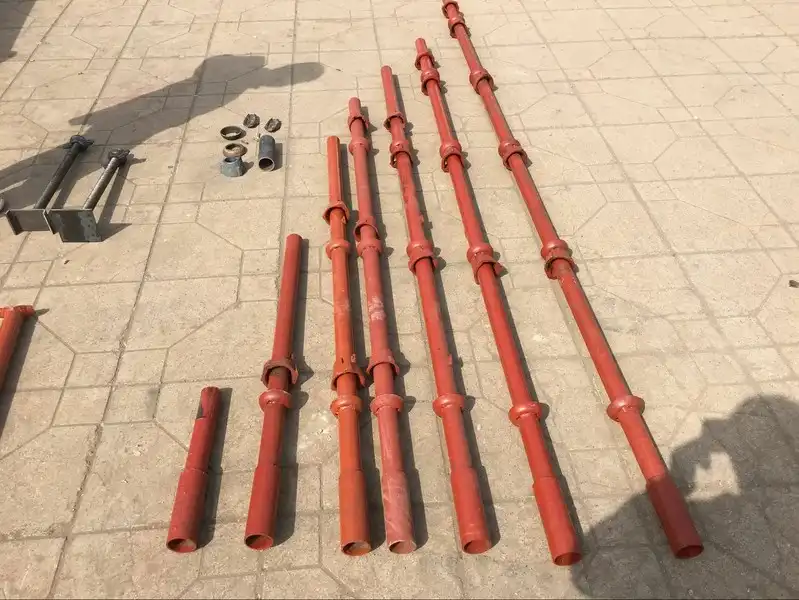
Each vertical standard has a fixed bottom cup that is welded every 0.5 m and a sliding top cup that has a spring built in. The spring locks all four connections at once when the ledger blades are lined up inside the cup node. The crew doesn't have to hammer or hand-tighten anything because the design locks itself. This gets rid of the loose bolts and wedges that often go missing on the job site. In line with GB/T 700, our standards call for 48.3 mm tubes with walls that are 3.2 to 3.5 mm thick and are made of Q235 carbon steel. The load path from ledger to standard stays simple and easy to check because the node is made up of one welded and sprung unit.
Why Setup Can Be Fast, and What Still Slows It?
Based on our data, these frames get an erection 40% better than regular bowl buckle frames. They also show that the cost of labor is up to 35% less than with tube-and-clamp methods. There are fewer loose parts, no hammer tightening, and standard spacing, which all add up to those gains.
Still, I tell every buyer that the benefit can be lost because of things like ground conditions, delivery order, crew training, and a complicated layout. The node saved time, but the crew that searches a pile of mixed parts loses it. A sloped base without adjustable jacks makes leveling take longer. Use the efficiency number as a guide for planning, and then check the real rate against your crew and your drawings.
Fast Cuplock Scaffolding Cost: Purchase Price, Rental, and Total Project Cost
What Drives the Quoted Price
Several inputs can change the quote for cuplock scaffolding. Weight and price are based on the steel grade and the thickness of the tube walls. Finish is also important. Hot-dip galvanizing at 65–85 microns, which is in line with ASTM A123, usually costs more than painting or electrophoretic coating, but it keeps the steel outside longer.
It includes things like extras, customization, certification, order size, freight, import taxes, and packaging. Buyers should look at bills of materials line by line and compare them. The "set" from one supplier might have base jacks, braces, and platforms, while the "set" from another supplier might only have standards and ledgers. A low price tag often hides things that aren't included.
Purchase, Rental, and Total Cost of Ownership
It's cheaper to buy suits for long-term projects than to rent them for a short time. Even though they cost more at first, reusable galvanized parts can be more valuable in the long run for fleets and work that needs to be done over and over again. This is because the cost of buying them is spread out over many jobs.
This is how I figure things out for fast cuplock scaffolding. The total cost is the price of buying or renting something plus the cost of labor, moving, storing, inspecting, maintaining, and replacing things that are lost or broken.
In this formula, labor usually weighs more than material. Even if the unit rate seems to be going up, a system that cuts down on erection hours can pay for itself. Our made-to-order, reusable parts are good for people who want to do a lot of projects with similar layouts.
A Simple Planning Example
Let's make up a fake shoring layout with 10 bays and 6 bays, just to show how the math works. That grid needs 77 vertical standards, which is 11 times 7. There should be 136 ledgers on each level of the lift, with 10 x 7 = 70 ledgers running along the length and 6 x 11 = 66 ledgers running across the width.
After adding up the prices of all the items on the list, multiply the ledger count by the number of lifts. Next, add the time it takes to do the work, pay for the freight, and do the inspection. There is no claim of productivity or load based on these numbers. Before you place an order, your engineer should check the project drawings to make sure that the quantities and loads match up.
Fast Cuplock Scaffolding Load Capacity: Evaluating Safe Performance
Load Terms Buyers Should Separate
The load capacity is based on the whole engineered structure, not just one tube diameter. There are four terms that are important: working load, safe working load, design load, and ultimate failure load. The plan also needs to take into account wind, impact, wet concrete and formwork weight, ground settlement, and live and dead loads.
For example, in the US, OSHA 29 CFR 1926.451(a)(1) says that a scaffold must be able to hold at least four times its own weight. Our specification says that each standard can hold up to 60 kN, but this value changes depending on the specification. Never use it as a general rating for every layout; instead, use it as a starting point for your own work.
Design Variables That Change the Result
The safe load can be moved up or down by the length of the bay, the height of the lift, the bracing and tie-ins, the strength of the foundation, the extension of the jack, the arrangement of the platforms, the grade of the steel, and the condition of the parts. Capacity goes down with a longer bay or a taller lift, but stability goes up with more bracing and sound ties. Infrastructure projects often have weak spots like fully extended jacks and weak soil.
Our system can reach heights of 50 meters or more with the right engineering. Ask for load tables, drawings, mill test certificates for the Q235 steel, and project-specific calculations before you sign off on anything. For industrial or shoring work that is heavy-duty, there needs to be more engineering review, batch tracking, and written inspection records.
Standards, Documents, and Inspection
ANSI/SSFI SC100-5/05, BS EN 12811-1, and AS/NZS 1576 are all used in our specification. Our business has ISO 9001, ISO 14001, and ISO 45001 certifications, and all of our products have CE certifications. They should also look at OSHA 29 CFR 1926 Subpart L and the project owner's requirements for a US site.
Separate the different kinds of paper. There are different kinds of proof, such as material certificates, factory quality records, product test reports, third-party certification, and project engineering approval.
Before each work shift and after any event that could affect the structure's strength, someone qualified must check the scaffolding on the job site for visible problems. Check the coating, welds, cup alignment, and any blades that are bent.
Fast Cuplock Scaffolding Setup Time: Erecting the System Quickly and Safely
Preparation Before the First Standard
Before the trucks get there, fast starts happen. I think there should be four steps: approved drawings, an assessment of the ground, planning for delivery, and a written risk assessment. Make sure that each base plate has enough bearing capacity. Ground that is soft or slopes can change how the jack is used and what the sole board needs.
Set up a place to lay down close to the work area where you can sort things for fast cuplock scaffolding. When the parts arrive, check them for bent blades, seized cups, cracked welds, and damaged coating, and mark the ones that can't be used. This early check doesn't take long and keeps a broken part out of the structure. Figure out who will sign off on each step so that work doesn't stop while you wait for approval.
Erection Sequence, Step by Step
Most of the time, base jacks and sole boards come first. Then you'll build the first bay, connect the ledgers and transoms, level and line them up, add the bracing and ties, put in the platforms and edge protection, and do the progressive inspections.
OSHA says that scaffolds that are more than 10 feet above a lower level must have fall protection, so guardrails are added as the structure rises. Early installation of stair or ladder units will help crews climb safely and keep working. Take it apart from the top down and lift or hand-line the lower parts. Never throw them. If someone isn't telling you to, never take off braces, ties, or guardrails.
Ways to Save Time Without Cutting Safety
These three habits shorten the time it takes to get an erection on the sites I look at.
- Pre-sort by component type. Group standards, ledgers, transoms, braces, and jacks near the work zone before the crew starts, so workers spend time connecting parts instead of searching for them. Label bundles by bay or lift to keep each delivery matched to the approved drawing and the daily site foreman's checklist.
- Deliver materials in erection order. Ask your supplier to pack and mark bundles by installation sequence, and plan truck arrivals around the daily erection target. Made-to-order lengths that match your drawings also reduce cutting and improvisation on site, which protects the galvanized finish and keeps components reusable for the next project.
- Train every crew the same way. Run a short toolbox talk on the spring-loaded node, correct seating of ledger blades, and brace placement. Consistent habits reduce rework, and they matter more than raw speed because a missed brace or an unseated blade can stop work during inspection and delay handover.
Being able to do these things cuts down on idle time and keeps the inspection record clean.
Choosing the Right System and Cuplock Scaffolding Manufacturer
Cuplock Compared with Ringlock, Kwikstage, Frame, and Tube-and-Clamp
There is no one system that works for all projects. Cuplock is good for layouts that are done over and over, supporting formwork, industrial maintenance, and building infrastructure. Ringlock uses a rosette node that can connect in more than one direction, which works well with complicated geometry. For simple facades, kwikstage and frame scaffolding are common and move quickly when the layout stays the same. The tube-and-clamp method is the most adaptable for odd interfaces, but it requires more fittings and more work.
Check each option's connection design, speed of installation, adaptability, availability of accessories, familiarity with labor, transport volume, and acceptance in the area. Then let the engineered design, the rules that apply, and the total cost of installation make the final decision. I can look at your drawings and see how they match up with the cuplock, ringlock, banana-type, HK, and frame scaffolding that we make without being biased by sales.
What to Check Before You Pick a Supplier?
Not only photos, but also proof of capacity, quality control, and documents are good signs of a good supplier of fast cuplock scaffolding. Check the factory's ability to make things, the specifications for the steel and tubes, the consistency of the welds, the surface treatment, the factory's experience exporting, and the customer service after the sale.
You should send a formal RFQ that includes the size, quantity, finish, standards, packaging, inspection method, Incoterms, and date of delivery. Before you place a large order, ask for samples of the parts and compare them to your drawings. Make sure that the replacement policies, load data, production schedules, and certificates are all confirmed in writing. Talk about private labeling, special dimensions, accessory combinations, and privacy at the beginning of OEM work so that nothing changes in the middle of an order.
What GREEN FORMWORK Brings to Your Order?
The Shandong Xingrui Building Materials Co., Ltd. company, which was established in 2007 in Rizhao, Shandong, helps GREEN FORMWORK. The site is 79,800 square meters big and has 920 workers, 180 of whom are technicians. Four cold roll forming machines, twelve welding robots, and six automatic welding lines make the product. This makes sure that the quality of the welds stays the same across large orders.
Besides CE certification, we have ISO 9001, ISO 14001, and ISO 45001 certificates. It has its own airport, seaport, and high-speed rail hub, which lets it ship goods to more than 100 countries. Our custom processing can be based on drawings and samples, and we offer samples. For large, standard projects, we keep technical support on call.
Conclusion
When buyers look at cost, load capacity, and setup time all at once, they can see that fast cuplock scaffolding is a good deal. The cup-and-spring node gets rid of loose fittings, and our tests show that it works 40% better than bowl buckle frames for getting an erection. The real schedule is still set by things like getting to the site, training the crew, and the state of the ground. To compare prices, you need to look at full bills of materials and total ownership costs, since finish, accessories, freight, labor, and reuse can change the final number. Because load capacity is part of the engineered configuration as a whole, load tables, drawings, mill certificates, and project calculations are more important than just one rating. OSHA rules and standards like EN 12811-1 are used to guide the review. A safe and well-informed choice can be made by comparing cuplock to other systems and checking supplier documents.
FAQ
How long does it take to erect fast cuplock scaffolding?
There is no one time that works for all sites. Pace is set by design, access, ground conditions, and the skill of the crew. Our spring-loaded node works 40% better than traditional bowl buckle frames to get an erection. I use that as a planning guideline and then check your drawings against the real rate.
How much load can a cuplock standard carry?
Our standard lists up to 60 kN per standard, but the exact value changes for each configuration. The outcome depends on the length of the bay, the height of the lift, the bracing, the ties, and the foundation. Before giving the go-ahead, ask for load tables and project calculations.
Can I order custom sizes and samples?
Yes. We offer samples, make parts to order from your drawings or samples, and have technical support available 24/7. We will make a proposal that fits your needs if you tell us the finish, standards, and destination.
Request Fast Cuplock Scaffolding Cost, Load Capacity, and Setup Time Support from GREEN FORMWORK
Ready to see how much fast cuplock scaffolding costs, how much it can hold, and how long it takes to set up? GREEN FORMWORK, which is backed by Shandong Xingrui, makes fast cuplock scaffolding. They offer samples, Q235 steel, ISO 9001, ISO 14001, and ISO 45001 certificates, and technical support that is available 24/7. Send your drawings, loads, quantities, finish, and where they need to go to sdxingruiqp@126.com.
References
1. OSHA, 29 CFR 1926 Subpart L: Scaffolds, 1996
2. BS EN 12811-1: Temporary Works Equipment, Part 1: Scaffolds – Performance Requirements and General Design, 2003
3. BS EN 12810-1: Façade Scaffolds Made of Prefabricated Components, Part 1: Products Specifications, 2003
4. ASTM A123/A123M: Standard Specification for Zinc (Hot-Dip Galvanized) Coatings on Iron and Steel Products, 2017
5. GB/T 700: Carbon Structural Steels, 2006
6. OSHA 3150: A Guide to Scaffold Use in the Construction Industry, 2002
Learn about our latest products and discounts through SMS or email