- English
- French
- German
- Portuguese
- Spanish
- Russian
- Japanese
- Korean
- Arabic
- Greek
- German
- Turkish
- Italian
- Danish
- Romanian
- Indonesian
- Czech
- Afrikaans
- Swedish
- Polish
- Basque
- Catalan
- Esperanto
- Hindi
- Lao
- Albanian
- Amharic
- Armenian
- Azerbaijani
- Belarusian
- Bengali
- Bosnian
- Bulgarian
- Cebuano
- Chichewa
- Corsican
- Croatian
- Dutch
- Estonian
- Filipino
- Finnish
- Frisian
- Galician
- Georgian
- Gujarati
- Haitian
- Hausa
- Hawaiian
- Hebrew
- Hmong
- Hungarian
- Icelandic
- Igbo
- Javanese
- Kannada
- Kazakh
- Khmer
- Kurdish
- Kyrgyz
- Latin
- Latvian
- Lithuanian
- Luxembou..
- Macedonian
- Malagasy
- Malay
- Malayalam
- Maltese
- Maori
- Marathi
- Mongolian
- Burmese
- Nepali
- Norwegian
- Pashto
- Persian
- Punjabi
- Serbian
- Sesotho
- Sinhala
- Slovak
- Slovenian
- Somali
- Samoan
- Scots Gaelic
- Shona
- Sindhi
- Sundanese
- Swahili
- Tajik
- Tamil
- Telugu
- Thai
- Ukrainian
- Urdu
- Uzbek
- Vietnamese
- Welsh
- Xhosa
- Yiddish
- Yoruba
- Zulu
Cuplock Scaffolding Benefits: Faster Assembly and Safer Worksites
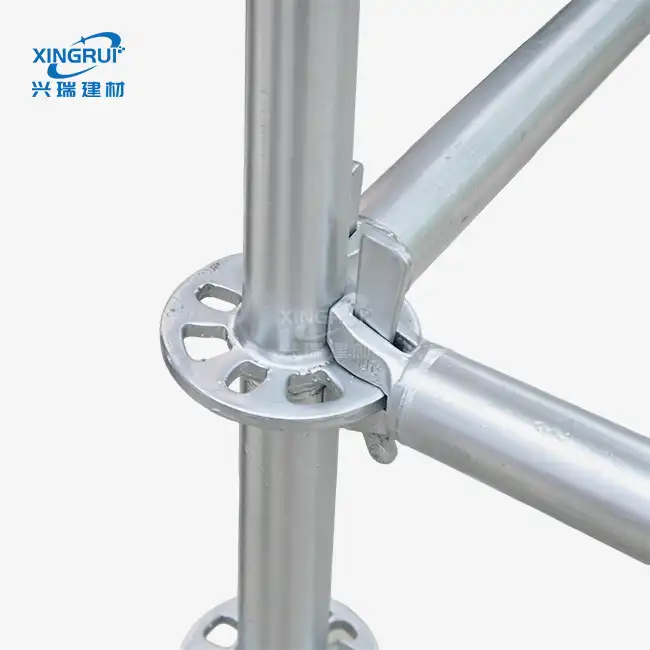
The node joint locks up to four horizontals to one vertical standard when you turn the top cup and hit it with a hammer. This speeds up the process of putting up cuplock scaffolding. Crews don't have to deal with as many loose clamps, bolts, and wedges, so they can put them up and take them down faster. When you load a connection with the same rigid joint, it stays put. This makes places of work safer. This platform is made from Q235 steel at Shandong Xingrui Building Materials Co., Ltd. Read on to learn how it works, where it fits, and what you should look for before you buy it.
How Cuplock Scaffolding Works and Who Needs It?
What Is Cuplock Scaffolding and How Does It Work?
A cuplock scaffolding system is made up of ledgers, transoms, vertical standards, and braces that are all linked to each other. Each standard has a set distance between the fixed bottom cup and the rotary top cup. Ours has steps that are 600 mm apart. You slide the stamped plug into the bottom cup on the ledger or transom end. Then you put the top cup down and turn it. A hammer tap is used to set the lock. At one point, this makes a four-way connection without bolts. Since the pattern is used over and over, crews can guess every bay before the first standard goes up. Before you place an order, check the drawings and tolerances to see what measurements the different manufacturers use.
What Makes Cuplock Different from Conventional Scaffolding?
This type of tube-and-clamp scaffolding has many loose couplers that need to be tightened one at a time. In cuplock scaffolding, the majority of them have been replaced by one-node joints, requiring crews to carry and connect fewer parts less frequently. It will take less time to do things and be less likely to lose or miss a fitting after this change. Some parts move in a fixed way, too. This keeps the height and space between the parts the same from bay to bay. When it comes to irregular plans, curved elevations, and different heights, a cuplock layout works better than a basic frame system. Before the first lift, I think it would be helpful to give a short talk on the locking sequence. This design works best when crews have been trained to use it.
Who Should Consider a Cuplock Scaffolding System?
This system can be used by those who rent scaffolding, general contractors, and distributors who buy for more than one job. It's also good for OEM buyers who need boxes or sizes that aren't standard. Most of the money is made on projects that use the same layout and stock over and over again. Before you decide, look at the project's height, moving loads, site shape, crew skill, local rules, and storage space. In the US, you should also make sure that the engineer and person in charge of the project understand how it works. If your job is small, light, or needs to be done quickly, being able to use a different brand of scaffolding might be more important than how fast it is done. Don't just look at this contract; use these points for all the contracts you have coming up.
Main Benefits of Cuplock Scaffolding: Faster Assembly and Safer Worksites
How Cuplock Scaffolding Cuts Assembly and Dismantling Time
You can go faster if you cut down on steps. You can lock up to four horizontals to one standard with just one turn and a hammer tap. For this joint, you don't need any special tools. It's easier to move, count, and replace things when there are fewer loose clamps. Before they start building, crews can sort standards, ledgers, and transoms by bay. Then they can start working steadily. To take things apart the other way around, just use the same simple locking action. When the cost of a project is based on labor, cutting down on the number of hours worked is important. It's not possible to give a set percentage because it depends on the design, the weather, the crew's training, and how easy it is to get to the site. Time a test bay and see how it stacks up against how you normally do things.
Why the Cup-Type Locking Joint Improves Safety
Where safety starts is at the joint. The fixed bottom cup holds the ledger end in place while the rotary top cup closes over it when the load is put on the connection. The cold roll forming and robotic welding are both things we do. The 12 robot welders on 6 automatic lines help keep the gaps between the nodes small. BS EN 12811-1 is the European standard for how well scaffolds work and how they are built, and our load capacity meets that standard. The rules are still in place on the site. OSHA's scaffold standard, 29 CFR 1926.451, says that a scaffold must be able to hold at least four times its own weight plus any other weight that is supposed to be put on it. Also, there must be fall protection above 10 feet, and a trained person must check it every shift.
How Reusable Q235 Steel Lowers Lifecycle Cost
Our cuplock scaffolding has 48.3 mm tubes that are made of Q235 premium carbon steel and have walls that are 3.0 mm to 3.25 mm thick. Electric powder coating or hot-dip galvanization are the two options you have. Galvanizing works well in humid, outdoor, and coastal places because the zinc layer doesn't rust. You can use the system for more than one project because the parts are all the same. If a part breaks, you only need to replace that part and not the whole assembly. That will help more jobs pay for the thing. Reusing still needs to be done with care. Carefully look over each piece after each project is done. If any of the tubes or cups are broken or bent, throw them away. Keep the parts dry and organized by type.
Cuplock Scaffolding Applications and System Comparisons
Where Contractors Use Cuplock Scaffolding
Firms that build tall buildings use cuplock scaffolding for tasks like painting, cladding, renovations, and working with concrete and masonry. It makes it easier to turn off machines, get to pipe racks, insulate, coat, and check equipment in factories. Because it is made up of separate modules, it can be used for highways, bridges, tunnels, shoring, and supporting large areas of formwork. Our system is good at many types of building support and frame assembly jobs. People who plan these jobs can do them more easily because the standard bay lengths and 600 mm step make it easier. Pick galvanized parts if you need to work outside or near the water. This tool might not be the best choice if the job is very small or if you need special access. Check that the system can do the job.
Cuplock vs. Ringlock Scaffolding
Both of them are modular, but the nodes in them are different. At a single cup point, Cuplock can lock up to four horizontals. It's good for heavy shoring because the load meets at a central node. It's helpful that Ringlock's rosette can connect at different angles because it can be used for complicated geometry and floor plans. Every job is different, so we choose the one that works best for that job. Take a look at each system's load data, accessory range, and nearby parts supply. Don't put together parts from different companies if the maker doesn't say it's okay. If the cup or node isn't the same shape all the way around, it can weaken the lock. If you already have one type, small differences in how well it works with what you already have may not matter as much.
Cuplock vs. Kwikstage and Frame Scaffolding
People who work on Kwikstage know how to use it well, and there is a lot of local stock in places like the UK and Australia. Normal frames are cheap and easy for crews to set up, so they can be used over and over for low to medium-height wall work. On the other hand, frames make it harder to put things in order when the plan has curves, steps, or other strange shapes. The bay size and height can be adjusted more freely on construction and industrial sites with cuplock scaffolding. Look at the training needs, load data, spare parts, assembly steps, and part weight before making a choice. The five types of scaffolding we offer are ringlock, cuplock, banana-type, HK, and frame. Our team can look at your drawings and tell you which one will work best for you.
How to Choose a Cuplock Scaffolding Manufacturer and Buy with Confidence?
Start with a Clear Component Schedule
Before a good quote, make a good list. You should write down all of the standards, ledgers, transoms, braces, jacks, platforms, and access parts to your boat. You can write down the bay sizes, lift heights, working loads, finish, quantity, packaging, and delivery port in the "Add" box. It's not just the unit price that should help you decide whether to paint or galvanize. You should also look at the site exposure and lifecycle cost. If you need different sizes, please send us drawings. We make based on drawings and samples from customers. There is less back and forth when there is a full schedule. The quote process goes faster, and parts don't arrive in the wrong order when the container does. We'll help you finish the list if you get stuck. Send us what you have.
What to Verify with a Cuplock Scaffolding Manufacturer
Get some papers and read them. Get copies of the test reports, packaging lists, load data, drawings, tolerances, and material certificates. Also get records of the welding and coating. Make sure you know how the supplier handles quality. We have ISO 9001, ISO 14001, and ISO 45001 certifications, and CE certifications for our products. They can also ask someone else to look at the plant or a video tour. Our Rizhao site is 79,800 square meters and has 920 workers, 180 technicians, and 4 cold roll forming sets. Rizhao has its own harbor, which makes sending goods to other countries easier. Look at each supplier's lead time, warranty, shipping terms, and customer service for spare parts next to each other.
Practical Steps for Safer, Faster Erection
You can save hours before the first mark goes up if you plan ahead. Set up delivery zones, lift routes, crew briefings, and layout plans ahead of time, and sort parts by bay. Do not wait until the very end to check the tie-ins, level, and plumb. Check them after each lift instead. Before it can be used, the scaffold must be checked out and recorded by a trained person. No one else should be able to change the design, and broken parts should not be used. If you keep track of erection hours per square meter, labor hours per bay, and repeat work, you can really see progress. Before you place a big order, we give you samples and technical help so that your team can find out how to lock things.
Conclusion
Because it can lock up to four horizontals to a standard with just one rotary motion and a hammer tap, cuplock scaffolding speeds up work and reduces the number of loose parts. Buildings are safer when they have the same fixed node, which is made from Q235 steel and welded to exact specifications. But this is only true if engineers confirm the design, crews set it up correctly, and a qualified person checks it before every shift. With ringlock, kwikstage, or frame systems, you can make other layouts, but this one is good for industrial maintenance, supporting formwork, and getting to the front of the building. It costs less over its lifetime to use parts more than once as long as they are stored and inspected properly. When there is a clear list of parts, test reports, and quality systems that have been checked, it's easier to buy. Make sure the system works for the project and that all the details are right.
FAQ
How does cuplock scaffolding speed up assembly?
The crew can lock up to four horizontals to one standard with a hammer tap and the fixed bottom cup and rotary top cup. Less loose parts lead to a faster erection.
What load can the system carry?
How much it can hold depends on the lift height, the size of the bays, the ties, the ground, and the bracing. BS EN 12811-1 says that our system works, but an engineer has to sign off on each design.
Does cuplock scaffolding meet OSHA rules?
OSHA is in charge of the whole scaffold, not just a small part of it. A trained person must check it before each shift, and anyone taller than 10 feet must wear fall protection.
Do you offer custom sizes and samples?
Yes. When a customer gives us drawings or samples, we use them to make things. We also give them samples and technical advice.
Which finishes are available?
It is possible for us to electrostatically powder coat and hot-dip galvanize. Outside, galvanized steel works well in wet places.
Request a Cuplock Scaffolding Quotation from GREEN FORMWORK
I want to know about your project. They are based in Rizhao, China, and make cuplock scaffolding. Send your plans to sdxingruiqp@126.com along with the number of items you need, the height, the bay size, the working loads, and the finish. Our Q235 steel cuplock scaffolding is shipped to over 100 countries and can be made to order. We offer samples and technical support. Get in touch with us to learn more about NDAs or a live video review of the factory.
References
1. OSHA, Safety and Health Regulations for Construction: Scaffolds (29 CFR 1926 Subpart L), 1996
2. BS EN 12811-1, Temporary Works Equipment – Scaffolds – Performance Requirements and General Design, 2003
3. BS EN 12810-1, Façade Scaffolds Made of Prefabricated Components – Product Specifications, 2003
4. ANSI/ASSP A10.8, Scaffolding Safety Requirements, 2019
5. ISO 45001, Occupational Health and Safety Management Systems – Requirements with Guidance for Use, 2018
6. ISO 9001, Quality Management Systems – Requirements, 2015
Learn about our latest products and discounts through SMS or email