- English
- French
- German
- Portuguese
- Spanish
- Russian
- Japanese
- Korean
- Arabic
- Greek
- German
- Turkish
- Italian
- Danish
- Romanian
- Indonesian
- Czech
- Afrikaans
- Swedish
- Polish
- Basque
- Catalan
- Esperanto
- Hindi
- Lao
- Albanian
- Amharic
- Armenian
- Azerbaijani
- Belarusian
- Bengali
- Bosnian
- Bulgarian
- Cebuano
- Chichewa
- Corsican
- Croatian
- Dutch
- Estonian
- Filipino
- Finnish
- Frisian
- Galician
- Georgian
- Gujarati
- Haitian
- Hausa
- Hawaiian
- Hebrew
- Hmong
- Hungarian
- Icelandic
- Igbo
- Javanese
- Kannada
- Kazakh
- Khmer
- Kurdish
- Kyrgyz
- Latin
- Latvian
- Lithuanian
- Luxembou..
- Macedonian
- Malagasy
- Malay
- Malayalam
- Maltese
- Maori
- Marathi
- Mongolian
- Burmese
- Nepali
- Norwegian
- Pashto
- Persian
- Punjabi
- Serbian
- Sesotho
- Sinhala
- Slovak
- Slovenian
- Somali
- Samoan
- Scots Gaelic
- Shona
- Sindhi
- Sundanese
- Swahili
- Tajik
- Tamil
- Telugu
- Thai
- Ukrainian
- Urdu
- Uzbek
- Vietnamese
- Welsh
- Xhosa
- Yiddish
- Yoruba
- Zulu
Best Steel Building Formwork System for Fast, Safe Construction
When it comes to concrete forming on high-stakes EPC projects, the right steel building formwork system makes the difference between a schedule that holds and one that collapses. Engineered from Q235 hot-rolled steel plate, a precision modular concrete forming solution delivers the load-bearing capacity, dimensional accuracy, and reuse potential that procurement managers on international construction projects demand. This guide walks you through how to evaluate, specify, and source concrete formwork panels that keep your pour schedule intact and your cost-per-use firmly under control.
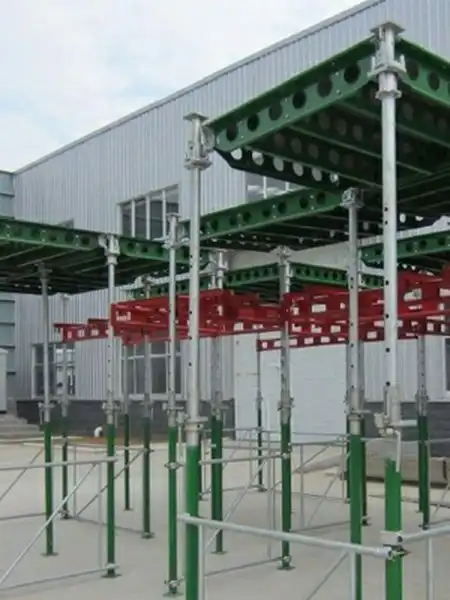
Understanding Steel Building Formwork Systems
A steel building formwork system is a pre-made set of steel face plates, stiffening ribs, and connecting hardware that holds freshly poured concrete until it is strong enough to stand on its own. Industry lifecycle data shows that a well-engineered steel panel system keeps its shape for 300+ turnover cycles, while timber or plywood shuttering absorbs water and warps after just 5–10 pours.
How the Modular Panel Concept Works
In the Xingrui system, splicing holes are exactly 150 mm apart, which makes it easy for crews to line up and connect sections without having to guess. Walls, columns, beams, and floor slabs can all be made from the 300-series and 200-series module widths, which are both compatible. Dimensional standards stay within ±2mm over a 2-meter span. This means that cutting and patching, which are expensive finishing tasks for big pours, are almost never needed.
Why Q235 Steel Outperforms Timber and Aluminum?
Q235 hot-rolled carbon steel is the standard material for high-cycle concrete forming around the world because it has a good yield strength and can be welded easily. With a face plate thickness of 2.5 mm, strengthened ribs of 3 mm, and a structural height of 55 mm, the Xingrui panel is designed in a way that it can withstand horizontal concrete pressure of more than 60 kN/m² without deflection. Aluminum formwork is lighter, but it costs a lot more per square meter and doesn't work well in structures with a lot of columns when heavy pour rates are used.
Choosing the Best Steel Building Formwork System for Your Project
At the project level, choices about procurement are about more than just the price per panel. EPC companies' engineering teams look at how well the system works with other systems, the state of the certification, and how responsive the provider is.
The most important things that experienced materials managers look for in a concrete panel forming supplier are listed below:
- Modular compatibility across structure types. A method that works with walls, beams, columns, and blocks from the same panel family makes on-site inventory simpler and stops costly mistakes from happening during fast pours.
- Certified quality management. With ISO 9001 certification, you can be sure that the whole process is well-documented, from receiving the raw steel to sending out the finished panels. Both ISO 14001 and ISO 45001 licenses are required for most foreign public-tender projects. They cover things like protecting the environment and keeping workers safe.
- Customization lead time. For projects with non-standard grid sizes, it's important to find a provider that can make custom panels using CNC profiling or robotic welding without stopping the normal delivery schedule.
- Sample availability and technical review. Receiving a physical sample panel to check for dimensions and weld quality before placing a large order is an important part of responsible procurement.
These requirements are in line with how Shandong Xingrui Building Materials Co., Ltd. has set up its supply chain. The company has ISO 9001, ISO 14001, and ISO 45001 certifications. It has more than 40,000 m² of standard workshop space and uses 12 welding robots and 6 automatic welding lines. Before an order is confirmed, the company gives customers real samples and full technical paperwork. Steel building formwork system from Xingrui benefits from this infrastructure, with robotic welding ensuring consistent joint quality and full documentation supporting site compliance and inspection sign-off.
Installation and Maintenance for Fast, Safe Construction
Speed on a forming system comes from planning ahead, not from winging it. Before the first panel is put up, a layout drawing that has been checked against the structural engineer's pour order gets rid of field issues that stop work crews.
Streamlined On-Site Assembly
Modular steel forming uses a sliding pin-and-wedge link, which means that a two-person crew can build a wall bay in a lot less time than it would take to nail wood ledgers together. The smooth face surface comes off easily and doesn't need strong pulling force. This keeps the concrete face and panel edge from getting damaged.
Maintenance That Extends Panel Life
Use a plastic or rubber tool to scrape off any extra concrete after each pour. Then, look for dents in the face plate that could cause blow-outs and coat the surface with a release agent before the next pour. That's what makes the difference between a 300-cycle panel and one that fails at 80 cycles. This routine adds less than 15 minutes to each panel set. Corrosion protection, like electrophoretic coating or applying anti-rust oil on a regular basis, is important in both humid tropical and seaside areas where foreign EPC projects often take place.
Cost and ROI Analysis of Steel Building Formwork Systems
A steel building formwork system costs about three to four times as much up front as shutters made of the same material. But that comparison is only useful in one way. Formwork lifecycle cost models used by big builders show that a Q235 steel panel is more than 70% cheaper per use than a wooden one over 300+ reuse cycles.
That difference is important for an EPC project with a formwork budget of 2,000,000 to 20,000,000 RMB. There are fewer transportation events, customs processes, and scheduling risks when there are fewer replacement orders in the middle of a project. Because the system's joints are waterproof and don't let water through, they also cut down on post-strip cleanup costs, which can make up a big chunk of finishing work for large wall areas.
Buying in bulk through a framework contract with staged delivery locks in unit prices and lines up shipment dates with pour goals. This is a model that GREEN FORMWORK actively supports for its international EPC customers.
Safety and Compliance: Ensuring Risk-Free Construction
Because steel building formwork systems are heavier than wood, following safe handling rules has real consequences. With robotic bond integrity, panels don't break under hydraulic pressure, which is a type of failure that not only wastes concrete but also poses real risks to the site.
When a supplier gets ISO 45001 certification at the manufacturing level, it means that they have made safety at work a part of their production process. This is linked to consistent weld quality and accurate measurements. On the project side, workers should be told about the maximum torque for the pins and wedges and the maximum pour rate that the system is meant to handle. This is because steel-formed walls usually blow out when the horizontal pressure is exceeded.
Conclusion
One of the most important things to buy for any EPC project that uses a lot of concrete is a precision-engineered steel building formwork system. The right system, which is made from Q235 steel, certified to ISO 9001/14001/45001, and based on real modular design discipline, shortens pour cycles, lowers the need for finishing repairs, and offers a cost-per-use that wood can't match on a large scale. Shandong Xingrui Building Materials Co., Ltd. has the production size, certifications, and ability to respond quickly to custom orders that foreign project teams need.
FAQ
How does the upfront cost compare to timber formwork?
The initial cost is about three to four times higher than for wood, but after more than 300 uses, the cost-per-use drops by more than seventy percent. The total cost of forming steel is almost always less on big EPC projects.
Can panels be customized for non-standard dimensions?
Yes, Xingrui can take orders based on models and plans provided by the customer. Custom panels that are CNC-profiled and robotically joined can be made to fit uneven wall grids, curved sections, and project-specific module needs without changing the lead time for standard panels.
How do crews prevent concrete adhesion to the panel face?
The surface of the panel is smoothed to a controlled level of sharpness. Putting on a strong chemical release agent before each pour makes sure that the panel is stripped cleanly and protects the finish on the face plate for the whole time it is in use.
What maintenance is required between pours?
Use a plastic brush to get rid of any leftover concrete. Then, check to see if the face plate is flat, and apply the release agent or anti-rust oil again. This is the main thing that determines whether a panel lasts 300 or 500 cycles, and it takes less than 15 minutes per set.
Elevate Your Next Pour with GREEN FORMWORK's Steel Forming Solutions
GREEN FORMWORK is a qualified steel building formwork system maker that can meet the tight international EPC schedules. It has 12 welding robots and a production base that's over 40,000 m² in Rizhao, China. Our Q235 modular panels are approved by ISO 9001, ISO 14001, and ISO 45001, and they are made there. We offer samples, a custom drawing service, and shipping that is broken up into stages to fit your pour goals. To get a forming solution proposal right away, email your project drawings to sdxingruiqp@126.com.
References
1. Hurd, M. K. (2005). Formwork for Concrete (7th ed.). American Concrete Institute.
2. European Committee for Standardization. (2011). BS EN 12812: Falsework — Performance Requirements and General Design. BSI Standards.
3. Concrete Construction Staff. (2019). "Choosing the Right Formwork Material." Concrete Construction Magazine.
4. International Organization for Standardization. (2015). ISO 9001:2015 Quality Management Systems — Requirements. ISO.
5. Peurifoy, R. L., & Oberlender, G. D. (2010). Formwork for Concrete Structures (4th ed.). McGraw-Hill.
6. Construction Industry Research and Information Association (CIRIA). (2012). Report C654: Concrete Formwork — Guide to Good Practice. CIRIA.
Learn about our latest products and discounts through SMS or email