- English
- French
- German
- Portuguese
- Spanish
- Russian
- Japanese
- Korean
- Arabic
- Greek
- German
- Turkish
- Italian
- Danish
- Romanian
- Indonesian
- Czech
- Afrikaans
- Swedish
- Polish
- Basque
- Catalan
- Esperanto
- Hindi
- Lao
- Albanian
- Amharic
- Armenian
- Azerbaijani
- Belarusian
- Bengali
- Bosnian
- Bulgarian
- Cebuano
- Chichewa
- Corsican
- Croatian
- Dutch
- Estonian
- Filipino
- Finnish
- Frisian
- Galician
- Georgian
- Gujarati
- Haitian
- Hausa
- Hawaiian
- Hebrew
- Hmong
- Hungarian
- Icelandic
- Igbo
- Javanese
- Kannada
- Kazakh
- Khmer
- Kurdish
- Kyrgyz
- Latin
- Latvian
- Lithuanian
- Luxembou..
- Macedonian
- Malagasy
- Malay
- Malayalam
- Maltese
- Maori
- Marathi
- Mongolian
- Burmese
- Nepali
- Norwegian
- Pashto
- Persian
- Punjabi
- Serbian
- Sesotho
- Sinhala
- Slovak
- Slovenian
- Somali
- Samoan
- Scots Gaelic
- Shona
- Sindhi
- Sundanese
- Swahili
- Tajik
- Tamil
- Telugu
- Thai
- Ukrainian
- Urdu
- Uzbek
- Vietnamese
- Welsh
- Xhosa
- Yiddish
- Yoruba
- Zulu
How to Select Tubular Scaffolding for Height and Safety Requirements
When buying tube and clamp scaffolding for a large construction project, the right choice directly affects worker safety, project costs, and long-term value. Tubular scaffolding — built from steel pipes connected by specialized couplers — gives procurement teams the geometric freedom to work around irregular structures while meeting international load standards. Whether you source for mid-rise commercial buildings in the Middle East or industrial plants in Southeast Asia, knowing how to match pipe wall thickness, zinc coating quality, and coupler grade to your specific height and load requirements will protect both your workers and your profit margin.
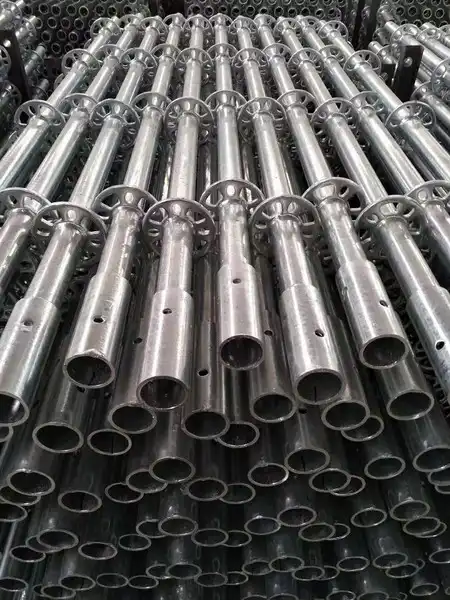
Understanding Tubular Scaffolding and Its Core Safety Principles
What Is Tube and Clamp Scaffolding?
Tube and clamp scaffolding is made up of separate pieces that are connected by right-angle, swivel, and sleeve couplers. It doesn't depend on set shape like prefabricated frame systems do. The system works for facades, tanks, and other odd-shaped industrial buildings because workers can freely angle the pipes. The outside width of the normal tube is 48.3 mm, which means it works with most coupler brands around the world. This is an important thing to think about when buying in places where spare parts have to be found locally.
Key International Standards You Must Know
Three rules govern how structures are built and how they can be used safely. In Europe, EN 12811-1 specifies how working ladders should be built and how well they should do their job. In the United States, OSHA 1926 Subpart Q sets the minimum safety standards for building with scaffolding. ANSI/SSFI SC100 gives extra information on inspection and ability. The tubular scaffolding suppliers you choose should be able to show proof that their goods work with at least one of these frames.
Why Safety Is a Non-Negotiable Priority
The U.S. Bureau of Labor Statistics says that about 4,500 injuries and 60 deaths happen every year in the building industry because of accidents involving scaffolding. A known reason is structural failure due to inadequate wall thickness or weak couplers. Choosing Q235 or S235 carbon steel with a wall thickness of at least 3.2 mm and EN 74-certified couplers greatly lowers that risk. Cutting corners on the grade of the material to save money on the cost per ton is a risk that no project budget can afford.
Critical Criteria for Selecting Tubular Scaffolding Based on Height and Load Requirements
Matching Height Tiers to Structural Design
In the business world, platform height is usually divided into three levels. Low-access platforms are structures that are less than 10 meters high. Standard engineering review is needed for structures between 10 and 25 meters tall. A licensed structural engineer must sign off on the design of any structure taller than 25 meters, taking into account wind pressure, dead load, and live load. When building tall buildings near the coast or in areas prone to storms, it is common to mention 4.0 mm wall thickness tubes. This is because walls that are thicker don't bend when wind blows from the side.
Load Class Selection: Light, Medium, and Heavy Duty
EN 12811-1 sets out six load classes (1–6) based on how much weight is spread out over a square meter of ground. Class 2 platforms (1.5 kN/m²) are light-duty and are used for inspection work. Class 3 (2.0 kN/m²) is usually used for general construction work. For finishing concrete or putting bricks, you may need Class 4 (3.0 kN/m²) or higher. Before making a large order, your engineer should make sure that the load class for each part of the project is clear. This way, the correct tube diameter and coupler grade can be chosen from the start.
Steel vs. Aluminum: Making the Right Material Call
Steel tubes, especially Q235 grade, can hold more weight and are stiffer when bent. This is why they are the best choice for heavy-duty construction in the Middle East, Africa, and Southeast Asia. Aluminum tubes are about 60% lighter than steel tubes. This makes hand assembly faster, but it costs more per unit and has a lower load limit. For big infrastructure projects where price per ton is very important, Q235 steel that has been hot-dip galvanized is the best choice because it is strong and won't rust over time.
Comparing Tubular Scaffolding with Alternative Systems: Making Informed Decisions
Tube and Clamp vs. Ringlock and Cuplock Systems
Ringlock and Cuplock systems make assembly faster because parts lock at set rosette or cup intervals. This cuts down on the time needed for skilled labor on-site. But because their geometry is fixed, they are less flexible when working with structures that aren't straight lines. Because they can work with any angle and span, petrochemical plants and marine repair projects still use tubular scaffolding systems even though modular systems have been around for decades.
Frame Scaffolding: Speed vs. Flexibility
Frame scaffolding that is already made can be set up quickly on flat, repeated walls, like those on standard apartment buildings or warehouses. On the other hand, frames have fixed heights and widths. When a building setback or an equipment barrier stops the same pattern from happening over and over, frame scaffolding either can't be used or needs expensive special pieces. That's not the case with tube and clamp systems, which lowers the overall project risk for complicated builds.
Bamboo and Aluminum vs. Steel Tubular Systems
Low-rise work is still often done with bamboo scaffolds in parts of East and Southeast Asia, but EN 12811 and OSHA do not allow it for industrial tasks. When the load is light, aluminum is good for inner fit-out and cleaning the outside of buildings. Galvanized steel tube and clamp scaffolding is the technically sound and cost-effective choice for big civil engineering jobs in developing markets that follow international safety standards.
Procurement Insights: How to Buy Tubular Scaffolding for Optimal Value and Reliability?
It takes more than checking prices per ton to find the right source. Before they sign a supply deal, procurement managers with a lot of knowledge check these main things:
- Certification documentation: Confirm ISO 9001 quality management, ISO 14001 environmental management, and ISO 45001 occupational safety certifications. These indicate systematic quality control, not just product-level testing.
- Wall thickness tolerance: Request mill certificates and specify that wall thickness must not fall below the nominal dimension by more than 0.2 mm. Underweight tubes are the most common hidden cost driver in emerging market procurement.
- Hot-dip galvanization depth: Specify a minimum zinc coating of 40–60 microns, measured by magnetic induction. Electro-galvanized or paint-coated alternatives corrode significantly faster in humid or coastal environments.
- Container loading plan: Confirm the supplier can provide a detailed packing plan that maximizes FCL utilization. This directly affects your landed cost per tonne.
- Payment terms and sample supply: Suppliers offering trial samples before full-order commitment and flexible payment terms — including L/C — reduce sourcing risk, especially for first-time orders.
These steps protect your profit margin and make sure that the product that shows up on site fits what was offered. Shandong Xingrui Building Materials Co., Ltd. supports trial sample orders and gives full technical documentation, such as quality guaranty certificates, which is very important for procurement processes that are based on bids.
Best Practices for Ensuring Safety Compliance and Performance
Pre-Use Inspection Protocol
Before any tubular scaffolding platform is used, each tube needs to be checked for distortion, pitting, or cracks in the weld joint that can be seen. To make sure that couplers meet the slip load standards in EN 74-1, they should be torque-tested. Most international safety standards require a written inspection record that is signed by a qualified person. This protects the contractor in case of an investigation into an accident.
Periodic Inspection During Use
Industry norms say that scaffolding must be inspected after it is first set up, every seven days while it is being used, and after any bad weather, like a storm or high winds. Each inspection cycle should be given to a named competent person, and the results should be written down. This method finds corrosion in its early stages, loose parts, or illegal changes before they become structural dangers.
Lessons from a High-Rise Case Study
A 30-story apartment building project in a Gulf Cooperation Council country needed Q235 tube and clamp support with a 50-micron zinc finish and 3.5 mm thick walls. The project team checked the pressure on the couplers once a week and changed about 2% of them every time they were inspected. Over the course of the 14-month job, there were no accidents involving the scaffolding. After being taken apart, the reusable system was put back into stock and used on a different project, which cut the cost per project by about 30%.
Conclusion
To choose the right tubular scaffolding tube and clamp scaffold system, you need to make sure that the material grade, wall thickness, and coupler specifications match your actual height and load needs. You should also make sure that your supplier's quality systems back up those specifications with proof. When hot-dip galvanized and made in an ISO-certified factory, Q235 steel has been shown to work well in harsh construction environments. If you set up the right inspection procedures, you can use the same system for more than one project cycle. This makes an expensive but necessary purchase an asset that will last for a long time.
FAQ
How do I calculate the correct load class for my project?
Find the hardest task that will be done on each station level, like storing materials, laying bricks, or inspecting, and then match that task to the EN 12811-1 load class table. Tell your source what load class it is so they can make sure you get the right tube width and coupler grade for your setup.
Can I mix 3.2 mm and 4.0 mm wall thickness tubes in one structure?
It is not a good idea. When you mix wall widths, it changes how load-bearing estimates work and how consistent the coupler grip is. Set one standard wall thickness for each level of the building, and make sure that the buy order makes this clear.
What certifications should a reliable tubular scaffold supplier hold?
Check for ISO 9001, ISO 14001, and ISO 45001 certifications at the very least. If your project is based on European standards, you should also make sure that the tube properties meet EN 39 standards and the couplers meet EN 74 standards.
How often should scaffolding components be retired from service?
Quality steel tubes can be used 50 times or more if they are stored and cared for properly. Any tube that has visible deformation, deep corrosion pits, or a wall thickness reading below the minimum required after ultrasonic measurement should be thrown away.
Does GREEN FORMWORK supply samples before bulk orders?
Yes. Shandong Xingrui Building Materials Co., Ltd., which sells under the brand name GREEN FORMWORK, offers free samples and full technical support before committing to a full order. This makes trial proof a normal part of the buying process.
Partner with GREEN FORMWORK for Your Next Tubular Scaffolding Order
Shandong Xingrui Building Materials Co., Ltd. makes GREEN FORMWORK, which sells ISO-certified Q235 tube scaffolding to people in more than 100 countries. Our goods are shipped from Rizhao seaport at reasonable prices per ton, and we offer flexible L/C payment terms and full mill certificates. As a reliable company that makes tube scaffolding, we can handle large orders, unique shapes, and test models. Please email our team at sdxingruiqp@126.com to get a quote right away.
References
1. European Committee for Standardization. EN 12811-1: Temporary Works Equipment — Scaffolds: Performance Requirements and General Design. CEN, 2003.
2. Occupational Safety and Health Administration. OSHA 1926 Subpart Q — Scaffolds. U.S. Department of Labor, 2022.
3. British Standards Institution. BS EN 74-1: Couplers, Spigot Pins and Baseplates for Use in Falsework and Scaffolding. BSI, 2005.
4. International Organization for Standardization. ISO 9001: Quality Management Systems — Requirements. ISO, 2015.
5. U.S. Bureau of Labor Statistics. National Census of Fatal Occupational Injuries. BLS, 2022.
6. Peng, J. L., & Chan, S. L. Scaffold Engineering: Analysis and Design of Temporary Structures in Construction. Taylor & Francis, 2009.
Learn about our latest products and discounts through SMS or email