- English
- French
- German
- Portuguese
- Spanish
- Russian
- Japanese
- Korean
- Arabic
- Greek
- German
- Turkish
- Italian
- Danish
- Romanian
- Indonesian
- Czech
- Afrikaans
- Swedish
- Polish
- Basque
- Catalan
- Esperanto
- Hindi
- Lao
- Albanian
- Amharic
- Armenian
- Azerbaijani
- Belarusian
- Bengali
- Bosnian
- Bulgarian
- Cebuano
- Chichewa
- Corsican
- Croatian
- Dutch
- Estonian
- Filipino
- Finnish
- Frisian
- Galician
- Georgian
- Gujarati
- Haitian
- Hausa
- Hawaiian
- Hebrew
- Hmong
- Hungarian
- Icelandic
- Igbo
- Javanese
- Kannada
- Kazakh
- Khmer
- Kurdish
- Kyrgyz
- Latin
- Latvian
- Lithuanian
- Luxembou..
- Macedonian
- Malagasy
- Malay
- Malayalam
- Maltese
- Maori
- Marathi
- Mongolian
- Burmese
- Nepali
- Norwegian
- Pashto
- Persian
- Punjabi
- Serbian
- Sesotho
- Sinhala
- Slovak
- Slovenian
- Somali
- Samoan
- Scots Gaelic
- Shona
- Sindhi
- Sundanese
- Swahili
- Tajik
- Tamil
- Telugu
- Thai
- Ukrainian
- Urdu
- Uzbek
- Vietnamese
- Welsh
- Xhosa
- Yiddish
- Yoruba
- Zulu
Can Crab System Scaffolding Be Customized for Complex Building Needs?
Yes — crab system scaffolding can absolutely be customized for complex building needs. Its modular, multi-directional connection design allows engineers to adapt the system to irregular geometries, varying load requirements, and site-specific spatial constraints. Whether you are working on a curved bridge pier, a confined tunnel portal, or a high formwork support frame for a stadium roof, the eight-way disc connection at each node gives procurement teams the geometric flexibility that rigid traditional systems simply cannot match. The short answer is yes; the longer answer is covered in full below.
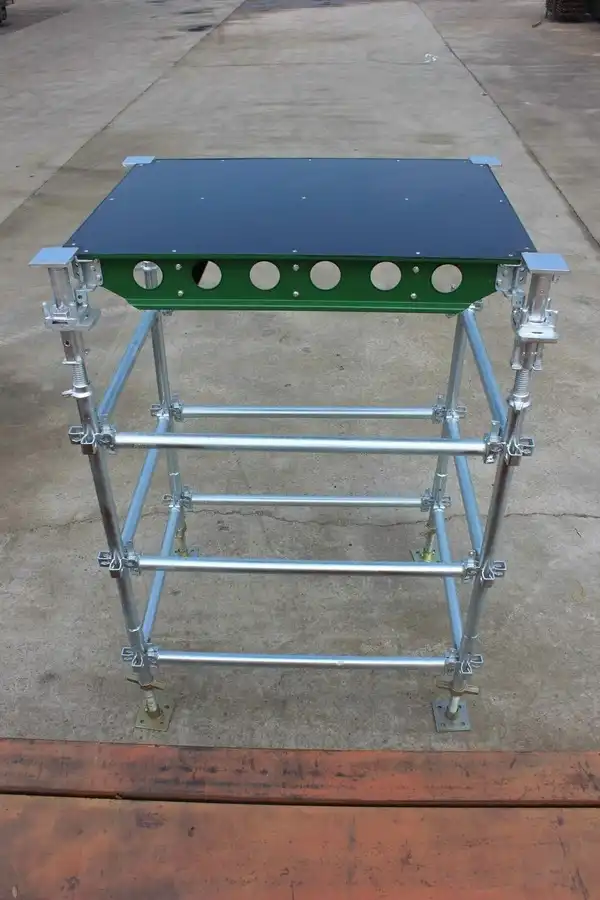
Understanding Crab System Scaffolding and Its Customizability
Before you look at the customization options, it's helpful to know what makes this support system unique.
What the System Actually Is?
This kind of crab system scaffolding is made up of separate support pieces that can connect to each other. It is based on a disc, called a rosette, that is attached to every vertical standard at regular intervals. Cross bars, diagonal bars, and tie bars can all join to the disc from up to eight different ways at the same time. It is made from Q235 premium carbon steel and has walls that are 3.2 mm thick. It is manufactured by Shandong Xingrui. The tower can hold up to 200 kN of weight if it is properly braced.
Why Traditional Scaffolding Falls Short?
On square or rectangular floor plates, frame scaffolding and tube-and-clamp systems work just fine. These systems need to be changed on the job site, which takes time, when the ground is sloped, there are curved surfaces, different bay widths, or limits on how high the ceiling can be. It is harder to keep inspection records up to date and the connections are not as accurate because of this.
Where Customization Adds Real Value?
You can change the standard lengths, bay spacing, disc pitch, surface treatment, and other setups of a disc-based modular system before the first part ships. A procurement engineer can send project plans and get a list of parts that will work with them. This means less trash and less cutting needs to be done on-site. The European standard EN 12811-1 for scaffolding says that when structures are being calculated, they must take into account load combinations that are specific to the site. This is much easier to do with a system that is already set up at the plant.
Core Customization Principles of Crab System Scaffolding
Designing things in modules is just the start. How the different parts work together is what makes the amount of customization real.
Dimensional and Geometric Scaling
Vertical standards come in different heights, and you can order horizontal ledgers with bay widths that aren't standard to fit column grids or tunnel cross-sections. One side of a bridge pier shoring frame might need different bay spacing to make room for base formwork that is already there. That can be done with the eight-hole disc instead of digging holes in the ground.
Material and Surface Treatment Options
The main material is Q235 carbon steel, which has a good yield strength for most shoring tasks in civil engineering. According to ISO 1461, a zinc covering of 60–80 μm is put on during hot-dip galvanization. In normal weather, this means the product will last for about 15 years. For jobs that will be done near the coast or in places that are rough on chemicals, clients can choose different coating systems during the sample confirmation stage.
Engineering Adaptations and Load Path Design
The diagonal bracing lines and load-bearing formulas for crab system scaffolding need to match the actual height of the shoring and the weight of the concrete pour. The client gives Xingrui structural drawings, which are used by the technical team to set up bracing angles and screw jack specifications. This process lowers the buyer's engineering risk and makes a list of parts that are connected to a certain load case. It is possible to send this list with a European project that needs a CE Declaration of Performance (DoP).
Comparing Crab System Scaffolding with Alternative Systems
When procurement teams know how this method stacks up against other choices, they can make smart decisions.
Modular Disc System vs. Tube and Clamp
It's possible to move around the most on tube-and-clamp scaffolding, but it takes very skilled workers to put together safely. Every link has to be made by hand, which makes ASTM F1926 or EN 12811 inspections very hard to do. On the other hand, a wedge-locking disc system lines itself up at every node. The wedge shape of Xingrui is gravity-assisted, which means that when it's loaded, it gets tighter instead of looser. This is really important in places that shake a lot, like bridge decks when concrete is poured.
Modular System vs. Frame Scaffolding
Frame scaffolding is easy to set up for normal heights from floor to ceiling, but it can't be shaped very well. The frame sizes decide how wide and tall the bays are. Fixing the frame of a building is hard to do without spending a lot of money when headroom and size change across the building, like in tunnel openings or stadium concourses. You don't need any special adapters to add to the disc-based modular system from the left or the right.
Standard vs. Customized Component Packages
Standard packages don't take as long to ship and can fit in the widest and tallest bays. It is possible to make packages that are specific to the size of a project, the non-standard stroke of a screw jack, or the needs of rental fleet owners who want branded parts. If a customer gives Xingrui samples or drawings, they can use those to make custom orders. Within 7–14 days of getting confirmation of the drawing, prototypes are made. That speed means that customization can be done even when time is short for a job.
Procurement Guide for Customized Crab System Scaffolding
Your budget and plan will be safe if you choose the right way to buy things.
Aligning Supplier Capabilities with Project Requirements
Make sure the supplier has the most up-to-date ISO 9001, ISO 14001, and ISO 45001 standards before you give them an RFQ. They show that taking care of quality, the environment, and worker safety is part of the whole production process, not just something that is done at the end for review. All three are held by Xingrui, and quality checks are done at the batch level with records that can be followed. When it comes to EPC contracts, this meets the rules for third-party proof.
Here are the most important things you should check with any company that sells crab system scaffolding supports before you buy:
- Certification currency: ISO 9001, ISO 14001, and ISO 45001 certificates should be valid and audited within the current cycle.
- Sample turnaround: A prototype should be sent out within 7–14 days of the plans being accepted as an example of turnaround time.
- Load calculation documentation: Suppliers should send calculation reports that are based on EN 12810 or 12811, and they should be customized to fit the order.
- OEM/ODM capability: Rental fleet operators need branded parts a lot of the time; make sure the NDA is okay before sharing proprietary joint designs that are secret.
- Port logistics: Rizhao Port in Shandong is where Xingrui ships leave from. It is a full-service seaport with direct lines for containers to many of the world's most important destinations.
These steps reduce the time it takes to qualify suppliers and give the engineering and procurement teams a way to rate suppliers from the start of the sourcing process.
Understanding Pricing and Warranty Terms
It usually takes 15–30 days for production to start after the sample is accepted for a customized order. There may also be a small planning fee for setups that aren't standard. That cost is usually covered by less work being done on-site and less material waste. The warranty should say how long the zinc finish will last, how well the welds will stay together, and how long the sizes will stay the same after a certain number of uses. Make sure you write this down before you sign the deal.
Best Practices and Common Pitfalls
To get customization right from the start, several teams must work together.
Start Technical Alignment Early
The most common mistake people make when they need to buy custom crab system scaffolding is talking to suppliers after they have a firm plan for the structure. Giving the provider a say in the design process means that the plan for the parts can actually shape the layout of the structure, rather than just reacting to it. When you set everything up early, changes made at the last minute are less likely to damage the load path.
Avoid Underspecifying the Diagonal Bracing System
Most of the time, people think that the vertical and horizontal bracing is more important than the diagonal bracing. On high-clearance shoring frames longer than 8 meters, lateral stiffness from diagonal bars is what prevents progressive collapse while concrete is being poured. Write down the support density and connection angles in the purchase order instead of leaving it to field judgment.
Plan for Reuse from the Beginning
Because it can be used over and over, a disc-based flexible system is a great way to save money. When parts are returned from a job site in good shape, they can be rented out again or used on the next project without needing much work to fix them up. In the purchase agreement, include a maintenance checklist with requirements about how to check the zinc coating, the disc weld, and the wedge-pin. Instead of guessing based on visual appearance, written conditions will be used to decide if it can be used again.
Conclusion
Crab system scaffolding can be fully modified, including non-standard bay sizes, custom screw jack specifications, OEM branding, and calculation packages based on EN standards. If you need to adapt to different sites, the wedge-locking disc system works more predictably than tube-and-clamp. The investment is worth it over many project cycles because the system is made of long-lasting Q235 steel and is hot-dip galvanized. Procurement teams that work with suppliers early, are clear about bracing requirements, and confirm certification validity before signing a contract will get the most value from a customized modular shoring system.
FAQ
Q1: Can the system be configured for curved or arched structures?
A: Yes. With the eight-way disc connection, bars can meet at angles other than right angles. This lets you approximate curved geometries in both the plan and elevation. You may need shorter bay intervals if your curve has a tight radius. Xingrui can supply these as custom lengths.
Q2: What is the typical lead time for a custom order?
A: Sample prototypes take 7–14 days after the drawing is accepted. Most of the time, full production orders take 15–30 days. When you order with a brand name or OEM, it may take an extra 30 to 45 days for tooling and batch registration.
Q3: Does customization affect CE certification compliance?
A: Custom configurations must be accompanied by up-to-date structural estimates that use either EN 12810 or EN 12811, depending on what you need. The technical team at Xingrui provides configuration-specific paperwork to support Declaration of Performance submissions.
Q4: What is the minimum order quantity?
A: MOQ varies by component type. Get in touch with Xingrui to talk about the project's size and component mix. New clients are welcome to send smaller test orders.
Q5: How is quality traced across a production batch?
A: Tests are done on all incoming raw materials, batches are checked for dimensional accuracy as they are being made, welds are inspected, and the zinc coating is verified for adhesion. Records are maintained in line with ISO 9001 standards.
Partner with GREEN FORMWORK for Your Next Scaffolding Project
GREEN FORMWORK — backed by Shandong Xingrui Building Materials Co., Ltd. — offers certified crab system scaffolding manufactured to EN 12810/12811, ISO 9001, ISO 14001, and ISO 45001 standards, with factory-direct pricing and a 40,000 m² production facility. As a trusted crab system scaffolding manufacturer with exports to 100+ countries, we accept custom orders from client drawings, provide samples within 7–14 days, and issue full technical documentation. Reach our export team at sdxingruiqp@126.com to request a quote today.
References
1. European Committee for Standardization. EN 12811-1: Temporary Works Equipment — Scaffolds — Performance Requirements and General Design. CEN, 2003.
2. European Committee for Standardization. EN 12810-1: Façade Scaffolding Made of Prefabricated Components — Product Specifications. CEN, 2003.
3. International Organization for Standardization. ISO 1461: Hot-Dip Galvanized Coatings on Fabricated Iron and Steel Articles — Specifications and Test Methods. ISO, 2022.
4. International Organization for Standardization. ISO 9001: Quality Management Systems — Requirements. ISO, 2015.
5. Peng, J. L., et al. "Structural Behavior of Steel Scaffolding Systems Under Vertical Loads." Journal of Constructional Steel Research, 2009.
6. Chandrangsu, T., and Rasmussen, K. J. R. "Investigation of Geometric Imperfections and Joint Stiffness of Support Scaffold Systems." Journal of Constructional Steel Research, 2011.
Learn about our latest products and discounts through SMS or email